Greenboog collector field guide
Albo, Thai Constellation, Aurea and Mint are useful shopping labels, but they do not sit at the same level as “half-moon,” “marble,” “sport” or a botanical species name. This guide helps you read the plant first and the marketplace label second.
Start by asking what kind of name you are looking at. That one step prevents most double-counting.
| Level | Examples | What it tells you | What it cannot prove |
|---|---|---|---|
| Accepted species | Monstera deliciosa | The botanical taxon supported by a taxonomic authority | A particular clone, color or future leaf pattern |
| Named horticultural plant | Thai Constellation, Variegata | A cultivated plant recognized in horticultural use | That every seller uses the name consistently |
| Trade or collector label | Albo, Aurea, Mint, Ocean Mint, White Monster | A useful color, phenotype or source-line claim | Formal registration, lineage, stability or rarity |
| Pattern term | Marble, speckled, sectoral, half-moon | How lighter tissue appears on a particular leaf | A separate variety or the pattern of the next leaf |
| Sale format | Exact plant, rooted cutting, tissue culture | What stage or unit the buyer receives | Identity, origin or mature pattern by itself |
First, anchor the name to Monstera deliciosa
Kew Plants of the World Online accepts Monstera deliciosa. It treats M. deliciosa var. borsigiana as a synonym of that species, so “Borsigiana Albo,” “Albo Variegata” and “deliciosa Variegata” should not be presented as three different species. Growers may still use Borsigiana as a practical trade descriptor, but it is not a second accepted species in the Kew backbone.
This article focuses on variegated M. deliciosa labels because that is what the dominant search intent and the legacy photographs show. Variegated forms of other accepted Monstera species exist in trade, but mixing them into a numbered list would confuse a color-form guide with the rare Monstera species guide.
Four useful variegated Monstera groups
Albo, Thai Constellation, Aurea/Marmorata and Mint are the most useful high-level groups for this search. Even here, the names do not have equal nomenclatural weight. Use color and pattern to orient yourself, then verify the actual plant and the evidence behind the label.
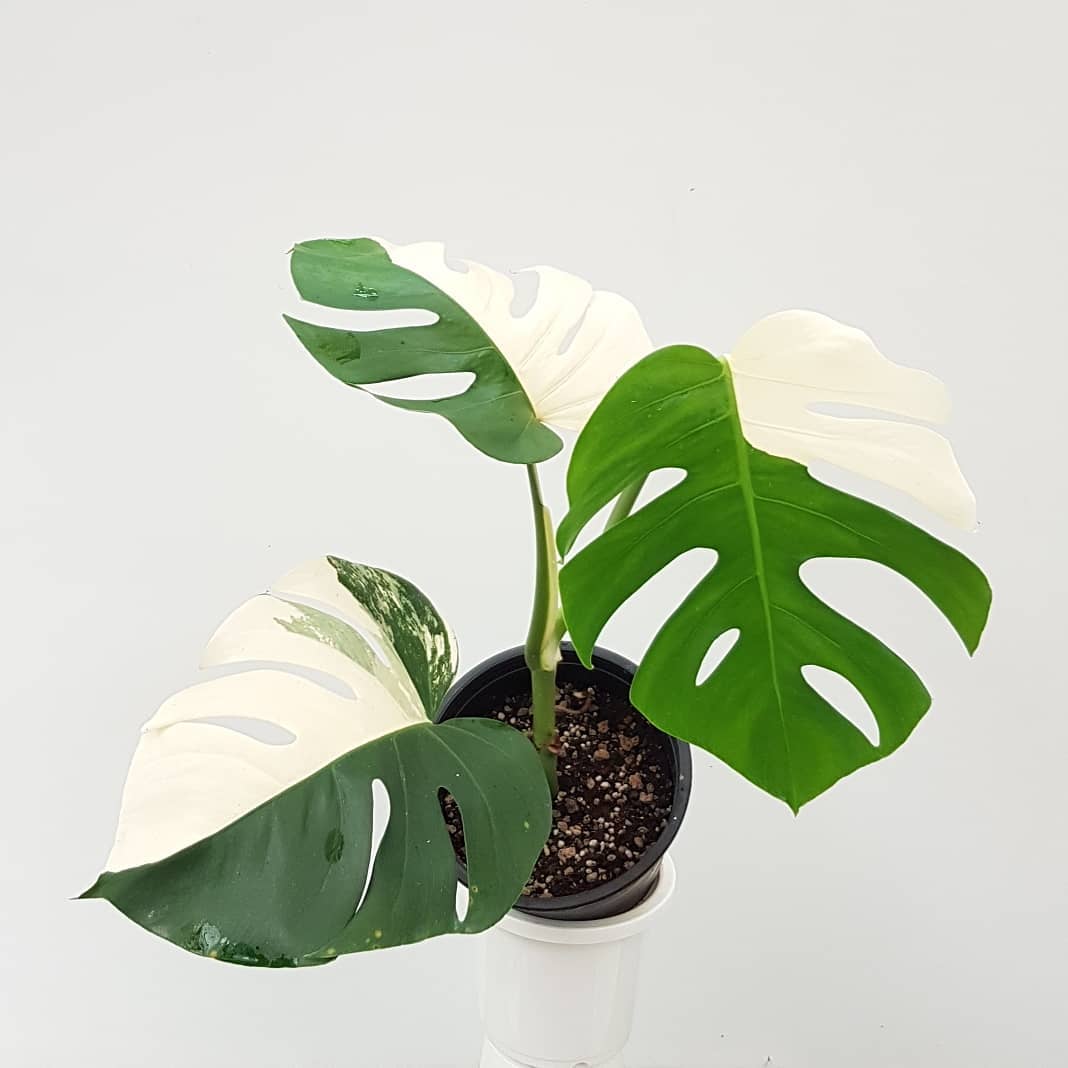
Albo or white Variegata
Albo is used for high-contrast white or cream variegation on green M. deliciosa. A plant may carry fine marbling, broad sectors or both. The word does not promise a half-white leaf, and one unusually white leaf does not establish the next leaf’s pattern.
Inspect the stem and active growth point as well as the foliage. Strong white sectors with very little green tissue can be visually dramatic but contribute less photosynthetic area. That is a growth trade-off, not an automatic measure of quality. Use the Monstera Albo guide for the identity and care details this broad comparison intentionally leaves out.
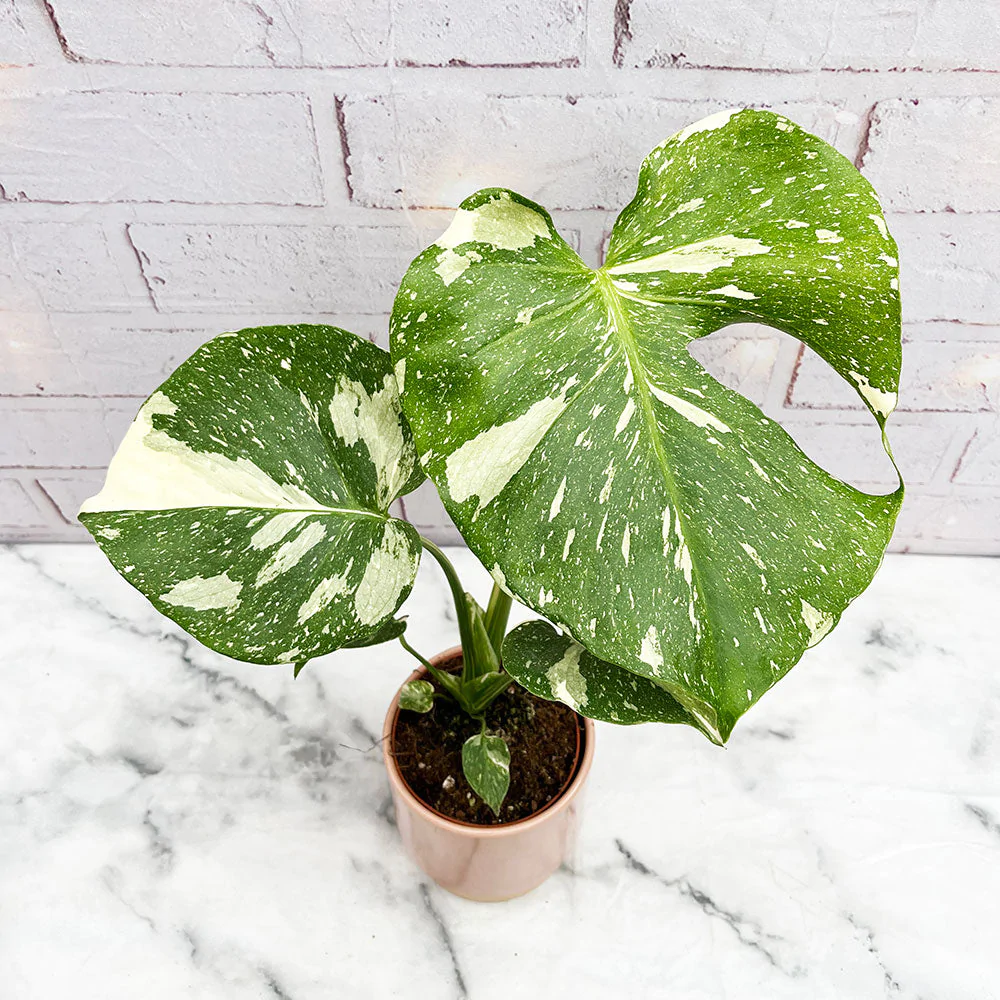
Thai Constellation
The Royal Horticultural Society lists Monstera deliciosa ‘Thai Constellation’ as an accepted horticultural name and describes deep-green leaves splashed and streaked with creamy white. The fine, distributed flecks are a useful visual cue, but mature leaves may also carry larger cream sectors.
Collector sublabels such as Legacy, Creme Brulee, White Snow, Green Snow or Platinum Mint require their own provenance. They should not be treated as additional botanical species. The Thai Constellation collector-label guide owns those names and the evidence needed to compare them, while the Albo versus Thai Constellation comparison owns the two-plant buying decision.
Aurea or Marmorata
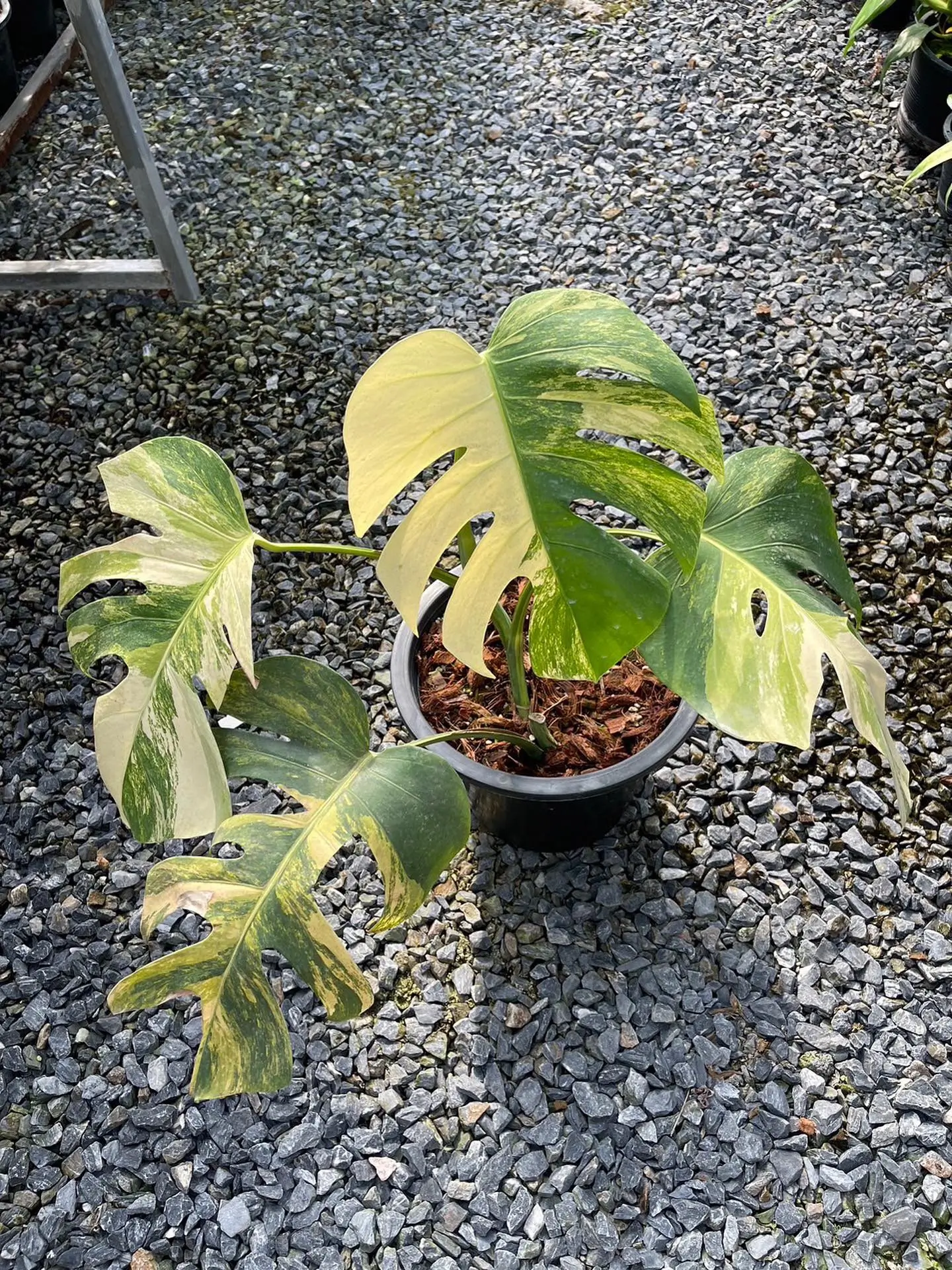
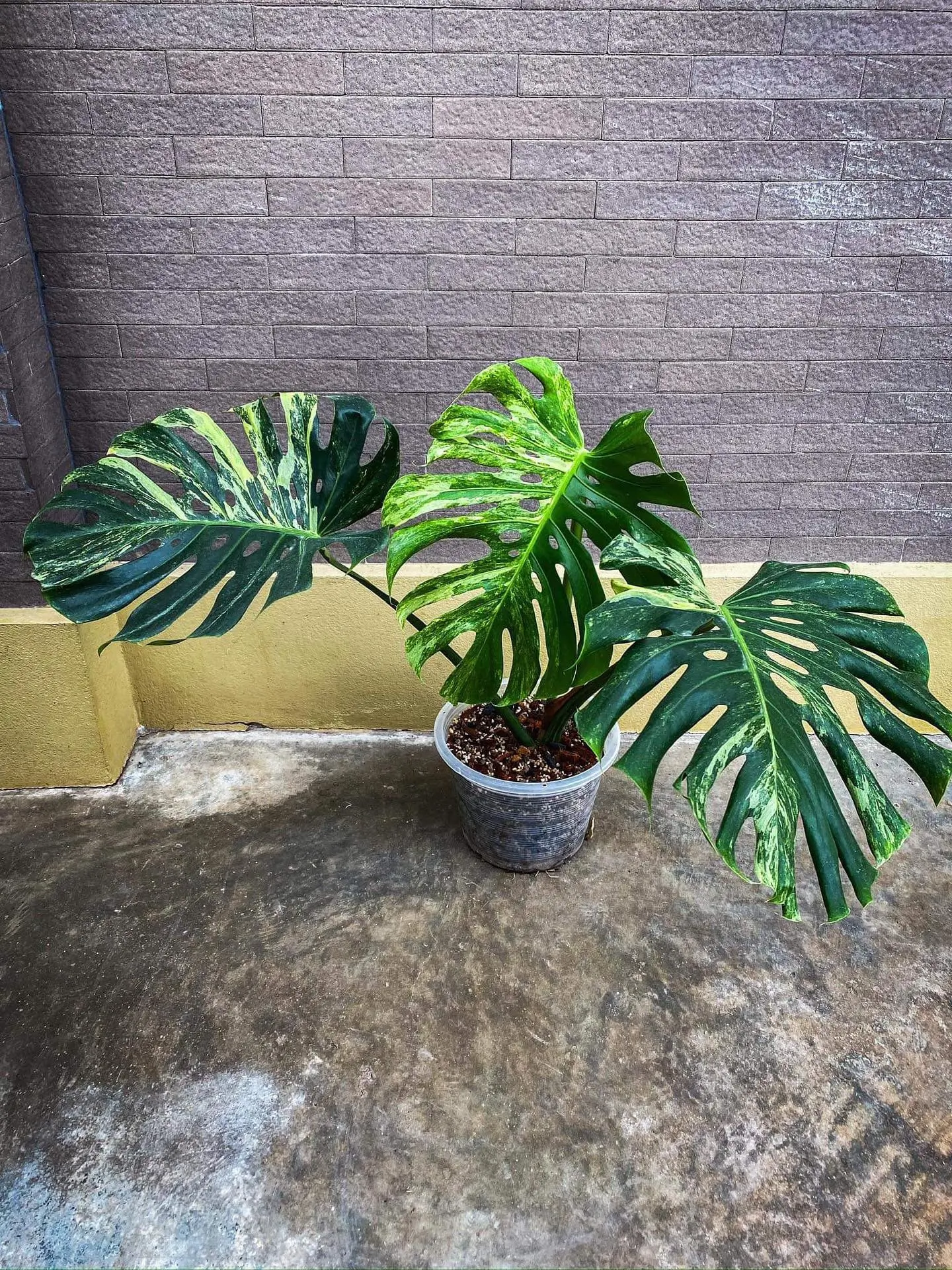
Aurea is the yellow-variegated group. New or strongly lit leaves can read as yellow, chartreuse or lime, and hardened color may look different from a fresh unfurling leaf. Marmorata is commonly used in the same yellow-marbled trade context, so a list should not automatically count Aurea and Marmorata as two independent types.
Color is only one clue. Compare several hardened leaves, the stem pattern and seller provenance. The dedicated Monstera Aurea guide covers this group without turning every yellow sector into a guaranteed clone or cultivar claim.
Mint and other pale-green labels
Mint is marketplace language for pale green, finely veined or green-on-green variegation rather than a separate accepted species. Photographs can be misleading because exposure, white balance, leaf age and translucency shift how pale tissue reads. Compare a hardened leaf beside the stem and several preceding leaves.
Ocean Mint, Jungle Mint, White Monster and similar collector names may refer to a source line, selected phenotype or seller convention. Their value depends on traceable provenance, not how many fashionable words fit in the title. Use the Monstera Mint identity and buyer guide for the focused evidence checks.
Half moon, marble and sport are not extra species
Half moon and marble describe patterns, not separate species. A single plant can produce sectoral and marbled leaves at different points on the same vine. Pattern vocabulary helps describe a photograph; it does not certify a stable cultivar or future output.
Describe what is visible before assigning an identity or value.
| Pattern term | What you can describe | Common overclaim | Better evidence |
|---|---|---|---|
| Marble or mottled | Fine or blended lighter areas distributed through green tissue | Calling every marbled leaf Mint or Marmorata | Hardened color, stem, consecutive leaves and source line |
| Speckled | Small lighter flecks spread over the blade | Using speckles alone to prove Thai Constellation | Whole plant plus a reliable horticultural label |
| Sectoral | A broad block or wedge with a relatively sharp boundary | Assuming a large white sector is a separate cultivar | Stem pattern and several connected leaves |
| Half-moon | A visually near-half sector on one leaf | Promising that every new leaf will split 50/50 | Treat it as a phenotype on the photographed leaf |
| Sport | Unexpected changed growth that may be selected for propagation | Treating one changed leaf as a stable named line | Repeated growth from the active point and documented propagation |
How to evaluate a named plant before buying
A compelling mature reference image is useful for showing potential, but it may not be the plant you receive. Ask whether each photograph is the exact plant, a representative batch or a mature example. Then assess the unit actually for sale.
Variegated Monstera buyer checklist
- Name level: decide whether the label is a species, horticultural name, collector line, pattern or sale format.
- Exact-plant disclosure: verify whether you receive the photographed specimen or a representative plant.
- Several leaves: compare hardened leaves in one neutral-light frame rather than judging a single new leaf.
- Stem and node: inspect the active growth point, node and stem pattern; a detached leaf cannot show the whole propagation unit.
- Roots and acclimation: identity does not compensate for weak roots, hidden rot, pests or an unacclimated plantlet.
- Provenance: ask what mother line, supplier record or seller history supports a collector name.
- No future guarantee: treat the current pattern as evidence, not a promise that every next leaf will match it.
- Live terms: confirm current size, format, availability, documents and shipping conditions on the listing.
Browse the Greenboog Monstera collection for current inventory and plant formats. Prices change with size, roots, provenance, market supply and whether the image is exact; use the variegated Monstera price guide for the evaluation method rather than relying on a frozen price table here.
Care and propagation: the short version
Variegated tissue has less chlorophyll than fully green tissue, so a highly variegated plant may grow more slowly. That does not mean it needs harsh sun. The RHS recommends bright indirect light for Thai Constellation, and abrupt direct exposure can scorch pale tissue. Keep changes gradual and judge new growth rather than chasing the brightness of a seller photograph.
Use an airy, well-drained root zone, water thoroughly after meaningful partial dry-down and let excess escape. Pot size, root mass, temperature, airflow and substrate change the timing, so no fixed weekly schedule fits every plant. The complete Monstera care guide owns light, watering, substrate, support and troubleshooting.
For propagation, University of Minnesota Extension states that a complete cutting needs a node and axillary bud; a leaf and petiole alone cannot produce a new vine. Variegated seed claims are also a red flag because seed does not preserve the named variegation mutation. Use the Monstera propagation guide for node selection and rooting steps.
Frequently asked questions
How many variegated Monstera types are there?
There is no single defensible fixed number because lists mix accepted species, horticultural names, collector lines and leaf patterns. For variegated M. deliciosa, Albo, Thai Constellation, Aurea/Marmorata and Mint are useful orientation groups, while half-moon and marble are pattern terms.
Is Monstera Borsigiana a different species from Monstera deliciosa?
Kew treats Monstera deliciosa var. borsigiana as a synonym of M. deliciosa. Borsigiana remains common in horticultural trade, but it should not be counted as a second accepted species.
Is a half-moon Monstera a separate variety?
Not by pattern alone. Half-moon describes a near-half sector on a leaf. An Albo, Aurea or another variegated plant can produce a sectoral leaf, and the next leaf may be different.
Are Aurea and Marmorata different?
The names often overlap in the yellow-variegated M. deliciosa trade. A seller may use Marmorata to emphasize marbling or a source line, but the words alone do not prove two unrelated types. Compare the actual plant and provenance.
Does tissue culture make variegation stable?
No universal guarantee follows from the format. Tissue culture can multiply selected material, but identity, off-type risk, plantlet condition and future expression still need evidence. Confirm the stated line and supplier history.
Can I grow a named variegated Monstera from seed?
Do not expect seed to preserve Albo, Aurea, Mint or Thai-style variegation. University of Minnesota Extension specifically warns against seed sold as variegated Monstera. Buy a traceable plant, plantlet or viable stem cutting instead.