
Greenboog collector field guide
“Rare Monstera” is a marketplace phrase, not a botanical rank. This guide starts with accepted species names, then shows collectors how to separate a species from a cultivar, trade label, leaf pattern or sale format before buying.
The same sales title can contain several kinds of names. Sort them before you sort the plants.
| Name level | Examples | What it tells you | What it does not prove |
|---|---|---|---|
| Accepted species | Monstera dubia, M. obliqua | A botanical taxon recognized by a current authority | Retail scarcity, price or exact identity from one leaf |
| Horticultural or trade label | Thai Constellation, Albo, Mint, Aurea | A cultivated plant, color group or source-line claim used in trade | That the label is an accepted species or used consistently |
| Pattern term | Half-moon, marble, sectoral | How color is arranged on a photographed leaf | A separate taxon or the pattern of the next leaf |
| Sale format | Cutting, rooted plant, tissue culture | The stage or unit the buyer should receive | Identity, maturity, future leaf form or health |
If your goal is to compare Albo, Thai Constellation, Aurea and Mint, use the variegated Monstera types guide. This page deliberately stays at species level so those two search jobs do not become another mixed list.
What “rare” can—and cannot—mean
In plant retail, rare often means difficult to find in a particular market at a particular moment. Supply can change when a nursery propagates a line, tissue culture increases production, import rules shift or collector attention moves elsewhere. Size matters too: an established climbing specimen may be scarce even when small starts are available.
That is different from scientific conservation status. A species can be uncommon in shops yet widespread in its native range, or easy to order while its wild habitat remains restricted. Kew’s record for M. dubia, for example, cites a taxonomic description calling it common and abundant despite relatively few herbarium collections. Low retail supply is not evidence of wild scarcity, and a high asking price is not a conservation assessment.
Six accepted Monstera species collectors compare
Kew’s Plants of the World Online records the following names as accepted species. They are not a permanent rarity ranking. They are a practical starting set because collectors encounter the names in cultivation and because their juvenile-to-adult changes make careful identification especially important.
Monstera obliqua: variable, not “all holes”
Monstera obliqua is accepted by Kew and native from Costa Rica into tropical South America and Trinidad. Online shorthand often reduces it to a paper-thin leaf with more hole than leaf, but the cited taxonomic description says roughly 80% of examined specimens had entire leaves; the remainder ranged from slightly to heavily perforated. That variability makes a single dramatic photograph a poor identity test.
Compare provenance, several growth stages and the whole plant rather than buying the most perforated leaf. The dedicated Monstera obliqua care guide owns the cultivation details this field guide intentionally keeps short.
Monstera dubia: juvenile shingler, transforming adult
Monstera dubia is an accepted species ranging from southern Mexico through tropical South America and Trinidad. Juvenile plants climb closely against a support, presenting overlapping foliage very differently from a mature climbing specimen. Adult form, inflorescence and provenance matter when similar juvenile aroids are sold under short labels.
A collector who buys the juvenile look should also plan for the adult plant rather than assuming the leaves will remain small and flat forever. Use the Monstera dubia growing guide for support, watering and transition questions.
Monstera pinnatipartita: divided mature leaves
Kew accepts Monstera pinnatipartita and records it across parts of Central and tropical South America. Its mature leaves can become deeply divided toward the midrib, while juvenile leaves are much less diagnostic. The name is often encountered beside other pinnatifid climbing aroids, so an adult reference photo should not be treated as a promise that a small juvenile will be easy to verify on arrival.
Monstera subpinnata: a feathered silhouette
Monstera subpinnata is an accepted species native from southeastern Colombia to Bolivia. Mature leaves develop narrow divisions that create a feathered outline. That silhouette is useful for comparison, but leaf cutting alone is not enough to authenticate a small plant. Ask for the source name, current plant photos and a view of stem, petiole and attachment—not only a mature stock image.
Monstera siltepecana: do not freeze the juvenile form
Kew accepts Monstera siltepecana and records its native range from Mexico to Nicaragua. The compact silver-marked juvenile foliage commonly shown in cultivation is only one stage. Kew’s cited description distinguishes the adult plant with multiple rows of perforations and reproductive characters. A collector should expect the plant’s appearance to change as it climbs and matures.
Monstera acacoyaguensis: large-leaved climber with an identity check
Monstera acacoyaguensis is accepted by Kew and native from southeastern Mexico to Belize. Taxonomic descriptions distinguish it with multiple rows of large perforations in adult leaves and additional reproductive and stem characters. Those are useful study clues, not a shortcut for identifying a juvenile from one listing photo.
Use visible traits to narrow a shortlist, then use provenance and mature evidence to support the name.
| Species | Useful orientation clue | Common buying mistake | Evidence to request |
|---|---|---|---|
| M. obliqua | Very variable leaves; some forms perforate heavily | Calling every ultra-perforated leaf obliqua | Source history, several stages, whole plant |
| M. dubia | Juvenile shingling habit; adult transformation | Expecting the juvenile look permanently | Support habit, node, source, adult reference |
| M. pinnatipartita | Deeply divided mature blade | Authenticating a juvenile from an adult stock photo | Exact plant plus mature provenance |
| M. subpinnata | Narrow, feather-like mature divisions | Using leaf silhouette as the only identifier | Stem, petiole, source and several leaves |
| M. siltepecana | Silver juvenile foliage; perforated adult stage | Treating juvenile and adult plants as different species | Growth-stage disclosure and provenance |
| M. acacoyaguensis | Large adult leaves with several perforation rows | Identifying a small entire leaf from shape alone | Mature mother plant and source record |
How to verify a rare-species listing
Seven checks before you compare price
- Parse the label: separate the italicized species name from a cultivar, collector nickname, variegation pattern and sale format.
- Check an authority: verify accepted name and synonyms in a current botanical database such as Kew POWO.
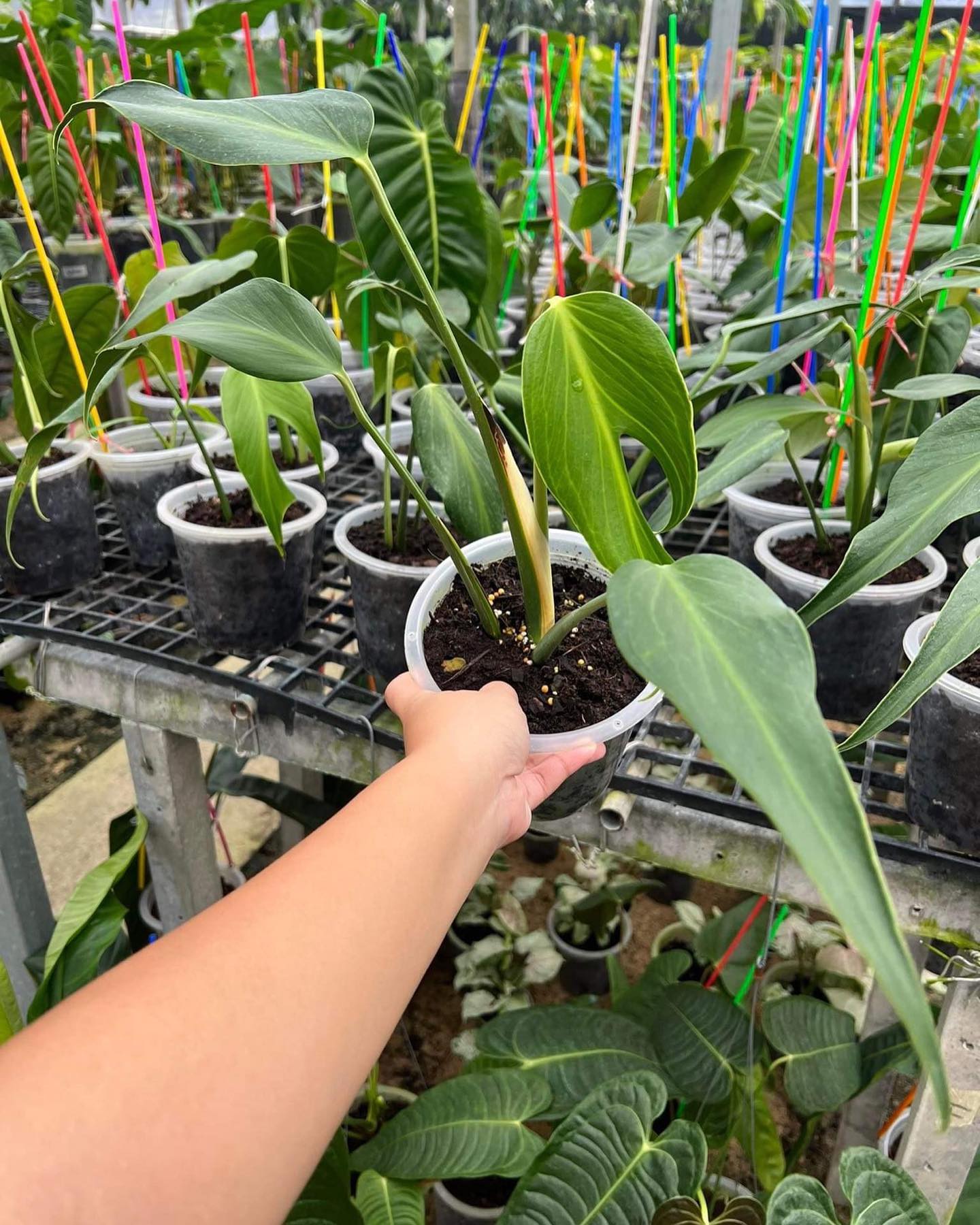
- Request the exact plant: ask whether images show the individual for sale, a representative batch or a mature reference.
- Match the growth stage: juvenile and adult Monsteras can look radically different; compare like with like.
- Look beyond the blade: request the stem, node, petiole, roots and growing point. A detached leaf cannot answer every identity or viability question.
- Trace provenance: a mother-plant record, nursery source or stable batch history is stronger than a fashionable title.
- Separate identity from condition: a correct name does not compensate for rot, pests, weak roots or an unacclimated plantlet.
After identity and condition are clear, compare the sale unit and total cost. The Monstera price evaluation guide explains exact-plant evidence, rooted versus unrooted material and landed cost without freezing prices into this species guide. Browse the current Greenboog Monstera collection for live formats and availability.
Care starts with growth stage, not rarity
These six species are tropical climbers, but they are not one interchangeable care sheet. A juvenile shingler, an established climbing specimen and a recently deflasked plantlet have different support, root-zone and acclimation needs. Repeated generic instructions such as “water weekly” or “mist for humidity” are less useful than observing root mass, substrate, airflow, temperature and the plant’s response.
Give a climbing Monstera stable support, avoid abrupt exposure changes and let the root system—not the marketing adjective—set watering decisions. Use the Monstera care hub for the general framework, then follow the dedicated species guide where one exists. If your question is why mature leaves split or perforate, the Monstera fenestration guide owns that explanation.
Frequently asked questions
What is the rarest Monstera species?
There is no durable worldwide retail ranking. Availability changes by region, size, propagation supply and season, while conservation status is a different question. Verify the accepted species first, then describe where and in what format it is hard to source.
Is Monstera Albo a rare species?
No. Albo is a horticultural trade label used for white-variegated Monstera deliciosa; it is not a separate accepted species. Use the variegated-types guide to compare Albo with Thai Constellation, Aurea and Mint.
Is Thai Constellation a Monstera species?
No. Thai Constellation is a named horticultural plant associated with Monstera deliciosa. Collector sublabels should not be added to a species count.
Does Monstera obliqua always have more holes than leaf?
No. The taxonomic description cited by Kew reports extensive variation and says most examined specimens had entire leaves. Heavy perforation is not a stand-alone identification test.
Can a juvenile leaf identify a rare Monstera?
Sometimes it can narrow the shortlist, but many species change dramatically as they climb. Ask for provenance, several growth stages and views of stem, petiole, node and whole plant before treating a juvenile-leaf match as proof.
Does an expensive Monstera have to be rare?
No. Price can reflect plant size, roots, provenance, variegation, seller costs, shipping and temporary demand. It is not a botanical identity or conservation test.
