
Greenboog collector field guide
Burle Marx’s Flame is collected for the change from narrow, entire juvenile leaves to mature blades cut into long, widely spaced segments. Its history is documented; its base species is not. This guide separates what can be verified from what a sales label merely suggests.
Use the name that matches the evidence you actually have.
| Label | What it refers to | What is supported | What it does not prove |
|---|---|---|---|
| Monstera ‘Burle Marx’s Flame’ | The cultivated plant documented in the aroid cultivar registry | Cultivation history and distinctive mature leaf form | A resolved wild species, hybrid formula or parentage |
| Monstera sp. ‘Burle Marx’s Flame’ | A cautious way to show the genus while the species is unresolved | The registry leaves the base-species field blank | That it is a newly described species |
| Monstera dilacerata | A historical botanical name | Kew synonymizes it under Epipremnum pinnatum | The identity of Burle Marx’s Flame |
| Philodendron burle-marxii | A different accepted species in a different genus | Its own Kew taxonomic record | Any relationship to the Monstera cultivar beyond the commemorative name |
Why this article has its own job
Burle Marx’s Flame appears in searches that mix identification, origin, care and purchase verification. Those questions are specific enough to deserve one focused owner. The rare Monstera species guide compares accepted species and therefore should not absorb an unresolved horticultural plant. The variegated Monstera field guide decodes color labels and patterns; an ordinary green Burle Marx’s Flame is not a variegated M. deliciosa type.
This boundary also changes how the plant should be described. Calling it a “rare species” sounds authoritative but outruns the evidence. Calling it a cultivar or horticultural selection preserves its documented identity without inventing a wild origin.
The leaf transformation collectors are looking for
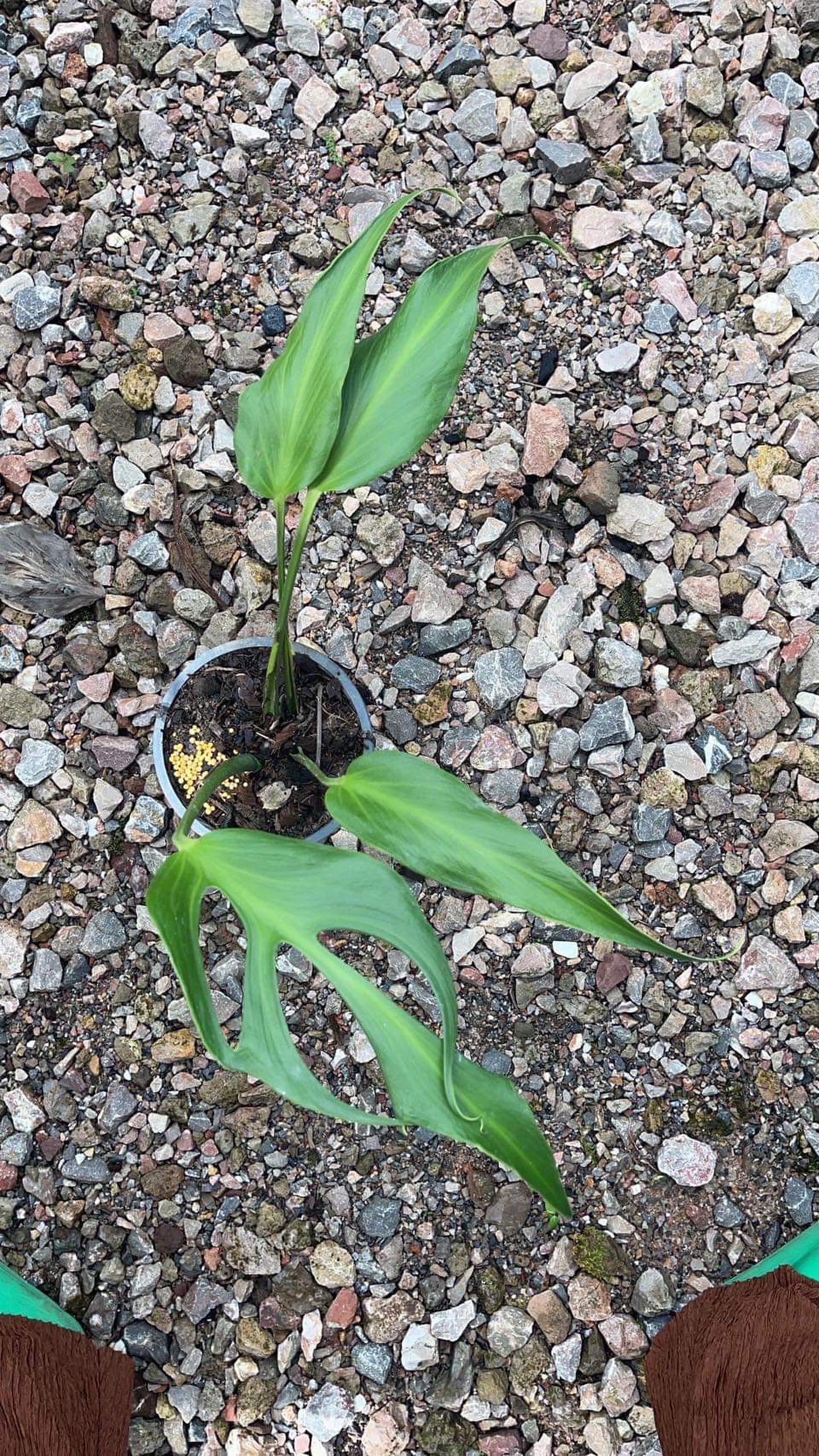
The registry describes an active climber with moderately spaced internodes. Juvenile leaves begin entire, then become deeply pinnatifid as the plant matures. The narrow segments sit noticeably far apart; on very mature plants, occasional perforations may appear near the midrib at the base of some segments.
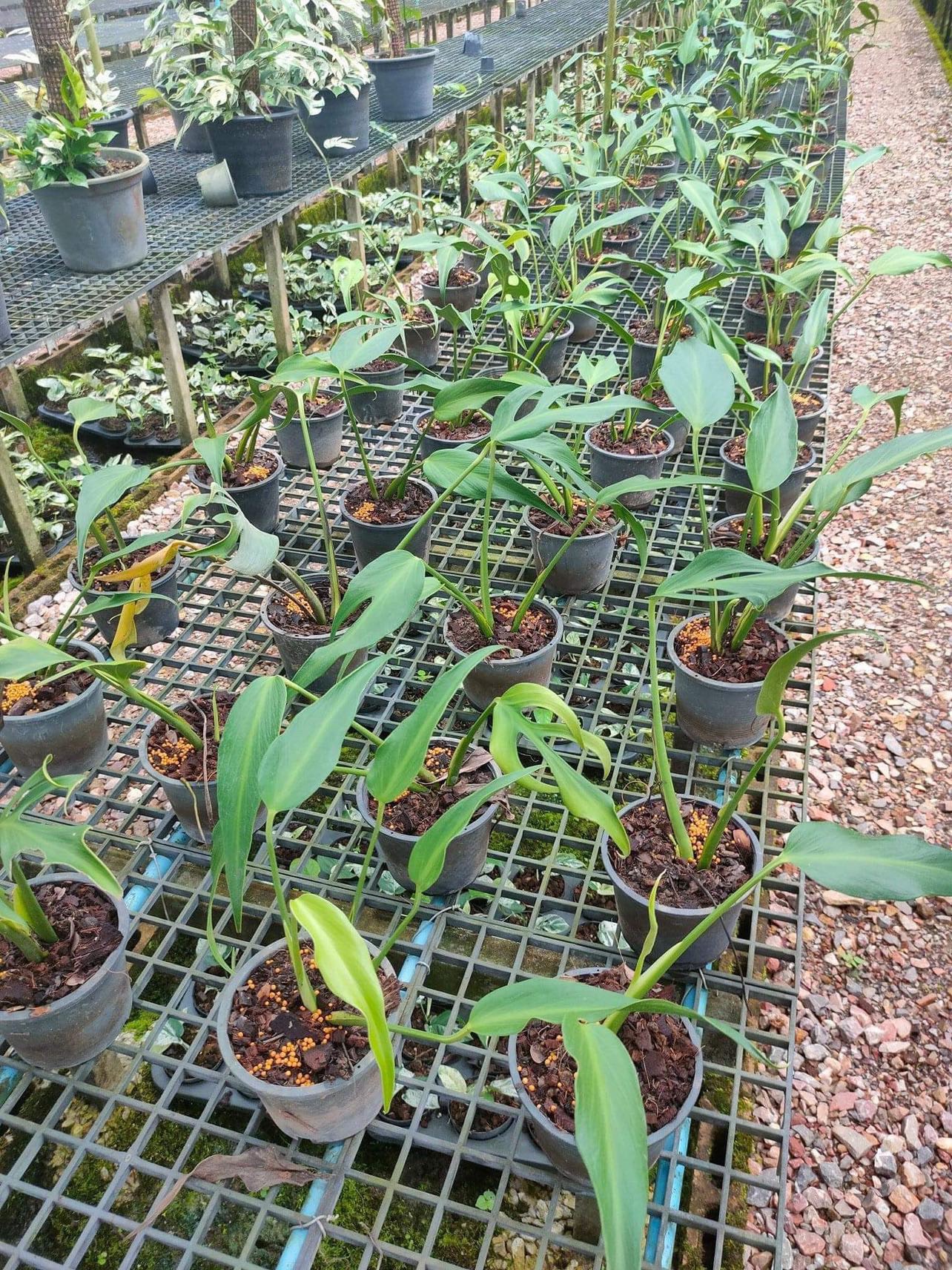
That sequence matters because a starter plant may look nothing like the dramatic mature reference image. One young, unsplit leaf cannot confirm the name, while one mature split leaf cannot prove the source line. Identification is strongest when the seller shows several connected leaf stages, the stem and a traceable mother plant.
| Stage | Likely foliage | Useful evidence | Do not promise |
|---|---|---|---|
| Plantlet or starter | Narrow, entire green leaves | Batch label, source line, roots and acclimation status | Immediate split leaves |
| Juvenile climber | Larger entire leaves; early cuts may begin | Sequential leaves, stem and attachment to support | A fixed age or leaf count for maturity |
| Intermediate | Deepening divisions and longer, narrower segments | Several recent leaves under consistent conditions | That every new leaf will be more divided |
| Very mature | Deep, widely spaced segments; occasional basal perforations | A supported vine and a sequence of mature leaves | Internal holes on every plant or leaf |
For the wider developmental science behind split leaves and internal holes, use the dedicated Monstera fenestration guide. This page stays with the Burle Marx’s Flame sequence rather than duplicating the whole topic.
How to assess a plant before you buy
A mature beauty shot can show the potential form, but it may not show the unit being sold. Ask whether each photograph is the exact plant, a representative batch or a mature reference. Then judge the plant you will actually receive.
Burle Marx’s Flame buyer checklist
- Name: look for Burle Marx’s Flame or Monstera sp. ‘Burle Marx’s Flame’, not an unsupported species assignment.
- Photo role: separate the exact plant, representative batch and mature reference images.
- Stage: compare several connected leaves; a juvenile plant can be entirely unsplit.
- Stem: inspect the node, active growth point and internodes, especially when buying a cutting.
- Roots: ask for current root and substrate evidence rather than judging foliage alone.
- Provenance: request the nursery, mother-stock or tissue-culture line behind the label.
- Variegation: treat a variegated Burle Marx’s Flame as a separate color-form claim requiring its own evidence.
- Live terms: confirm present size, acclimation, documents, shipping method and return terms on the listing.
Care for steady climbing growth
Because the base species remains unresolved, highly specific habitat claims are not defensible. A safer routine begins with the plant’s observed climbing habit and the well-established indoor baseline used for cultivated Monsteras: bright filtered light, an airy root zone, thorough watering followed by meaningful partial dry-down, and stable support.
Light and placement
Choose bright, filtered light and introduce any brighter position gradually. Very dim placement can slow growth and make it harder for a juvenile plant to progress, while abrupt hot sun can scorch foliage. Rotate only when necessary; a climber develops most coherently when its front faces the room and its aerial-root side faces the support.
Water by root-zone condition, not a weekday
Water thoroughly, let excess drain, then wait until the upper portion of the substrate has dried while the deeper zone is no longer saturated. Pot material, root mass, temperature, airflow and substrate change the interval. Yellow leaves can follow root stress, but color alone does not diagnose overwatering; inspect moisture, roots and timing together.
Substrate, pot and repotting
Use a container with a working drainage hole and a structured mix that holds some moisture without collapsing around the roots. Bark, coarse mineral material and a quality potting component can create air spaces, but there is no magic universal ratio. Repot when roots crowd the container, the mix degrades or the plant becomes unstable—not simply because a calendar date arrives. Move up modestly in pot size so the root zone does not remain wet for too long.
Support, temperature and feeding
Give the vine a sturdy board, pole or trellis and secure the stem without constricting it. Keep it away from cold drafts and sudden temperature changes. Feed lightly during active growth according to the product label, reducing or pausing when growth slows. More fertilizer cannot compensate for weak light, damaged roots or an unsupported vine.
The complete Monstera care guide owns the broader light, watering, soil and troubleshooting routine. Use it as the baseline, then adjust to what this plant’s roots and new leaves show.
Propagation: preserve the line with a viable node
Vegetative propagation is the practical route for retaining a named horticultural selection. University of Minnesota Extension’s Monstera guidance establishes the key anatomy: a cutting needs a stem node and axillary bud. A leaf and petiole without viable stem tissue cannot produce a new vine.
Choose healthy stock, locate the active growth point, make a clean cut with sterile tools and keep the rooting medium moist but aerated. Water, perlite and structured potting media can all work when oxygen and moisture are balanced. A rooted cutting may pause before it activates a new bud, so judge progress by firm tissue and healthy roots rather than a fixed deadline.
Tissue culture can multiply a documented line at scale, but the format alone does not prove identity. Plantlets also need a controlled transition from sealed high-humidity conditions to ordinary nursery or home conditions. Ask for line traceability and acclimation status. The step-by-step mechanics belong to the Monstera propagation guide.
Troubleshooting without chasing one symptom
| What you see | Check first | Reasonable response | Avoid |
|---|---|---|---|
| New leaves stay small | Light, roots, support and recent environmental change | Stabilize conditions and assess the next growth cycle | Increasing fertilizer before checking roots and light |
| No splits yet | Plant stage, consecutive leaves and climbing support | Provide stable bright filtered light and a firm support | Assuming one juvenile leaf proves misidentification |
| Yellowing | Root firmness, substrate moisture, drainage and pests | Correct the observed cause and remove only irreversibly damaged tissue | Diagnosing by color alone |
| Brown patches | Heat, abrupt sun, dryness, roots and physical damage | Stop the stressor and monitor new growth | Repeatedly moving the plant between extremes |
| Soft cutting | Node integrity, oxygen, temperature and rot progression | Remove failed tissue with sterile tools if healthy material remains | Keeping a collapsing node continuously submerged |
Frequently asked questions
Is Burle Marx’s Flame a species of Monstera?
Its botanical identity is unresolved. The International Aroid Society cultivar registry records Monstera sp. ‘Burle Marx’s Flame’ as an accepted cultivar name, not yet established and pending publication, with no base species assigned. Avoid presenting it as a formally resolved species.
Is Monstera dilacerata the correct name?
No for this plant. Kew treats Monstera dilacerata as a synonym of Epipremnum pinnatum. The old trade label does not identify Burle Marx’s Flame.
Why does my young plant have no split leaves?
Juvenile leaves begin entire. Divisions develop as the climber matures under supportive conditions, and there is no reliable universal leaf count or age at which the change must occur. Verify the source line and compare a sequence of new leaves.
Does Burle Marx’s Flame need a moss pole?
It needs stable climbing support; that can be a board, trellis or suitable pole. Support alone does not create mature leaves, but it gives the vine a consistent climbing structure while light and root health sustain growth.
Can a leaf cutting grow a new plant?
Not without viable stem tissue. A propagating unit needs a node and axillary bud. A leaf and petiole may remain green or form roots for a time, but it cannot produce a new vine by itself.
Is variegated Burle Marx’s Flame the same plant?
It is sold as a variegated form of the same horticultural line, but that is an additional color-form and provenance claim. Verify repeated variegation on the actual plant or documented mother stock rather than assuming every Burle Marx’s Flame is variegated.

Good info.