
Greenboog Monstera propagation guide
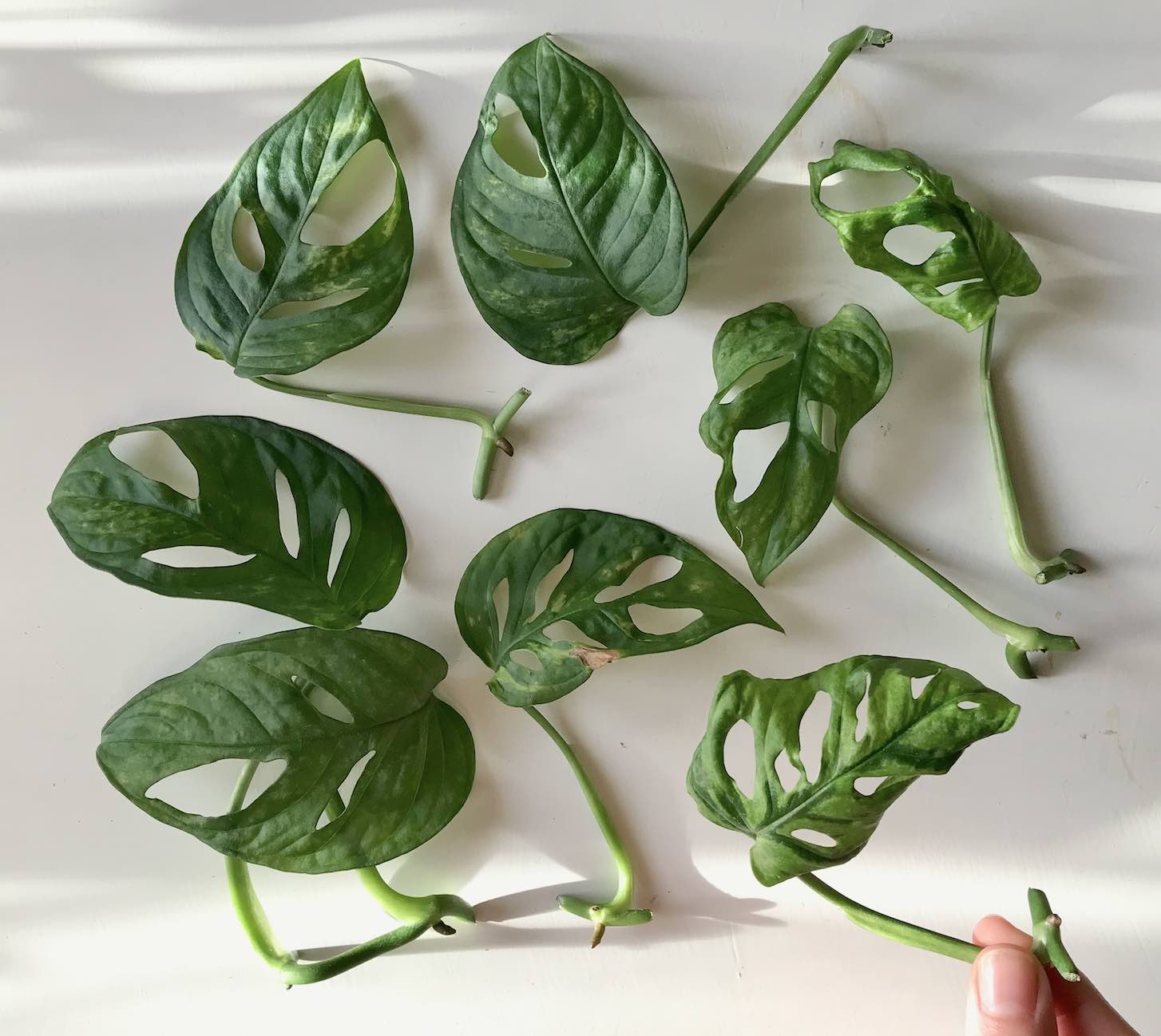
A Monstera leaf can stay green in water for months and still never become a plant. The deciding feature is a piece of main stem with a viable node and growth point.
Before cutting, identify what you actually have.
| Plant piece | What to look for | Propagation outlook |
|---|---|---|
| Top cutting | Growing tip plus a node; an aerial root is helpful | Usually the clearest route to continued vine growth |
| Mid-stem cutting | Node, axillary bud and correctly oriented stem section | Can root and activate the dormant bud; often slower to show a leaf |
| Wet stick | Leafless node with a healthy bud and firm stem | Possible, but has fewer stored resources and less margin for error |
| Leaf with petiole only | No segment of main stem, node or axillary bud | May remain decorative or form limited roots, but will not make a new vine |
| Root or aerial root alone | No viable stem node and growth point | Cannot replace the missing stem growth point |
Find the node before you make the cut
The node is a thickened joint on the main stem, usually where a leaf petiole and aerial root emerge. Nearby, the axillary bud may look like a small raised eye or bump. That bud—not the decorative leaf—is where a new shoot can begin.
Trace the petiole back to the vine instead of cutting the leaf stalk by itself. Plan the cut through the internode, leaving enough stem around the node to handle without slicing into it. An aerial root can help identify the area and may speed establishment, but it does not substitute for a viable node.
Prepare the plant and tools
- Choose a firm, hydrated mother plant without active rot or a heavy pest infestation.
- Use sharp pruners or a knife and clean the blade before moving between plants.
- Decide which node belongs to the cutting and which growth point remains on the mother plant.
- Prepare the rooting container and medium first so the cutting is not left exposed while you improvise.
- Wear gloves if the sap irritates your skin, and keep cut material away from children and pets.
Make one decisive cut through the internode. Crushing and repeated sawing create more damaged tissue. If the cut surface is bruised, trim it cleanly with the sanitized blade. There is no need to coat a healthy cut in household powders or sealants.
Choose water, perlite or a potting medium
| Method | Best advantage | Main risk | Good practice |
|---|---|---|---|
| Water | Roots and rot are easy to inspect | Stagnant water and a difficult transition if left too long | Submerge the node, keep leaves out, refresh when cloudy or dirty |
| Perlite or airy soilless medium | Balances moisture, support and root-zone oxygen | The surface can look dry while the node stays wet | Keep evenly moist, never waterlogged, in a draining container |
| Potting mix | Avoids a later water-to-mix transition | Root progress is hidden and dense mix can suffocate the cutting | Use a small draining pot and an open, fresh mix |
| Air layering | The section remains attached while roots form | Wrapped medium can dry out or stay anaerobic | Root a node first; separate only after roots are established |
Root a Monstera cutting in water
- Place the node and any aerial-root base in a clean vessel. Keep the leaf blades and most of the petiole above the water line.
- Set the vessel in warm, bright indirect light. Use the Monstera light guide to avoid a dark corner or harsh unfiltered sun.
- Check the node frequently. Replace water when it becomes cloudy, develops odor or collects debris; rinse the vessel without scrubbing fragile new roots.
- Remove soft black tissue with a sanitized blade. A firm darkened cut end is different from tissue that is mushy and spreading.
- Pot when the cutting has several firm roots, preferably with branching side roots, and the node remains healthy. Root structure and active growth matter more than a calendar date.
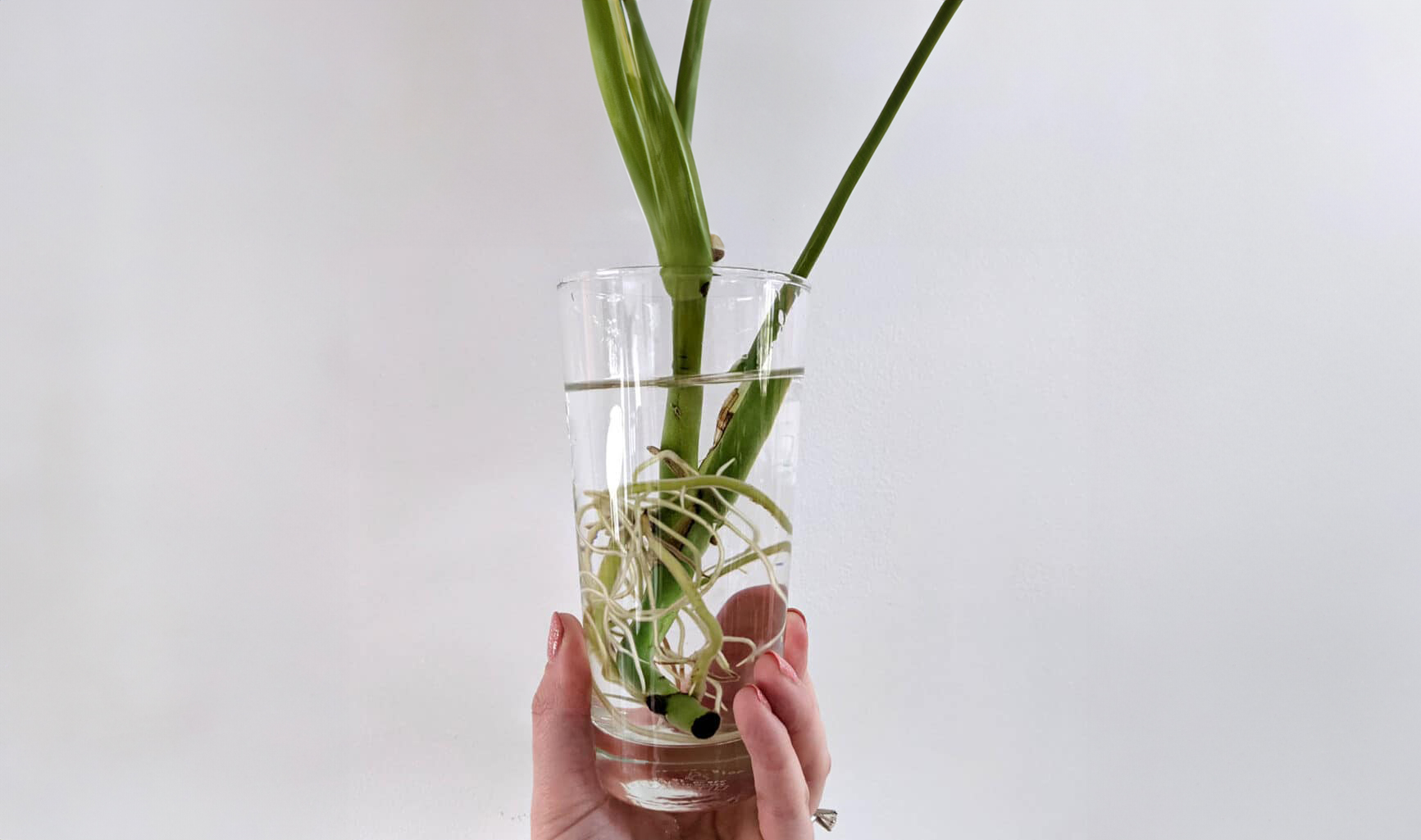
New water roots are adapted to that environment. During transfer, use a small pot with drainage, settle fresh open mix around the roots without packing it hard, and keep conditions gently consistent while the cutting adjusts. Do not compensate for transplant stress by leaving the pot saturated.
Root directly in an airy medium
Moisten the medium before inserting the cutting. Support the stem so the node stays in contact with the medium instead of rocking and tearing emerging roots. The mix should feel lightly and evenly moist while still containing air. A large decorative pot of dense, wet soil creates more risk than a small functional propagation container.
Because roots are hidden, look for a stable cutting, resistance to a very gentle tug and eventual shoot activity. Do not pull the cutting out repeatedly to check. If the stem softens, odor appears or the container stays saturated, inspect once, remove failed tissue and correct the wet, airless condition.
Air-layer a valuable or awkward stem
Air layering lets a node form roots while it is still supplied by the mother plant. Hold moist sphagnum or another airy propagation medium around the chosen node and aerial-root base, then wrap it so moisture is retained but the site can still be monitored. Keep the medium damp, not dripping.
Once a useful root system is visible through the wrap, cut the stem below the rooted node and pot it. This is particularly useful when a large top cutting would be difficult to support or when you want evidence of roots before separating a valuable plant.
Can you divide a Monstera?
Sometimes—but division is not the same as slicing one vine and root ball into arbitrary pieces. Separate only a distinct rooted shoot or stem section that retains its own viable node or growth point and enough roots to function. For a typical single climbing vine, a stem cutting or air layer is the clearer method.
Monstera does not reproduce by spores. Seeds are a sexual-propagation route for species plants, but they are not the normal answer for multiplying a named variegated cultivar, and seed-grown plants do not reliably copy a parent plant’s variegation.
Troubleshoot by tissue, roots and time
| What you see | Likely issue | First response |
|---|---|---|
| No new leaf yet | Mid-cutting bud is still activating, roots are still developing, or light/temperature is limiting | Check that the node is firm and conditions are stable; do not discard a healthy cutting by date alone |
| Soft black node | Active rot, often encouraged by damaged tissue and stagnant wet conditions | Cut back to firm tissue with a clean blade and restart in a cleaner, airier setup if a viable node remains |
| Leaf droops after cutting | Water loss exceeds the new cutting’s limited uptake | Reduce harsh light and heat, support the cutting and keep the root zone appropriate; do not drown it |
| Roots brown but firm | Color alone may reflect age, medium or staining rather than rot | Judge texture and odor; healthy roots are firm, while rotten roots are soft and collapsing |
| Cutting declines everywhere | Rot, pests, severe dehydration or failed environment | Use the Monstera recovery guide and preserve only firm viable tissue |
Extra caution with variegated cuttings
A highly white cutting has less chlorophyll and therefore less capacity to support itself. Prefer a cutting with useful green tissue as well as an intact node and growth point. The pattern on one leaf does not guarantee the exact pattern of future leaves; the location and stability of variegation through the stem matter.
Do not increase fertilizer to force a slow unrooted cutting. Establish roots first, then follow the broad Monstera care dashboard. If you are assessing several symptoms rather than propagation progress alone, use the healthy Monstera checklist.
FAQ
Can a Monstera leaf grow roots without a node?
It may remain alive and may form limited roots, but without a piece of main stem containing a viable node and axillary bud, it cannot make a new Monstera vine.
Where should I cut a Monstera for propagation?
Cut through the internode below the node you want to keep on the cutting. Leave enough stem for handling and avoid slicing through the node or growth point.
Is water or soil better?
Both can work. Water makes progress visible; an airy rooting medium can reduce the later transition. The better method is the one that lets you keep the node moist, oxygenated, supported and easy to monitor.
How long does Monstera propagation take?
There is no universal deadline. Cutting type, node condition, light, warmth and season change the pace. Judge progress by firm roots, branching and active growth rather than a promised number of weeks.
Can I propagate a variegated Monstera from seed?
Seedlings do not reliably reproduce the named parent’s variegation. Use a viable stem cutting, air layer or qualified rooted division when preserving a cultivar is the goal.
