Greenboog collector plant field guide
The strongest buy is not automatically the palest plant. Look for a viable node, active bud, healthy roots, enough green tissue to support growth and a seller who can show the exact plant or document what the trade name means in that listing.
Use this identity card before comparing price or color.
| Question | What to check |
|---|---|
| What is it? | A variegated Monstera deliciosa sold under a horticultural Mint label. |
| What does “mint” describe? | Pale green, cream-green or white-green marbling and veining; expression can change as a leaf hardens. |
| Is every Mint the same clone? | No assumption should be made from the name alone. Ask for lineage and actual-plant evidence. |
| Best buying signal | A healthy root system, viable node and active bud with a workable balance of green and pale tissue. |
| Biggest avoidable mistake | Buying a leaf-only cutting or “variegated seed.” Neither is a reliable route to a Mint plant. |
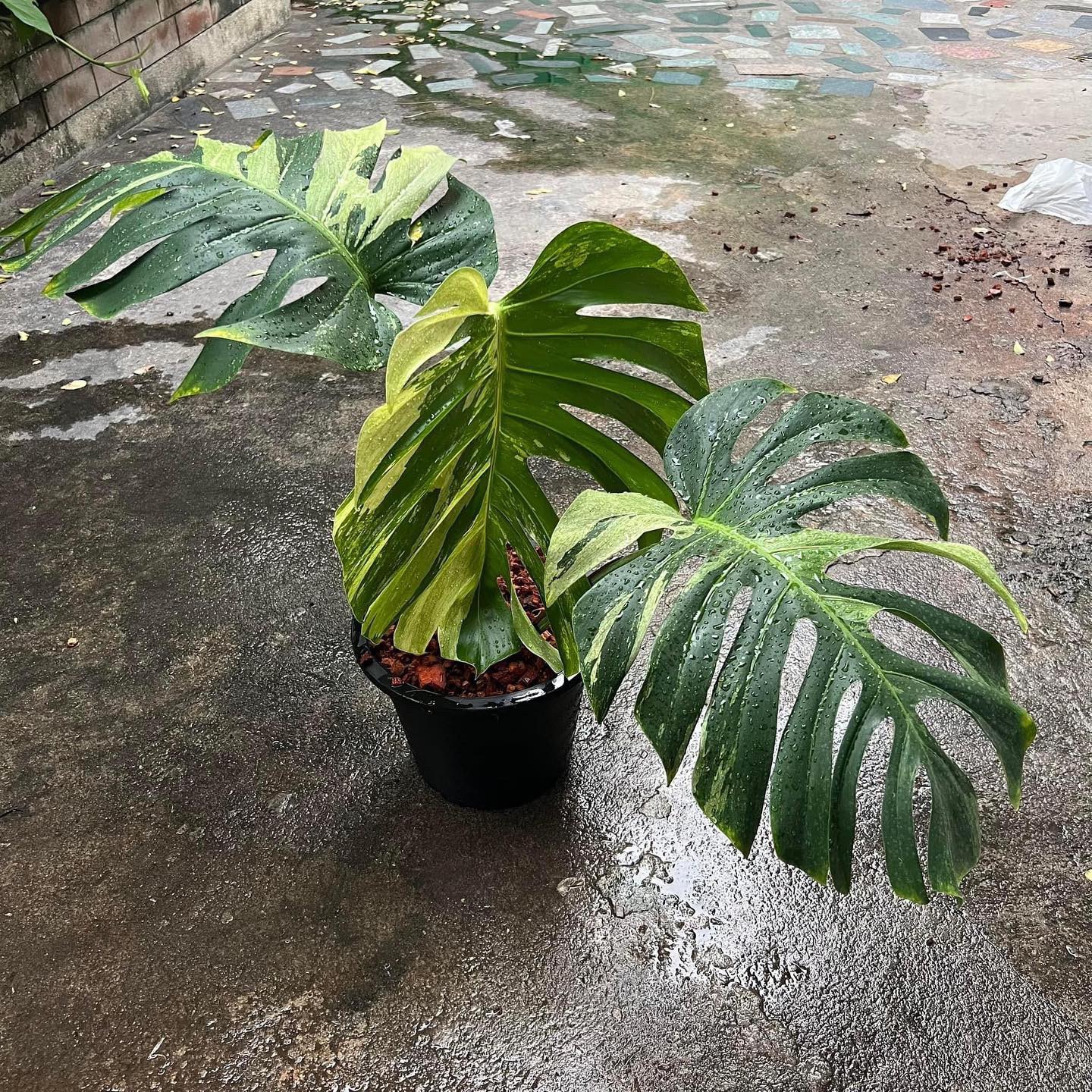
Is Monstera Mint a species or a cultivar?
The botanical species is Monstera deliciosa. Kew’s Plants of the World Online accepts that name and treats Monstera borsigiana and M. deliciosa var. borsigiana as synonyms, not separate accepted species.
“Mint” is used in horticultural trade to describe a color and pattern, and sometimes a particular seller’s or propagator’s line. Marketplace terms such as Jungle Mint, Blue Mint, White Mint and NOID Mint are not applied consistently enough to identify a plant without supporting evidence. A responsible listing should tell you the botanical species, the trade label, the propagation format and whether the photograph shows the exact plant.
This naming caution is practical, not pedantic. A buyer may receive a chimeric cutting, a tissue-culture plant, a green-on-green sport or another pale-variegated line under similar wording. Those plants can differ in juvenile appearance, stability and how the pattern develops.
How to identify a Monstera Mint
Look at a hardened leaf, not only a fresh one
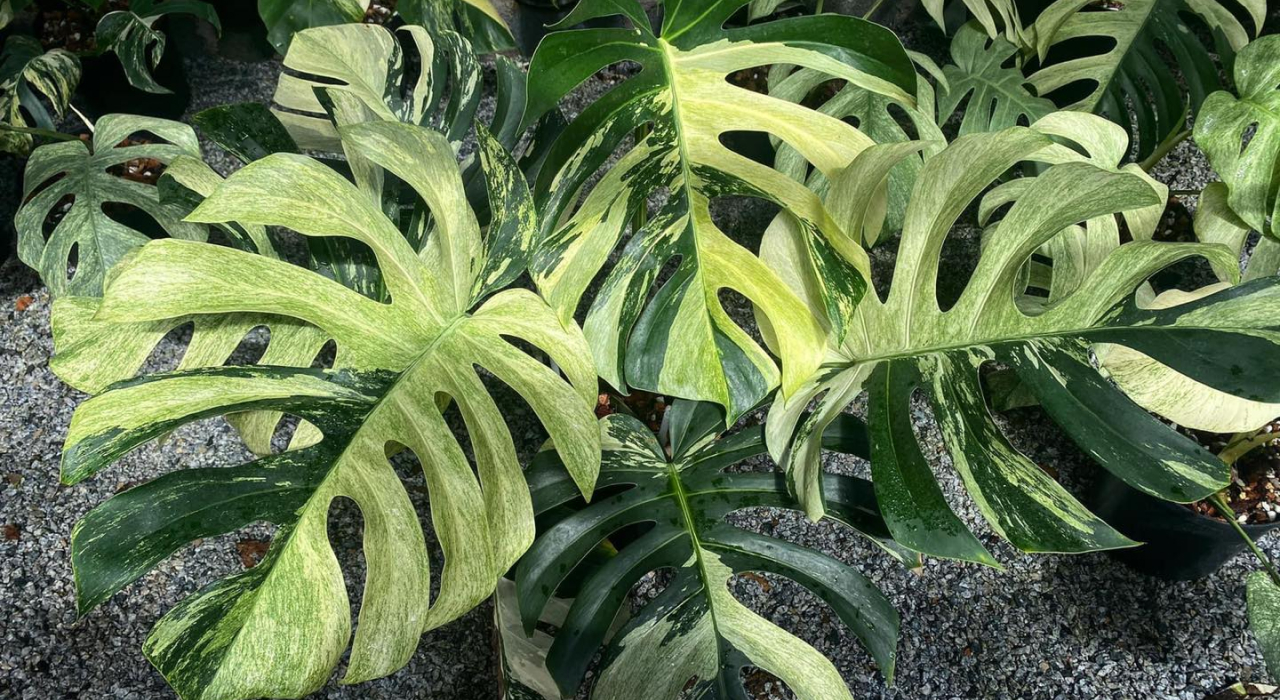
New Monstera leaves are often lighter before they harden. Judge the pattern on both a fresh leaf and an older, fully hardened leaf. Mint-type foliage commonly shows fine green veining, speckles or marbling through pale green to creamy areas. A single washed-out new leaf is not enough to establish identity.
Inspect the stem and node
For a cutting, ask for a clear photograph of the node, axillary bud and stem coloring. The node must be intact; the bud is where a new shoot can develop. A rooted leaf and petiole without a node can remain attractive for a time but cannot grow into a new vine.
Follow several leaves
Variegation is best assessed as a sequence. Compare the last three or more leaves and the stem section that produced them. One nearly white leaf followed by green growth tells a different story from repeated, balanced mint marbling. Ask whether the listing photo is the mother plant, a representative plant or the exact plant for sale.

Monstera Mint versus similar variegated forms
Compare patterns as evidence, then verify the actual plant and its history.
| Marketplace label | Typical visual cue | What the name cannot prove |
|---|---|---|
| Mint | Pale green or cream-green tissue with fine darker veining, flecks or marbling. | A single shared clone, origin or stability level. |
| Albo / Variegata | Usually stronger white-to-cream sectors or marbling against green. | That every node will continue the same balance. |
| Thai Constellation | Typically cream speckling and larger cream sectors distributed across the leaf. | That a juvenile plant will already show its mature pattern. |
| Green on green | Different green tones rather than white contrast. | Whether a seller uses “Mint” for the same look. |
| Jungle, Blue, White, Sphinx or NOID Mint | Line-specific pale patterns described by the seller. | Identity without lineage, mother-plant images or propagation records. |
If your decision is mainly between a high-contrast Albo and the cream-speckled Thai form, use our Monstera Albo versus Thai Constellation comparison. For Mint, seller documentation and the actual plant remain especially important because trade language overlaps.
For a wider label check before narrowing to Mint, use the variegated Monstera names and patterns guide. It distinguishes M. deliciosa color groups from pattern descriptions and from separate accepted species.
Monstera Mint buyer checklist
- Actual-plant status: confirm whether the photograph is the plant you will receive.
- Format: identify whether it is an established potted plant, rooted cutting, unrooted node or tissue-culture plantlet.
- Node and bud: for any cutting, request a close view of the intact node and active axillary bud.
- Root condition: look for firm, healthy roots and ask when the plant was last moved into its current medium.
- Color balance: avoid selecting solely for maximum pale tissue; the plant needs green tissue to photosynthesize.
- Leaf sequence: request more than one leaf and, if possible, a mother-plant photograph.
- Pest check: inspect the leaf undersides, petiole joints and new growth for mites, thrips, scale and mealybugs.
- Arrival plan: know the shipment format and prepare the correct recovery or acclimation environment before delivery.
What a mature Monstera Mint looks like
A young plant may have small, entire leaves. Larger leaf blades, marginal splits and internal fenestrations develop with age and suitable growth conditions. The plant is a climber, so vertical support and a stable root zone matter more than cosmetic pruning if mature foliage is the goal.
Give aerial roots a support they can contact, keep the support stable and turn the plant only when needed for access. Constantly changing the vine’s direction makes it harder to train. Bright filtered light supports growth, but fenestration is not created by light alone; maturity, root health and climbing habit all contribute.
Monstera Mint care
The basic root, leaf and climbing needs remain those of the species. Use our Monstera care guide for a broader routine; the notes below focus on decisions that matter more when much of the leaf is pale.
Light
Use bright, indirect light as the starting point. Pale sections contain less chlorophyll, so a variegated plant has less productive green area than an all-green Monstera. At the same time, pale tissue is easier to scorch in intense sun. Increase exposure gradually, use a sheer curtain where midday sun is strong, and judge the placement by new growth rather than a fixed distance from a window.
The Royal Horticultural Society’s variegated Monstera profile recommends bright indirect light and moist but well-drained conditions. Long internodes and progressively smaller leaves suggest the plant needs a better combination of light and support. Dry tan patches on the window-facing side can indicate excess direct sun or heat.
Watering
Water thoroughly, let excess water leave the pot, then reassess the medium instead of watering by calendar. Minnesota Extension uses the top 1–2 in (2.5–5 cm) of dry soil as a practical checkpoint for an established Monstera, but pot size, substrate, temperature and root mass change how quickly that happens.
A plant that stays wet for many days needs investigation, not another drink. Check drainage, air space in the mix, root condition and whether an oversized pot is holding too much water. Our Monstera watering guide explains how to combine a finger check, pot weight and plant response.
Potting mix and container
Use a container with drainage holes and a mix that holds some moisture while retaining air after watering. Bark, coarse mineral material and a quality potting component can create that balance, but there is no universal recipe. A warm, bright plant in a small pot dries much faster than a recently rooted cutting in a large container.
Temperature and humidity
A stable indoor range around 65–80°F (18–27°C) suits active growth. Keep leaves away from cold glass, air-conditioning discharge and heating vents. Moderate household humidity can work when watering and roots are stable; a clean humidifier is more controllable than repeatedly wetting leaves.
Fertilizer
Feed only while the plant is actively growing, using a complete fertilizer at the product’s labeled houseplant rate or a conservative dilution. Flush accumulated salts periodically if your water or fertilizer leaves crust on the medium. Do not fertilize a newly arrived, root-damaged or waterlogged plant in an attempt to force recovery.
Support and pruning
Attach the stem—not the petioles—to a plank, pole or trellis. Petioles need freedom to orient each leaf. Prune for damaged tissue, space or a planned propagation point; pinching a climbing Monstera does not reliably create the compact, bushy habit implied by many generic care guides.
How to manage Mint variegation
Light helps the green tissue power growth, but light does not rewrite the genetic pattern in an existing leaf. Avoid promises that a dim green plant will become “full Mint” simply by moving it to a brighter window. Track the stem and several new leaves.
If a vine produces repeated all-green growth, identify a lower node with visible variegation before considering a cut. If growth becomes excessively pale, preserve the healthiest green-bearing section and avoid removing multiple functional leaves at once. Every cut spends stored energy, so root health and an active bud are more important than chasing a particular color ratio.
How to propagate Monstera Mint
A propagation must include stem tissue with a node and viable axillary bud. Aerial roots are helpful but do not replace the node. You can root a node cutting in water, damp sphagnum, perlite or an airy potting mix; choose the medium you can keep evenly aerated and monitor consistently.
- Choose a healthy section with an intact node, visible bud and a workable green-to-pale balance.
- Cut with a clean tool, leaving enough internode to handle without damaging the node.
- Let active bleeding stop, then place the node so the bud is not buried in wet material.
- Keep the medium lightly moist, warm and aerated; avoid sealing a saturated cutting without observation.
- Pot up after a functional root system and active new growth have formed, not after the first tiny root tip.
Tissue-culture plantlets require a different transition from sterile, high-humidity conditions. Do not apply the same timeline to a freshly deflasked plantlet and an established node cutting. Verify the format before arrival and change only one major environmental factor at a time.
Troubleshooting Monstera Mint
Brown pale sections
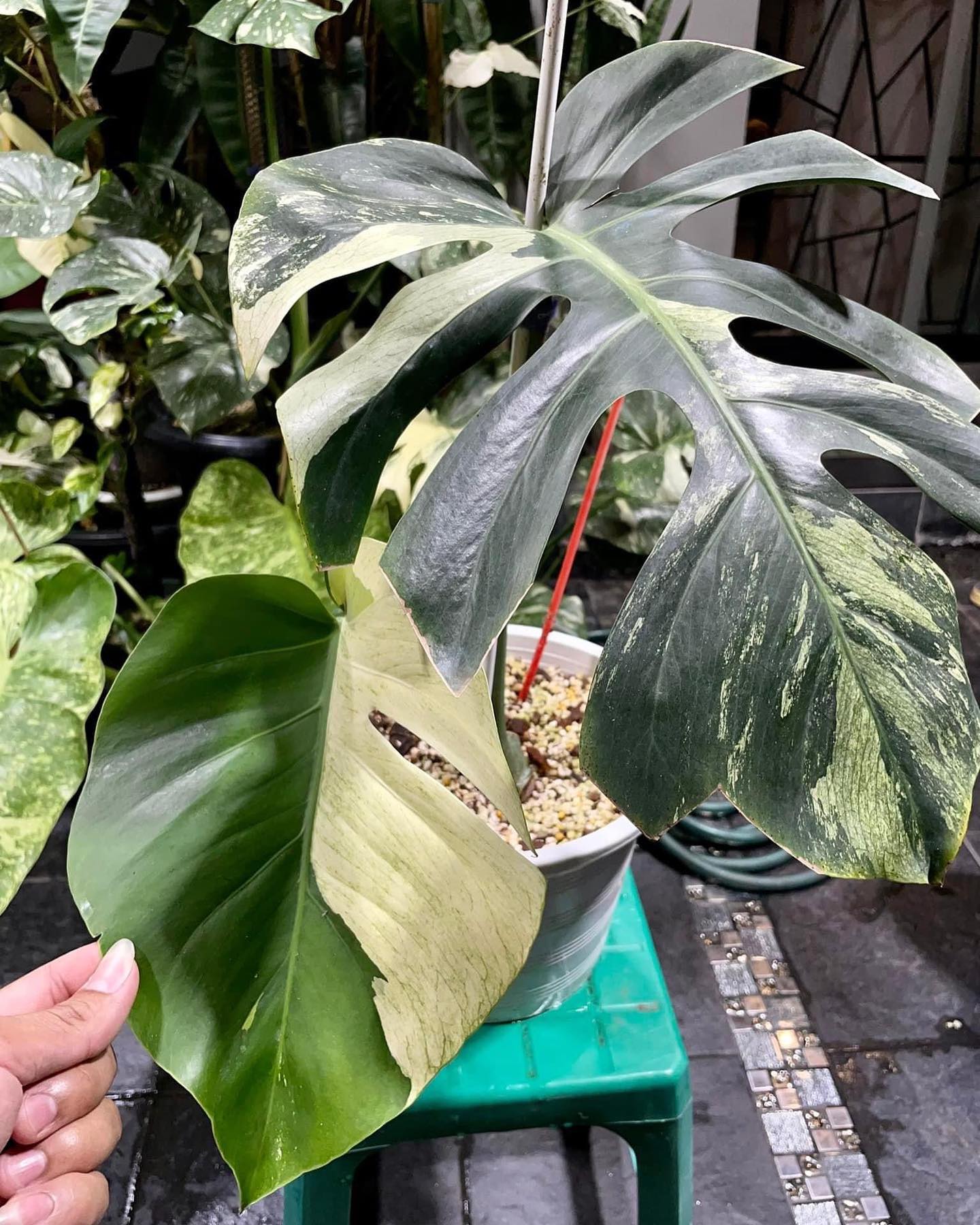
White and mint tissue has less chlorophyll and often shows stress first. Check the pattern: crisp edges can follow dry roots, low humidity or salt buildup; bleached window-side patches suggest sun or heat; yellow-brown tissue with a wet pot raises concern about root stress. Use the full diagnostic in our guide to Monstera leaves turning brown.
Yellow leaves and a heavy pot
Stop treating the symptom with more water. Check the drainage path and roots. Firm pale roots are different from soft brown roots with an unpleasant odor. Remove collapsed root tissue with a clean tool, reduce the volume of wet medium around a small root system and stabilize warmth and light before feeding.
Small leaves and long internodes
Reassess both light and support. A healthy climbing stem that cannot attach may continue producing juvenile growth. Do not repot automatically unless the root system actually needs more space; an oversized wet pot can create a second problem.
No new growth after shipping or propagation
Check that a viable bud exists, the node remains firm and roots are not decaying. A stressed plant may pause while rebuilding roots. If the whole plant is declining, follow the triage steps in our Monstera recovery guide rather than changing light, water, fertilizer and substrate on the same day.
Pet and child safety
Monstera foliage is not edible. NC State Extension lists calcium oxalate crystals as the toxic principle and describes mouth and skin irritation. Keep the plant and pruning waste away from pets and children, wear gloves if sap irritates your skin, and contact an appropriate medical or veterinary professional if ingestion occurs.
Frequently asked questions
Is Monstera Mint the same as Monstera borsigiana Mint?
Kew treats Monstera borsigiana as a synonym of Monstera deliciosa. Sellers may still use “borsigiana” to describe a growth form or trade line. Ask for the plant’s lineage and actual growth characteristics rather than treating the older name as proof of a different species.
Can Monstera Mint grow from seed?
Do not buy seed on the promise that it will reproduce Mint variegation. Variegated Monstera are propagated to preserve a selected mutation or line; seeds do not reliably carry the displayed leaf pattern.
Does more light create more Mint variegation?
Better light can support stronger growth, but it cannot guarantee the pattern of the next leaf. Variegation expression follows the growing tissue. Use light to maintain plant health, then evaluate the stem and several leaves.
Where can I compare available Monstera forms?
Sources and identity references
- Kew Plants of the World Online: accepted Monstera deliciosa record and synonyms
- University of Minnesota Extension: viable nodes, axillary buds and variegated seed claims
- Royal Horticultural Society: variegated Monstera growing conditions
- NC State Extension: species profile and calcium oxalate safety