Greenboog white-variegated adansonii guide
This field guide is for collectors and indoor growers who want to verify the plant in front of them, protect functional green tissue and make a propagation decision from the node—not from a viral calendar or one dramatic leaf.
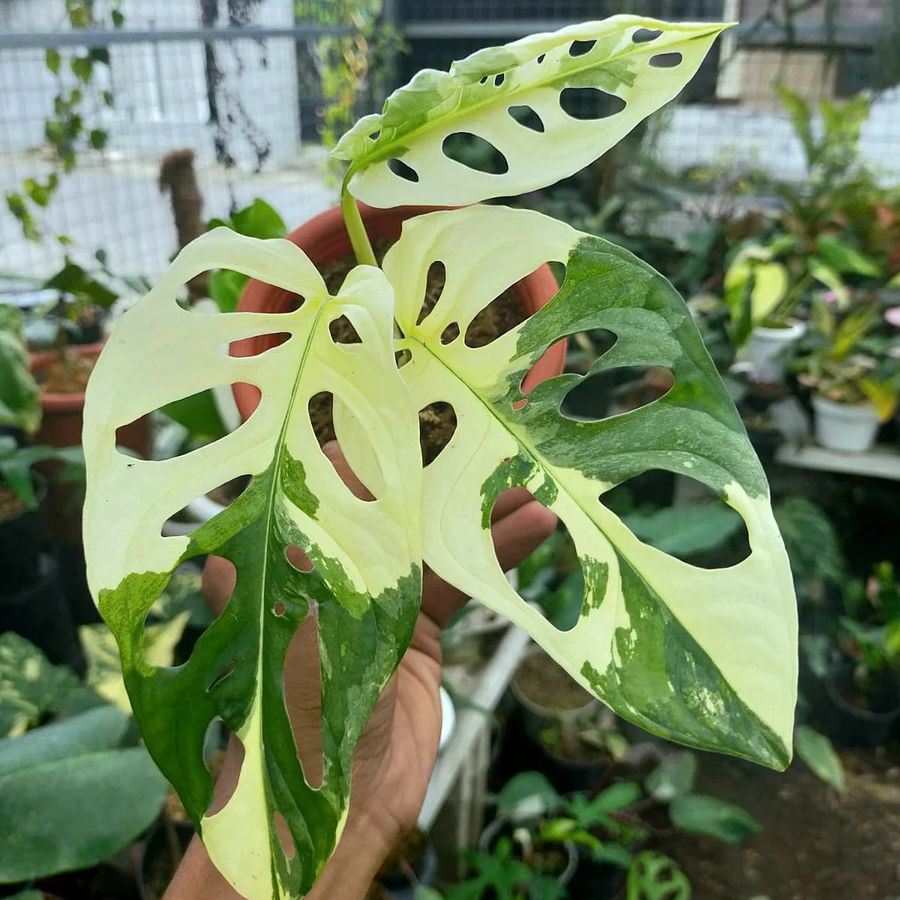
Start with identity and plant format; only then apply a care decision.
| Question | Useful evidence | What it cannot promise |
|---|---|---|
| Is it adansonii? | Whole vine, several hardened leaves, petioles, stem and provenance | A single perforated leaf cannot prove species or subspecies |
| Is the pattern viable? | Green tissue across several leaves and pattern near active nodes | One highly white leaf cannot predict the next shoot |
| Can it propagate? | Stem node, axillary bud, sound tissue and current roots if sold rooted | A leaf-only cutting may stay decorative but cannot build a new vine |
| Which care applies? | Established plant, fresh cutting, rooted cutting or acclimating plantlet | One watering or humidity recipe does not fit every format |
What the name does—and does not—tell you
Monstera adansonii is an accepted species in Kew’s Plants of the World Online. Kew places its native range across Tropical America and recognizes several infraspecific taxa. “White variegated,” “Albo,” “Giant” and similar words in listings are horticultural or trade descriptions; they are not automatic proof of a registered cultivar, a particular subspecies or a stable future pattern.
Use several connected leaves, the stem, petiole structure and source history together. Fenestrations belong naturally to the leaf architecture, but hole number and shape change with growth stage and conditions. If your question is broader—how Albo, Thai, Aurea, Mint and pattern labels differ—use the variegated Monstera names and patterns guide rather than forcing that comparison into this care page.
Care the green tissue and root system together
White sectors contain less photosynthetic tissue than green sectors, so a dramatic plant is not automatically the strongest plant. Your goal is not to maximize white at any cost. It is to keep enough healthy green tissue, a functional root system and an active growth point working together.
Use these as decisions, not fixed calendar entries.
| Factor | Useful starting point | Adjust from evidence |
|---|---|---|
| Light | Bright filtered light with a stable day/night rhythm | Internodes stretch, growth stalls or pale sectors heat and crisp |
| Water | Water thoroughly after meaningful partial dry-down, then drain | Pot weight, rooted depth, light, temperature or growth rate changes |
| Root zone | Airy, moisture-retentive medium in a draining container | The center remains saturated, mix collapses or water channels past roots |
| Air and warmth | Warm stable room, moderate humidity and gentle airflow | Cold glass, drafts, heater blasts or stagnant wet foliage appear |
| Support | Firm pole, plank or trellis installed before the vine leans | Stem direction changes or ties begin to constrict new growth |
Light: enough for useful growth, not a variegation switch
The RHS profile for M. adansonii recommends bright indirect light and moist but well-drained conditions. Acclimate the vine gradually when increasing exposure. Strong direct sun can heat and scorch pale sectors; prolonged low usable light can weaken growth and lengthen internodes.
Do not promise that a brighter window will turn a green shoot white again. Light supports the tissue a growth point can produce; it does not let a grower order a half-moon or chosen white percentage. Read a sequence of leaves and the stem around active nodes before considering pruning.
Water the rooted depth, not the weekday
Check pot weight and moisture at more than the surface. Water fully when a meaningful portion of the rooted zone has dried, then let excess leave the pot. A shallow cutting pot and a tall, root-filled container can have the same dry top inch while holding very different moisture below.
A continuously wet center, sour smell, black soft roots or a soft stem base calls for inspection, not another measured drink. A very light pot, dry medium through the root zone and loss of leaf firmness point in a different direction. The complete Monstera care framework explains how to read these interacting signals without duplicating a fixed schedule here.
Humidity, airflow and feeding
Stable moderate humidity can help thin leaves open cleanly, but a universal 60–80% target is not supported for every home and format. A humidifier is measurable; daily misting changes the leaf surface briefly and does not repair failed roots or cold stress. Pair humidity with gentle air movement rather than keeping foliage stagnant and wet.
Feed an actively growing, rooted plant according to the product label. Do not increase strength to force variegation. Reduce or pause when light and growth decline, roots are compromised or a fresh cutting is still establishing. Salt crust, burned root tips and stalled growth are reasons to reassess the whole system.

Climb or trail? Choose the habit you can support
M. adansonii is a climber with adventitious roots, although it can be displayed trailing. Vertical contact can organize the vine and support larger later growth, but a pole does not punch holes into leaves or guarantee more white. Install support without burying the stem, use soft ties and extend the structure before the active tip bends away.
For attachment direction, tie placement and support choices, use the Monstera support guide. If the question is window exposure rather than this plant’s variegation, use the Monstera light guide.
How to propagate a white-variegated adansonii
The essential unit is a stem node with a viable growth point. Aerial root presence can be helpful, but it does not replace the bud. A leaf and petiole without stem tissue may remain attractive or even maintain roots for a time; it cannot create a new vine.
The University of Minnesota Extension Monstera propagation guide demonstrates the node and axillary-bud principle on M. deliciosa. That structural principle applies across a node-forming Monstera vine, but its timing and care numbers should not be copied as guarantees for every adansonii cutting.
- Map the stem first. Identify the node, axillary bud, petiole and any aerial root. Photograph both sides before cutting.
- Choose a viable section. Prefer sound stem tissue with useful green pattern near the growth point; avoid a leaf-only piece or a node already collapsing.
- Make a clean cut. Use a clean sharp tool and leave enough internode to handle the piece without cutting into the bud.
- Select one medium you can monitor. Clean water makes roots visible; airy damp moss or perlite can reduce the later water-to-substrate transition. None succeeds if the node is suffocated or allowed to rot.
- Keep the node correctly oriented. Maintain warmth and bright filtered light, keep leaves out of standing water, and provide oxygen around developing roots.
- Pot by root function, not a deadline. Move when the cutting has a healthy branching root system able to support the leaf and new shoot. Transition moisture gradually.
The Monstera propagation owner covers air layering, division, wet sticks and root-transition decisions in more depth. This page stays focused on the white-variegated adansonii evidence boundary.
Read problems by pattern, not one symptom
A symptom starts an inspection; it does not finish the diagnosis.
| Pattern | Check first | Useful next step |
|---|---|---|
| Crisp white sectors | Recent sun increase, full dry-down, salts, hot/cold contact | Prevent the next injury; dead tissue will not recolor |
| Greener new leaves | Several hardened leaves and pattern around active nodes | Observe the sequence before any irreversible pruning |
| Mostly white weak growth | Remaining green tissue, roots and next viable bud | Protect functional tissue; do not add intense sun or heavy feed |
| Droop + wet heavy pot | Drainage, odor, black roots and soft stem tissue | Inspect roots before adding water |
| Stippling, webbing or cottony deposits | Leaf undersides, petiole joints, support and nearby plants | Isolate, identify and use a label-directed treatment |
Brown tissue has many possible causes. If the whole plant is declining, work from root condition and recent changes. If only mature leaves need a prune-or-retain decision, use the Monstera brown-leaf diagnosis guide.
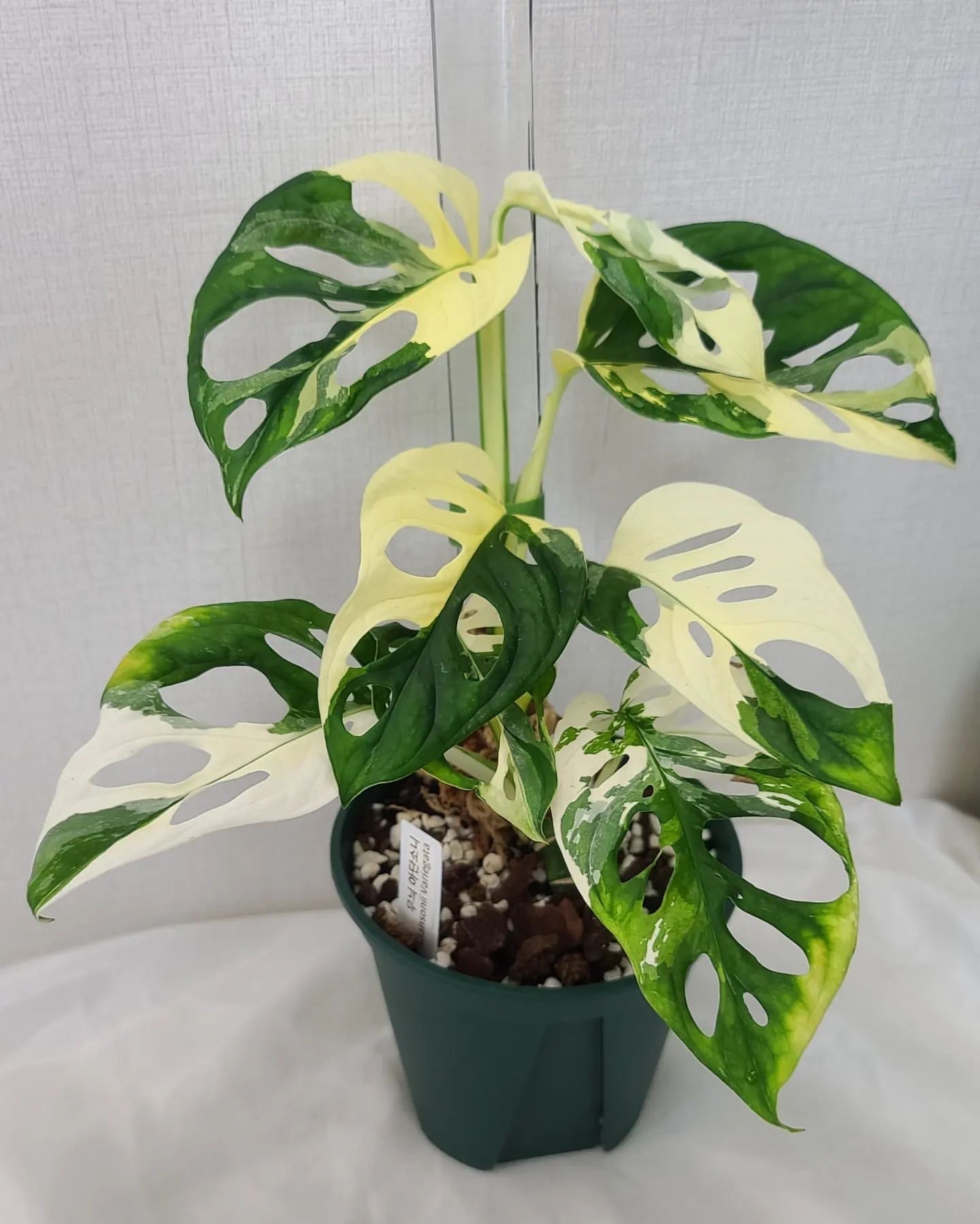
Buying evidence: established plant, cutting or lot
Normalize the format before comparing photos or price.
| Format | Ask to see | Main uncertainty |
|---|---|---|
| Established plant | Current whole plant, newest growth, roots, stem and both leaf surfaces | Transit stress, pests and future pattern |
| Rooted cutting | Node, bud, root system, medium and rooting history | Root quality and transition—not just the word “rooted” |
| Unrooted cutting | Fresh stem, viable bud, node orientation and exact plant disclosure | Rooting loss and bud viability |
| Wholesale lot | Representative-batch disclosure, size range, roots, count and terms | Variation and viable-unit cost across the lot |
Frequently asked questions
Is white-variegated Monstera adansonii a separate species?
No. Monstera adansonii is the accepted species; “white variegated” or “Albo” describes a horticultural phenotype or trade label. A listing needs additional evidence to support a subspecies or named-line claim.
Can a white adansonii leaf grow roots without a node?
A leaf or petiole may remain alive or maintain roots for a time, but a new vine requires stem tissue with a viable node and growth point. Buy or cut the node when propagation is the goal.
Does low light cause permanent reversion?
Low usable light can weaken and stretch growth, but moving a plant brighter does not command white tissue to reappear. Read several leaves and the pattern around viable nodes before deciding whether a shoot has become consistently green.
Why are the white parts turning brown?
Pale tissue has less margin for stress. Check abrupt sun change, root moisture through the pot, salt buildup, cold or hot contact and pests. Brown tissue will not recolor; prevent the next injury rather than treating one cause by slogan.
How long should a cutting stay in water or moss?
Use root function rather than a fixed number of weeks. Pot when roots are healthy, branching and able to support the leaf and new shoot; weak or rotting roots need correction, not a deadline.
Should I choose the whitest plant?
Not automatically. Evaluate usable green tissue, the node, active growth, roots, pests and seller evidence. A greener, well-rooted plant may be a more resilient choice than a spectacular but weak high-white plant.
Sources and further reading
- Kew Plants of the World Online: accepted name, range and infraspecific taxa for Monstera adansonii
- Royal Horticultural Society: habit, cultivation, safety and propagation
- NC State Extension: species profile, root-zone, pest and stem-cutting evidence
- University of Minnesota Extension: node and growth-point propagation anatomy