Greenboog Monstera support guide
The safest support holds the climbing stem close to a stable surface while each leaf stalk remains free to turn toward the light.
Choose for the plant’s weight, growth habit and the maintenance you will actually do.
| Support | Best for | Trade-off | Check before use |
|---|---|---|---|
| Cedar plank or board | Heavy mature vines needing a rigid back | Does not hold moisture; may need extensions as the vine grows | Untreated, smooth enough to avoid injury, rot-resistant and firmly anchored |
| Moss or coir pole | Aerial-root contact and a compact vertical profile | True moist poles require regular watering; dry decorative poles act mainly as stakes | Core strength, material retention and whether moisture will create a mess or rot risk |
| Trellis | Several stems or a broad display | Can spread the plant wider and create many tie points | Base width, pot stability and clearance for petioles |
| Bamboo or metal stake | Juvenile plants and temporary correction | Narrow contact area and limited capacity for a heavy vine | No sharp edge; deep stable placement without root spearing |
| Wall-mounted system | Large permanent displays outside the limits of one pot | Commits the plant to a location and can mark wall finishes | Suitable anchors, wall moisture protection and an accessible route for care |
Find the front, back and main stem
A Monstera leaf is connected to the vine by a long petiole. Petioles need to swivel as the plant tracks light; they are not the structure to strap to a pole. Follow one petiole inward until it meets the thicker, jointed main stem. Nodes, aerial roots and old leaf scars help reveal the vine’s climbing side.
Place the support along that back side so aerial roots can meet it and leaf blades can face the room and light. If the plant has several independent vines in one pot, orient each before forcing them into a single bundle. A broad trellis may fit better than one narrow pole.
Install the support without guessing through roots
- Measure the plant and choose a support that is tall and rigid enough for the current vine plus near-term growth.
- Remove the plant from its cachepot and check whether the inner pot can drain. A heavier decorative outer pot can add stability but must not trap runoff.
- If the root ball is dense, install the support during repotting: expose the pot edge, position the support behind the vine and arrange roots around it instead of driving it blindly through them.
- Anchor the support deep enough that it does not pivot when the stem is attached. Test stability before adding ties.
- Return mix around the roots without burying stem sections that were previously above the surface.
- Water according to the root zone and let all excess drain; use the Monstera watering guide rather than assuming repotting always requires extra water.
A support that rocks in the pot transfers leverage to roots. If the plant and support make the container top-heavy, use a wider stable pot or a weighted cachepot that still allows the inner pot to drain. Do not solve instability by massively oversizing the volume of wet mix around a small root system.
Attach the vine, not the leaves
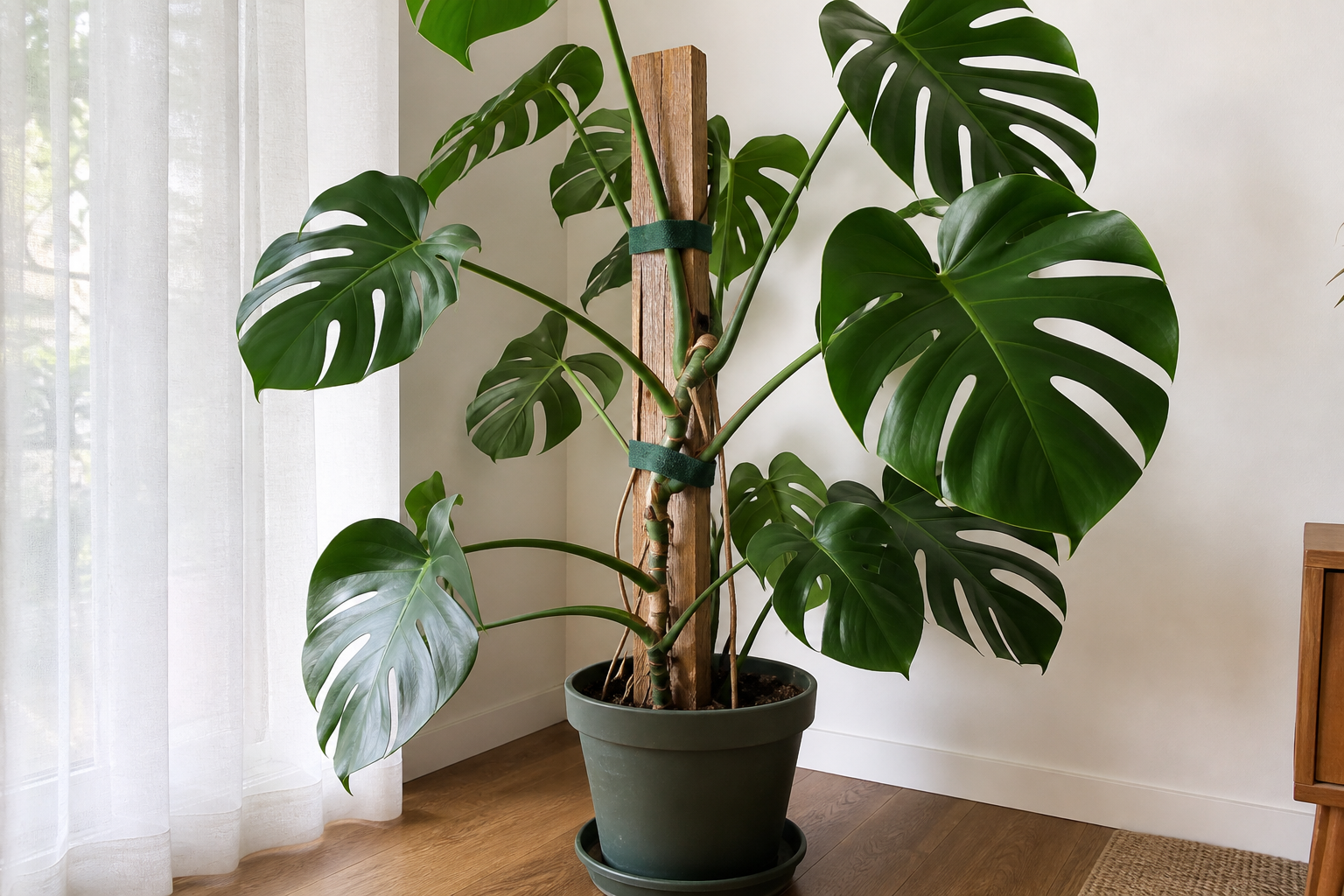
Use wide, soft hook-and-loop tape, cloth strips or flexible plant ties. Make a loose loop around the main stem and support; you should be able to inspect the tissue and adjust the tie. Avoid wire, fishing line and narrow cord that can cut into a thickening stem.
Start with the lowest stable stem section, then add only enough ties to keep the vine close to the support. Do not pull a stiff mature stem abruptly into a new angle. Correct it gradually across several adjustments or reposition it during repotting.
What to do with aerial roots
Aerial roots are normal anchoring structures on a climbing Monstera. Guide a flexible root toward the support or potting mix if it reaches naturally, but do not sharply bend or force it. A dry aerial root does not by itself prove that the pot needs water or the room lacks humidity.
On a moist pole, aerial roots may attach and enter the material. That can make later removal difficult, so treat the pole as part of the plant’s long-term structure. A dry plank can still provide excellent mechanical support even if roots do not penetrate it.
Light and support solve different problems
A pole cannot correct low light. A plant may still stretch toward a window or produce long internodes while firmly tied. Use the Monstera light-placement guide to position the supported side without rotating the plant unpredictably every few days.
Support can help present leaves and reduce stem leverage, but it does not guarantee larger leaves or fenestrations. Species, maturity, root health, usable light and consistent growth all contribute. Use the whole-plant health checklist when the issue is growth quality rather than posture alone.
Check the setup as the plant grows
| What you see | Likely cause | First response |
|---|---|---|
| Tie leaves an indentation | Stem thickened or tie was too narrow/tight | Remove it, inspect tissue and replace with a wider loose tie at a sound stem section |
| Pole leans with the vine | Shallow anchor, weak core or unstable pot | Reinstall during repotting or move to a rigid support and stable container |
| Leaves face backward | Vine orientation and light direction conflict | Reorient the support/plant gradually; leave petioles free rather than twisting leaves |
| Stem cracks or collapses | Forced bend, load damage or tissue decline | Stabilize immediately; assess viable nodes and use the propagation guide if a salvage cut is required |
| Whole plant declines after repotting | Root injury, saturation, light shock or another stressor | Stop changing variables and use the Monstera recovery workflow |
FAQ
Does every Monstera need a moss pole?
No. A cedar plank, sturdy stake or trellis can provide mechanical support. Moss is useful when you intend to maintain a moist rootable surface, but a weak decorative pole is not automatically better than a solid board.
When should I add support?
Add it before the vine becomes difficult to reposition, or during repotting when you can see the root ball. A juvenile upright plant may need only a temporary stake; a heavy climbing vine benefits from a long-term structure.
Can I push a pole into the existing pot?
Only when there is a clear path and the support becomes stable without excessive force. In a dense root ball, remove the plant and install the pole during repotting instead of spearing roots blindly.
Should I tie aerial roots to the pole?
Guide flexible aerial roots gently toward the surface if they reach naturally. Do not bind them tightly or force a sharp bend. The main stem—not an aerial root or petiole—carries the structural tie.
Will a moss pole make leaves larger?
Support can encourage a climbing posture, but leaf size and fenestration also depend on maturity, genetics, root function, light and sustained growth. A pole is not a guarantee.