
Greenboog Philodendron field guide
This is the genus-level operating guide. Individual species, hybrids and horticultural labels can differ, especially in growth rate, support and light response, so use the plant’s new growth as feedback rather than forcing every Philodendron into one recipe.
Philodendron care at a glance
Use the first column to identify the variable, then read across before changing the routine.
| Variable | Check first | Practical response |
|---|---|---|
| Plant identity | Climbing vine, crawling stem or self-heading form? | Choose support, container shape and spacing for the actual growth habit. |
| Light | New internode length, leaf size, orientation and scorch history | Adjust distance or filtering gradually; avoid sudden moves into hot direct sun. |
| Water | Moisture below the surface, pot weight, drainage and root condition | Water thoroughly when the root zone is ready, then drain the container. |
| Potting mix | How quickly the mix wets, drains and regains air | Use a porous mix matched to the room, container and your watering habits. |
| Feeding | Active growth, root health and existing fertilizer or salt load | Feed lightly according to the product label; pause when the plant is stressed. |
| Symptoms | What changed before the symptom and where it appears | Check environment, roots and pests before choosing a treatment. |
Three rules that prevent most over-corrections
- Read new growth and the root zone before reacting to one older leaf.
- Match support and container shape to the plant’s actual growth habit.
- Change the highest-confidence variable first, then record the response.
Identify the growth habit before setting up care
North Carolina Extension separates Philodendrons broadly into climbing and non-climbing forms. A climbing plant can attach by aerial roots and usually benefits from a stable pole, plank or trellis. A self-heading plant holds leaves around a compact stem and needs enough floor or bench space rather than a vine-training plan. Some former “Philodendrons” are now placed in other genera, and marketplace names are not always formal botanical names.
Confirm the label and observe the whole stem before applying cultivar advice. The Philodendron name and variety guide explains the species, hybrid, cultivar and trade-label boundary. For entity-level examples, compare the stem and label evidence in the Philodendron pedatum ‘Glad Hands’ guide and the separate Philodendron joepii guide.
Set light by reading new growth
Most indoor Philodendrons perform well in moderate to bright indirect light. Solid-green heartleaf types often tolerate less light than colorful or highly variegated plants, but “tolerate” does not mean they will maintain the same growth rate, leaf size or pattern.
Signs that the plant may need more useful light
- New internodes are becoming longer and weaker than the earlier stem.
- New leaves are consistently smaller after establishment.
- The vine leans strongly toward one window and growth slows away from it.
- Variegated growth loses contrast after identity, roots and nutrition have been checked.
Signs that the move was too bright or too abrupt
- Pale, bleached or sharply scorched patches appear on the window-facing side.
- Damage follows a recent move into direct sun or hot glass exposure.
- The pot dries dramatically faster and the plant wilts during the brightest period.
Move the plant in stages and evaluate the next one or two leaves. A grow light can be useful where daylight is weak, but distance, output, heat and duration matter together; a universal number of hours is not a substitute for observing the plant.
Water the root zone, not the calendar
Iowa State Extension recommends keeping Philodendrons evenly moist but not wet and watering when the top of the soil is dry. In practice, a surface check alone can mislead in a tall pot, dense mix or cool room. Add pot weight, drainage speed, a skewer or finger check below the surface, and the recent drying pattern.
- Check whether the root zone has used enough of the previous watering.
- Water across the surface until the mix is evenly wetted and drainage appears.
- Empty any standing water from a saucer or cachepot.
- Record how long the pot takes to become ready again; investigate sudden changes.
Wilt is not proof of dryness. A plant with damaged roots can wilt in wet media because the roots are no longer functioning. For tap-water salts, wet-versus-dry diagnosis, watering technique and the difference between propagation water and maintained hydroponics, use the Philodendron watering and water-culture guide.
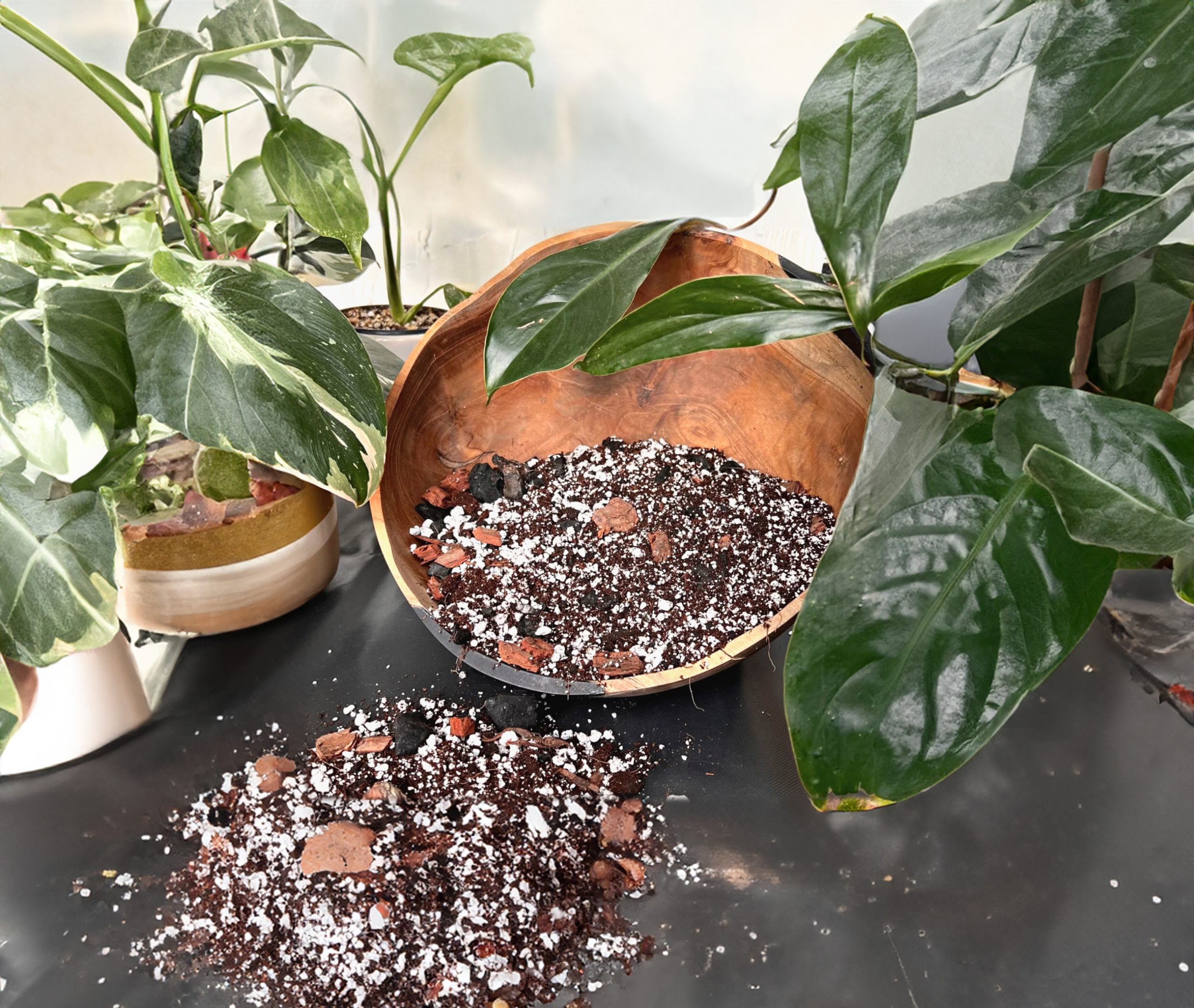
Build an airy root zone
A useful Philodendron mix holds some moisture while reopening air spaces after drainage. The exact components are less important than the behavior of the complete system: fine ingredients retain more water, coarse ingredients increase large pores, a large pot dries differently from a small one, and warm bright rooms use water faster than cool dim rooms.
Choose a container with an unobstructed drainage route. A decorative cachepot can work if the inner pot drains freely and is not left standing in runoff. Do not enlarge the pot simply to create room for years of future growth; excess wet volume around a small root system is harder to manage.
Repot when the system, not the calendar, requires it
Repot when roots and media no longer work together: the plant has become unstable or crowded, water runs around a compacted root ball without wetting it, the mix has collapsed and stays wet, or the pot dries too quickly to manage. Inspect roots before choosing the next container. Healthy roots are generally firm; dark, soft tissue and an unpleasant odor require a root-health response rather than automatic upsizing.
Manage temperature, humidity and airflow together
Philodendrons suit typical warm indoor conditions. Iowa State gives 65–80°F (about 18–27°C) as a well-tolerated range, while North Carolina Extension emphasizes avoiding cold drafts. Protect the plant from abrupt temperature swings at doors, air-conditioning outlets and hot windows.
Many Philodendrons appreciate higher humidity but can adapt to average household humidity. Before buying a humidifier, confirm that brown edges are not coming from dry roots, salt accumulation, heat or root damage. If a humidifier is used, clean it as directed and maintain air movement; high humidity with wet foliage and stagnant air can support disease. Misting produces a brief wet surface, not dependable room-scale humidity.
Feed active roots, not a stressed plant
Fertilizer supports growth; it does not repair rot, poor light or a saturated root zone. Feed lightly while the plant is actively producing healthy growth, following the fertilizer label and accounting for any slow-release product already in the mix. Reduce or pause feeding when growth slows, roots are compromised, the plant has just arrived, or salts are suspected.
White crust on the mix or pot, burned margins across multiple leaves, and a history of frequent feeding justify reviewing the fertilizer and water routine. Flush only when the container drains correctly; pouring more water through a poorly draining pot can make the root problem worse.
Support, prune and clean with a purpose
Give climbing plants a support early enough that roots and stems can be positioned without force. Tie the stem loosely rather than fastening petioles, which need room to move. Self-heading plants need stable containers and enough clearance for expanding leaves.
Prune to remove damaged tissue, manage size or create a deliberate propagation point. Use a clean, sharp tool and avoid coating routine cuts with household powders or sealants. Wipe dust with a soft damp cloth while inspecting both leaf surfaces, petiole bases and stems. Cleaning is a monitoring opportunity, not a cosmetic treatment plan.
Diagnose symptoms before treating them
A symptom narrows the inspection; it does not prove one cause.
| What you see | Useful differentiators | First check |
|---|---|---|
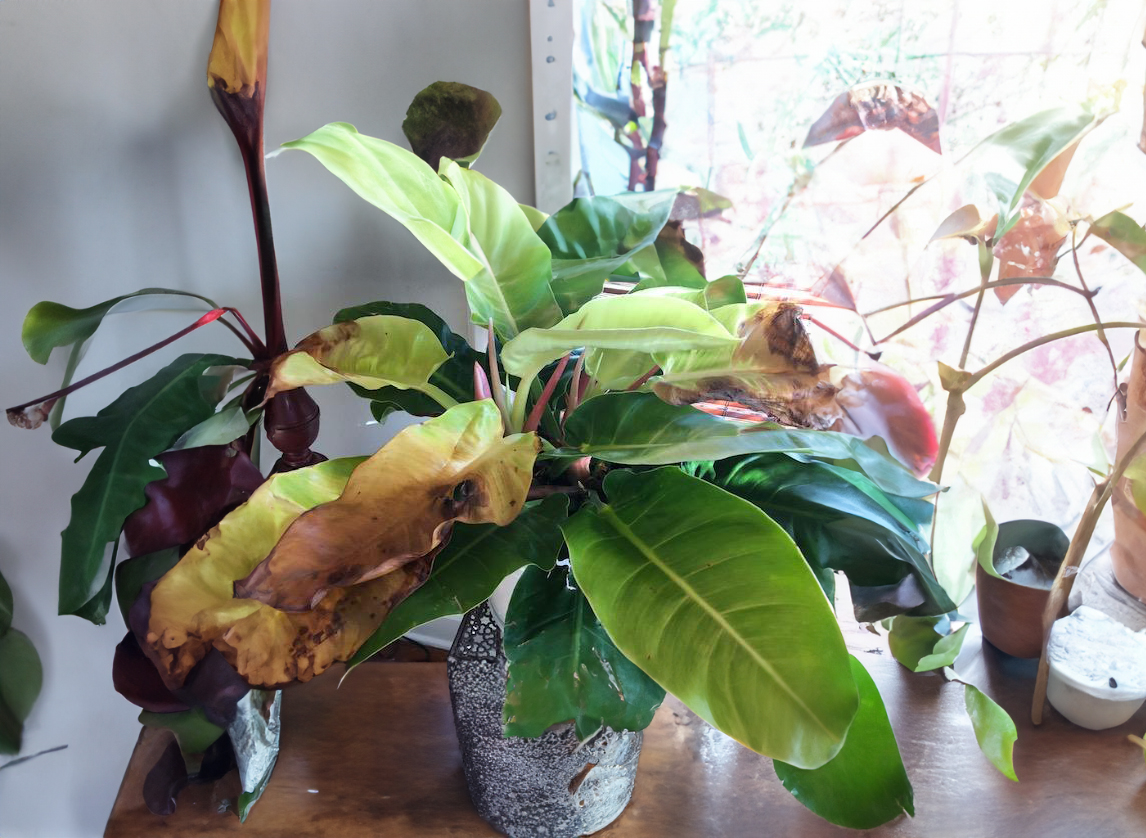
| Yellow leaves | Oldest versus newest leaves; wet or dry mix; recent light or temperature change | Root-zone moisture and root condition |
| Wilt | Pot weight, stem firmness, roots, heat exposure | Do not add water until wet-root failure is excluded |
| Brown tips or margins | Fertilizer history, dry cycles, salts, hot glass, root health, humidity | Review the complete water/root environment |
| Long internodes and small leaves | Change after a move; direction toward the light; support status | Light quantity and growth habit |
| Fine stippling or webbing | Damage concentrated below leaves or around new growth | Isolate and inspect for mites |
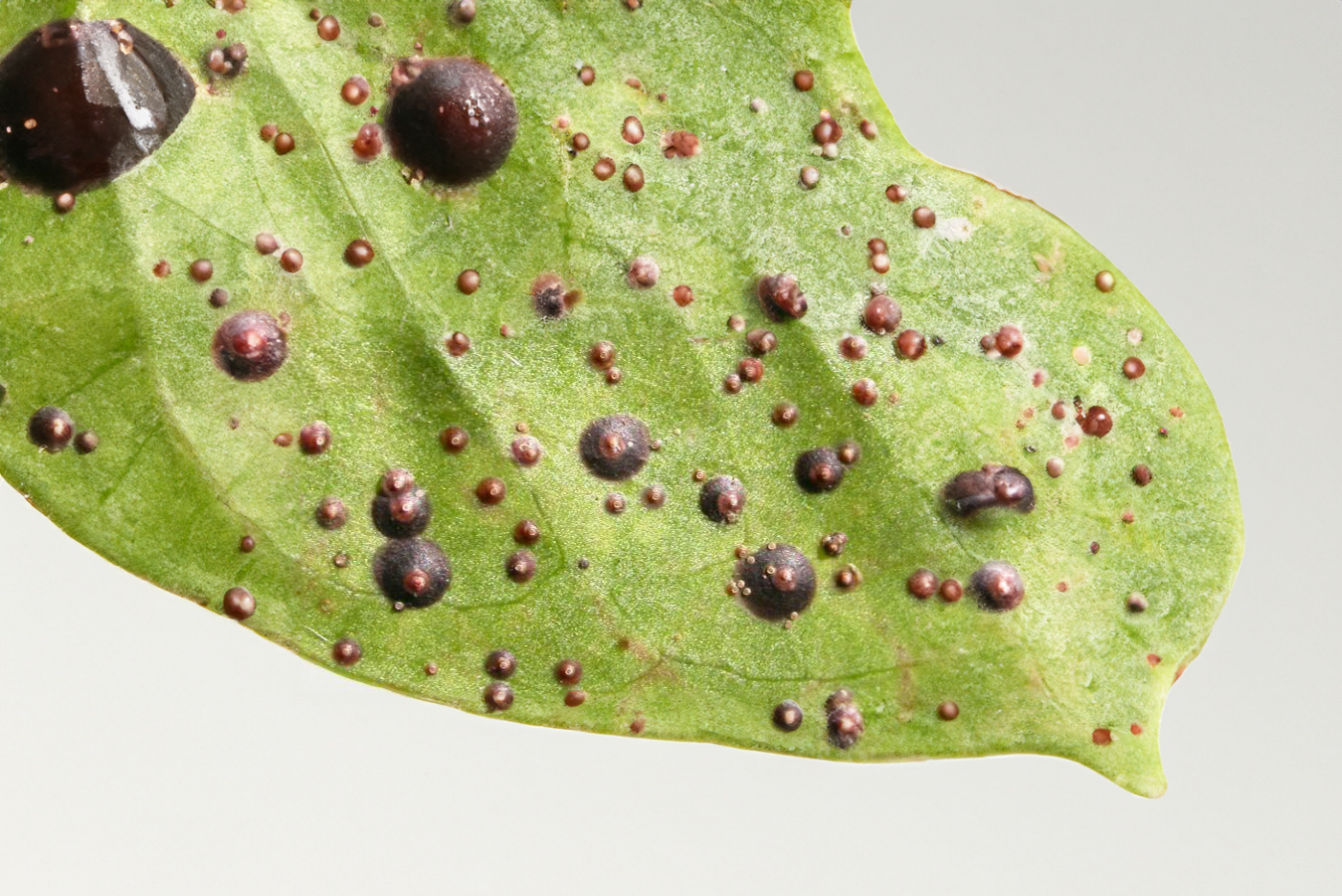
| Sticky residue, cottony clusters or fixed bumps | Leaf undersides, petiole bases and stems | Confirm aphids, mealybugs or scale before treatment |
| Small dark flies near the pot | Adults around persistently moist organic media; root vigor | Moisture management and fungus-gnat identification |
| Soft dark roots or stem base | Odor, poor drainage, collapsed mix, spreading lesions | Stop routine care and assess viable tissue |
UC IPM lists overlapping causes for yellowing and wilt, including roots, water, light, temperature, nutrition and pests. Confirm evidence before treating.
A 15-minute check order
- Isolate the plant if insects, mites or spreading spots are possible.
- Read the pot. Check weight, moisture at depth, drainage openings and standing water.
- Review the last two weeks. Note moves, heat, cold, watering, feeding, sprays and repotting.
- Inspect roots when evidence points below the surface. Wilting in wet media and a soft stem base are strong reasons to look.
- Inspect pests under magnification. Check both leaf surfaces, new growth, petiole bases and stems.
- Change the highest-confidence cause first. Photograph and date the response instead of stacking treatments.
Handle pests and disease with an identification step
UC Statewide IPM notes that care and environmental problems cause many houseplant symptoms, while mites, scale, mealybugs, aphids and fungus gnats can also occur. Isolate a suspect plant, remove heavily affected debris, clean tools and identify the organism before selecting a control. Water can remove some soft-bodied pests; insecticidal soap, horticultural oil or another pesticide should be labeled for indoor use, the target pest and the plant, and must be used exactly as directed.
Spreading soft rot, a foul odor, collapsing stems or extensive root loss is not a routine yellow-leaf problem. Separate the plant, remove contaminated material from the collection area and decide whether any firm, viable stem remains before trying to save it.
Propagate only from viable stem tissue
A leaf and petiole are not a dependable replacement for a stem cutting with a node and usable bud or growing point. The method also changes for a top cut, mid cut, water, airy medium or air layering. Use the Philodendron propagation guide for anatomy, method choice, transfer and rot prevention rather than treating propagation as a paragraph inside general care.
Frequently asked questions
How often should I water a Philodendron?
There is no safe universal interval. Check moisture below the surface, pot weight, light, temperature, container size, mix and root health. Water thoroughly when the root zone is ready and let the container drain.
Can a Philodendron live in low light?
Some solid-green vining types tolerate low light, but growth may slow and leaves or internodes can change. Most perform better in moderate to bright indirect light. Increase light gradually and read the new growth.
Why is my Philodendron yellowing?
Possible causes include wet or dry roots, poor drainage, a light or temperature change, root disease, fertilizer imbalance and sap-feeding pests. The location and timing of yellowing, root-zone condition and recent care history are more useful than color alone.
When should I repot?
Repot when the roots, mix or container no longer function well together—not because a calendar date arrived. Examples include crowding and instability, collapsed media, water bypassing the root ball, or drying so fast that normal care cannot keep up.
Where can I compare Philodendrons available to buy?
Use the live Philodendron collection for current formats, stock and transaction details. An editorial care guide should not copy changing price, availability or shipping promises.
Safety around children and pets
Philodendron tissue contains irritating calcium oxalate crystals. Keep plants and fresh cuttings out of reach, wash after handling sap and do not use a blog symptom list to manage an exposure. Contact a veterinarian, poison-control service or medical professional appropriate to the person or animal and location.

4 thoughts on “Philodendron Care: Light, Water & Problem Checks”