
Greenboog evidence-first collector hub
“Rare” can describe a restricted wild species, limited nursery supply, an uncommon cultivated phenotype or a temporary demand spike. Those are four different claims with different proof.
Scan name status and growth plan first; use the detailed sections to verify each choice.
| Name | Status used here | Collector feature | Growth plan |
|---|---|---|---|
| P. spiritus-sancti | Accepted species | Very long narrow mature blades | Vertical support; conservation-sensitive provenance |
| P. × joepii | Accepted natural hybrid | Unusual three-part silhouette | Support and room for mature leaves |
| P. billietiae | Accepted species | Long blades and orange petioles | Climbing support and horizontal clearance |
| ‘Florida Beauty’ | Documented cultivated hybrid | Lobed yellow/cream variegation | Climbing support; preserve green tissue |
| ‘Ring of Fire’ | Accepted cultivar name | Lobed leaves with changing warm colors | Compact/upright space; patient growth |
| Caramel Marble | Trade/cultivar label | Caramel, cream, yellow and green sectors | Verify exact plant and active growth point |
| Red Congo Variegated | Trade/cultivar label | Broad leaves, red stems, pale sectors | Upright display and identity check |
| Golden Dragon Variegated | Trade/cultivar label | Lobed foliage with yellow sectors | Support as the stem extends; verify lineage |
What does “rare Philodendron” actually mean?
At least four different ideas are often compressed into the word “rare”:
- Restricted in nature: a species has a narrow documented range or threatened populations.
- Limited in cultivation: few nurseries currently propagate or distribute it.
- Uncommon phenotype: one variegation pattern or color line occurs less often within cultivated stock.
- Temporary market scarcity: demand is growing faster than legal nursery supply at this moment.
These are not interchangeable. Tissue culture can make a once-expensive clone widely available without changing the condition of wild populations. Conversely, a threatened wild species can become inexpensive in cultivation. Always date a conservation assessment and compare current offers rather than repeating an old price range.
Species, hybrid, cultivar or trade label?
An accepted botanical species has a formally published name. A natural hybrid may also be formally recognized and written with a multiplication sign, as in Philodendron × joepii. A cultivar is a selected cultivated plant written in single quotation marks. A trade label can be useful in commerce but may not have published parentage or an authoritative registration trail.
The distinction changes what a buyer should request. Species identity can be checked against botanical descriptions and provenance; a variegated cultivar or selected line also needs evidence from the mother plant, stem and current growth point. A name on a pot is not enough for a premium purchase.
1. Philodendron spiritus-sancti
Philodendron spiritus-sancti is an accepted Brazilian species, naturally restricted to Espírito Santo. Mature plants develop exceptionally long, narrow blades, while juvenile and tissue-culture plants can be much less diagnostic.
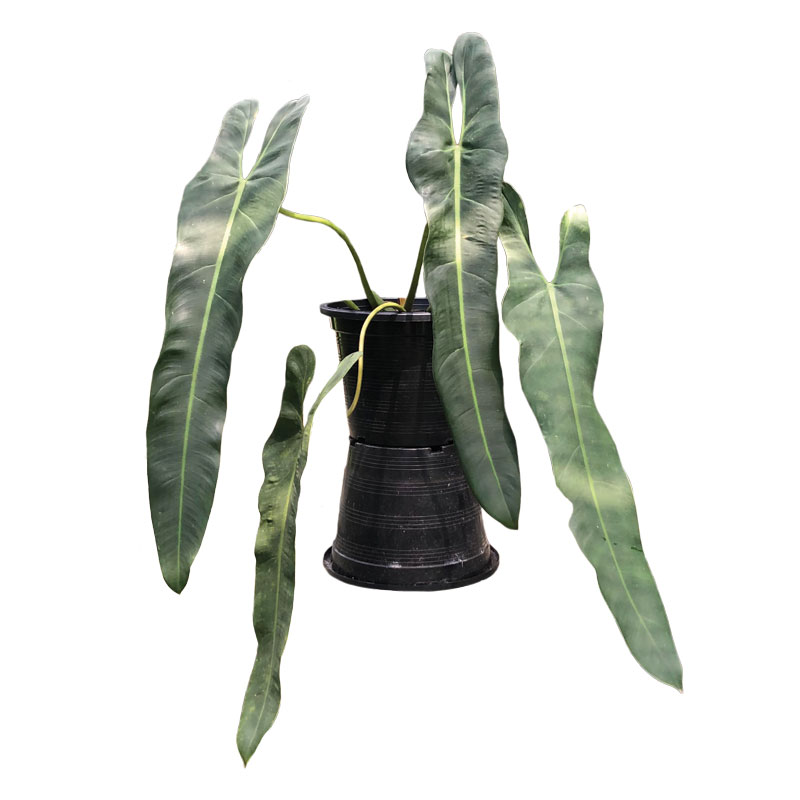
Buyer risk: conservation sensitivity and ambiguous juveniles. Require a documented cultivated source and avoid any seller implying freshly collected wild material. The dedicated Philodendron spiritus-sancti identity and conservation guide separates Brazil’s national/state assessments from the nonexistent IUCN listing claim.
2. Philodendron × joepii
Kew now accepts Philodendron × joepii as a natural hybrid from French Guiana, with the formula P. bipennifolium × P. pedatum. That multiplication sign matters: a listing that calls it a simple species is using outdated or incomplete taxonomy.
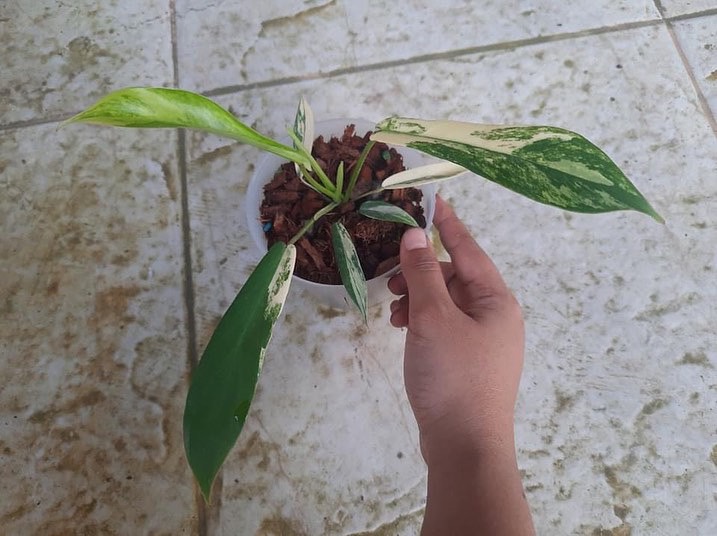
Buyer risk: a juvenile’s outline may not yet show the distinctive narrow waist and side lobes. “Variegated Joepii” is a cultivated phenotype layered on top of the hybrid identity; ask for mother-plant/batch evidence and actual growth-point photos.
3. Philodendron billietiae
Philodendron billietiae is an accepted climbing species native to the Guianas and northern Brazil. Collectors recognize the combination of elongated blades and orange petioles. The variegated form is a cultivated selection; the species itself is not “Philodendron billietiae variegata” as a separate botanical taxon.
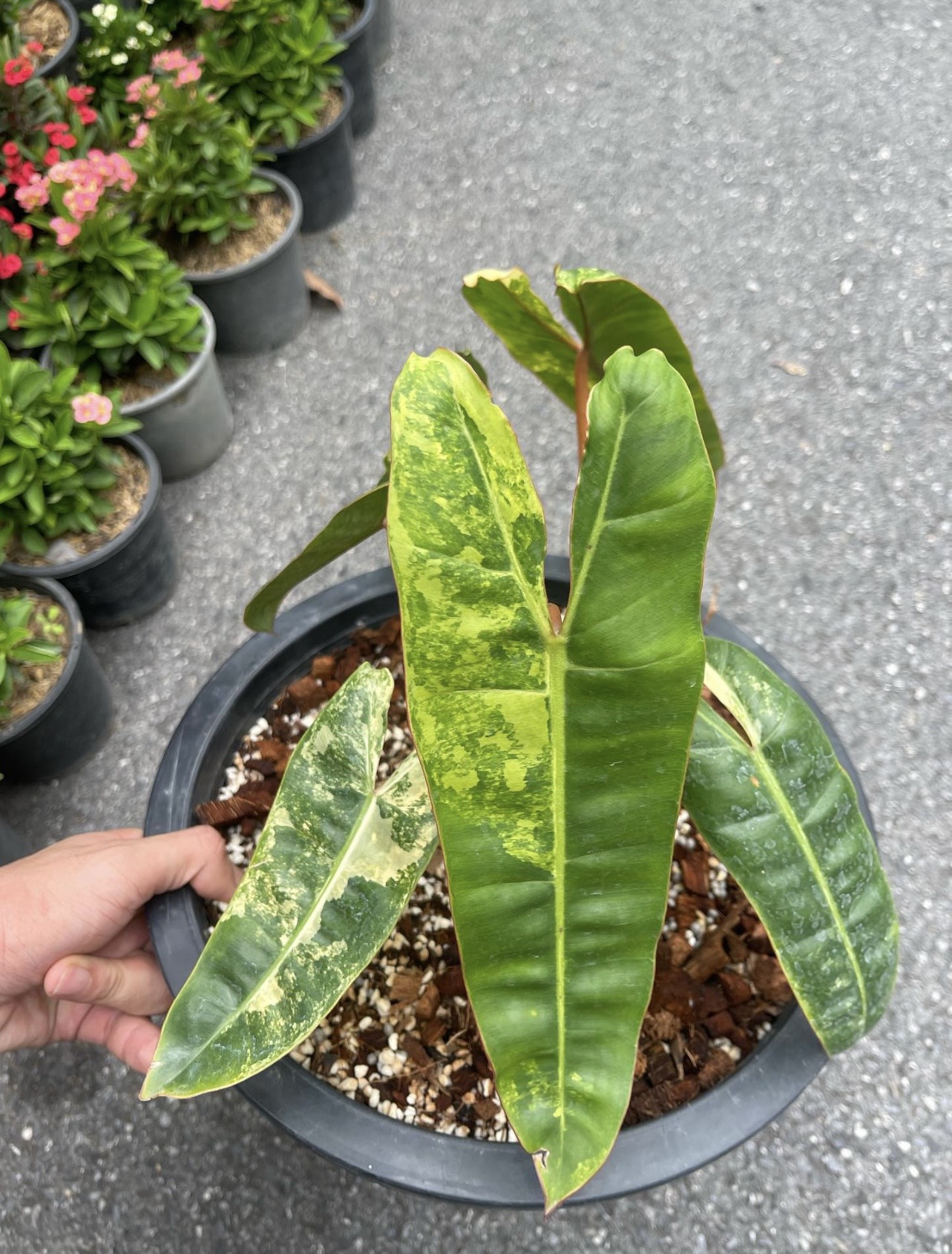
Buyer risk: paying for one highly patterned leaf without seeing the stem and active point. Plan both vertical support and lateral room—the leaf blades can extend far beyond the pot.
4. Philodendron ‘Florida Beauty’
The RHS profile describes ‘Florida Beauty’ as a cultivated hybrid of P. pedatum and P. squamiferum. Juvenile leaves can be spear-shaped; mature leaves become deeply divided. It is a climber, not a compact self-heading plant.
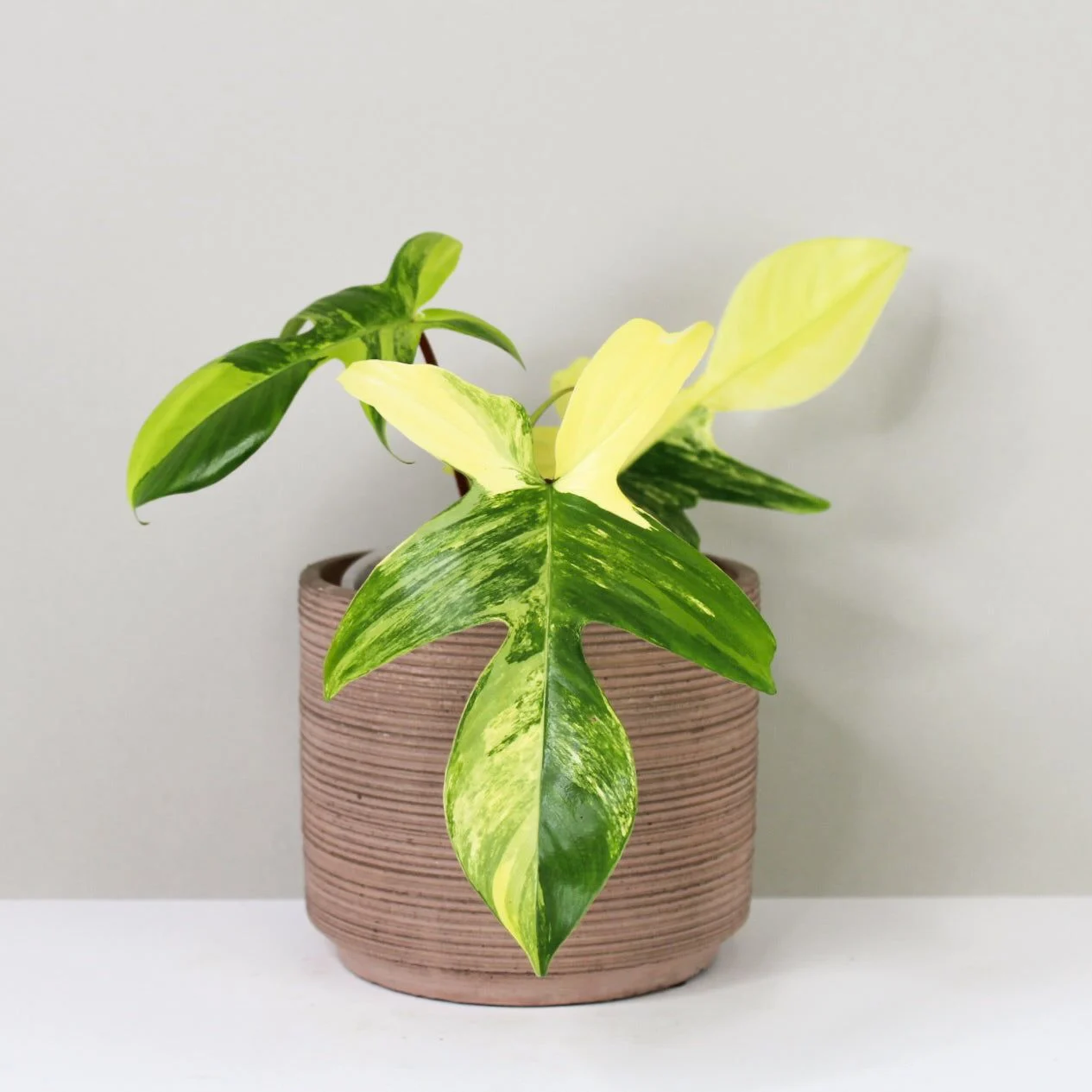
Buyer risk: confusing Florida Beauty with Green Form, Florida Ghost or a different pedatum-type hybrid. Compare the Florida Beauty identification and care guide, then request the exact plant, stem pattern and mature-source evidence.
5. Philodendron ‘Ring of Fire’
RHS accepts the name Philodendron ‘Ring of Fire’ and lists ‘Henderson’s Pride’ as a synonym. Its leaves become increasingly lobed, and emergent foliage may open cream, yellow, copper or orange before changing as it hardens.
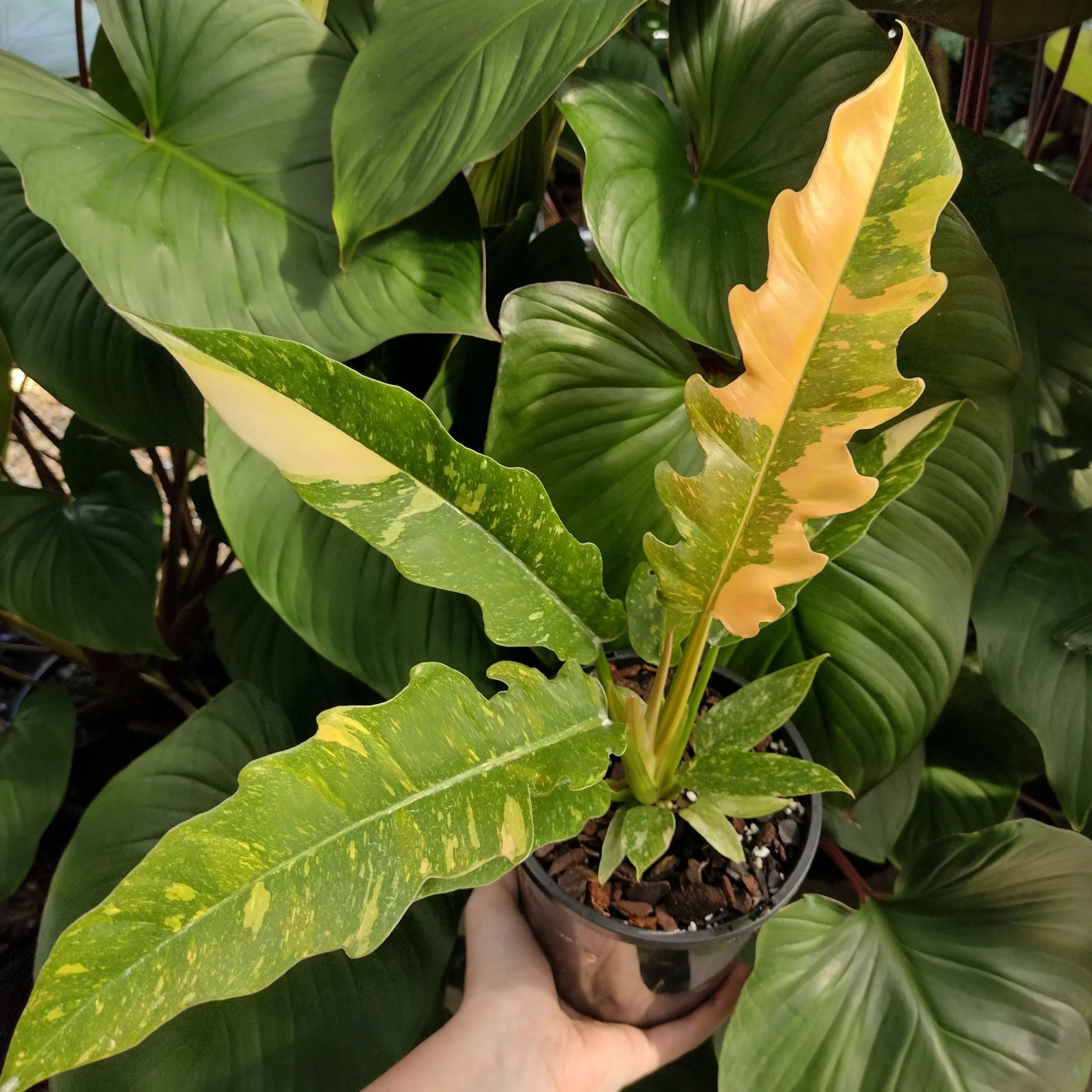
Buyer risk: assuming every warm-colored lobed Philodendron shares the same name or that extra light can manufacture variegation. The Ring of Fire variegation and care guide explains color change, reversion evidence and condition-based care.
6. Philodendron Caramel Marble
Caramel Marble is used in the collector trade for plants with divided foliage and a shifting mix of green, cream, yellow and caramel sectors. Unlike the species above, this article does not assign it a native range or unverified hybrid parents. Treat the label as a cultivated identity that needs a lineage trail.
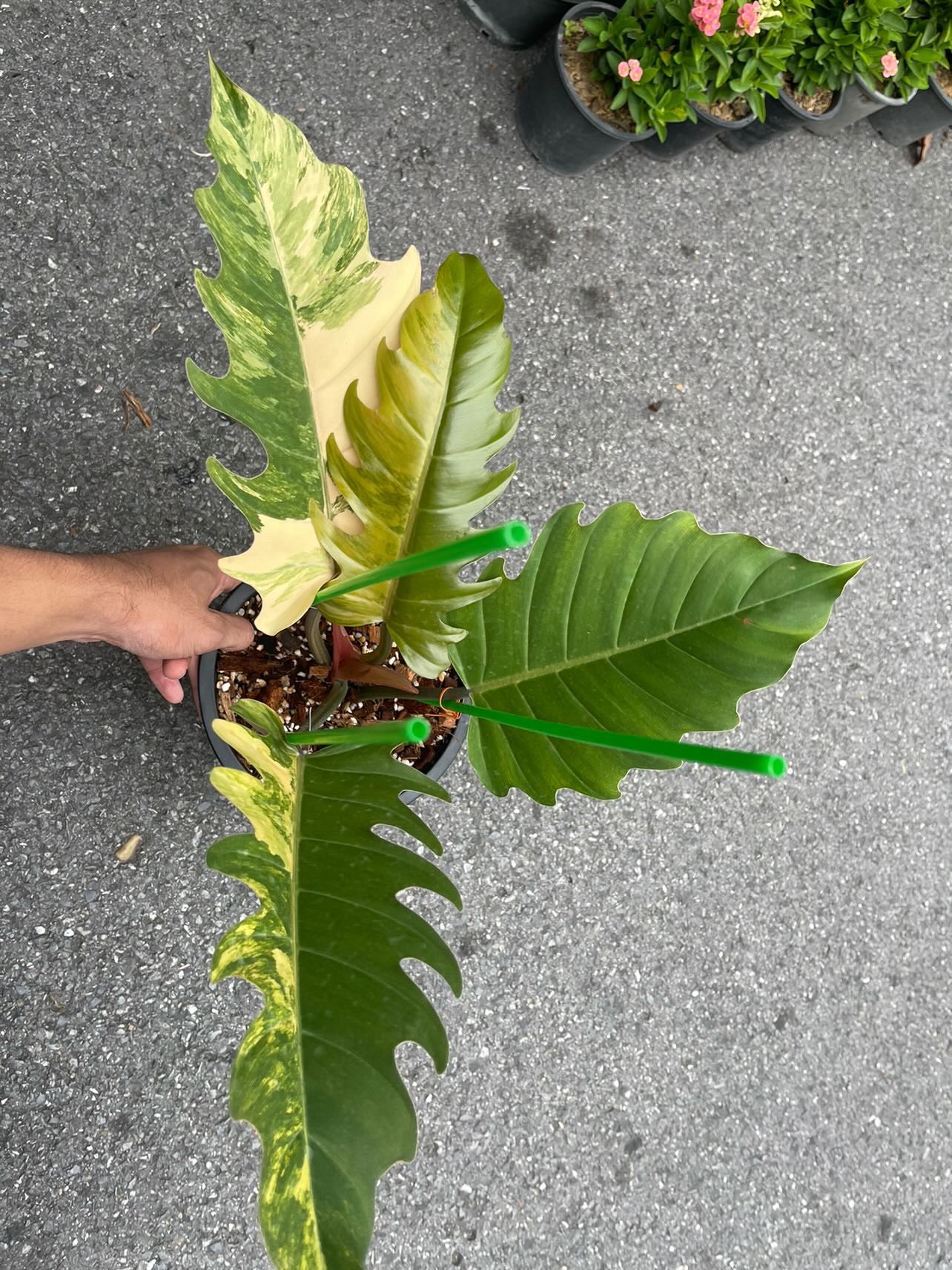
Buyer risk: confusing temporary emergent color, stress yellowing or another lobed variegated hybrid with a documented Caramel Marble line. Ask for the mother/source plant, several hardened leaves, stem pattern, roots and exact-plant video.
7. Philodendron Red Congo Variegated
Red Congo Variegated is a commercial cultivar label used for upright plants with broad leaves, red-toned petioles/stems and pale or yellow sectors. It should not be presented as a wild species with a rainforest origin. Similar “Congo,” “Imperial” and “Princess” names make source documentation especially important.
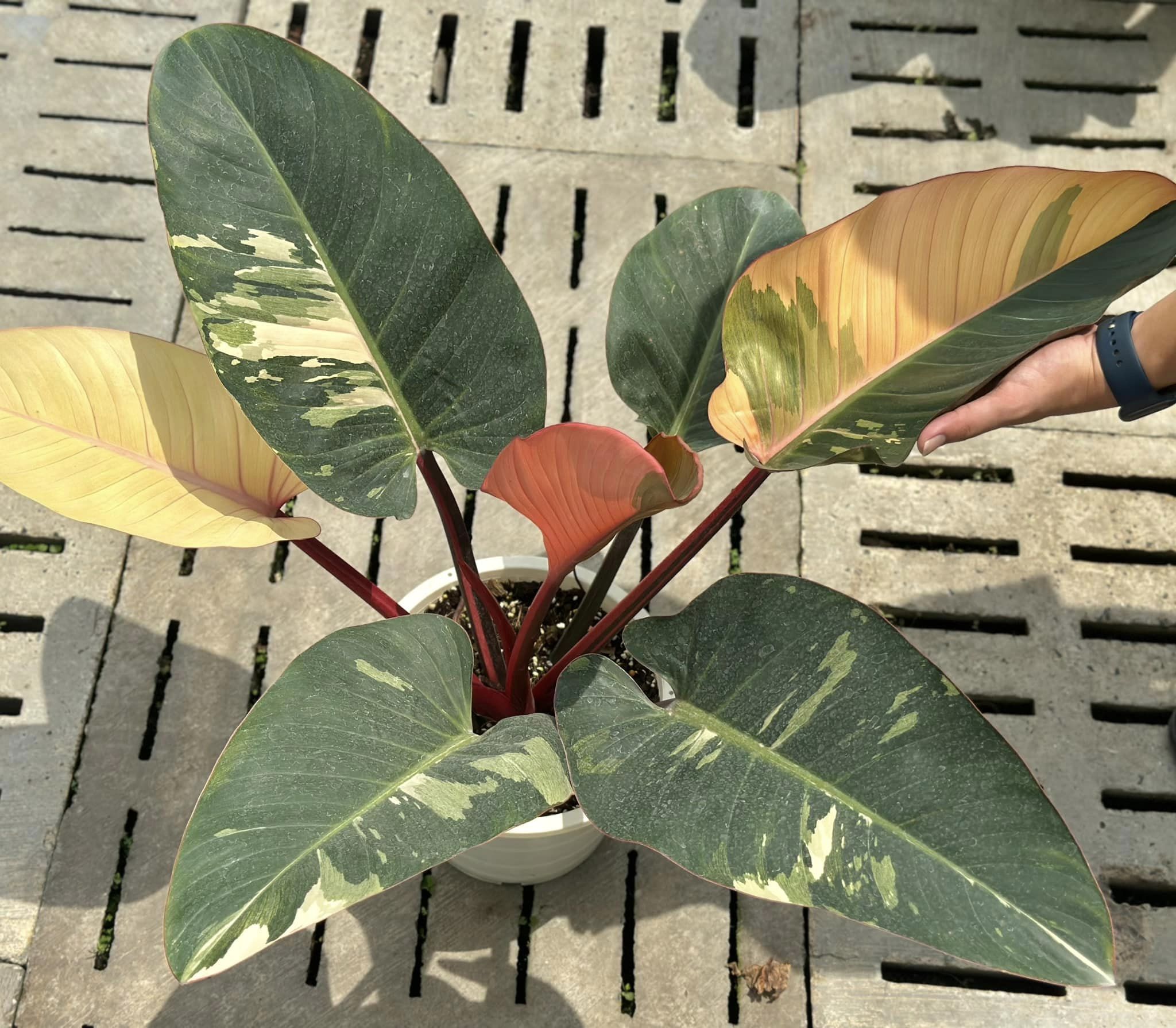
Buyer risk: purchasing from one close-up leaf photo. Request the entire growth habit, petioles, newest hardened leaf and roots. A chemically induced pink flush or damaged leaf is not stable variegation evidence.
8. Philodendron Golden Dragon Variegated
Golden Dragon Variegated is another collector trade/cultivar label, typically applied to plants with large lobed foliage and bright yellow sectors. The dramatic mature outline is more useful than a tiny tissue-culture leaf, but a seller should still provide the cultivated source because several lobed Philodendron lines look similar when young.
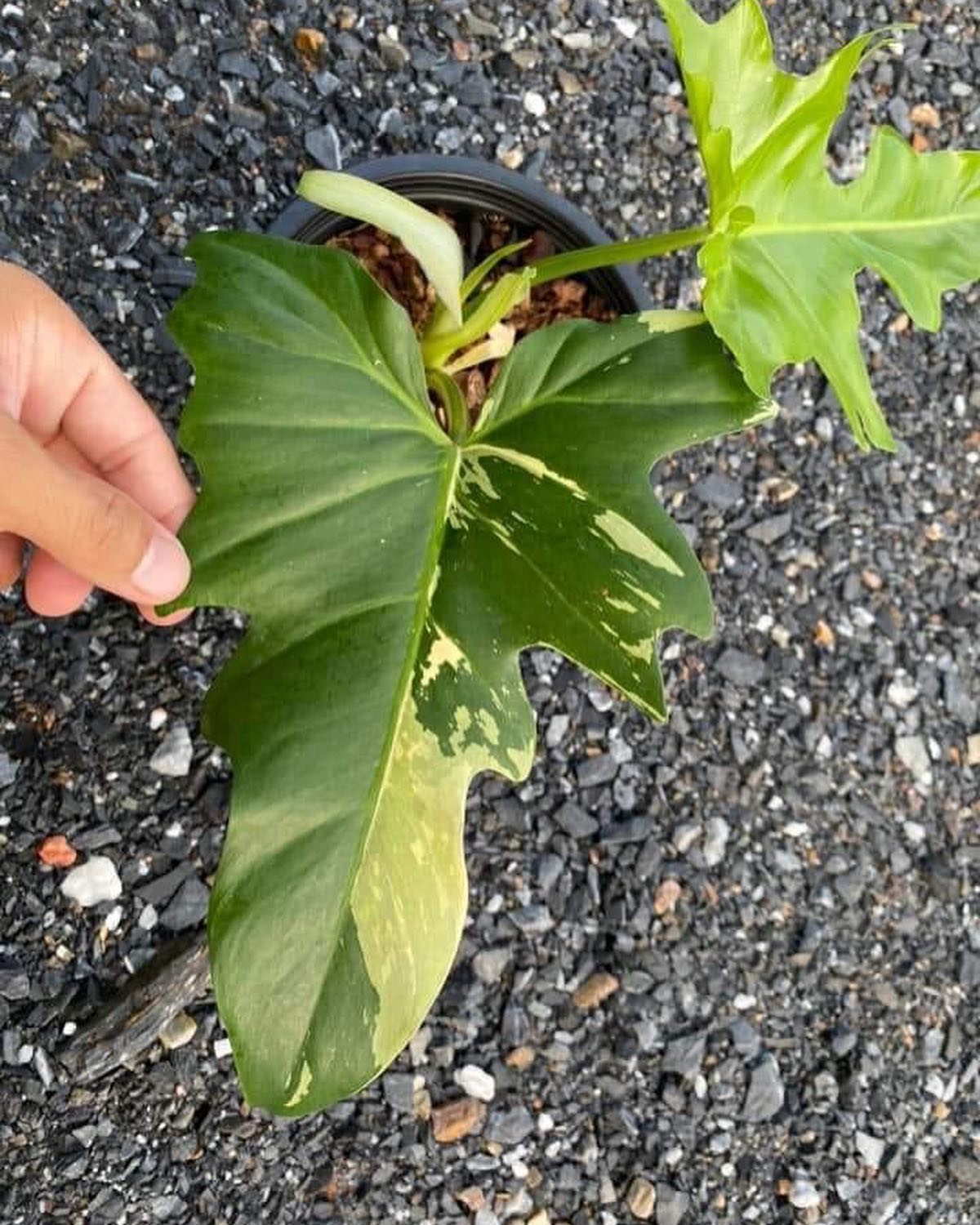
Buyer risk: a vague name attached to an unacclimated plantlet. Ask whether the image is the exact plant, a batch example or only a mature reference; then price those formats separately.
Which collector Philodendron fits your space?
Choose the constraint you can support, not only the leaf you like today.
| Your priority | Start by comparing | Constraint to accept |
|---|---|---|
| Botanical story | Spiritus Sancti, Joepii, Billietiae | Identity/provenance matters more than variegation alone |
| Climbing lobed display | Florida Beauty, Golden Dragon | Needs vertical support and mature space |
| Warm multicolor foliage | Ring of Fire, Caramel Marble | Emergent colors change; pattern varies by growth point |
| Upright broad-leaf display | Red Congo Variegated | Trade-name confusion and exact-plant evidence |
| Small starting format | Tissue-culture offerings | Juvenile identity, acclimation and batch-level photos |
Compare labels and changing foliage
- Use the Philodendron Birkin guide for pinstriping, unstable sectors and Rojo Congo context.
- Use the Philodendron camposportoanum guide when juvenile and mature leaves look dramatically different.
- Compare emerging red colour in the Cherry Red guide without assuming every red new leaf keeps the same mature colour.
- Check climbing form and sector evidence in the variegated Philodendron domesticum guide.
- Separate a generic market label from a named cultivar with the variegated heartleaf Philodendron guide.
- Keep a toothed compact crown distinct from similarly marketed plants with the Jungle Boogie guide.
Premium-plant buying checklist
- Normalize the name: species, natural hybrid, cultivar or trade label?
- Identify the image: exact plant, representative batch or mother/reference only?
- Inspect the growth point: does current stem tissue support the advertised phenotype?
- Inspect health: recent roots, pests, rot, leaf damage and active growth.
- Confirm format: flask, recently deflasked plantlet, rooted cutting or established potted plant.
- Document provenance: nursery/lab/batch, invoice and seller statements.
- Calculate landed cost: plant + packing + shipping + documents/tax + expected acclimation risk.
- Check import rules: destination requirements before paying; US buyers can start with USDA APHIS online-plant guidance.
Browse Greenboog’s current Philodendron catalog only after deciding which growth habit and evidence standard fit you. Availability, price and seller labels are live catalog data; they should not be copied into a static guide as permanent facts.
Care principles after purchase
- Light: bright filtered light is a sensible starting point; acclimate before stronger exposure and protect pale sectors from scorch.
- Water: inspect the root zone and pot weight; water through when the upper mix has dried somewhat, then drain fully.
- Roots: use a clean, airy, moisture-balanced mix and a pot only modestly larger than the root mass.
- Support: give climbing types a board/pole early; do not force compact self-heading forms to trail.
- Arrival: quarantine, inspect pests/roots and avoid stacking repotting, feeding and pruning on the same stressed day.
- Variegation: preserve enough green tissue for growth; one green or pale leaf is not a pruning command.
Philodendrons contain calcium oxalate crystals and are not pet-safe if chewed. Keep plants and propagation debris away from children and animals; contact a veterinarian or poison-control service for an exposure.
FAQ
What is the rarest Philodendron?
There is no timeless single answer. Wild conservation rarity, cultivated supply and the price of one variegated clone are different measures. State which measure and date you mean.
Is every variegated Philodendron rare?
No. Tissue culture and nursery propagation can make some variegated lines widely available. Judge the exact plant, phenotype stability, supply and provenance rather than the word “rare.”
Is Philodendron joepii a species?
Kew accepts it as Philodendron × joepii, a natural hybrid of P. bipennifolium and P. pedatum.
Can a juvenile photo confirm a rare Philodendron?
Often not by itself. Mature leaf shape may be absent in plantlets, and multiple cultivars can look similar when young. Combine batch/source history with current roots, stem, growth point and mature-source photos.
Does a high price prove a plant is rare?
No. Price also reflects hype, shipping, plant size, seller risk, location and temporary supply. Compare same-week like-for-like offers and calculate landed cost.

I have many and I love them all. Glad to find this site.