Greenboog taxonomy-first rare-aroid guide
This guide separates current evidence from collector folklore. Every conservation label is dated because an old botanical note, a national assessment, a state list and an IUCN Red List evaluation are not interchangeable.
Read each status with its geography and publication date.
| Question | Evidence-based answer |
|---|---|
| Accepted name | Philodendron spiritus-sancti G.S.Bunting |
| Native range | Espírito Santo state in southeastern Brazil |
| Growth habit | A climbing aroid; field records include hemiepiphytic and rock-growing plants |
| National status | Endangered (EN), CNCFlora assessment published in 2012 |
| State status | Critically Endangered in Espírito Santo, as reported by researchers in 2024 |
| IUCN Red List | Not evaluated as of the 2024 field report |
| Buyer safeguard | Traceable cultivated origin plus actual-plant or batch evidence |
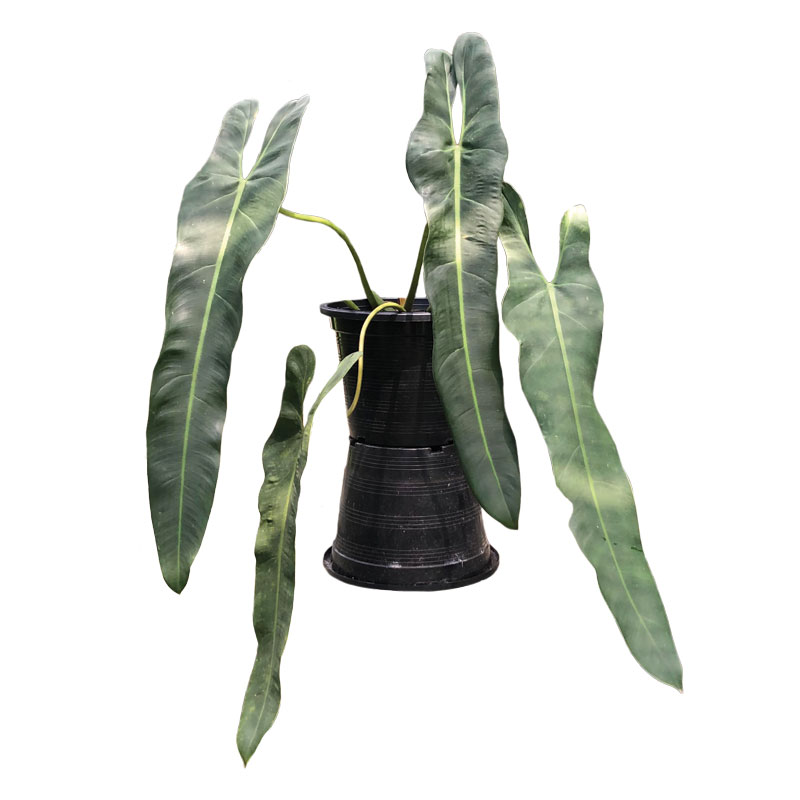
What is Philodendron spiritus-sancti?
Philodendron spiritus-sancti G.S.Bunting is an accepted species in the aroid family, Araceae. George Bunting formally published the name in 1987. Kew records it as a climber from the wet tropical biome of Espírito Santo in southeastern Brazil.
The species name connects it with Espírito Santo, the Brazilian state where the type material was collected. The Latin words can be translated as “Holy Spirit,” but there is no need to invent stories about ghostly leaves, flames or black pigment to explain the name.
The old claim that this species belongs to Philodendron subgenus Meconostigma is also wrong. The taxonomic treatment linked by Kew places it in Philodendron section Macrobelium. Familiar collector names do not override a botanical description.
How to identify a mature plant
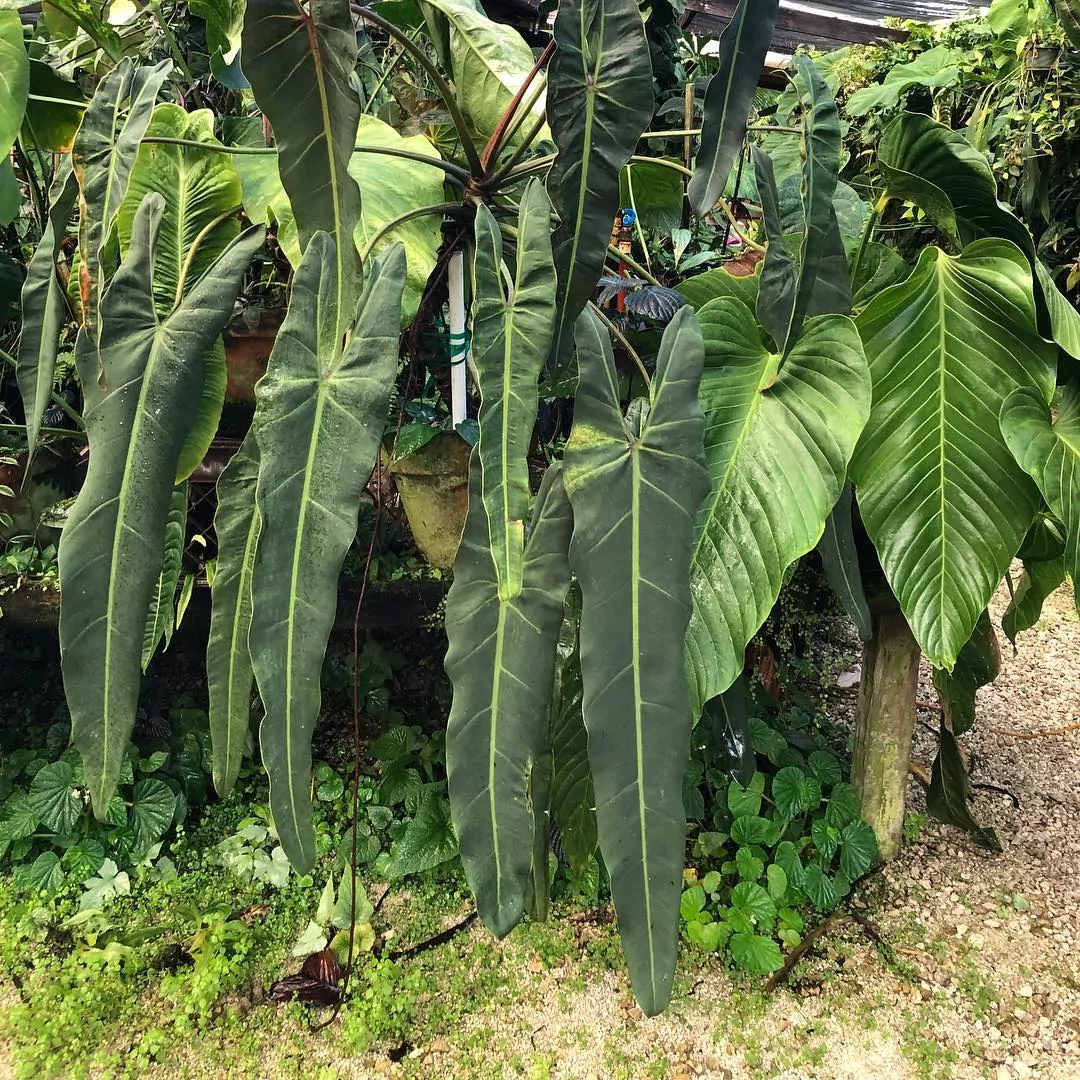
A mature P. spiritus-sancti is recognized by proportion, not by one color cue. Kew’s description, based on the 2005 taxonomic revision, reports a long triangular leaf blade with a cordate-sagittate base. The front division is at least four times longer than the rear divisions, which have relatively straight lobes. The lower blade surface is paler and the margin can be wine-colored.
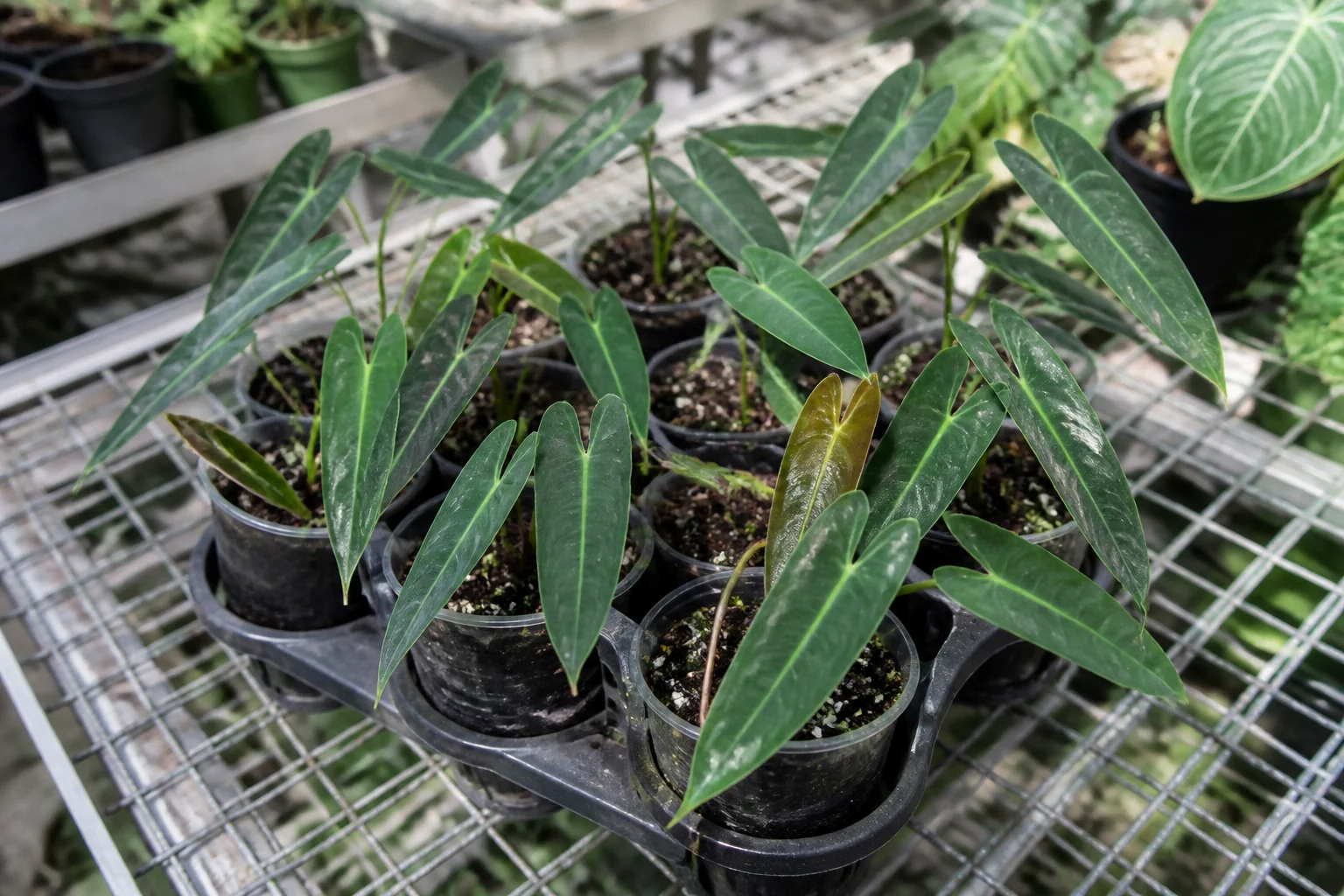
Those characters are most useful on mature foliage. A juvenile, recently deflasked plant may have shorter, broader or simpler leaves, so a tiny plant cannot be authenticated from leaf shape alone. Likewise, dark veins, a red petiole or one unusually narrow leaf is not a species diagnosis.
Identity checklist for a listing
- Ask what is pictured: the exact plant, a representative batch or only a mature mother plant.
- Ask for source history: seed, cutting or tissue culture, and which documented cultivated parent or laboratory batch it came from.
- Inspect plant structure: a healthy stem or plantlet, viable growth point and roots—not a leaf-only cutting.
- Compare mature evidence: request photos of the source plant when the juvenile features are not diagnostic.
- Treat variegation separately: a variegated label describes a cultivated phenotype; it does not prove species identity or make it a separate wild species.
No seller photograph can replace expert botanical determination where scientific certainty matters. For an expensive or conservation-sensitive purchase, preserve the invoice, batch information and seller correspondence with the plant record.
Where does it grow in nature?
The natural range is the Atlantic Forest of Espírito Santo, Brazil. It is not native to the upper Amazon of Ecuador and Peru, as older versions of this page claimed. The 2005 revision described a hemiepiphytic vine from tropical forest near the type locality, but later field evidence expanded that picture.
In February 2024, Brazilian researchers confirmed a population inside Monumento Natural da Serra das Torres, a protected area. Their Oryx field report placed it 128 km from previously known records and documented at least 50 well-developed plants plus many seedlings. Some grew directly on a rocky wall, showing that the species is not limited to a high-canopy hemiepiphytic habit.
That discovery is encouraging, but it does not make the species common. A newly confirmed population can expand scientific knowledge while still requiring strict protection. Exact wild locations should not be turned into collecting directions.
How rare is Philodendron spiritus-sancti?
“Rare” needs a reference point. A plant can become more available in laboratories and collections while remaining highly restricted in nature.
- Brazilian national assessment: CNCFlora assessed the species as Endangered (EN) in 2012, citing its limited range and habitat loss.
- Espírito Santo: the 2024 Oryx researchers report it as Critically Endangered at state level.
- Global IUCN Red List: the same 2024 report explicitly says the species had not been evaluated. It is therefore inaccurate to call it “IUCN Endangered.”
- Older botanical text: Kew reproduces an older Data Deficient assessment from the 2005 revision. That historic text and the later Brazilian lists answer different questions at different dates.
The main documented pressures are restricted distribution, Atlantic Forest habitat loss and overcollection. In 2021, Brazil’s environmental authorities intercepted 28 specimens being trafficked abroad; the Rio de Janeiro Botanical Garden’s official account states that collection and trade of the threatened native species require authorization in Brazil.
Does tissue culture solve the conservation problem?
Tissue culture can produce many cultivated plants without repeatedly taking material from wild populations. A more accessible legal supply may reduce some collector pressure, and uniform young plantlets can be shipped efficiently.
It is not the same as conserving a species in nature. A commercial batch may represent limited genetic diversity, and a plant in a cabinet does not protect habitat, pollination, population structure or ecological relationships. Tissue culture is a propagation route; in-situ protection, enforcement, documented ex-situ collections and scientific fieldwork remain separate conservation work.
How to buy a responsibly sourced plant
A premium price is not provenance. Before paying, get answers that remain useful after the listing disappears.
Ask for evidence that survives after the listing disappears.
| Ask the seller | Useful evidence | Warning sign |
|---|---|---|
| Where did this plant originate? | Named cultivated parent, nursery or tissue-culture batch | “Rare wild form” with no legal documentation |
| What will I receive? | Exact-plant photos or a clearly defined batch and size grade | Only a mature reference photo |
| What is its current state? | Recent roots, growth point, leaf and container photos | Old photos or concealed roots |
| Green or variegated? | Current plant photos and a careful phenotype description | Price premium based only on a label |
| What documents travel with it? | Invoice, phytosanitary certificate and destination-required permits | A promise to misdeclare or hide the plant |
For a clearly separated commercial option, Greenboog lists a green tissue-culture P. spiritus-sancti and a distinct variegated tissue-culture listing. Product pages, not this species guide, should carry current stock, price, batch and shipment details. Verify those details at the time of purchase.
Rules depend on origin, destination, species, size and shipment method. For United States orders, start with the current USDA APHIS guidance for buying plants and seeds online before ordering; most plants for planting require conditions specified by a PPQ 587 permit. Buyers elsewhere should check their own plant-health authority rather than copying another country’s requirements.
What about price?
There is no durable “correct” price for this species. Cultivated supply, plant size, root condition, variegation stability, seller location, documents and landed shipping cost all change the comparison. A fixed price range becomes stale quickly and can reward a rare-sounding label rather than a healthy, traceable plant.
Compare offers from the same week and normalize them:
Landed cost = plant price + packing + shipping + permit/certificate fees + taxes + expected loss risk.
Then compare like with like: flask versus acclimated plant, green versus variegated, exact plant versus representative batch, and domestic versus international delivery.
Care without mixing search intent
This page owns identity and conservation, not a second full care tutorial. Once you have a correctly identified cultivated plant, use the dedicated Philodendron spiritus-sancti care guide for light, root-zone, climbing support, watering and troubleshooting.
For a newly arrived tissue-culture plant, do not copy conditions from a mature specimen. Confirm whether it is still in sterile medium, recently deflasked or already acclimated. Transition humidity, airflow and root-zone moisture according to its current stage rather than a fixed calendar.
Common claims, checked
- “It comes from Ecuador and Peru.” False. Authoritative records place the native range in Espírito Santo, Brazil.
- “It is IUCN Endangered.” False as stated. The 2024 field report says it had not been evaluated for the IUCN Red List; EN is the dated Brazilian national assessment.
- “Black leaf veins are anthocyanin camouflage.” Unsupported. This is not a diagnostic claim in the botanical treatment.
- “Every narrow juvenile is spiritus-sancti.” False. Juvenile form can be ambiguous; provenance and mature-source evidence matter.
- “Tissue culture means conservation.” Incomplete. It can provide cultivated supply, but it does not replace wild-population and habitat conservation.

FAQ
Is Philodendron spiritus-sancti extinct in the wild?
No. Multiple natural populations have been documented, including a protected-area population confirmed in February 2024. The species remains threatened and naturally restricted.
Is it native to Ecuador?
No. Kew accepts Espírito Santo in southeastern Brazil as its native range.
Is Philodendron spiritus-sancti on the IUCN Red List?
The 2024 Oryx report states that it had not yet been evaluated for the IUCN Red List. Do not confuse this with Brazil’s 2012 Endangered assessment or Espírito Santo’s state-level Critically Endangered status.
Can I identify a tissue-culture plantlet from one leaf?
Usually not with confidence. Ask for the laboratory batch or cultivated-parent history and compare mature source material; juvenile leaves may not yet show diagnostic proportions.
Is a variegated Spiritus Sancti a separate species?
No. Variegation is a phenotype within cultivated material, not a separate botanical species. Its stability and pattern must be evaluated on the actual plant or batch.
Does buying a tissue-culture plant fund conservation?
Not automatically. It may support cultivated supply and reduce demand for field collection, but only a seller’s documented conservation partnership or donation supports that financial claim.
Sources and evidence boundaries
- Kew POWO: accepted name, native range and mature diagnostic treatment
- CNCFlora/JBRJ: 2012 Brazilian national Endangered assessment
- Oryx 2024: protected-area population, range extension and growth-habit evidence
- Brazilian INMA 2026: illegal extraction and Espírito Santo endemism
- USDA APHIS: current U.S. plant-import workflow