Philodendron care by growth stage
Care for Philodendron spiritus-sancti by reading its stage, stem, roots and room. A newly acclimatized seedling and an established climbing plant should not receive the same pot, support or watering interval.

Start with stage, not rarity
Kew accepts P. spiritus-sancti as a species from Espírito Santo, Brazil, and describes it as a hemi-epiphytic vine. A 2024 Oryx field record expanded the known picture: a protected population included rock-growing plants and both narrow and broad leaves. The habitat is evidence, not a room recipe.
Use the rarity, identity and responsible-buying guide for conservation and provenance. Here, the first care question is whether the plant is still acclimatizing, is a rooted juvenile, or has enough stem and leaf mass to behave as an established climber.
| Stage | Priority | Avoid |
|---|---|---|
| Recently potted plantlet | Stable humidity-to-room transition, gentle light and active-root evidence. | Immediate repotting, strong sun or established-plant dry-down. |
| Rooted juvenile | Small stable pot, airy moisture, gradual light and stem observation. | Oversized pot and fixed high-humidity dependence. |
| Established climber | Close support, larger root volume, usable light and condition-led feeding. | Unsecured top-heavy growth and pruning aerial roots for neatness. |
Give the stem a path upward
The long blades become leverage as the plant develops. Place a firm plank, pole or other support near the stem before it leans away from the pot. Support the stem before the leaves become leverage. Tie the stem loosely and leave petioles free to orient each blade toward light.
Do not prune aerial roots simply because they look untidy. Guide useful roots toward support or substrate where practical. If the plant repeatedly leans, inspect light direction, stem-to-support contact and pot stability before cutting it back.
Do not stress a plant to change leaf shape
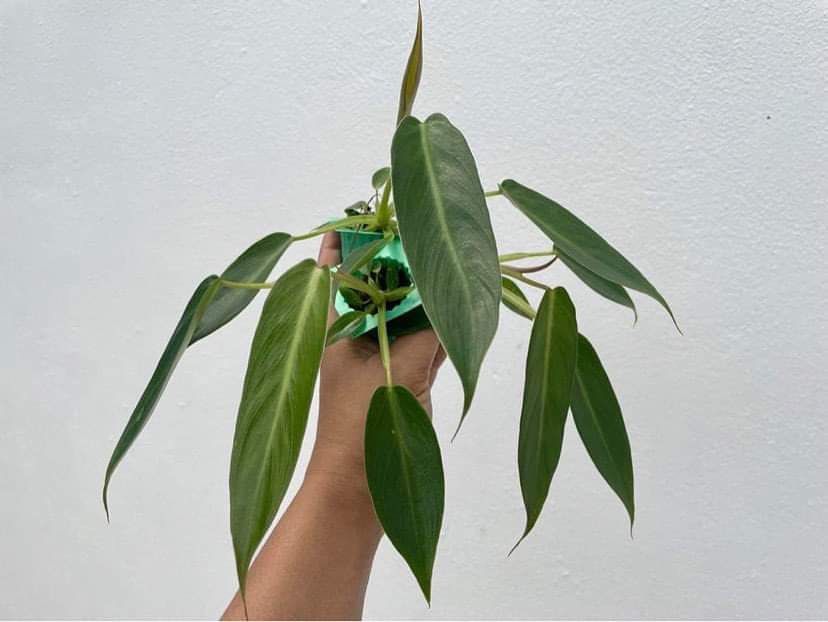
Kew notes that cultivated leaves may be shorter and broader than the published wild description. Oryx documented a natural narrow-to-broad gradient within one population. Leaf width is not a care score. Genetics, age, support, root function and environment can all influence expression; withholding water or overlighting a plant will not create a more authentic specimen.
Balance light, warmth and root oxygen
RHS guidance for Philodendron favours bright indirect light and warm indoor conditions. Move toward stronger exposure in steps and judge new leaves, internode spacing and water use. Hot direct sun can scorch; dim conditions slow growth and extend the time a pot remains wet.
Use a moisture-retentive but well-drained mix with coarse bark plus water-holding and mineral-aeration components. Check below the decorative surface and lift the pot. Water thoroughly when the upper root zone has dried somewhat and the pot is lighter, then drain completely. Pot volume, root mass, light, temperature and airflow determine the next interval.
Feed lightly only during active rooted growth. Humidity can help a transition or reduce edge stress, but a humid room does not rescue oxygen-poor roots. Avoid universal percentages and keep gentle airflow without cold or hot drafts.
Diagnose a pattern before applying a fix
| Pattern | Check first | Measured response |
|---|---|---|
| Droop with wet mix | Roots, drainage, pot size, temperature and recent repotting. | Restore warmth and oxygen; remove only confirmed rot. |
| Brown tip or margin | Root moisture history, salts, sun, mechanical damage and airflow. | Correct the observed cause; do not assume humidity alone. |
| Small leaves and long internodes | Usable light, support contact, roots and active-growth nutrition. | Increase light gradually and improve support before feeding more. |
| Yellowing older leaf | Whether isolated/age-related or spreading with root symptoms. | Preserve healthy tissue and act on the pattern, not one leaf. |
Propagate with a viable node and provenance record
A node is required for a complete new plant. Map the stem, growth point and aerial roots before cutting; a leaf and petiole alone will not regenerate a complete Philodendron. Avoid fixed rooting-time promises and use the Philodendron propagation guide for method choices.
- Keep source, supplier and propagation records with the plant.
- Photograph the whole plant and growth point before cutting.
- Use a clean tool and preserve enough leaf area for recovery.
- Move to a larger pot only when root volume and water use justify it.
- Never imply that cultivated ownership supports wild collection.
Philodendron contains calcium oxalate. Keep foliage away from chewing children and pets, wear gloves while cutting and seek appropriate medical or veterinary guidance for mouth swelling, drooling or difficulty swallowing.