
Greenboog provenance-first care guide
Identity starts with architecture and records; care starts with roots and recent growth. Neither a seller label nor one dramatic leaf should override the whole plant.
Use this before diagnosing, pruning or selecting a product format.
| Question | Evidence-led answer |
|---|---|
| Species or hybrid? | Commercial variegated hybrid/trade line; do not assign wild species or parentage without records |
| Congo or Rojo Congo? | Documented `Congo` and `Rojo Congo` are distinct cultivars; a Green Congo label alone proves neither |
| Growth habit | Self-heading, upright and short-stemmed—not trailing or moss-pole dependent |
| Leaf pattern | Irregular lime/yellow-green marbling and sectors in Greenboog’s photographed stock; batches vary |
| Light and water | Bright diffused light; water after partial upper-zone drying and drain completely |
| Pet-safe? | No; Philodendron contains irritating insoluble calcium oxalates |
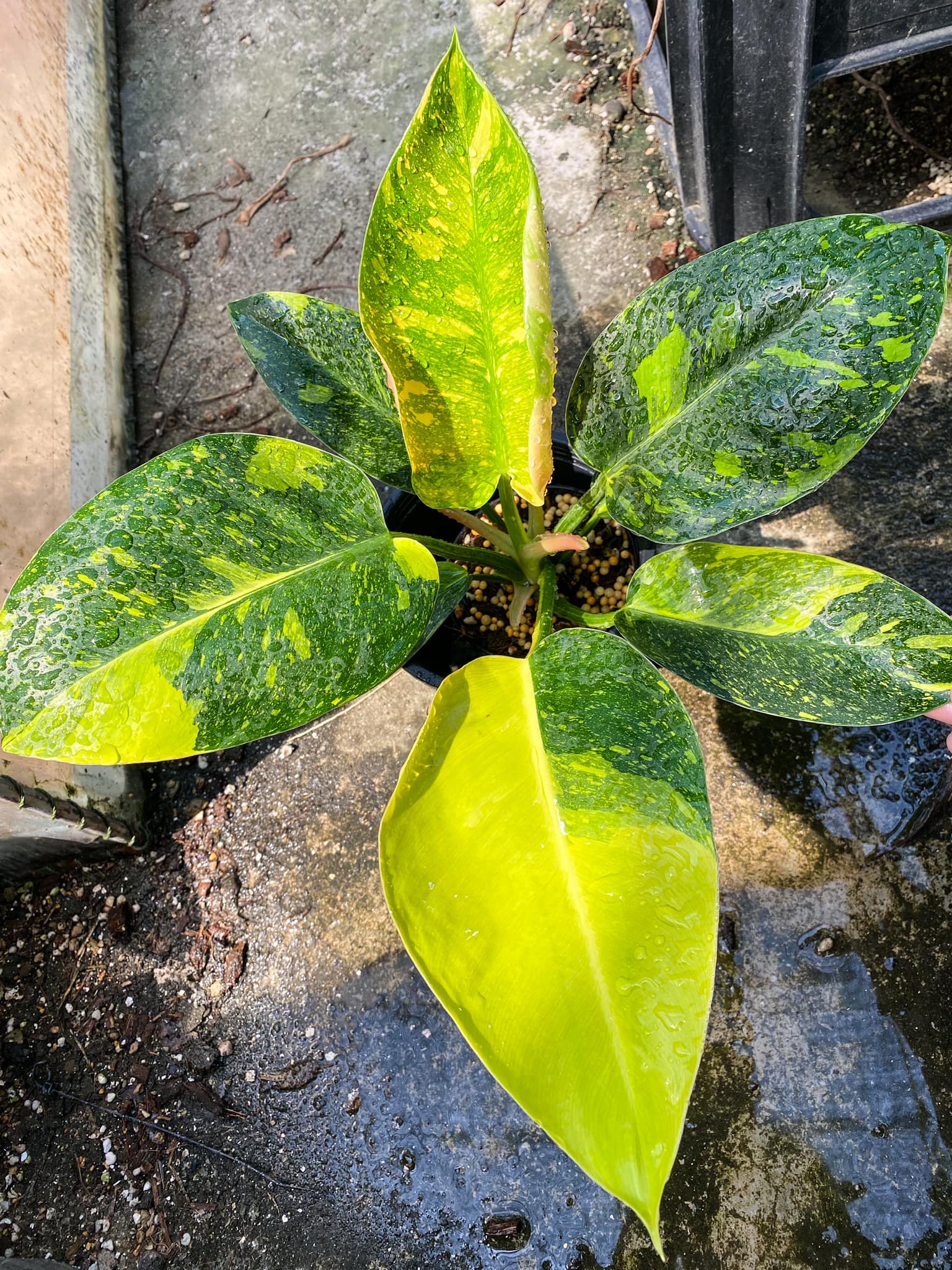
What is Philodendron Green Congo Variegated?
The safest identity is the commercial one on the propagated line: Philodendron Green Congo Hybrid Variegated. It describes a self-heading plant sold with irregular green-and-lighter variegation. It does not establish a naturally occurring species, native country, breeder, parent cross or formal cultivar registration.
The distinction is not pedantic. The Royal Horticultural Society recognizes Philodendron `Congo` as an accepted horticultural name. U.S. Plant Patent 11,724 describes `Congo` as a self-heading, non-vining cultivar with green petioles and thick glossy green leaves. A separate patent describes `Rojo Congo` as a distinct hybrid cultivar with darker purple-brown petioles and brown-maroon young leaves, and explicitly compares it with `Congo`.
Therefore the old phrase “a cultivar of the Congo Rojo philodendron species” fails twice: Rojo Congo is a cultivar, not a species, and the two documented Congo names are distinct. Greenboog’s exact variegated stock may have a commercial propagation history, but this article will not invent a bridge to either patent without batch records.
What do Green Congo “Hybrid” and “Nuclear” mean?
“Hybrid” is an appropriate high-level description when parentage is undocumented to the buyer. “Nuclear” appears in search and trade language for strongly mottled lime/yellow-green forms, but the word alone is not proof of a registered cultivar or a particular lab line. Use exact batch photographs, labels and propagation records to keep those names meaningful.
How to identify the plant in front of you
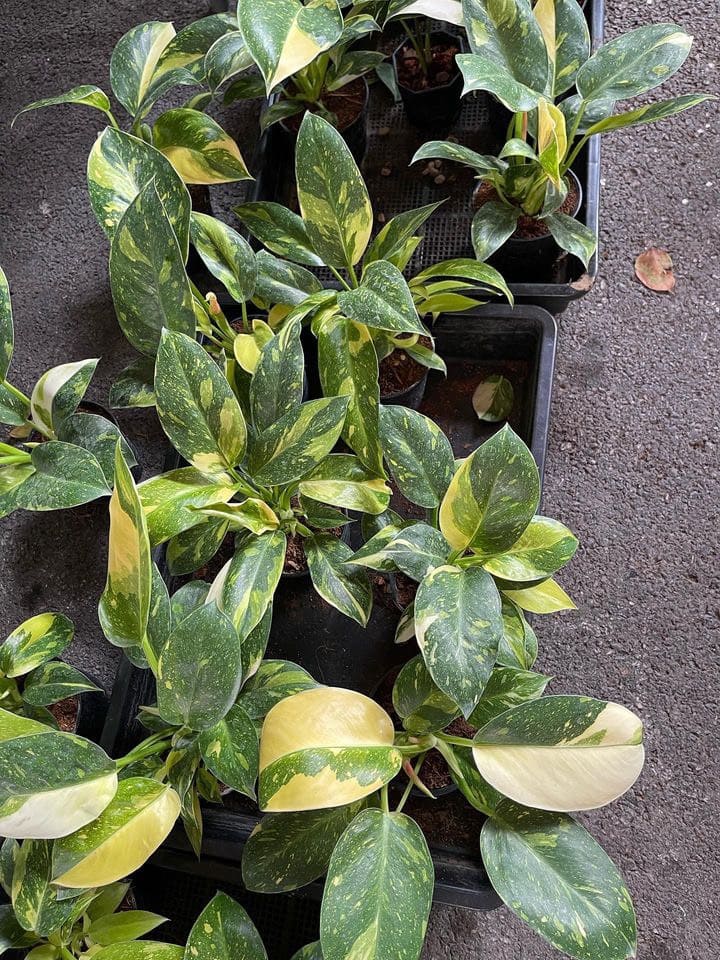
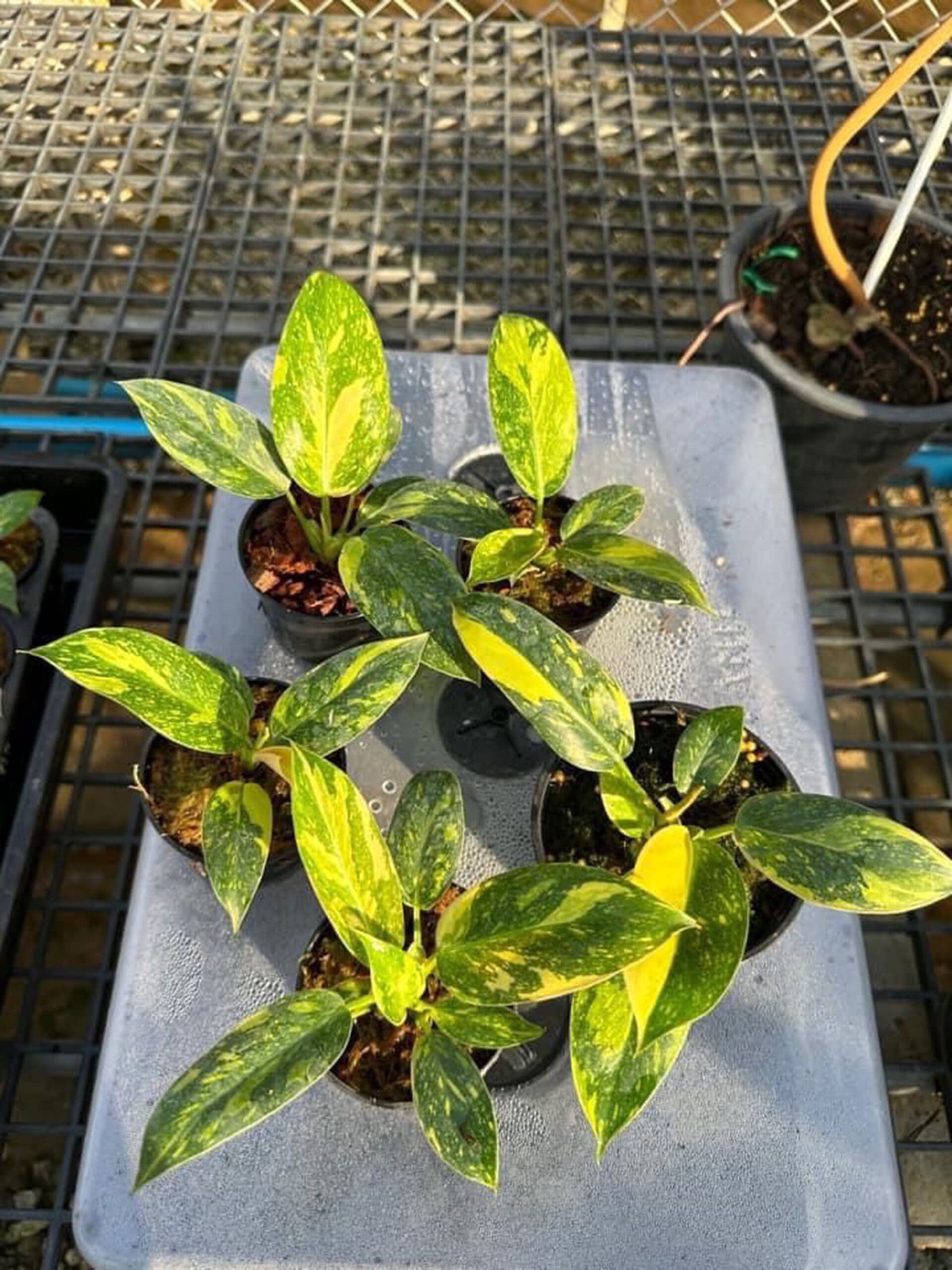
Greenboog’s four first-party images consistently show a self-heading plant: petioles emerge close together from a compact center and the plant holds an upright, spreading rosette. The leaves are glossy, entire and elliptic-to-ovate with pointed tips. They do not become deeply lobed, and this plant should not be identified from a generic heart-shaped Philodendron template.
- Habit: compact central crown with short internodes; no long running vine.
- Blade: broad glossy leaf, smooth entire margin and acute tip.
- Variegation: irregular lime, yellow-green and multiple-green marbling or sectors in the photographed stock.
- Leaf hardening: a new leaf may change tone as it expands and hardens; compare several mature leaves in neutral light.
- Identity limit: leaf color cannot prove breeder, parentage or whether two sellers’ “Nuclear” lines are identical.
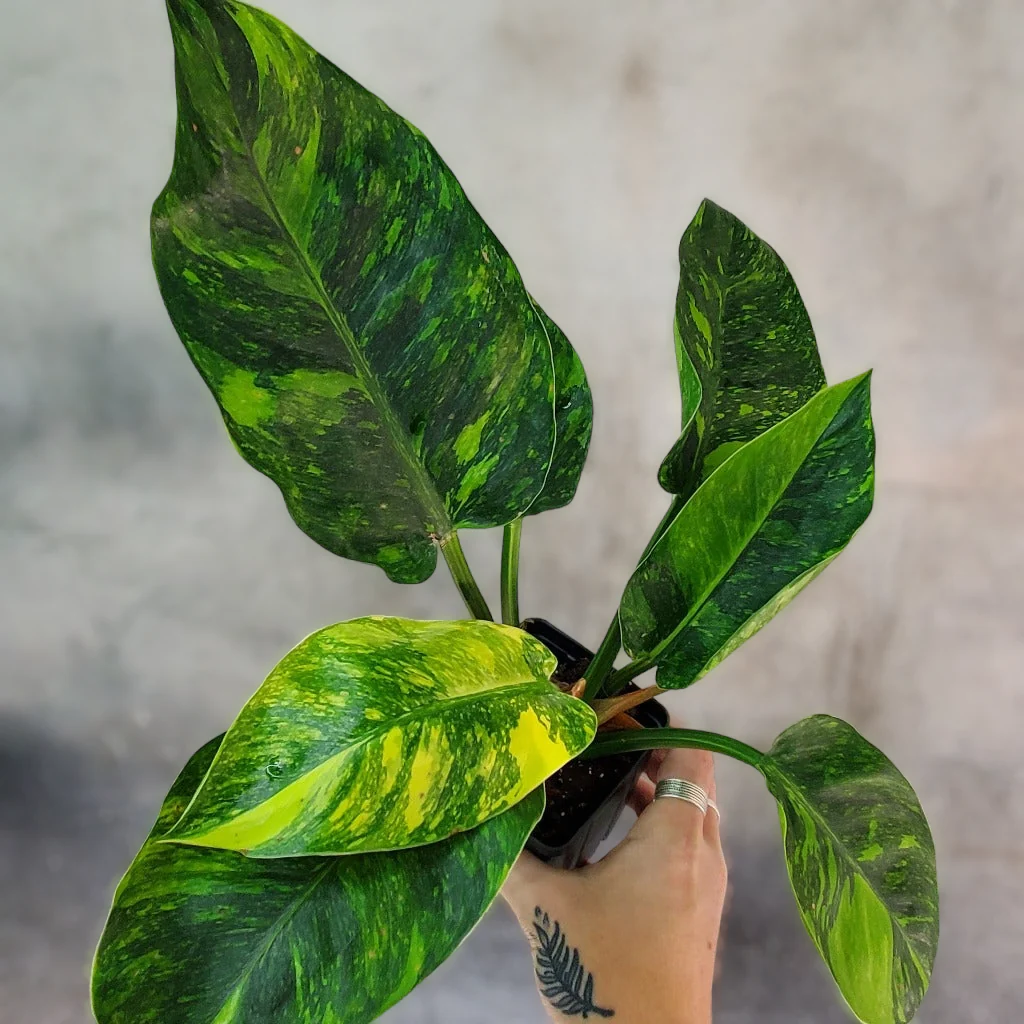
Self-heading care is different from vining Philodendron care
A self-heading Philodendron supports a rosette on a short, thick stem. It does not need a moss pole, curtain rod or living-wall training. As the crown matures, the lower stem may become visible and basal shoots may form, but attaching a pole will not convert its architecture into a climbing vine.
Give the plant room to spread and rotate it gradually if one side receives most of the light. Support a top-heavy nursery pot with a stable cachepot, but keep the inner pot above any drainage water.
Light: support green tissue without scorching pale sectors
Place an established plant in bright diffused light. Strong direct midday/afternoon sun through glass can heat and bleach lighter tissue; a dark interior location slows photosynthesis, root-zone drying and leaf production. Move the plant toward stronger light in stages after shipping or a season in lower light.
Light can change the plant’s performance and how colors appear, but it does not create a genetic variegation pattern. A green leaf after a move is not a reason to expose the crown suddenly to sun. Record several leaves under stable conditions before judging a change in the line.
Water and root-zone decisions
During active warm growth, check below the surface and lift the pot. When the upper root zone has dried somewhat and the container feels lighter, water the entire root ball until excess drains. Empty the saucer or cachepot. Do not water every seven days regardless of pot size, substrate, temperature and light.
Use a mix that holds even moisture while leaving air around the roots. Fine-to-medium bark, coco or quality peat-free houseplant mix, and mineral aeration such as perlite or pumice can be adjusted to your climate. The UF/IFAS commercial Philodendron guidance likewise emphasizes both moisture-holding capacity and aeration.
Choose a pot only modestly larger than the healthy root mass. Persistent wetness in an oversized pot can cause root decline that looks like drought: droop, yellowing and brown edges despite damp mix.
Temperature, humidity and airflow
Keep the plant warm and away from cold glass, drafts and sudden air-conditioning. Stable household warmth is more useful than chasing a narrow number. When light and temperature fall, growth and water use fall too; reduce irrigation rather than keeping a slow plant continuously wet.
Average-to-moderately high humidity can help new leaves expand, but humidity cannot repair failed roots. Combine it with gentle airflow. A humidifier and hygrometer create a measurable change; routine misting leaves water spots and may conceal the actual cause of brown margins.
Feeding, repotting and leaf care
Feed only while the plant is actively rooting and making leaves, following a complete houseplant fertilizer label at a conservative rate. Do not feed a dry, newly shipped, cold or rotting plant. Salt accumulation can burn roots and pale sectors; flush only when the root system is healthy and drainage works.
Repot when roots are crowded, the substrate has collapsed or water no longer moves evenly—not on a fixed annual schedule. Wipe glossy leaves gently, inspect petiole bases and both leaf surfaces for mites, thrips, scale and mealybugs, and remove a fully spent leaf with a clean tool.
Variegation, reversion and pruning limits
Variegation may increase, decrease or shift as leaves mature. UF/IFAS explains that chimeral plants can revert toward all-green or all-non-pigmented growth, but the exact genetic or chimeral mechanism of this Green Congo trade line is not documented here. Do not prescribe aggressive pruning as if every variegated plant works identically.
First distinguish one greener leaf from a separate all-green basal shoot. If a well-established plant repeatedly produces a distinct vigorous green shoot, document where it originates before removing anything. Cutting the central crown of a small self-heading plant can remove its only reliable growing point. Preserve enough green tissue: an almost-yellow plant may be visually striking but has less photosynthetic capacity.
How to propagate Green Congo Variegated
A leaf and petiole without viable stem/crown tissue will not reliably produce a new Philodendron. The practical home option is an independently growing basal shoot with a node/growing point and preferably its own roots. Separate only when the parent is healthy and actively growing.
- Unpot and locate the shoot’s connection to the main stem; do not pull blindly from above.
- Confirm viable stem tissue and roots or a rootable node on the division.
- Cut with a clean tool while preserving as many roots as possible.
- Pot into a small, airy, lightly moist medium and stabilize in bright diffused light.
- Wait for root/new-growth evidence before normal feeding or a larger pot.
Commercial tissue culture is a separate propagation pathway. An in-vitro plantlet needs staged humidity and light reduction after opening; follow the tissue-culture acclimation guide rather than treating it like an established potted plant.
Troubleshooting by pattern
Check roots and recent environmental changes before treating a leaf.
| Pattern | Check first | Do next |
|---|---|---|
| Droop plus wet mix | Roots, drainage, cold, pot size and recent repot | Restore warmth and oxygen; remove only confirmed rot |
| Droop plus light pot | Root-ball moisture and heat load | Rehydrate evenly, drain and stabilize the next interval |
| Brown pale sectors | Hot sun, root damage, humidity swing and salts | Correct measured cause; damaged tissue will not recolor |
| Curled new leaf | Thrips, mites, roots, dry air and physical trapping | Use the leaf-curl diagnostic before spraying |
| Long leaning petioles | Direction/distance of useful light and crowding | Improve diffused light gradually and rotate in small steps |
| New leaves trend greener | Several-leaf trend, basal shoots and seller lineage | Stabilize care and document the growth point before pruning |
| TC plantlet collapses | Humidity/light transition and root function | Return to the last stable acclimation stage; change one variable |
Buying evidence and the correct product format
Use the rare-Philodendron buyer guide to separate documented cultivar identity from a seller label. For this plant, ask for the exact batch, propagation method, plant size, root/acclimation status, current photos and arrival terms. “Rare”, “Nuclear” and a mother-plant image are not substitutes.
Choose by acclimation burden and current use—not by the same mother-plant image.
| Need | Greenboog owner | Verify before ordering |
|---|---|---|
| Established collector plant | potted Green Congo Hybrid Variegated | Exact plant/batch photo, pot size, roots, pests and recent repot |
| In-vitro starter | Green Congo tissue culture | Plant count, vessel/root stage, phenotype selection and contamination/arrival policy |
| Wholesale established plants | five-pot format or ten-pot format | Actual grade, pot size, uniformity limits, MOQ, packaging and phytosanitary terms |
Safety and unsupported health claims
Philodendron is not pet-friendly. The ASPCA lists Philodendron among houseplants containing insoluble calcium oxalates. Chewing can irritate the mouth and gastrointestinal tract and cause drooling, retching, vomiting, swelling or difficulty swallowing. Keep the plant and cut debris away from pets and children, wear gloves around sap, and contact a veterinarian or poison-control service after exposure.
Do not buy this plant as an air purifier or room humidifier. A few potted plants in an ordinary ventilated room are not a medical air-treatment system. Choose it for its form and foliage, then manage indoor air quality with ventilation, source control and appropriate equipment.
FAQ
Is Philodendron Green Congo Variegated a species?
No. Treat it as a commercial variegated hybrid/trade line unless traceable records identify a formal cultivar and parentage.
Is Green Congo the same as Rojo Congo?
No assumption is safe. `Congo` and `Rojo Congo` are documented as distinct cultivars, and the exact relationship of a Green Congo Variegated sale line requires provenance records.
Does it need a moss pole?
No. It is self-heading and forms an upright rosette on a short stem rather than a long climbing vine.
How often should I water it?
There is no universal interval. During active growth, water thoroughly after the upper root zone dries somewhat; reduce watering as light, warmth and growth decline.
Can more light create more variegation?
No. Useful light supports photosynthesis but does not create the genetic pattern. Sudden direct sun can scorch lime or yellow tissue.
Can I propagate it from one leaf?
No. A propagation piece needs viable stem/crown tissue and a growing point; a leaf and petiole alone are insufficient.
Is Green Congo Variegated safe for cats and dogs?
No. Philodendron contains insoluble calcium oxalates and should be kept where pets cannot chew it.
Sources and evidence boundaries
- RHS: accepted horticultural name Philodendron `Congo`
- US Plant Patent 11,724: self-heading, non-vining `Congo`
- US Plant Patent 14,116: distinct `Rojo Congo` cultivar
- UF/IFAS: commercial Philodendron root-zone guidance
- Penn State Extension: household humidity and misting limits
- ASPCA Animal Poison Control: calcium-oxalate exposure

Are the unique patterns and colors of variegated plants purely aesthetic, or do they serve a purpose in the plant’s survival and growth?”,
“refusal