Greenboog hybrid-name field guide
The multiplication sign, French Guiana record and three-lobed mature leaf sequence matter more than rarity language or one dramatic sales photo.
For broader discovery, compare it with other plants in the rare Philodendron varieties guide.
Philodendron × joepii at a glance
| Question | Evidence-led answer |
|---|---|
| Accepted name | Philodendron × joepii Croat; the multiplication sign marks a hybrid |
| Accepted parent formula | Philodendron bipennifolium × Philodendron pedatum |
| Formal publication | 2022 in Aroideana, not 1991 |
| Native range | French Guiana; Kew records it in the wet tropical biome |
| Growth habit | Scandent or climbing, with a stem that benefits from support |
| Useful leaf evidence | A mature sequence of deeply three-lobed blades with spreading, strongly constricted lateral lobes |
| Safety | Philodendron tissue contains irritating calcium oxalate crystals; keep it away from pets and children |
Why the name includes “×”
Kew’s Plants of the World Online record accepts Philodendron × joepii as a hybrid and gives the parent formula P. bipennifolium × P. pedatum. In botanical writing, the multiplication sign before the epithet signals a nothospecies: a formally named hybrid.
Thomas Croat’s original description was published in 2022. The paper also distinguishes the botanical name from the cultivated name Philodendron ‘Joep’. A 1991 date belongs to the plant’s collection and cultivation history; it is not the year the botanical name was formally published.
This distinction matters when comparing listings. “Joepii,” “Joep,” “Joep’s Philodendron” and misspellings may point toward the same horticultural material, but a label alone cannot authenticate a clone. Ask for the plant history and inspect its repeated structure.
How to identify Philodendron × joepii
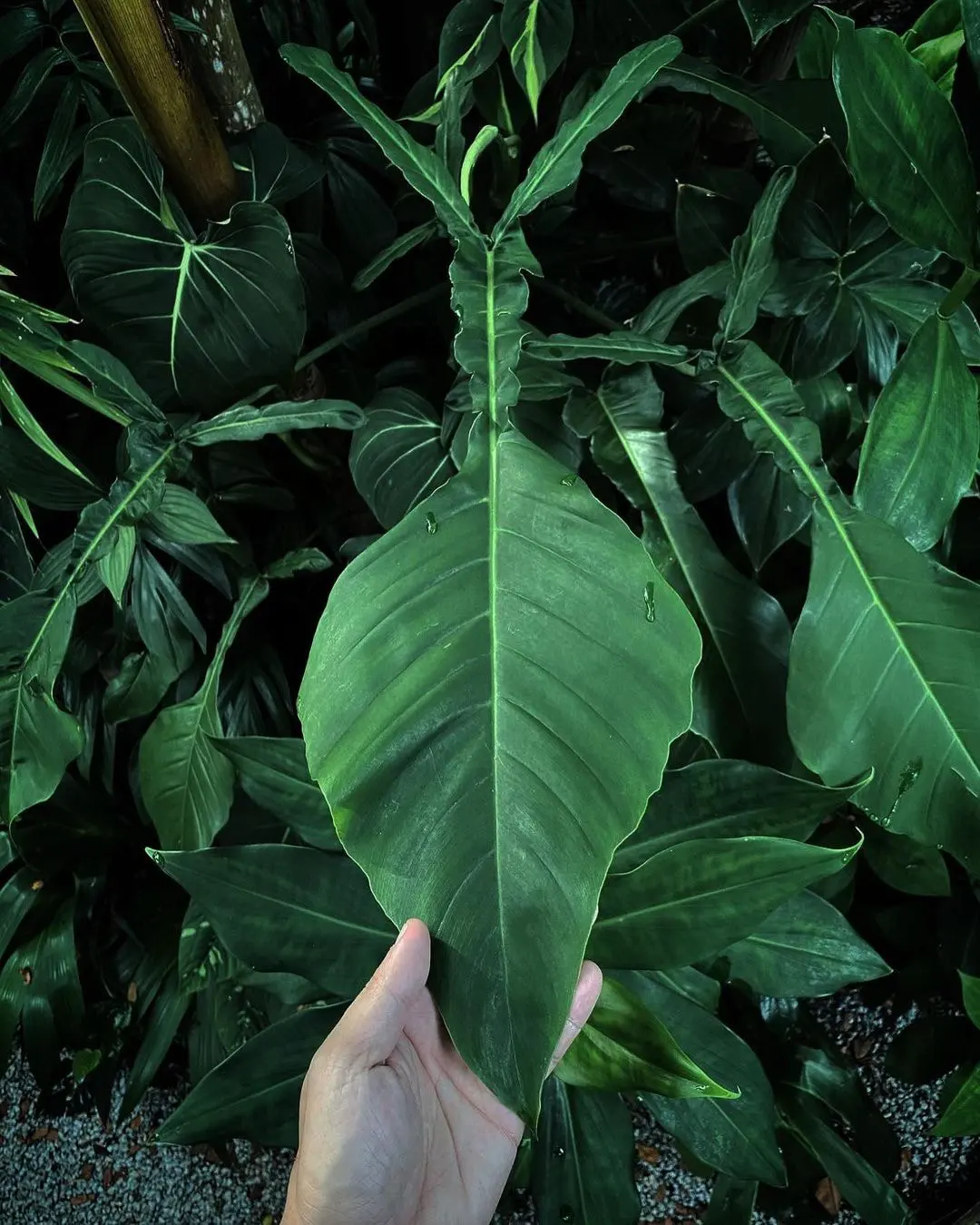
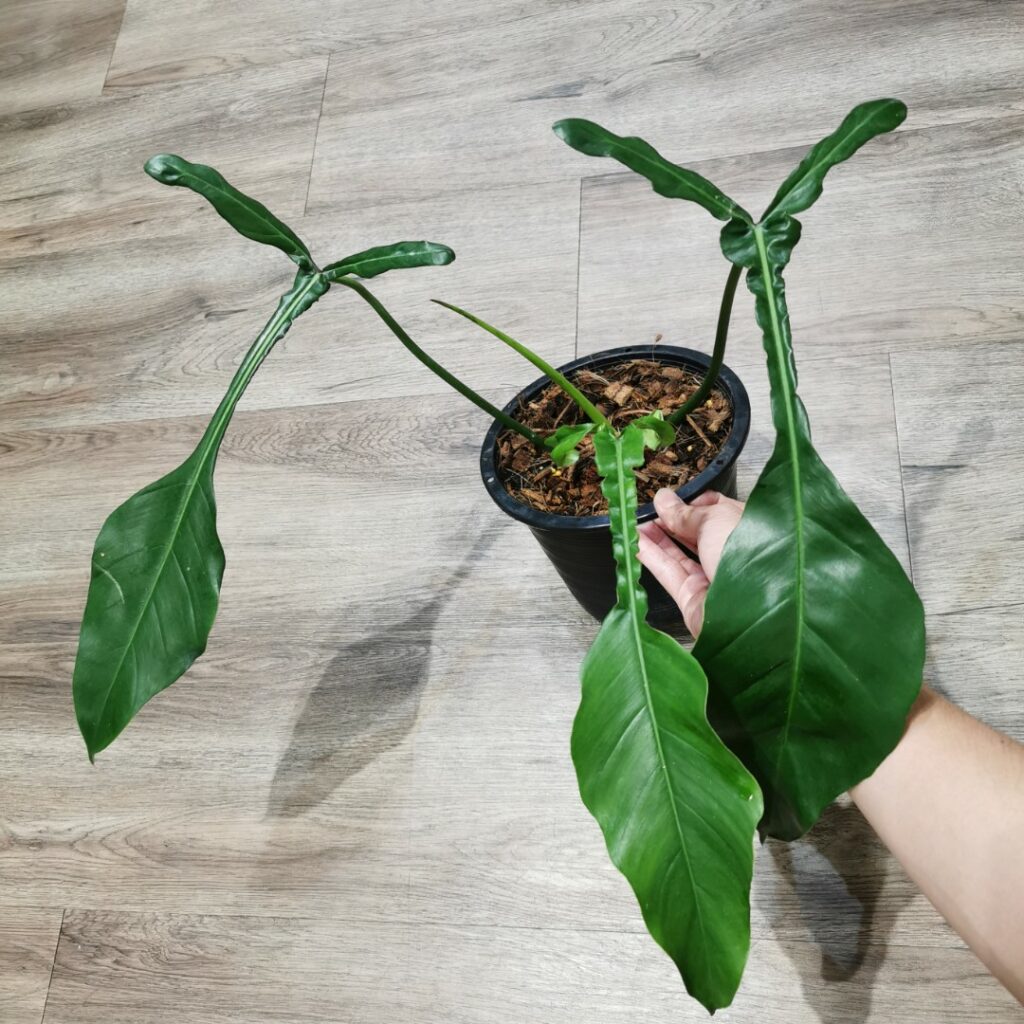
Start with the whole plant and several hardened leaves. The original description characterizes a climbing plant with deeply three-lobed blades. The lateral lobes spread outward and narrow sharply near their bases, creating the recognizable “waist” around a longer central lobe.
Strong and weak identity evidence
| Check | Stronger evidence | Weak evidence |
|---|---|---|
| Leaf sequence | Several leaves progressively show the central lobe, spreading side lobes and deep constriction | One detached mature leaf |
| Plant form | A climbing stem with nodes, petioles and aerial-root activity | A hanging or tabletop styling photo that hides the stem |
| Source | A traceable mother plant or clone history and current whole-plant photos | Price, rarity language or a seller title alone |
| Color | Green blades assessed in neutral light | A claimed red petiole or filtered photograph used as the deciding feature |
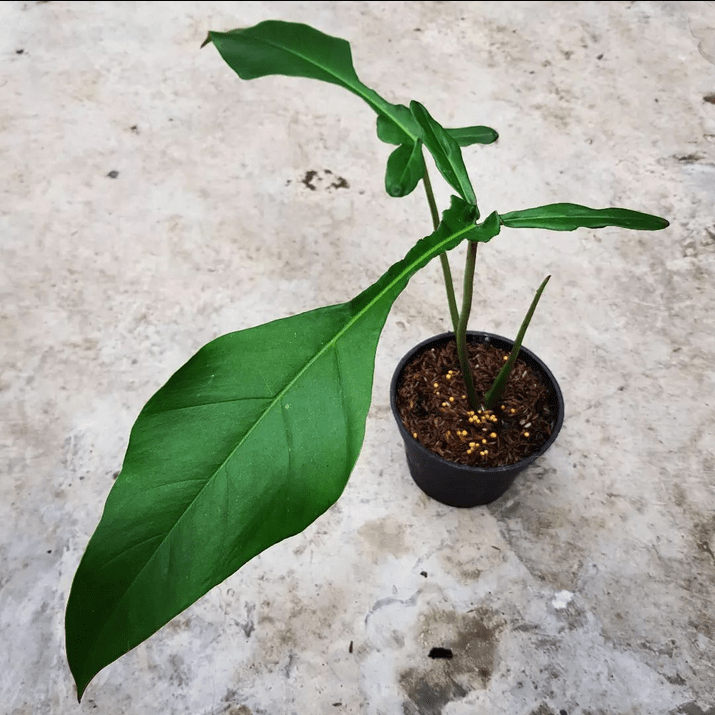
The formal description records mature type material rather than a size promise for every home-grown plant. Juvenile or recently propagated plants may not yet show the most exaggerated proportions. Support, usable light, root health and maturity all affect what can be observed; they do not change a different plant into Joepii.
Joepii and ‘Bette Waterbury’ are not interchangeable
Croat’s paper describes both Philodendron × joepii and the similar cultivated hybrid Philodendron ‘Bette Waterbury’. Their comparison in one paper is a warning against identifying a plant from a generic three-lobed silhouette. The Philodendron pedatum ‘Glad Hands’ guide owns that horticultural label and its boundary from Joepii. Preserve the seller’s source information and compare the full leaf sequence, petiole, stem and mature proportions rather than borrowing a name from a social-media photo.
Light and support work together
Give Joepii bright, indirect light and a stable climbing support. NC State Extension’s Philodendron profile recommends bright indirect light for the genus. In a real room, judge the location by the plant’s response rather than a window direction alone.
- Possible insufficient light: elongated internodes, slow growth and progressively smaller leaves after roots and nutrition have been checked.
- Possible excess exposure: pale or crisp damage concentrated on the window- or lamp-facing surface.
- Safer adjustment: change filtering, distance or duration gradually and judge the next hardened leaves.
Secure the stem loosely to a board, pole or trellis while leaving the petioles free to orient their leaves. A support helps the plant express its climbing body plan and keeps the growing stem manageable. Do not cut healthy aerial roots merely because they look untidy; guide them toward the support or growing medium when practical.
Build an airy, evenly hydrated root zone
Use a container with open drainage and a medium that holds some moisture while regaining air after watering. Particle size, water retention and pot size should fit your climate and plant—not a universal recipe. Bark, coarse mineral components, coco or peat-based material can all play a role, but a long ingredient list does not compensate for a compacted or oversized wet pot.
Water from evidence, not “the top inch”
- Compare the pot’s current weight with its weight after a thorough watering and drainage.
- Check moisture deeper in the rooted volume rather than touching only the surface.
- Water thoroughly when much of that rooted volume is approaching dry, then let excess drain.
- If the pot remains heavy for an unusually long time, inspect light, temperature, airflow, compaction, root health and excess unrooted medium before watering again.
Yellow leaves do not prove overwatering, and brown edges do not prove low humidity. Both are symptoms with multiple possible causes. The root condition, symptom pattern and recent environmental changes provide the diagnosis. Use the Philodendron watering guide for the detailed wet-versus-dry checks.
Temperature, humidity and feeding
Stable household warmth and protection from cold drafts suit Philodendron better than repeated hot-cold swings. Moderate to higher humidity can reduce rapid water loss, but a pebble tray or routine misting does not repair poor roots. Wet leaves plus weak airflow may instead increase disease risk.
Feed only while the plant is actively growing and its roots are functioning. Follow the fertilizer label, start conservatively after a move or repot, and watch for salt accumulation. The UF/IFAS Philodendron production guide advises against immediately repotting or fertilizing plants after placement in a new indoor environment. Let an imported or shipped plant stabilize before stacking elective changes. The complete Philodendron care guide owns the genus-wide routine.
Troubleshoot the pattern, not one symptom
| Observation | Inspect first | Low-risk response |
|---|---|---|
| Older leaves yellow while the mix stays wet | Root firmness and smell, drainage, pot size, drying time and light | Correct the root environment; remove only dead tissue |
| New leaves remain small or less divided | Plant maturity, support, usable light, roots and recent stress | Stabilize the limiting factor and judge several new leaves |
| Crisp edges or patches | Water availability, salt buildup, heat, sudden sun and root damage | Correct the confirmed driver rather than automatically misting |
| Fine stippling or webbing | Leaf undersides and petiole junctions for spider mites | Isolate, clean the area and use a correctly labelled control as directed |
| Cottony clusters or sticky residue | Nodes, sheaths and leaf undersides for mealybugs or scale | Isolate and inspect nearby plants before the problem spreads |
| Soft stem or foul-smelling roots | Oxygen-starved medium, damaged tissue and sanitation | Separate viable tissue, correct the wet system and disinfect reusable tools |
The University of California’s houseplant problem guide emphasizes environmental conditions, root health and pest inspection. Use it to narrow a symptom before choosing a treatment; avoid applying pesticide or fertilizer as a general cure.
Propagate only from a viable node
A Joepii leaf and petiole without a viable stem node cannot produce a new climbing shoot. Choose a healthy section with at least one node and bud area. Make a clean cut, then root the node in water or an airy medium that stays hydrated without becoming stagnant.
There is no universal requirement to leave every Philodendron cutting exposed for two days. Wound size, medium, temperature and sanitation affect the risk. Focus on a clean cut, an oxygenated root environment and stable gentle light. Vegetative propagation also preserves a known cultivated clone more clearly than an unsupported seed label.
For node anatomy, water-versus-medium rooting and transfer decisions, use the dedicated Philodendron propagation guide.
Joepii buyer checklist
For current format, stock and transaction terms, browse the Philodendron collection. Product pages own the live offer; this article remains the stable hybrid-name and care reference.
- Ask whether the listing shows the actual plant, a representative plant or the mother plant.
- Request neutral-light photos of the whole stem and several leaves, including the newest hardened leaf.
- Confirm whether the offer is an established plant, rooted cutting, unrooted cutting or tissue-culture plantlet.
- For a cutting, verify the node, bud, root status and mother-plant history.
- Check the live-arrival, refund, phytosanitary, import and weather-delay terms for your destination.
On arrival, document the unopened package and plant condition. Isolate it while inspecting leaves, sheaths, nodes and roots. Avoid repotting, feeding and dramatically increasing light on the same day unless damaged or unsafe media creates a more immediate risk.
Do not invent a conservation status
A narrow published range or limited collection history is not the same as an IUCN threat category. The Kew record cited here establishes accepted taxonomy, French Guiana distribution and wet-tropical biome; it does not justify calling Joepii endangered, almost extinct or protected by an active conservation program.
Prefer traceable nursery-propagated material and retain provenance, but do not use unsupported conservation language as sales pressure. Responsible buying starts with evidence about the actual plant and source.
Safety around people and pets
The ASPCA explains that Philodendron contains insoluble calcium oxalates. Chewing can cause oral pain, drooling, swelling, vomiting or difficulty swallowing in pets. Keep the plant and fresh cuttings out of reach, avoid sap contact with eyes and mouth, and contact a veterinarian or poison-control service if exposure causes symptoms.
Frequently asked questions
Is Philodendron joepii a species or a hybrid?
It is accepted as a named hybrid, written Philodendron × joepii. Kew gives the parent formula P. bipennifolium × P. pedatum.
Was Philodendron × joepii described in 1991?
No. The formal botanical publication is from 2022. A 1991 date appears in its collection and cultivation history, which should not be presented as the publication year.
Is Philodendron × joepii native to Colombia?
No in the accepted record used here. Kew gives French Guiana as its native range; the repeated Colombia claim is not supported by Kew or the original description.
How often should I water Joepii?
There is no reliable calendar interval. Use pot weight, deeper moisture, drying speed, roots, light and temperature together; thoroughly water the rooted volume when it is ready, then drain.
Can I propagate a Joepii leaf?
Not as a new vine if it lacks a viable stem node and bud area. A leaf-only cutting may remain alive temporarily but cannot replace the missing growth point.
Does a young Joepii always have the mature leaf shape?
No. A young or recently propagated plant may show less dramatic proportions. Evaluate source history, climbing stem and a sequence of leaves rather than demanding one mature display leaf.
Sources and evidence
- Kew Plants of the World Online: accepted Philodendron × joepii hybrid record
- Croat 2022: original nothospecies description and ‘Bette Waterbury’ comparison
- NC State Extension: Philodendron growth, light, root-zone and safety guidance
- UF/IFAS: Philodendron production and indoor-transition guidance
- UC Statewide IPM: houseplant root, environment and pest diagnosis
- ASPCA: Philodendron calcium-oxalate safety