Greenboog species field guide
Read the whole climbing plant—not just one wrinkled leaf—then tune light, support and root-zone aeration from evidence in your room.
If you are comparing other collector plants, start with Greenboog’s rare Philodendron varieties guide. This page stays focused on Rugosum.
Philodendron rugosum at a glance
| Question | Evidence-led answer |
|---|---|
| Accepted name | Philodendron rugosum Bogner & G.S.Bunting; formally published in 1983 |
| Native range | Southern Colombia to Ecuador; wet tropical biome |
| Growth habit | Climber with short internodes and aerial roots; benefits from vertical support |
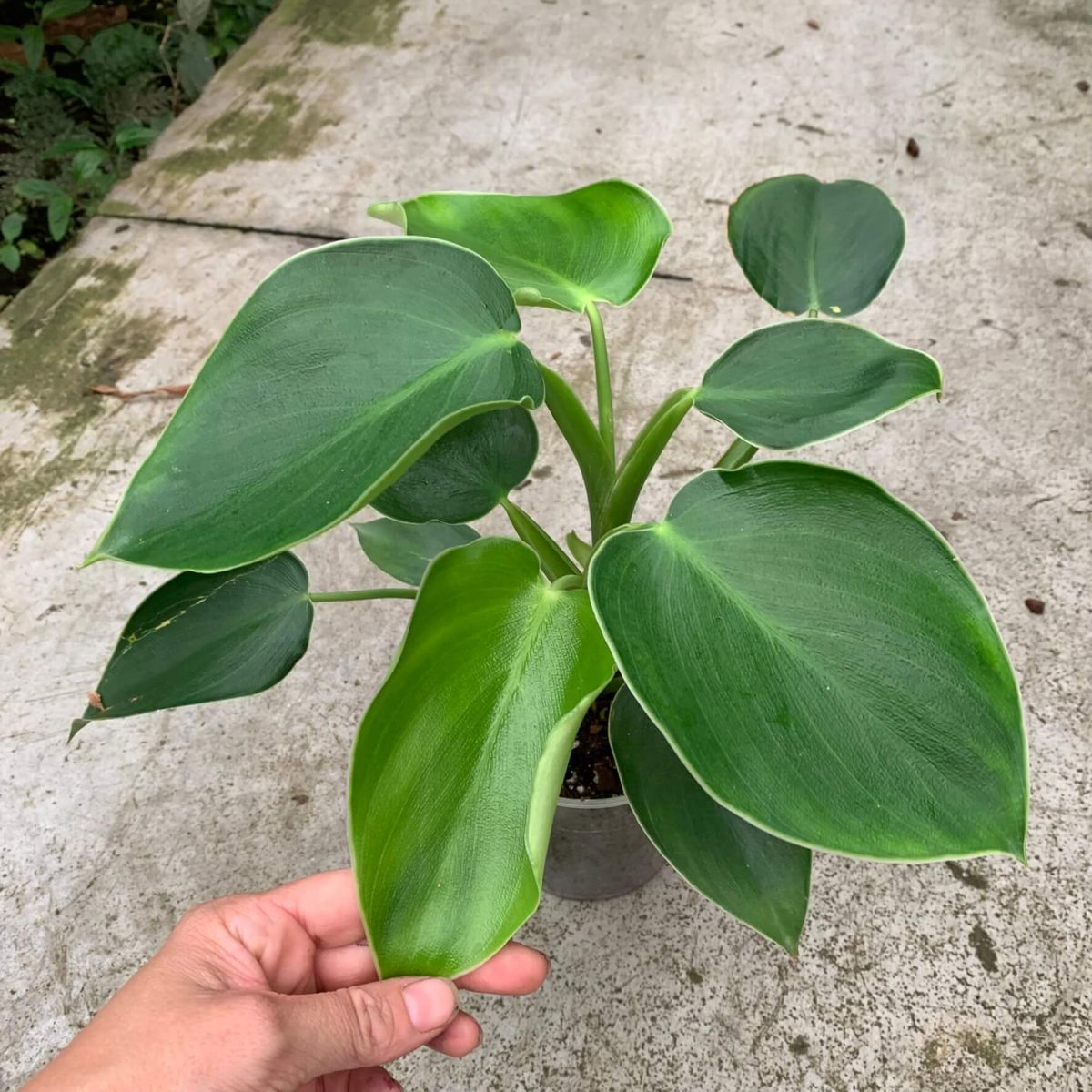
| Best identity clue | A repeated sequence of coriaceous, ovate-cordate blades with a conspicuously rugose upper surface—not texture alone |
| Root-zone goal | Even hydration plus rapid return of air after watering |
| Safety | Philodendron tissue contains irritating calcium-oxalate crystals; keep away from pets and children |
What “rugosum” should look like
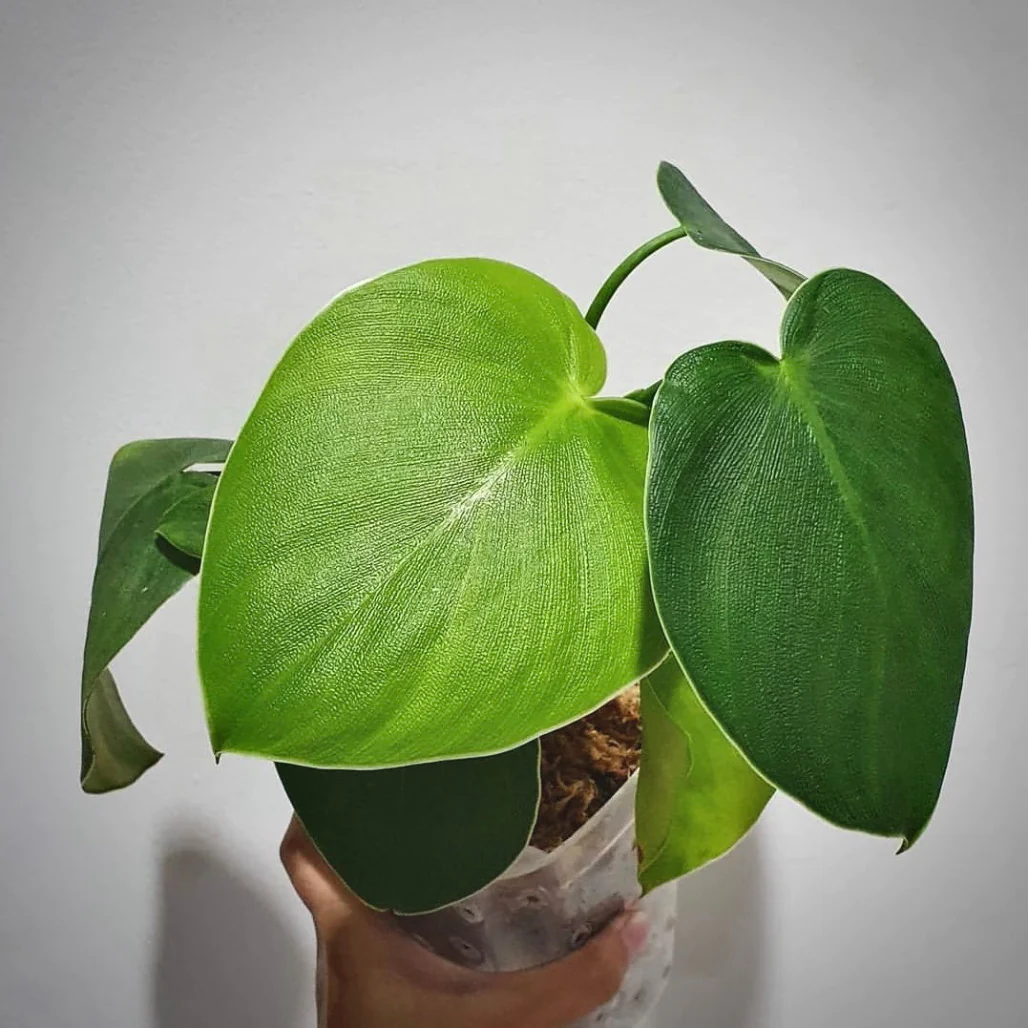
Kew’s Plants of the World Online record accepts the species and describes a climber with thick leaves that are ovate, heart-shaped at the base and pointed at the tip. The upper surface is conspicuously rugose; the lower surface is smooth and edged by a prominent hyaline margin. These combined characters are more useful than the familiar “pigskin” nickname by itself.
Use an evidence stack, not one dramatic leaf
| Check | Stronger evidence | Weak evidence |
|---|---|---|
| Leaf sequence | Several hardened blades repeatedly show rugosity, a cordate base and pointed tip | One cropped or newly unfurled leaf |
| Two surfaces | Textured upper face plus smoother underside and visible margin character | Texture judged from a filtered photograph |
| Plant form | Climbing stem, short internodes, nodes and aerial-root activity | A tabletop view that hides the stem |
| Provenance | Traceable mother-plant history and current whole-plant photos | Price, “rare” wording or a marketplace title |
Light and support shape the plant together
NC State Extension recommends bright indirect light for Philodendron generally and distinguishes climbing species from self-heading ones. For Rugosum, pair usable light with a stable board, pole or trellis. Secure the stem loosely while leaving petioles free to turn their leaves. Guide aerial roots toward the support or medium when practical.
- Possible insufficient light: progressively longer internodes, slower growth and smaller new blades after root health has been checked.
- Possible excess exposure: bleaching or crisp patches concentrated on the window- or lamp-facing side.
- Safer correction: change distance, filtering or duration gradually, then judge the next hardened leaf rather than yesterday’s damage.
A compass direction alone is not a care instruction. Glass, season, latitude, tree cover and lamp output change the light that reaches a leaf. The broader Philodendron care guide explains how to adjust the room without forcing every species into one recipe.
Build a moisture-balanced root zone
The useful goal is not “fast draining” at any cost. Roots need access to moisture and oxygen. Choose a pot with open drainage and a medium whose particle size, water retention and pot volume suit your temperature, light and watering habits. Coarse bark, mineral aggregate and coco- or peat-based material can all contribute; an oversized pot of dense, decomposed mix can stay wet even when its surface looks dry.
Water from the rooted volume
- Learn the pot’s weight after a full watering and complete drainage.
- Check moisture below the decorative surface, within the depth that actually contains roots.
- When much of that rooted volume is approaching dry, water thoroughly and let excess escape.
- If the pot stays heavy unusually long, inspect light, temperature, compaction, excess unrooted medium and root condition before adding more water.
The Philodendron watering guide owns the detailed wet-versus-dry diagnostic. A weekly calendar cannot account for a seasonal light drop, a repot, a smaller root system or a warmer room.
Temperature, humidity and airflow
Keep Rugosum warm and away from cold drafts, hot vents and abrupt transitions. NC State notes that Philodendron prefer warm conditions and often adapt to ordinary indoor humidity, although a drier room can increase water loss. Do not chase a universal percentage. Watch how quickly the pot dries, whether new growth opens cleanly and whether still, wet conditions are encouraging pests or spotting.
A humidifier can help in a very dry room, but measure it and keep air moving. Misting is short-lived surface wetting, not a substitute for root hydration. Clustered leaves should not remain wet in stagnant air.
Feed and repot by growth evidence
Feed modestly while the plant is actively producing leaves, following the fertilizer label and reducing or pausing when growth slows. More fertilizer cannot compensate for low light or damaged roots. White crust on the medium, burned root tips or marginal damage after feeding are reasons to stop and reassess water quality and accumulated salts.
Repot when the root ball, drainage or medium condition creates a real constraint: roots densely circle the container, water runs through channels without wetting the center, drainage remains slow after other causes are excluded, or the medium has collapsed. Move up conservatively and preserve healthy roots; a large jump creates a wet, unrooted buffer.
Read symptoms before treating them
| Signal | Check first | Safer response |
|---|---|---|
| Lower yellow leaf | Pot weight, root smell/firmness, recent repot and whether it is one old leaf or a spreading pattern | Correct the confirmed cause; do not automatically water or fertilize |
| Brown edges | Uneven root hydration, salts, heat, root injury and recent environment change | Stabilize one variable at a time; damaged tissue will not turn green |
| Curling blade | Moisture at root depth, heat/light load, mites or thrips, and root function | Use the leaf-curl diagnostic before choosing a treatment |
| Smaller new leaves | Usable light, climbing contact, active roots and nutrition | Improve the limiting factor and judge subsequent growth |
| Wilting in wet mix | Root firmness, odor and oxygen-starved media | Pause watering and inspect roots promptly; wet soil does not prove functional roots |
Propagate from a viable stem node
A Rugosum leaf and petiole without viable stem tissue is not a complete propagation unit. The node is the stem area where a leaf or bud attaches; a cutting needs a viable node or growth point to become an independent plant.
- Choose a healthy section with a clearly identifiable node; an aerial-root nub is helpful but not a substitute for the node.
- Use a clean, sharp tool and cut with enough stem on each side to protect the node.
- Root in water or a clean, airy medium kept moist rather than saturated, under bright indirect light.
- Pot on when new roots are branched and new growth demonstrates that the cutting is functioning.
Penn State Extension recommends healthy starting material, clean tools and an aerated, moist propagation environment. For method comparisons and aftercare, use Greenboog’s Philodendron propagation guide.
Buyer checklist for a labelled Rugosum
- Ask for an unfiltered whole-plant photo plus close views of upper and lower leaf surfaces.
- Look for repeated rugosity across hardened leaves, not only a soft newly opened blade.
- Check nodes, stem condition, active roots and the absence of fresh pest damage.
- Ask whether the plant is a rooted cutting, established juvenile or recently acclimated tissue culture.
- Keep the wild conservation assessment separate from cultivated provenance and value.
When you are ready to compare live availability, the Philodendron collection owns current inventory. Product pages own the live offer; this field guide owns species evidence and care.
Safety around people and pets
ASPCA lists Philodendron spp. among houseplants whose insoluble calcium-oxalate crystals can cause oral pain, drooling, retching, vomiting and related irritation when chewed. Keep cuttings, sap and plant debris away from children and pets, wear gloves if sap irritates your skin, and wash tools and hands after pruning. Contact a veterinarian or poison service after suspected ingestion, especially if swallowing or breathing is affected.
Philodendron rugosum FAQ
Is Philodendron rugosum the pigskin Philodendron?
“Pigskin Philodendron” is a horticultural nickname inspired by the rugose upper leaf surface. It is a useful clue, not a botanical authentication; use the leaf sequence, underside, margin, climbing stem and provenance together.
Is Philodendron rugosum from all of Central and South America?
No. Kew records the accepted native range as southern Colombia to Ecuador. Broader regional claims should not replace that documented range.
Does Rugosum require a fixed high-humidity percentage?
No universal percentage can account for temperature, airflow, root condition and acclimation. Keep conditions stable, avoid cold drafts, and judge new growth and drying rate rather than chasing one number.
Can I propagate one leaf without a node?
A detached leaf may remain alive for a time, but it lacks the stem growth point needed to produce a complete new climbing plant. Use a cutting with viable node tissue.
Why is my new leaf smoother than the older leaves?
A newly opened leaf is still expanding and hardening. Judge its mature texture later and compare multiple leaves. If successive leaves remain smaller or less characteristic, check light, support, roots and nutrition before questioning the label.
Evidence notes
Botanical identity: Kew Plants of the World Online, accepted-name, range and morphology record for Philodendron rugosum. General cultivation: NC State Extension Philodendron profile. Propagation: Penn State Extension, “Propagating Houseplants.” Pet safety: ASPCA guidance for Philodendron spp. Care guidance here translates genus-level horticultural principles into checkpoints; it does not claim a controlled Rugosum-specific growing trial.