Greenboog cultivar-history field guide
Pluto is a compact crown plant, not a trailing vine. Use its green lobed leaf sequence and short stem before borrowing names from variegated trade plants.
For wider collector context, use the rare Philodendron varieties guide. This page stays with green Pluto identity and care.
Philodendron Pluto at a glance
| Question | Evidence-led answer |
|---|---|
| Name type | Historical horticultural/trade name, not an accepted species binomial |
| Historical evidence | USPP 6,293 (1988) records “Venus or Pluto” as an unpatented, totally green comparison plant |
| Growth habit | Compact, self-heading crown with very short internodes; not a trailing basket vine |
| Identity stack | Green lobed leaf sequence, upright petioles, compact crown and provenance |
| Root-zone goal | Even hydration plus a reliable return of air after watering |
| Safety | Philodendron tissue contains irritating calcium-oxalate crystals |
What the 1988 patent actually proves
US Plant Patent 6,293 protects ‘Red Empress’, not Pluto. Its value here is the comparison: the breeder names an unpatented plant sold as “Venus or Pluto,” says he also developed it, and describes it as totally green with a similar compact form. The comparison documents that the Pluto trade name and self-heading architecture existed by 1988.
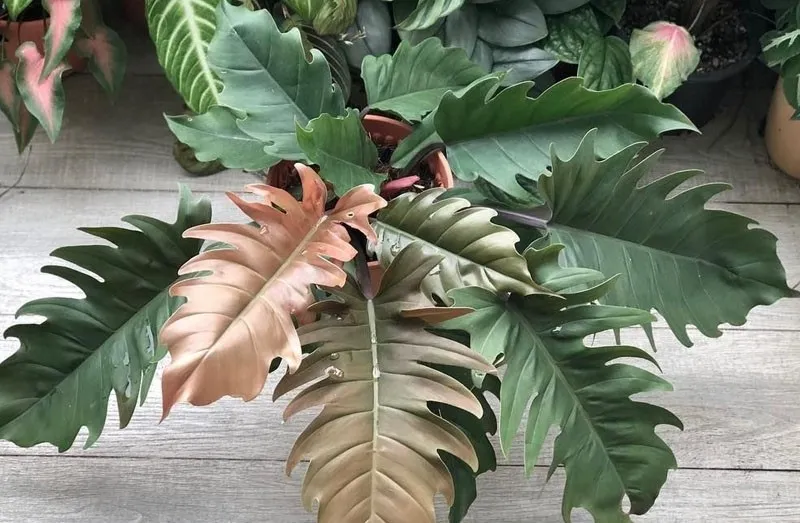
Current trade photos often show copper, bronze or reddish emerging leaves that harden greener. That may help compare a labeled plant, but it is not enough by itself. Camera color, new-leaf stage and different selections can overlap.
Use the whole crown
| Check | Stronger evidence | Weak evidence |
|---|---|---|
| Growth center | Upright petioles arise around a compact crown with very short internodes | A description calling it “vining” or “trailing” |
| Leaves | Several hardened, green, lobed leaves with repeated architecture | One bronze new leaf or yellow-stressed leaf |
| Color | Green mature foliage assessed in neutral light | “Variegated Pluto” used to identify standard Pluto |
| Source | Traceable mother plant and current whole-plant photo | A Caramel Marble association or seller price |
Pluto, Caramel Marble and Jungle Boogie
The Caramel Marble guide owns the variegated comparison. Its collector name does not prove that it is a sport of Pluto. Keep that historical question open unless a breeder or registration record establishes it.
Jungle Boogie also develops dramatic teeth and lobes, but its long narrow leaf outline differs from the compact Pluto crown shown in trade. Compare mature sequences, not one juvenile leaf.
Light for a compact, green crown
NC State Extension recommends bright indirect light for Philodendron generally. Pluto should remain upright and compact rather than stretching toward a window. Judge usable light from the plant’s response.
- Possible low light: progressively longer petioles, leaning and smaller new leaves after roots are checked.
- Possible excess exposure: bleaching or crisp damage on the exposed side.
- Safer adjustment: change filtering, distance or lamp duration gradually and judge subsequent hardened leaves.
The Philodendron care guide owns broader room-level acclimation. Rotate Pluto a little at a time for balanced presentation; do not turn it abruptly from shade into harsh sun.
Pot the crown, not a trailing vine
Use a stable container with open drainage. Keep the crown above the medium rather than burying petiole bases. Pluto does not need a moss pole to express its documented self-heading architecture. A discreet stake may steady a top-heavy specimen, but it should not force petioles together.
Choose a medium that holds useful moisture and regains air after watering. Bark, coarse mineral components and coco- or peat-based material can all contribute. Pot size and particle behavior matter more than the marketing name “aroid mix.”
Water from the rooted volume
- Learn the pot’s weight after a thorough watering and full drainage.
- Check moisture below the surface, within the actual root depth.
- Water when much of the rooted volume is approaching dry, then let excess escape.
- If the pot stays heavy unusually long, inspect compaction, lower light, oversized pot volume and root health.
Use the Philodendron watering guide for detailed diagnosis. Yellowing and drooping can occur with both dry roots and oxygen-starved damaged roots.
Warmth, humidity, feeding and repotting
Keep Pluto warm and away from cold drafts or hot vents. Average indoor humidity may be workable when roots are healthy; use a measured humidifier if the room is genuinely dry. A fixed percentage, pebble tray or routine misting cannot replace root hydration and airflow.
Feed modestly during active growth according to the fertilizer label. Stop and inspect if growth has slowed because of cold, low light or root injury. Repot only when roots densely occupy the pot, drainage behavior changes or the medium collapses. Moving up conservatively protects the compact root system from a wet unrooted buffer.
Symptom table
| Signal | Check first | Safer response |
|---|---|---|
| Yellow lower leaf | Age pattern, pot weight, roots and recent feeding | Correct the confirmed cause; do not water automatically |
| Soft dark center | Trapped moisture, cold, odor and spreading tissue damage | Keep crown dry, isolate if disease is suspected and inspect promptly |
| Long leaning petioles | Light direction and root function | Improve usable light gradually and rotate modestly |
| Brown margins | Uneven hydration, salts, heat/light load and roots | Stabilize one verified cause at a time |
| Yellow-green mottling | Whether the label is standard Pluto, plus pests, roots and nutrition | Do not call it variegation from one image; verify the plant and pattern |
Propagation and division boundary
A compact crown does not offer the obvious flexible nodes of a climbing vine. Do not cut into the center merely to follow a generic “stem cutting” instruction. Wait for a clearly separable offset or visible viable stem/growth point, use clean tools and preserve roots. Commercial Pluto may also be produced by tissue culture.
If no safe division point is visible, leave the plant intact. A detached petiole cannot rebuild a complete crown. General node anatomy is covered in Greenboog’s propagation hub, but Pluto’s compact structure requires a more conservative decision.
Buyer checklist
- Request an unfiltered whole-crown photo and several hardened leaves.
- Confirm compact self-heading architecture rather than a trailing stem.
- Separate bronze new-leaf color from true variegation claims.
- Ask for roots, growth point and mother-plant history.
- Do not infer a genetic Caramel Marble connection from price or color.
The Philodendron collection owns current inventory. Product pages own the live offer; this guide owns Pluto history, identification and care.
Safety
Philodendron tissue contains insoluble calcium-oxalate crystals that can irritate the mouth and digestive tract when chewed. Keep the plant and cut material away from children and pets; contact a veterinarian or poison service after suspected ingestion.
Philodendron Pluto FAQ
Is Philodendron Pluto variegated?
The historical “Venus or Pluto” comparison plant was described as totally green. A separate variegated trade label should not redefine standard Pluto without provenance.
Does Pluto trail from a hanging basket?
No. The historical evidence and current compact trade form support a self-heading crown, not a trailing vine.
Is Pluto the parent of Caramel Marble?
A primary genetic or breeder record confirming that relationship was not found. Keep the labels and owner intents separate.
Why are new leaves bronze?
Bronze or copper emergence is common in current trade photos, but color changes as leaves harden. Use the mature green sequence and crown architecture for identity.
Can I propagate Pluto from one leaf?
No. A complete new crown requires viable growth-point or offset tissue, not a detached leaf and petiole.
Evidence notes
Name/form history: US Plant Patent 6,293, a comparison inside the ‘Red Empress’ patent. General care: NC State Extension Philodendron profile. Propagation anatomy: Penn State Extension. Safety: ASPCA. The historical patent does not establish modern clone identity, Pluto parentage or a genetic Caramel Marble link.