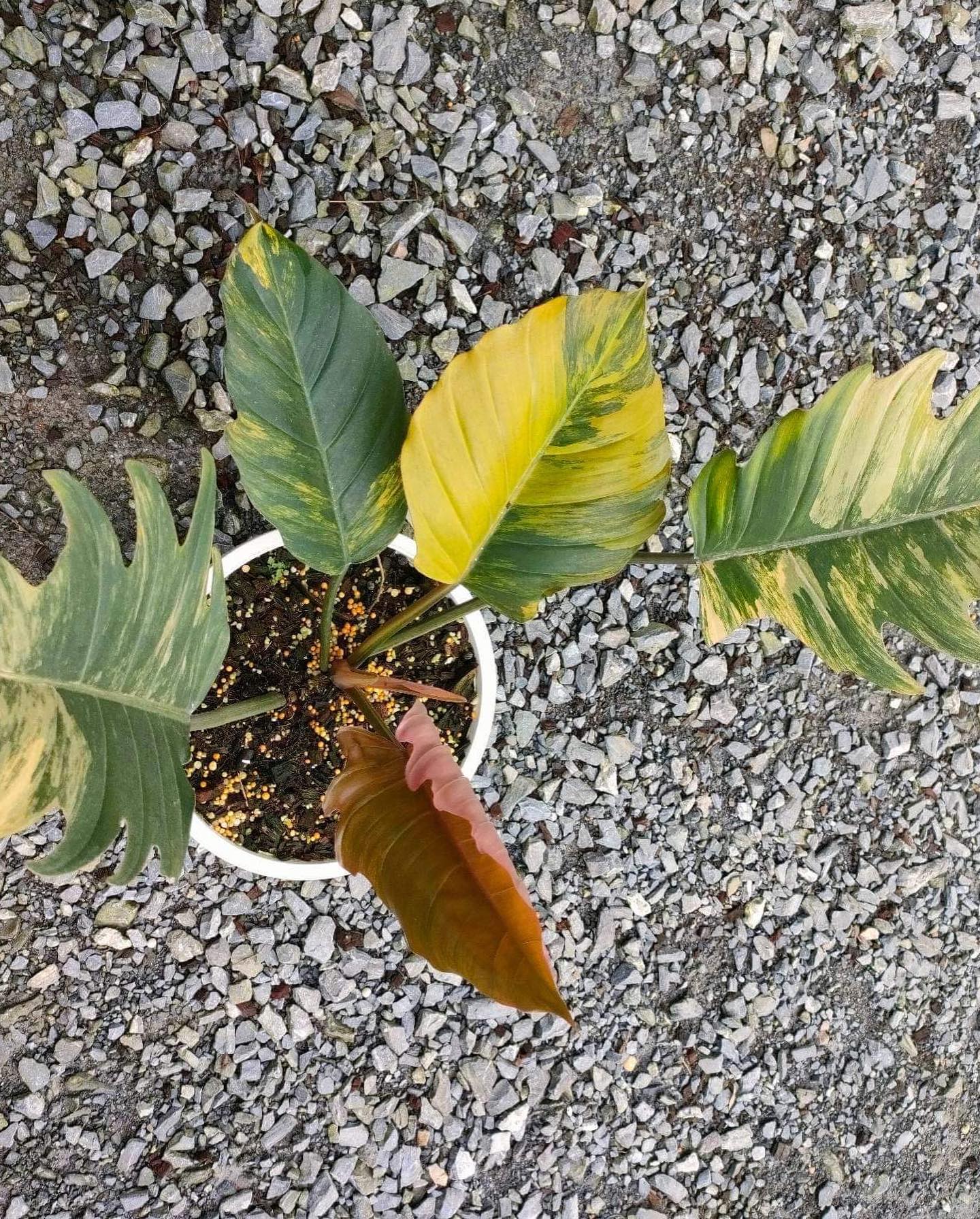
Philodendron Caramel Marble is a compact, self-heading collector plant recognized by deeply lobed leaves that combine green tissue with persistent cream, yellow or caramel-colored sectors and marbling. The plant trade often connects it with `Pluto`, but the history is repeated more confidently than the evidence supports. Verify the crown, leaf sequence and lasting pattern instead of buying a name or one dramatic new leaf.
This guide is for collectors deciding whether a plant is genuinely variegated, reverting, too pale to grow well or simply showing normal bronze new growth. It also separates established plants from tissue-culture plantlets and explains why a self-heading crown should not be cut or trained like a climbing Philodendron.
Philodendron Caramel Marble at a glance
| Question | Practical answer |
|---|---|
| What is it? | A horticultural/cultivar label used for a variegated, deeply lobed, self-heading Philodendron in the plant trade; it is not a botanical species. |
| Best identity evidence? | A short central crown, erect petioles, progressively lobed blades and irregular pale areas that remain after the leaf hardens. |
| Is every caramel new leaf variegated? | No. Normal emerging pigment may turn green across the whole blade. Variegation remains as a cream/yellow/green pattern after hardening. |
| Does it climb? | No in the material reviewed here. It is a compact self-heading rosette, not a vine that matures by attaching to a moss pole. |
| Can bright light restore variegation? | No. Useful light supports the green tissue but cannot manufacture a missing variegated cell line or guarantee the next pattern. |
| Is one green leaf a reversion? | Not by itself. Inspect the active crown and several consecutive hardened leaves before making an irreversible cut. |
| How is it propagated? | From viable crown/stem tissue with a growth point, a genuine offset or tissue culture. A leaf and petiole alone cannot restart the plant. |
| Is it pet-safe? | No. Philodendron contains insoluble calcium oxalates and should not be chewed. |
What the name does – and does not – prove
`Caramel Marble` is useful as a horticultural label because it points buyers toward a recognizable leaf pattern and growth habit. It does not, by itself, prove a species, breeder, parentage, mutation date or registered pedigree. The authoritative public sources checked for this guide did not establish those details for Caramel Marble.
An important piece of history comes from US Plant Patent 6,293 for Philodendron `Red Empress`, published in 1988. The breeder compared that patented plant with an unpatented Philodendron sold as `Venus or Pluto`, described Pluto as totally green and documented the comparison plant’s compact, self-heading form. That proves the Pluto trade name and architecture existed; it does not prove that today’s Caramel Marble arose as its sport.
The International Aroid Society’s cultivar guidance requires a cultivated aroid to be distinguishable and stable through propagation before registration. Seller repetition, price or social-media popularity is not that evidence. For practical care, the safest label is therefore `Philodendron Caramel Marble`, followed by photographs and a description of the actual plant.
How to identify the plant in front of you
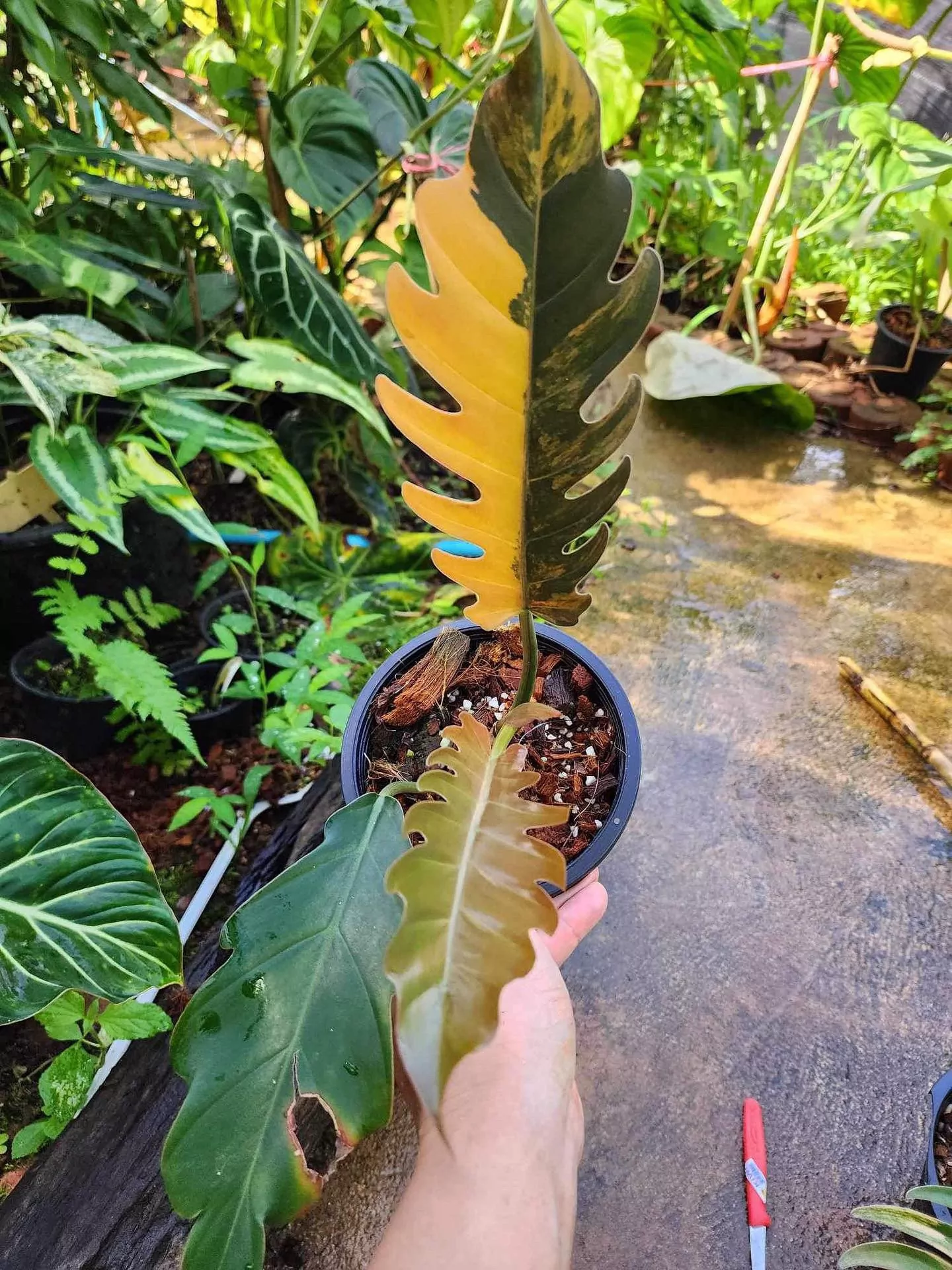
Read a set of features
- Crown: petioles emerge close together from a short central axis. The plant forms an upright rosette rather than an extended vine.
- Blade: juvenile leaves can be simpler; older leaves develop pronounced, irregular lobes on both sides of the midrib.
- Emerging color: a soft new blade may open copper, bronze, caramel or reddish brown before hardening greener.
- Persistent pattern: cream, yellow and light-green sectors, streaks or marbling remain visible beside darker green tissue after hardening.
- Petiole: inspect color, attachment and spacing. One detached leaf cannot show the plant’s architecture or growth point.
- Sequence: compare the newest soft leaf with three or more older leaves. The sequence is more trustworthy than one seller photograph.
Do not confuse hardening color with variegation
Take a photograph when a leaf opens and another after it has firmed. If the entire blade shifts from bronze or caramel toward green, that is a developmental color change. If irregular pale sectors remain beside green tissue, they are the useful variegation evidence. Sun stress, nutrient problems and mosaic-like pest or disease damage can also change color, so pattern alone is not a diagnosis.
Caramel Marble, Pluto and Fire Tiger
| Label | What it usually communicates | What to verify |
|---|---|---|
| Pluto / Venus-Pluto | A historical green, compact self-heading trade Philodendron documented in a 1988 patent comparison | Actual leaf shape, crown and provenance; the patent does not connect it genetically to Caramel Marble |
| Caramel Marble | The variegated, caramel-to-yellow-and-green collector plant covered by this guide | Persistent pattern on hardened leaves, active crown, roots and several-leaf sequence |
| Fire Tiger | A seller or selection label used for some highly patterned plants in this trade group | Whether it is a documented selection, the exact plant or representative stock; color alone does not establish a formal distinct cultivar |
Use labels to find the right catalogue area, then compare plants by evidence. Greenboog keeps the established Fire Tiger-labelled plant as a separate transaction page, while this article owns the comparison and care question. Neither a brighter photograph nor a higher price resolves nomenclature.
How much variegation is workable?
Pale tissue carries less chlorophyll than green tissue. UF/IFAS explains that some variegation comes from pattern genetics, meristem chimeras, transposons or pathogens; without cultivar-specific evidence, do not assign one mechanism to Caramel Marble. The practical question is whether the current crown is producing enough green tissue to support the whole plant.
- Balanced sequence: several leaves retain both green and pale tissue and leaf size is stable or increasing. Keep conditions steady.
- One greener leaf: monitor the next leaves. A single change can fall within normal expression.
- Repeated all-green leaves: photograph the crown and sequence. This raises a reversion concern but does not make blind crown removal safe.
- Repeated nearly colorless leaves: the plant has little photosynthetic margin. Protect the green leaves, avoid root stress and do not force growth with fertilizer.
- Damaged mosaic or stippling: inspect for thrips, mites, nutrient/root trouble or disease rather than assuming desirable variegation.
More light cannot write a new pattern into a growth point. It can help the chlorophyll-bearing tissue produce energy, while an abrupt increase can scorch the pale sections first. Judge the crown over time, not with a `more sun equals more variegation` rule.
Light for color and growth
Provide bright diffused light and acclimate every increase. The University of Minnesota Extension recommends matching indoor plants to measured light conditions and notes that foliage plants can use supplemental light when daylight is inadequate. Window direction alone is not a dose: season, glass, curtains, distance and outdoor shade all change the energy reaching the leaf.
- Move the plant closer to a brighter position in stages, especially after shipping or a greenhouse-to-home transition.
- Keep hot midday rays off a soft emerging leaf and large pale sectors.
- Rotate the pot gradually for a symmetrical crown; do not repeatedly turn a leaf while it is unfurling.
- If using a grow light, provide a stable daily light period and observe leaf temperature and crown response before increasing intensity.
- Clean dust from hardened leaves with water and a soft cloth; leaf shine does not improve photosynthesis.
Water the root ball, not the calendar
Water when the upper root zone is drying and the pot has become lighter, then saturate the full root ball and let it drain. Iowa State Extension’s houseplant guidance emphasizes checking the potting mix and watering thoroughly instead of following a weekday schedule.
- Check below the decorative surface; bark can look dry while a dense core remains wet.
- Lift the pot and note its weight after watering so future comparisons are meaningful.
- When watering is due, moisten the entire root ball rather than adding a daily sip.
- Empty the saucer or cachepot and confirm every drainage hole remains open.
- If the plant droops while the mix is wet, inspect roots and oxygen before adding more water.
High-variegation plants have less margin for root loss, but that does not mean keeping them constantly wet. Repeated severe drying kills fine roots; persistent saturation excludes air and encourages rot. The right interval changes with root mass, pot material, substrate, temperature, light and season.
Substrate, pot and self-heading support
Build an open root zone that still holds enough moisture to wet evenly. Fine bark or coco chips add structure, pumice or perlite protect air space, and a smaller fine fraction buffers moisture. There is no universal `aroid mix` ratio because a warm nursery, bright windowsill and cool cabinet dry at different rates.
Choose a container only modestly wider than the active root mass, with unobstructed drainage. A self-heading Caramel Marble does not need a moss pole to mature. As the compact stem rises, a short discreet stake can stabilize a leaning plant, but tie the stem or pot support – never a soft petiole or emerging leaf.
Repot when roots have filled the available mix, the substrate has collapsed, salts have accumulated or water no longer moves through evenly. Do not repot every two years by rule. The broader Philodendron care guide covers shared root and seasonal routines.
Temperature, humidity and airflow
Keep the root zone and crown warm and stable. Protect the plant from cold glass, air-conditioner jets, heater blasts and abrupt moves between a humid greenhouse and a dry room. High humidity can slow water loss during unfurling, but a fixed percentage is not a pass/fail number.
Read humidity together with airflow, pot drying and condensation. A closed wet cabinet can still produce edema, fungal problems and weak roots. Use a clean humidifier if the room is persistently dry; do not rely on misting or a pebble tray to correct root-zone dehydration.
Feeding and growth pace
Feed only while roots are healthy and the crown is actively producing leaves. Begin with a dilute complete fertilizer and observe the next growth cycle. Reduce concentration or frequency when tips burn, growth stalls or salts crust the mix. Fertilizer cannot correct missing light, root rot or a low-green growth point.
New leaves can change shape, size and color as the plant establishes. Do not chase a dramatic leaf by changing light, water, fertilizer and humidity at once. Hold conditions stable, photograph each hardened leaf and use the sequence to decide whether the trend is improving.
Troubleshooting by symptom
| Symptom | Check first | Useful response |
|---|---|---|
| One new leaf is greener | Previous leaves, crown pattern, recent stress | Monitor several leaves; do not cut the only crown from one result |
| Several nearly colorless leaves | Amount of green tissue, roots, total light | Protect green leaves, stabilize roots/light and avoid forcing growth |
| Bleached dry patch | Heat, abrupt direct sun, lamp distance | Diffuse peak light and acclimate in smaller steps |
| Yellowing plus wet mix | Root firmness/odor, drainage, dense core | Restore air space and remove only dead roots; stop reflex watering |
| Crisp edges | Dry-root event, salt buildup, hot/dry airflow | Correct the root cycle and environment; damaged tissue will not turn green |
| Silver scars or distorted leaf | Thrips, mites and crown crevices | Isolate, inspect with magnification and treat the identified pest |
| Curling leaf | Wet/dry roots, heat/light, pests, unfurling damage | Use the leaf-curl diagnostic guide before changing everything |
Propagation is different on a compact crown
A leaf and petiole may stay attractive in water, but they cannot rebuild Caramel Marble without viable stem/crown tissue and a growth point. On a mature self-heading plant, the stem can be extremely short and crowded by petiole bases. A blind cut can remove the only crown, damage hidden tissue or leave no viable bud.
- Prefer a naturally formed offset with its own growth point and roots when one is genuinely separable.
- If a stem is exposed, map every growth point and root before considering a cut.
- Do not dig or slice into a juvenile rosette merely to search for a node.
- Use clean tools and avoid propagation while roots, pests or new-leaf emergence are unstable.
- For a valuable specimen, ask an experienced propagator to assess the crown in person.
Penn State Extension explains nodes, stem cuttings and air layering, while Greenboog’s Philodendron propagation guide covers tools and rooting aftercare. Apply those principles only after confirming that this compact plant actually has accessible viable stem tissue.
Tissue-culture Caramel Marble acclimation
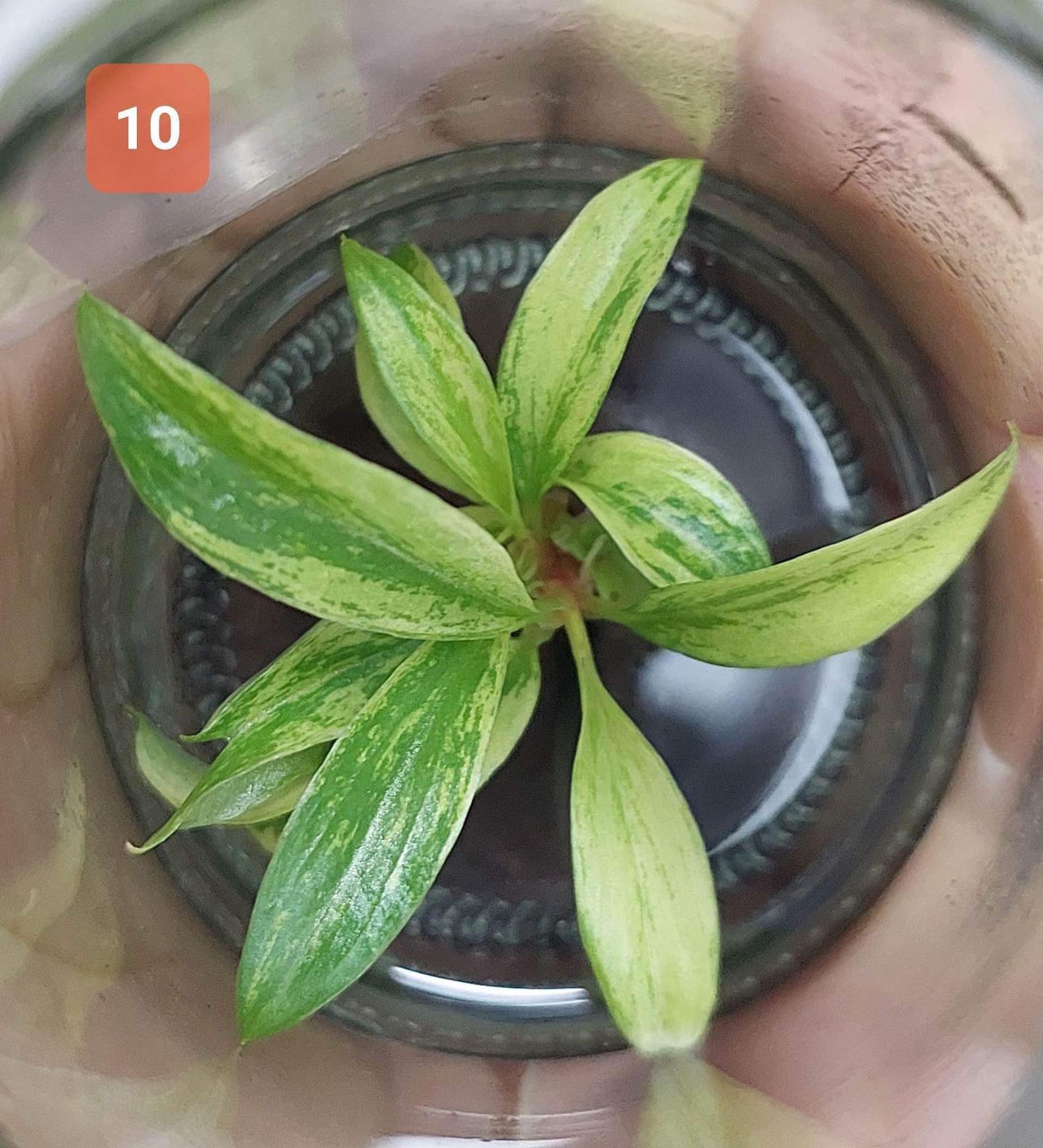
UF/IFAS describes Stage IV micropropagation as acclimatization: plantlets produced in protected in-vitro conditions must develop functional water control and photosynthesis in ordinary growing media and atmosphere.
- Confirm whether the purchase is sealed in vitro, freshly deflasked or already hardened.
- If deflasking, remove gel gently and discard tissue with obvious rot.
- Use a small clean container and pre-moistened airy medium; oversized wet pots raise root risk.
- Begin with protected humidity, warmth, modest light and some ventilation.
- Increase ventilation and light gradually only while leaves remain firm and roots are active.
- Delay strong fertilizer, frequent handling and a large pot until new ex-vitro growth appears.
The current tissue-culture Caramel Marble listing owns batch and purchase details. `Showed variegation` describes observed plantlet-stage evidence, not a promise that every future leaf will carry the same ratio. Tissue culture alone also does not guarantee zero pathogens or perfect genetic uniformity.
Buyer checks for an established plant
- Exact versus representative: ask whether the photograph is the exact plant, a mother plant or batch example.
- Hardened sequence: request at least three consecutive leaves, not only the newest soft leaf.
- Crown: inspect the active growth point for rot, mechanical damage and the current color balance.
- Roots: ask whether the plant is rooted, recently imported, freshly repotted or still acclimating.
- Architecture: confirm a compact central crown rather than buying a detached leaf or unrelated climbing plant under the name.
- Label evidence: for `Fire Tiger`, `Pluto` or an exact clone code, ask what record links the label to that plant.
- Format: compare an established Caramel Marble with tissue culture by root condition, transition risk and evidence – not by price alone.
Pet and handling safety
Philodendron is not pet-safe. The ASPCA lists Philodendron varieties among plants containing insoluble calcium-oxalate raphides. Chewing can cause mouth pain, drooling, retching, vomiting and, less commonly, swelling that affects swallowing or breathing. Keep the plant out of reach and contact a veterinarian or animal poison service after a concerning exposure.
The collector’s decision rule
Buy and grow the evidence, not the adjective. Confirm a self-heading crown, deeply lobed blades and pale pattern that remains after hardening. Track several leaves before calling reversion, protect the available green tissue, water by the root zone and never cut a compact crown as though it were an ordinary climbing stem. Treat Pluto and Fire Tiger as labels requiring records, and treat tissue culture as a developmental stage requiring acclimation.
Sources and evidence boundary
- US Plant Patent 6,293: Philodendron `Red Empress` – historical `Venus or Pluto` comparison and self-heading architecture; not evidence of Caramel Marble’s origin.
- International Aroid Society: Cultivar Registry guidance – cultivar stability, distinctness and registration boundary.
- UF/IFAS Plant Propagation: variegation – multiple variegation mechanisms.
- UF/IFAS Plant Propagation: chimeras – chlorophyll and meristem-layer behavior.
- NC State Extension: Philodendron – self-heading versus climbing forms, root and pest risks.
- University of Minnesota Extension: indoor-plant lighting.
- Iowa State Extension: condition-based houseplant care.
- Penn State Extension: nodes, cuttings and air layering.
- UF/IFAS EP520: tropical-foliage micropropagation and acclimation.
- ASPCA: Philodendron calcium-oxalate exposure.
Evidence note: `Caramel Marble` and `Fire Tiger` are treated here as horticultural labels. A historical source establishes `Pluto` as a green self-heading trade plant, but no authoritative source checked established Caramel Marble’s breeder, mutation event, parentage or a formal Fire Tiger synonym. The first-party photographs support the plant-level identity and architecture described here.