Greenboog collector comparison guide
“Alocasia type” can mean an accepted species, a named cultivar, a hybrid or simply a foliage look. Start with the plant in front of you: blade shape, surface texture, vein contrast, petiole pattern and mature scale.
This page is the comparison hub. Use it to narrow the identity, then continue to the exact guide or the current Alocasia collection. Live products—not this evergreen guide—own price, stock, size, quantity and photographed-unit details.
Alocasia names do not all mean the same thing
Kew Plants of the World Online accepts the genus Alocasia and currently lists 91 accepted species, native from tropical and subtropical Asia to eastern Australia. That count can change as names are published or revised. It also does not include every horticultural cultivar, hybrid and trade label sold by nurseries.
| Name level | Example | What it supports | What it cannot prove |
|---|---|---|---|
| Accepted species | A. reginula, A. baginda, A. scalprum, A. tandurusa | A botanical identity backed by a current taxonomic source | That a nursery plant is correctly labeled from one photo |
| Horticultural cultivar or hybrid | ‘Polly’, ‘Stingray’, ‘Sarian’ | A plant selected or produced in cultivation | A wild native range or guaranteed growth in every room |
| Trade or collector label | Jacklyn, Frydek, Yucatan Princess | Useful discovery language linked to a known plant in trade | Formal registration, parentage or consistent seller usage |
| Pattern description | Pink variegated, aurea, mint, splash | The visible color arrangement on the current plant | Future leaves, genetic mechanism or provenance |
Use six visible traits before choosing a label
- Blade outline: broad heart, shield, arrow, narrow scalpel, long tail or deeply divided lobes.
- Surface: glossy, velvety, bullate, puckered, smooth or heavily textured.
- Venation: white, silver, dark impressed or low-contrast; compare primary and marginal veins.
- Petiole: solid green, maroon, mottled, striped or visibly hairy.
- Scale and spacing: compact crown versus a tall structural plant; use an actual measurement, not a close-up.
- Several leaves: juvenile and mature blades can differ, while one stressed or unusually patterned leaf can mislead.
Photograph the whole plant in neutral light, then take separate close views of the upper leaf surface, underside, petiole and growth point. If the label still depends on origin or parentage, ask for provenance rather than inferring it from color.
Jewel Alocasias: compact form, strong texture
“Jewel Alocasia” is useful collector language for compact species with thick, often highly textured leaves. It is not a formal botanical rank. These plants deserve their own comparison because a large elephant-ear silhouette is a poor identification model for them.
| Plant | Strong visual clues | Important boundary | Exact route |
|---|---|---|---|
| Black Velvet A. reginula |
Compact crown; very dark velvety blade; bright pale primary and secondary veins | Not a 3–5-foot giant and not the same species as A. gageana | Variegated Black Velvet guide |
| Dragon Scale A. baginda selection |
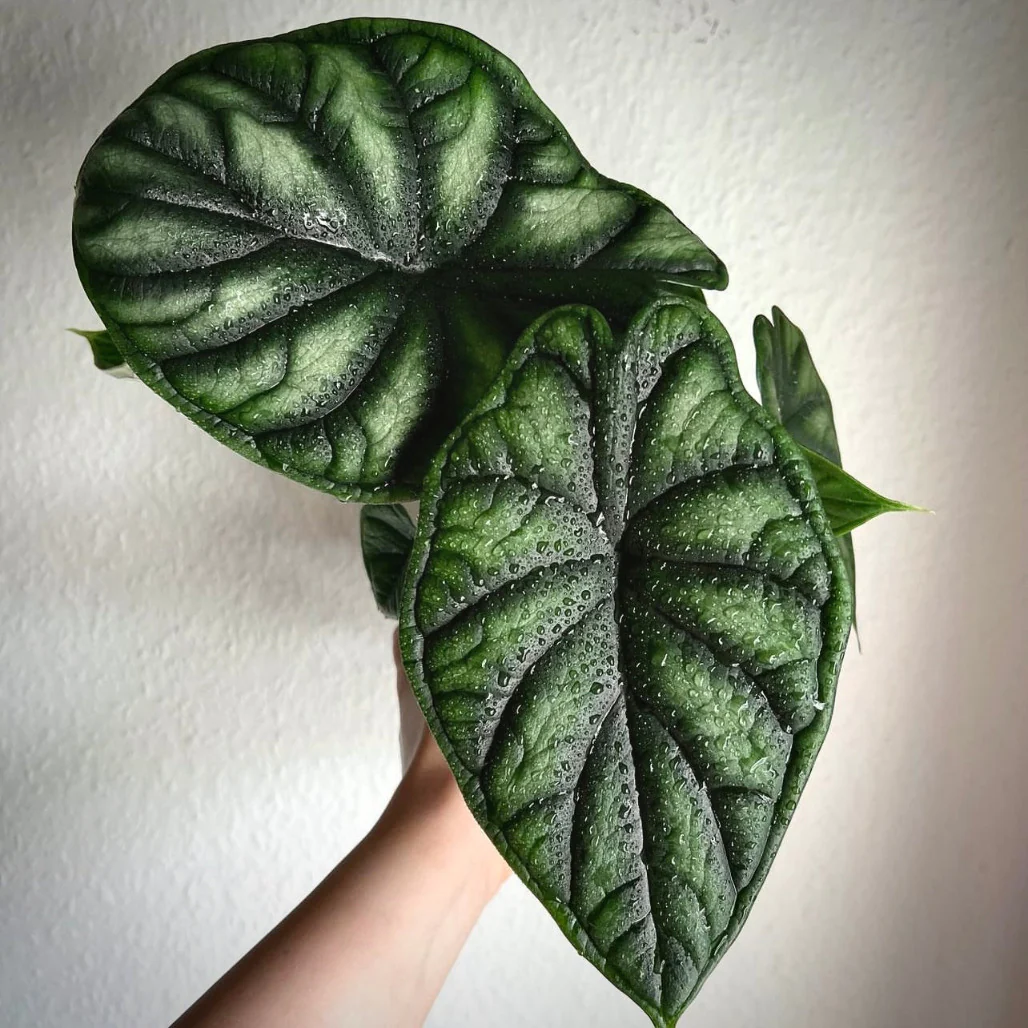
Thick, stiff, broad blade; pale bullate panels divided by darker impressed veins | Silver Dragon is a paler cultivated look; color alone does not prove the label | Dragon Scale guide |
| Scalprum A. scalprum |
Narrow knife-like blade; deeply recessed venation; darker hardened foliage | Do not identify it from “dark leaf” alone; blade proportion is central | Scalprum guide |

Velvety, divided and large structural forms
Frydek: read velvet texture before variegation
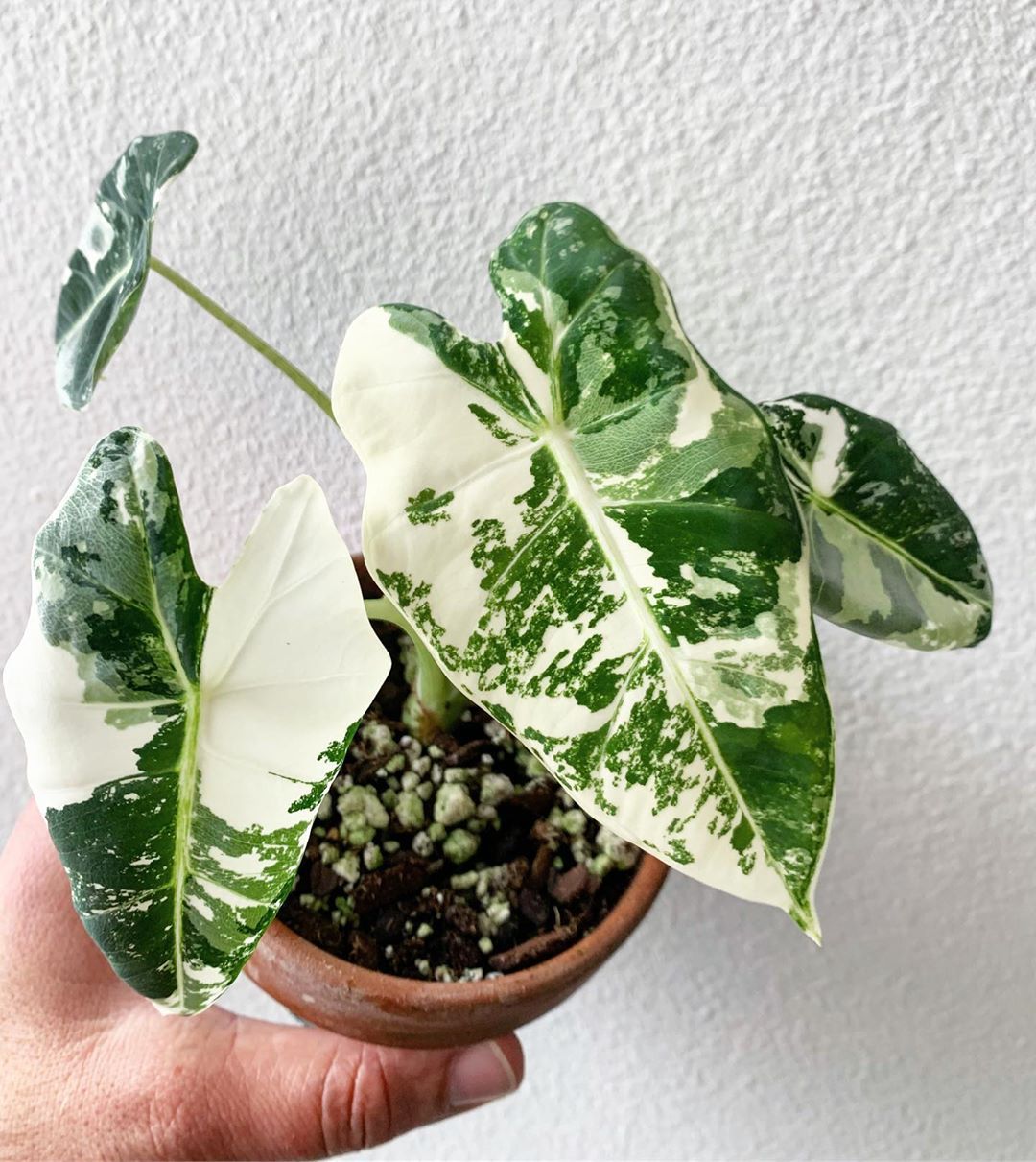
Frydek is horticultural shorthand associated with Alocasia micholitziana. Kew describes the accepted species as an erect-to-decumbent plant with deep velvety green sagittate blades and pale veins. Green, white-variegated and other trade forms still share the basic leaf architecture. Use the Alocasia Frydek identity and care guide to separate species traits from a particular variegation claim.
Jacklyn: accepted species beneath a trade name
Jacklyn is the familiar trade name associated with Alocasia tandurusa, an accepted species from Sulawesi. Deep division, toothed-looking margins and a textured or hairy surface are useful clues, but compare multiple leaves and petioles. The Alocasia Jacklyn guide covers the current species boundary and indoor care without turning every lobed Alocasia into Jacklyn.
Yucatan Princess and other cultivar-level names
Yucatan Princess is sold for dark puckered foliage, maroon-toned petioles and an upright structural look. Use that combination as a horticultural comparison, not proof of unpublished parentage. The Yucatan Princess guide keeps the trade-name boundary visible and separates the standard plant from variegated sale labels.
RHS also lists widely used cultivated choices such as Alocasia × amazonica ‘Polly’, ‘Stingray’, ‘Sarian’ and A. lauterbachiana. Their leaf silhouettes are useful shopping signals: sharp high-contrast veins for Polly, a long tail-like tip for Stingray, bold upright arrow-shaped foliage for Sarian and narrow wavy blades for A. lauterbachiana. Confirm the exact plant rather than relying on one common name.
Alocasia versus Colocasia: keep the genera separate
Both genera are called elephant ears, so a common name cannot settle the identity. Leaf attachment and orientation can help, but cultivar variation and photographs make them clues rather than a one-step test. Use the whole plant, inflorescence when available, and a reliable botanical label.
| Check | Alocasia tendency | Colocasia tendency | Limit |
|---|---|---|---|
| Leaf presentation | Often held more upright or outward | Often more pendent or outward-drooping | Age, wind, cultivar and hydration change posture |
| Petiole attachment | Often near the basal sinus or shallowly peltate, depending on species | Commonly attaches to the underside within the blade | Use a clear underside view and botanical key |
| Shopping label | Many jewel and structural ornamental forms | Taro and ornamental cultivars such as ‘Mojito’ | “Elephant ear” applies to both |
Colocasia ‘Mojito’ therefore does not belong in an Alocasia types list. Compare that separate genus through the current Colocasia collection.
Choose by mature scale and plant format
RHS notes that some Alocasias remain compact while A. macrorrhizos and A. odora can become large structural plants. Do not plan from a juvenile sale photo. Ask for current pot width and plant height, then check a credible mature range for the exact species or cultivar.
| Decision | Better evidence | Risk to avoid |
|---|---|---|
| Compact shelf or cabinet plant | Exact mature-size source plus a whole-plant photo and pot measurement | Assuming a juvenile giant remains tabletop-sized |
| Large floor specimen | Room width, warm-season light, stable pot and clearance from traffic | Buying from leaf close-ups without checking petiole spread |
| Established potted plant | Current roots, leaves, pest condition and whether the photo is exact | Treating a representative photo as the delivered specimen |
| In-vitro plantlet | Current batch, container stage and an acclimation setup prepared before opening | Comparing a plantlet directly with an established-pot price or care load |
Use the tissue-culture Alocasia collection only when you are prepared for a gradual in-vitro transition. For established and other current formats, use the main Alocasia category and verify the live listing.
Shared care baseline—then adjust to the plant
RHS recommends warmth and bright indirect light for Alocasias, with a draining medium and less water when growth slows or dormancy begins. That is a safe starting framework, not a universal weekly schedule. A compact jewel plant in a small airy pot and a large outdoor container do not dry at the same rate.
- Light: begin with bright filtered light and increase exposure gradually; strong direct sun can scorch foliage.
- Root zone: water thoroughly, drain fully and recheck moisture below the surface before repeating.
- Temperature: protect tropical foliage from cold drafts and abrupt transport exposure.
- Humidity: pair additional humidity with air movement and clean plant spacing; do not keep the root zone saturated to compensate for dry air.
- Season: reduce water in proportion to lower light, temperature and active leaf production rather than forcing summer growth.
Buyer checklist
- Identify whether the name is a species, cultivar/hybrid, trade label or pattern description.
- Request a whole-plant photo plus upper leaf, underside, petiole and growth-point views.
- Confirm whether images show the exact plant or a representative batch.
- Compare the delivered format: in-vitro plantlet, plug, corm, juvenile pot or established specimen.
- Check roots, active growth and pests rather than valuing color alone.
- Read current shipping and destination rules at checkout instead of relying on an evergreen article.
Alocasia types FAQ
How many Alocasia species are there?
Kew’s current accepted-species list contains 91 entries at the time of this review. Taxonomic counts change, and nursery lists also include cultivars, hybrids and trade labels that are not extra accepted species.
What is a jewel Alocasia?
It is useful horticultural language for compact Alocasias with thick, often highly textured or strongly veined foliage. It is not a formal taxonomic rank.
Is Alocasia Frydek a climbing plant?
No. Frydek is associated with the terrestrial species A. micholitziana. An older stem may become decumbent, but it is not a vine that needs a moss pole or trails like a pothos.
Is Black Velvet a large Alocasia?
No. Black Velvet is a compact dark-leaved plant associated with A. reginula. A listing that describes it as a multi-foot giant should be checked carefully.
Is Colocasia Mojito an Alocasia?
No. ‘Mojito’ is a Colocasia cultivar. Both genera are called elephant ears, but they should remain separate in identification and shopping routes.
Which Alocasia is easiest to grow?
No label guarantees an easy plant. Choose a healthy specimen whose mature scale and plant format match your light, warmth, space and ability to manage the root zone.
Sources and evidence boundaries
- Kew Plants of the World Online: accepted genus, range and current species list
- Kew: accepted Alocasia reginula record
- Kew: accepted Alocasia baginda record and morphology
- Kew: accepted Alocasia micholitziana record and morphology
- Kew: accepted Alocasia tandurusa record
- Royal Horticultural Society: Alocasia selection and growing guide
- Royal Horticultural Society: compact Black Velvet profile
- NC State Extension: genus habit, leaves and calcium-oxalate safety