
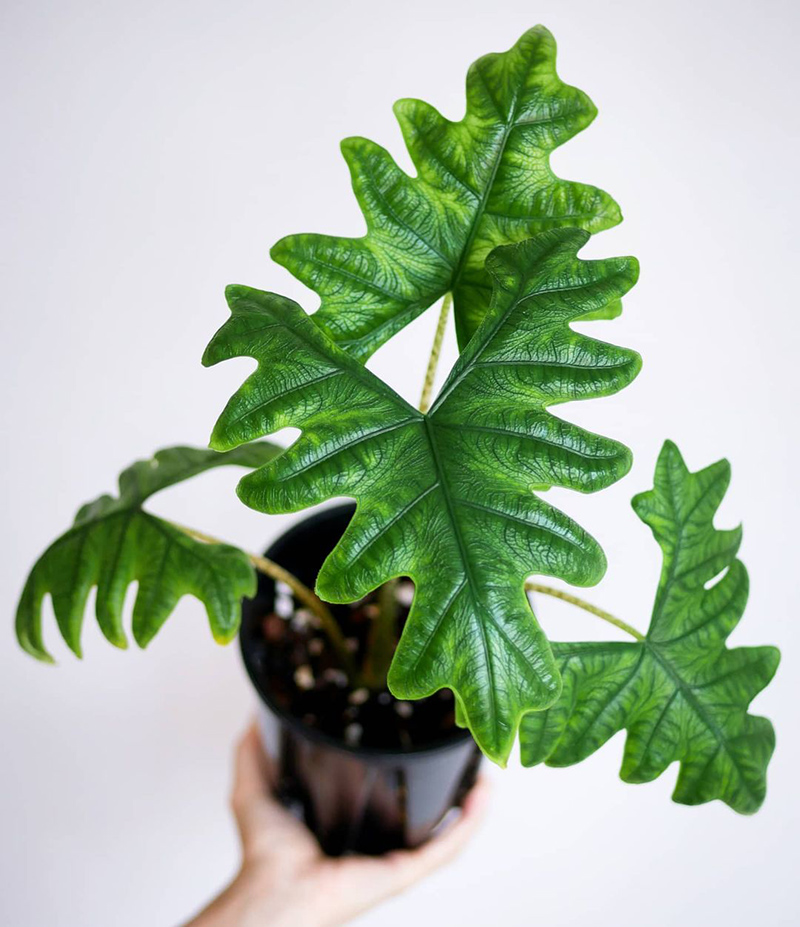
Greenboog Alocasia identity and care field guide
This guide is for Alocasia owners, collectors and buyers who need to identify standard Jacklyn, solve leaf or root problems and distinguish an established green plant from a variegated or Mystic tissue-culture sale format.
Use a group of traits; one young leaf or a seller name is not enough.
| Trait | Useful cue | Boundary |
|---|---|---|
| Adult blade | Deeply pinnatifid, antler-like divisions | Juvenile blades can be much less divided |
| Surface | Often visibly pubescent on the upper side and margin | “Velvety” alone is too broad for identification |
| Venation | Primary veins impressed above and prominent beneath | Crisp white veins are not a universal Jacklyn trait |
| Petiole | Brown-to-purple speckles or mottling | Check multiple petioles and the whole plant |
| Name | A. tandurusa is accepted; Jacklyn is the familiar trade/synonym label | Variegated and Mystic are current seller-line descriptors, not Kew varieties |
Jacklyn now has an accepted botanical name
Kew’s Plants of the World Online accepts Alocasia tandurusa Pram. & A.Hay, first published in Aroideana in 2023. Kew gives the native range as Sulawesi and the biome as wet tropical. The RHS species record uses the correct botanical name and lists Alocasia Jacklyn as a synonym.
“Jacklyn” remains useful because buyers search and sell under it, but it should not replace the species name in an identity guide. Nor should “Sulawesi” be expanded into a vague claim that the species is native throughout tropical Asia.
How to identify Alocasia tandurusa

The published-description summary for A. tandurusa gives a much stronger identification set than “large arrow-shaped leaf”:
- Adult blade: deeply pinnatifid, with divisions extending more than halfway toward the midrib and sometimes carrying small subsidiary lobes.
- Surface: the upper side is often pubescent—covered with short hairs—and the margin can remain hairy on older leaves.
- Venation: primary veins are impressed above and prominent beneath; they are not defined by universal crisp-white coloring.
- Petiole: brownish-to-purplish speckles or mottling, rather than a plain green stalk.
- Scale: the original description records a plant to about 1 m tall, petioles to about 75 cm and adult blades to about 70 cm.
- Juvenile change: young blades are less divided, somewhat peltate and sinuous, so a small plant will not show the full antler shape.
Jacklyn is not Alocasia nycteris
The 2023 description compares A. tandurusa with the Philippine species A. nycteris and distinguishes them by leaf-sheath proportions, blade outline, pubescence, depth of lobing and floral structures. That makes A. nycteris a separate comparison species, not a Jacklyn variety or synonym. Identify an ambiguous juvenile cautiously rather than forcing a trade label from one leaf.
For broader comparison without collapsing distinct species into one seller family, use the Alocasia types and identification hub.
Alocasia Jacklyn care at a glance
Start with active leaves, rooted volume and room conditions rather than a fixed schedule.
| Factor | Useful starting point | Adjust when |
|---|---|---|
| Light | Bright, diffused light; gentle sun after acclimation | Fixed scorch appears or growth weakens and stretches |
| Water | Soak after the upper rooted mix partly dries, then drain | Leaf area, pot depth, light, temperature or growth rate changes |
| Root zone | Open, moisture-retentive mix in a draining pot | The core stays saturated or the full pot dries too quickly |
| Temperature | Warm and stable, away from cold glass and drafts | Cooler conditions slow roots and leaf activity |
| Humidity and air | Stable room humidity with gentle circulation | Edges repeatedly dry after light, roots and watering are corrected |
| Feeding | Label-directed fertilizer during active growth | Roots fail, light falls or the plant slows or becomes leafless |
Light: use brightness, not window direction
The RHS Alocasia growing guide recommends bright but indirect light and protection from strong sun. A compass label is not enough: an east window can be shaded, while a west window can be intense through summer glass. Judge duration, distance, season, curtains and leaf response.
Acclimate a shade-grown plant gradually. Pale fixed patches on the exposed side support scorch; weak petioles, small new leaves and long gaps between growth may support inadequate usable light. A grow light can work when its intensity, distance and schedule are appropriate.
Water the root zone, not the calendar
The old page told readers both to let the soil dry and to keep it consistently moist. A better rule is conditional: allow the upper portion of an airy mix to partly dry while the deeper root zone remains lightly moist, then water thoroughly and let excess drain. Check at more than one depth and learn the pot’s weight.
A plant in strong light with several leaves can use water quickly. The same plant in cool, dim conditions or after losing leaves may use very little. Repeating a summer volume during slowdown can leave the rhizome without oxygen. A cachepot, compact center plug or oversized pot can also stay wet after the visible surface dries.
Why fixed care targets can mislead
Translate a broad recommendation into an observable plant response.
| Common advice | Useful core | Context that changes it |
|---|---|---|
| Give 6–8 hours of bright indirect light | Jacklyn needs usable light without abrupt scorch | Window intensity, season, distance and acclimation matter more than an hour count alone |
| Water when the top 1–2 inches dry | Avoid continuous saturation | The same depth represents different proportions of a shallow plantlet pot and a deep mature pot; check weight and rooted-zone moisture |
| Keep 65–85% humidity | Stable air can reduce stress on tender leaves | Humidity cannot repair failed roots, cold or stagnant air; established plants can adapt outside a narrow band |
| Feed every 4–6 weeks | Active leaves and roots need nutrients | Product strength, light and growth rate decide whether that interval is useful or excessive |
| Stop all winter care | Slow plants use less water and fertilizer | A warm bright plant may keep growing; a sound leafless rhizome still needs protection from saturation and prolonged desiccation |
Mix, pot and repotting
Choose a container with working drainage and an open mix that still holds useful moisture. Bark, coarse mineral aggregate and a quality potting base can supply structure, but the right ratio depends on the room and watering style. Repot for a filled root volume, collapsed mix, chronic channeling or a root problem—not just because the calendar changed. Move up modestly rather than placing a small root system in a large wet volume.
Humidity, airflow and hairy leaves
Wet lower montane forest is humid and sheltered, but an indoor plant still needs gas exchange around roots and leaves. A humidifier is more controllable than routine misting. Repeatedly wetting the pubescent blade does not create lasting room humidity and can leave mineral spots or prolong leaf wetness. Aim for stable air moisture plus gentle circulation, not a sealed stagnant corner.
Warm growth, winter slowdown and dormancy
Keep Jacklyn warm and away from cold glass, air-conditioning and heater blasts. Under stable warmth and useful light it may retain leaves and continue growing. Under shorter days or cooler conditions it may slow sharply or shed foliage. Do not promise that every plant stays evergreen, and do not declare a firm rhizome dead just because the last leaf drops.
During slowdown, stop feeding and reduce water in proportion to root and leaf activity. Keep a sound rhizome from remaining saturated or becoming desiccated for weeks. Increase water and nutrition only after warmth, light and new growth return.
Feeding and leaf maintenance
Feed an actively growing, rooted plant at the label rate. More fertilizer cannot compensate for inadequate light or failing roots and can add salt stress. Flush or repot if a persistent crust forms and root tips decline. Remove only fully dead or diseased leaves with a clean tool; healthy leaves support the rhizome even when they are not cosmetically perfect.
Dust hairy leaves gently with a soft brush or a low-pressure rinse when conditions allow quick drying. Do not polish them with oil, mayonnaise or leaf-shine products.
How to propagate Alocasia tandurusa
Alocasia is not propagated from a leaf cutting. The practical routes are rooted offsets, small tubercles/corm-like propagules associated with the rhizome, or rhizome division. RHS recommends separating offsets with as much root as possible or dividing the fleshy rhizome during active growth.
- Unpot only when there is a reason and locate a naturally separable offset or sound rhizome section.
- Use a clean tool if a cut is necessary; retain roots and a viable growth point.
- Pot the division in a small, airy, lightly moist volume rather than burying it in an oversized wet pot.
- Keep it warm with gentle bright light. Increase normal watering and feeding only after roots and a new leaf show active growth.
Division reduces the mother plant’s stored resources and creates infection surfaces, so “more pieces” is not always the safest goal.
Tissue-culture plantlets need a different first phase
A sealed in-vitro plantlet has functioned in very high humidity and is not ready for mature-plant care on day one. UF/IFAS describes acclimatization as a gradual transition: protect rooted microplants from rapid desiccation in shaded high humidity, then reduce humidity and increase light as functional roots and leaves develop.
Ask whether a listing is in vitro, freshly deflasked, rooted in community trays or already hardened. That stage matters more to initial care than a generic “water weekly” instruction.
Troubleshooting Alocasia Jacklyn
Use the pattern to choose the first inspection; the detailed branches below explain each decision.
| Pattern | Check first | Next decision |
|---|---|---|
| One oldest leaf yellows | Whether the rest of the plant and newest growth remain firm | Observe the trend before treating normal senescence as root rot |
| Repeated yellowing + heavy pot | Odor, drainage, black roots and soft rhizome tissue | Inspect the root zone before adding water |
| Brown or curled margins | Sun change, dry-down, salts, cold contact and root condition | Correct the cause; trimming does not repair the environment |
| Stippling, webbing or residue | Both blade surfaces, veins, petiole bases and pot rim | Isolate, identify and use a label-directed pest treatment |
| No leaf after shipping | Warmth, light, roots and rhizome firmness | Give a firm stable plant time; inspect soft spreading tissue immediately |
One older leaf turns yellow
A single oldest leaf can senesce as resources move to a new one. Check the whole trend: repeated yellowing, a wet heavy pot, odor, black roots or a soft rhizome point to root-zone failure; a dry light pot and limp but firm tissue point toward water deficit. Yellow alone does not diagnose overwatering.
Brown or curled margins
Review abrupt sun, dry-down, root health, cold contact, fertilizer salts and humidity. Correct the cause before trimming. Brown tissue will not recover, but removing green leaf area does not repair the root or environment.
Fine stippling, webbing or sticky residue
Inspect both blade surfaces, veins, petiole bases and the pot rim with magnification. Isolate the plant. University of Minnesota Extension recommends washing or physical removal for small infestations and label-directed products when needed; household detergent is not insecticidal soap.
No new leaf after shipping or repotting
Check warmth, light, root firmness and whether the plant is actually in active growth. Repeated unpotting, fertilizer or heavy watering can add stress. A firm rhizome with stable roots may need time; soft spreading tissue needs immediate inspection.
Buying standard, Variegated and Mystic Jacklyn
Use Alocasia tandurusa for the species. “Variegated” and “Mystic” are seller-line descriptors in current commerce, not separate botanical varieties in the Kew species record. Verify the exact batch, plantlet stage, current leaves and seller terms; do not assume stable color or a formal cultivar pedigree from the title.
- The standard Alocasia Jacklyn listing is the established green transaction.
- The variegated tissue-culture listing is a juvenile propagation format requiring stage-specific acclimation.
- The Mystic variegated tissue-culture listing is another seller-line transaction; request current batch evidence rather than transferring its label to every Jacklyn.
Prefer propagated stock with lawful provenance. The original-description summary notes that precise wild locality information was limited because desirable aroids can be stripped after locations spread online.
Safety and household fit
The ASPCA lists Alocasia as toxic to cats and dogs because of insoluble calcium oxalates. Keep leaves, rhizomes, offsets and propagation material away from children and pets; wear gloves if sap irritates your skin. The Alocasia fit and trade-offs guide covers space, maintenance and safety without repeating an unsupported air-purifying promise.
Frequently asked questions
Is Alocasia Jacklyn the same as Alocasia tandurusa?
Yes in current horticultural use. Jacklyn is the familiar trade/synonym label; Alocasia tandurusa is the accepted species name published in 2023.
Are Jacklyn leaves velvety with white veins?
The stronger cues are a deeply divided adult blade, pubescent upper surface, impressed dark venation and brown-purple mottled petiole. “Velvety white-veined arrowhead” can lead to the wrong Alocasia.
How often should I water Alocasia Jacklyn?
There is no safe fixed interval. Check the root zone, pot weight, light, temperature and active leaf area; water thoroughly after the upper zone partly dries, then let excess drain.
Can I grow Jacklyn from a leaf?
No. A detached leaf does not create a new rhizomatous plant. Use a rooted offset, viable tubercle/propagule or rhizome division with a growth point.
Does Alocasia Jacklyn purify indoor air?
A potted plant is not a substitute for ventilation or validated air treatment. Grow Jacklyn for its documented foliage and collector interest, not as a health claim.

1 thought on “Alocasia Jacklyn: Tandurusa ID, Care & Problems”