
Greenboog species-first Alocasia guide
The “scale” effect is relief and contrast, not multicolored paint. This guide separates the standard plant from Silver Dragon and mint/variegated trade lines, then turns generic care ranges into decisions you can verify at the pot.
Use this identity-and-care frame before diagnosing, buying or propagating.
| Question | Evidence-led answer |
|---|---|
| Accepted species | Alocasia baginda Kurniawan & P.C.Boyce |
| Published / range | 2011; Borneo (eastern Kalimantan), with exact wild locality and habitat unresolved |
| Standard foliage | Matte dark green, bullate pale-grey/green panels and darker veins; no normal rainbow flecking |
| Growth habit | Compact terrestrial Alocasia, not a climbing aroid or routine stake candidate |
| Established-care baseline | Warm stability, bright filtered light, airflow and an airy root zone allowed to dry partially |
| Propagation | Offsets, cormels or viable divisions; in-vitro plantlets need staged acclimation |
What is Alocasia Dragon Scale?
Kew’s Plants of the World Online accepts Alocasia baginda and gives its native range as Borneo (eastern Kalimantan). IPNI records Kurniawan and P.C. Boyce’s 2011 publication and a cultivated type linked to eastern Kalimantan without an exact locality.
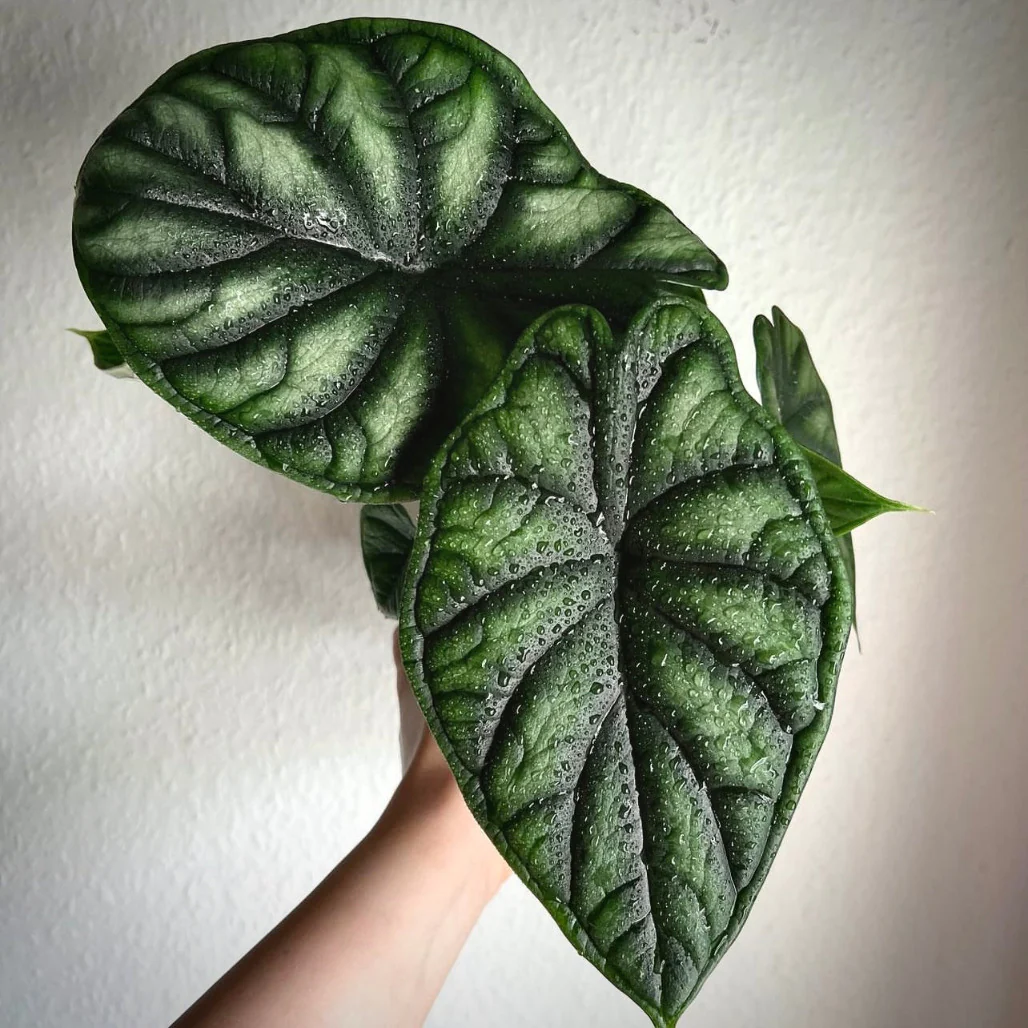
“Dragon Scale” is the familiar horticultural selection/name associated with the species. It is not the botanical meaning of baginda, and it should not be expanded into a story about multicolored dragon paint. The scale effect comes from relief and contrast: raised interveinal panels, an impressed vein network and thick, stiff foliage.
What the species description says
Kew reproduces a detailed description of a small, robust terrestrial herb about 25–30 cm tall. It carries up to four spreading leaves on pale-green petioles about 13–23 cm long. The blade is broadly ovate to suborbicular, almost completely peltate, about 10–18 cm long and 7–12 cm wide, thick and stiff. Its upper surface is matte dark green with contrasting pale-grey bullate portions defined by the veins.
The same source says the habitat is unknown and the distribution is eastern Kalimantan without an exact locality. Similar species are associated with limestone or ultramafic geology, but that is a search hypothesis—not proof that every wild A. baginda grows on a specific rock, stream bank or forest layer.
How to identify Dragon Scale foliage
- Outline: broad ovate-to-rounded shield, not a long generic arrowhead.
- Attachment: almost peltate, with the petiole attaching inside the blade rather than only at its basal margin.
- Texture: raised/bullate interveinal panels, while the upper surface itself is described as smooth rather than finely rough like A. melo.
- Color: dark matte green and pale grey/green panels with darker veins—not rainbow flecking.
- Scale: naturally compact; a small plant is not automatically a juvenile of a giant elephant-ear form.
Water droplets, flash, sharpening and white balance can exaggerate texture or silver. Compare several mature leaves in neutral light and inspect the whole plant before naming it.
Dragon Scale vs Silver Dragon vs mint or variegated lines
The trade name should predict visible evidence—not simply a higher price.
| Trade name | Expected evidence | Do not assume |
|---|---|---|
| Dragon Scale | Dark-green A. baginda selection with pale bullate panels and dark veins | One wet, sharpened or color-shifted close-up proves identity |
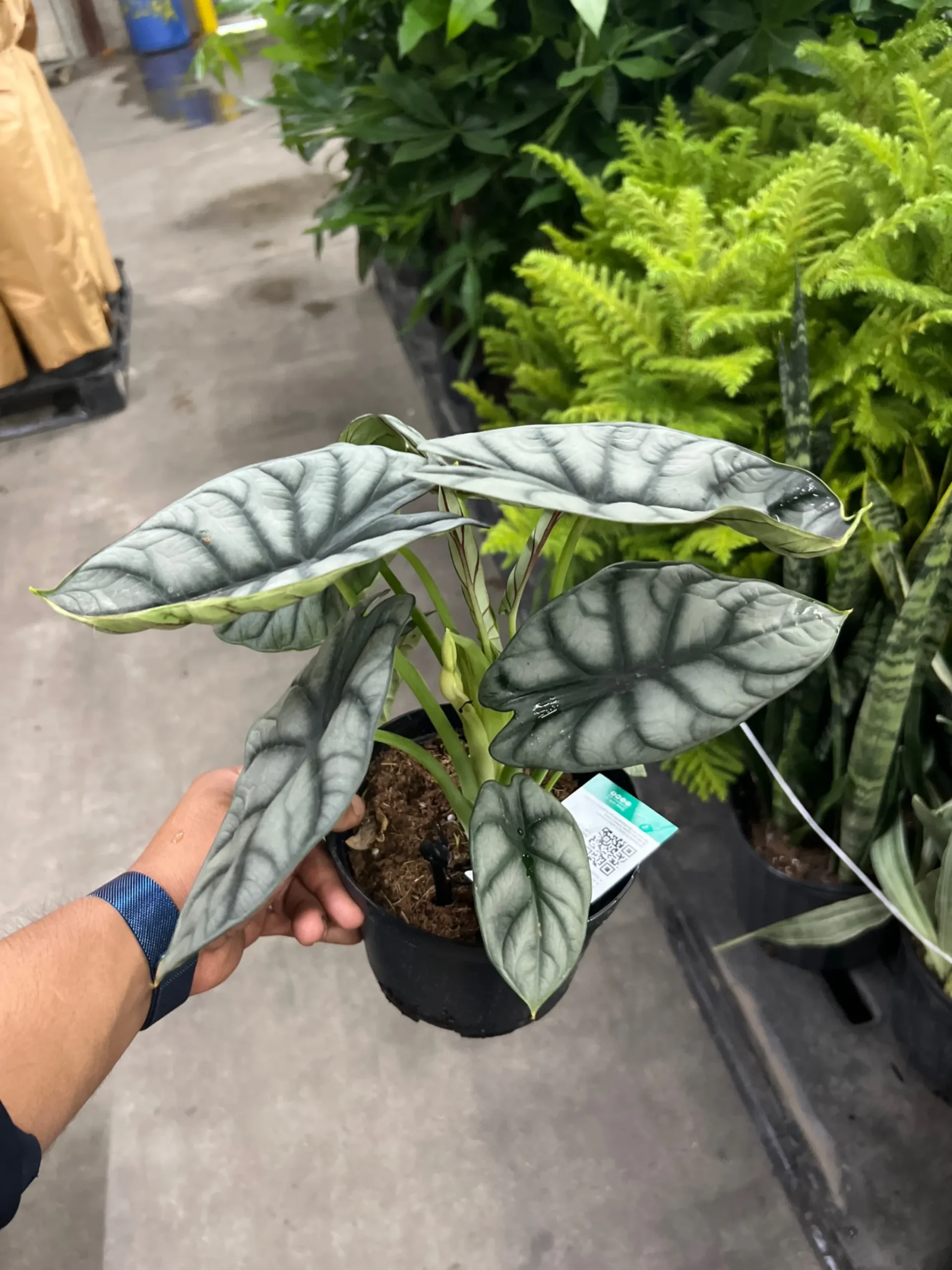
| Silver Dragon | A much paler silver interveinal field with contrasting dark venation | It is the standard dark form; use the Silver Dragon guide |
| Mint / albo / variegated | Irregular pigmentation beyond the normal vein-defined panel pattern | A label guarantees the phenotype, stability or every plantlet in a batch |
The photo below is Silver Dragon, not standard Dragon Scale. It remains here deliberately as a comparison: its pale silver field dominates each panel, while the standard plant pictured above reads much greener.
Light: useful and diffused
The Royal Horticultural Society’s Alocasia guide recommends bright indirect light and warns that strong sun can scorch foliage. Place Dragon Scale where it receives useful daylight without a sudden hot beam. After shipping, a cabinet move or a darker season, increase light in stages.
Low light reduces photosynthesis and root-zone drying. It may slow new leaves before color visibly changes. Stronger light cannot turn normal Dragon Scale into a mint-variegated line, and repeated wetting does not create its scale pattern.
Why fixed humidity and watering rules can mislead
Turn a broad care rule into an observable plant decision.
| Common shortcut | Useful core | Safer boundary |
|---|---|---|
| Bright indirect light | Supports growth while limiting abrupt scorch | Acclimate by leaf response and heat load; compass direction alone cannot measure usable light |
| Dry the top 1–2 inches | Avoid a continuously saturated root zone | Check below the surface and lift the pot; two inches is unsafe shorthand in a small cell or deep cachepot |
| 60–80% humidity | Dry air may increase edge damage and difficult unfurling | Humidity cannot repair failing roots; combine a measured level with airflow and sound irrigation |
| Equal-part aroid mix | Roots need both moisture and oxygen | Adjust particle size and water-holding capacity to the pot, climate and root system |
Water and root-zone decisions
During active warm growth, check below the surface and lift the pot. When the upper zone has dried somewhat and the container feels lighter, water the full root ball until excess drains, then empty the saucer or cachepot. A fixed “top inch” or weekly rule ignores pot size, substrate, roots, light and temperature.
Use a clean mix that balances moisture with oxygen. Quality houseplant substrate or coco/peat-free mix, fine-to-medium bark and mineral aeration such as perlite or pumice can work when adjusted to your climate. Choose a pot only modestly larger than the healthy root mass; excess wet medium around a compact corm raises rot risk.
Active growth versus slowdown
In warmth and useful light, the plant may keep growing. In cooler or dimmer conditions, it can slow or lose leaves. Follow root-zone drying and the active growth point rather than forcing calendar dormancy. A firm leafless corm can remain viable; keep it warm and only lightly moist, never saturated.
Humidity, airflow and leaf care
Medium-to-high humidity can support leaf expansion, but stagnant wetness is not the goal. Use gentle airflow and a hygrometer if conditions are uncertain. Keep leaves away from cold glass and heating/air-conditioning vents. A room humidifier can create a measurable change; a pebble tray or frequent misting cannot compensate for damaged roots.
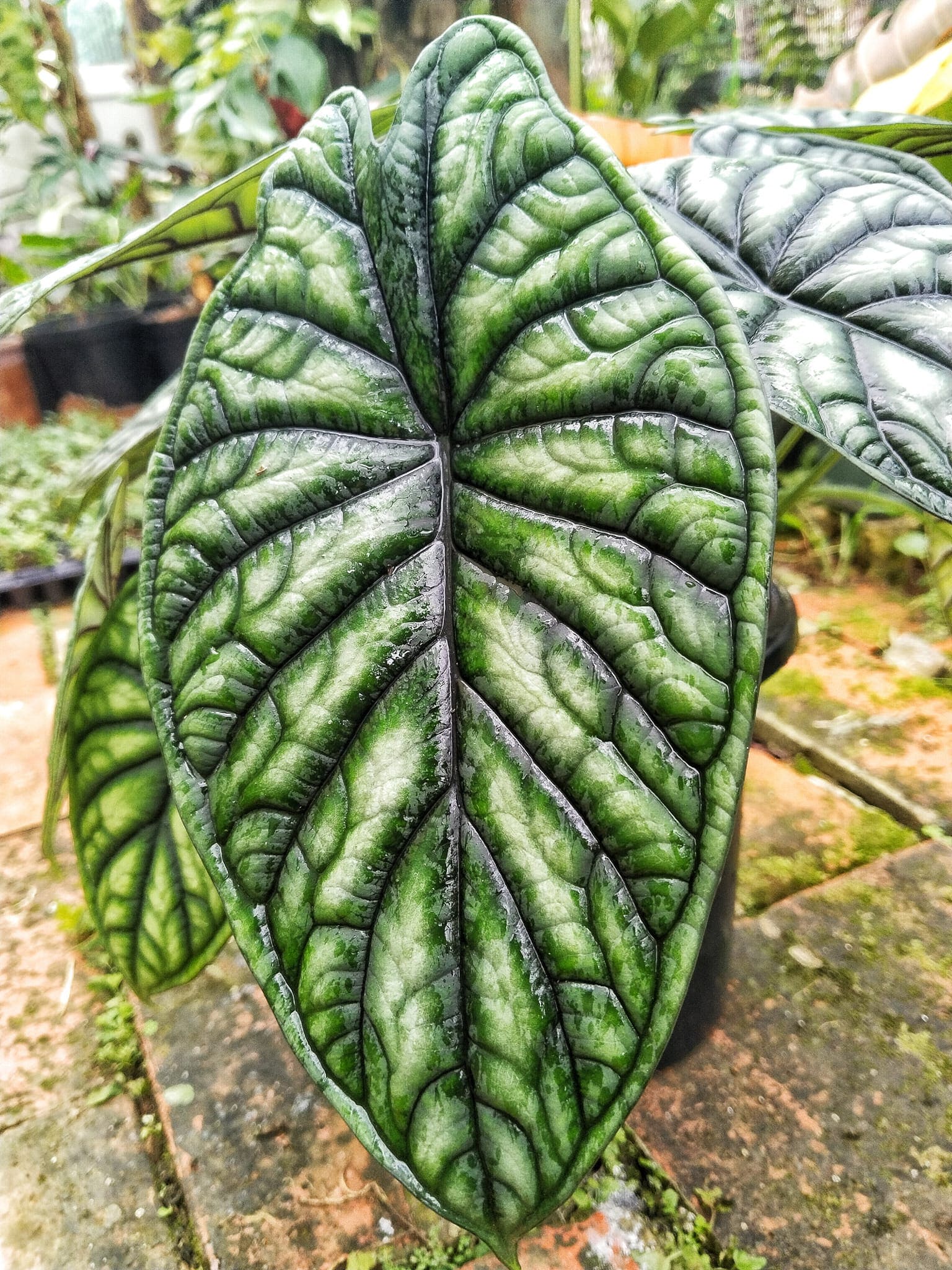
The photographed leaf is wet, but Dragon Scale does not require droplets on the blade. Water left in the texture can mark foliage and complicate pest checks. Wipe dust gently and inspect the lower surface and petiole bases for mites, thrips, scale and mealybugs.
Feeding, repotting and support
Feed only while the plant is actively rooting and producing foliage, following the fertilizer label at a conservative rate. Do not fertilize a dry, cold, newly shipped or rotting plant to “wake it up.” Accumulated salts can damage roots and mimic drought.
Repot when roots are crowded, the substrate has collapsed or water no longer moves evenly—not automatically every spring. Dragon Scale is compact and does not need a climbing stake. If the display is top-heavy, use a stable outer pot or wider base while keeping drainage water away from the inner pot.
How to propagate an established Dragon Scale
Use independently developing offsets/cormels or divide a rhizome/corm only where each section has viable growing tissue. A leaf and petiole alone are not a complete propagation unit. Do not repeatedly cut a small crown to chase variegation.
- Work during active growth with a hydrated, pest-free parent.
- Unpot and locate naturally separate cormels or rooted offsets before cutting.
- Use clean tools and retain a viable growth point and as many roots as possible.
- Pot into a small container with clean, airy, lightly moist medium.
- Keep warm in bright diffused light and wait for root/new-leaf evidence before normal feeding.
An in-vitro plantlet is different from an established division. UF/IFAS describes acclimatization as the final micropropagation stage, initially protecting plantlets from desiccation while functional roots develop. Use the tissue-culture acclimation guide for staged humidity and light changes after opening.
Troubleshooting by pattern
Read the symptom with root-zone moisture, temperature and recent change.
| Pattern | Check first | Do next |
|---|---|---|
| Droop + wet mix | Corm/roots, drainage, cold and recent repotting | Restore warmth and oxygen; remove only confirmed rot |
| Droop + light dry pot | Root-ball moisture and heat load | Rehydrate evenly, drain fully and stabilize the interval |
| Oldest leaf yellows | New growth, roots, prolonged wetness and slowdown | Diagnose the trend; one aging leaf is not a feeding prescription |
| Brown edges | Roots, drought, salts, hot/dry airflow and humidity | Correct the measured cause rather than misting automatically |
| Distorted new leaf | Mites, thrips, roots, humidity swing and physical trapping | Use the leaf-curl diagnostic before spraying |
| Leafless in cool/dim conditions | Corm firmness and root-zone saturation | Keep warm and much drier; wait for an active growth point |
| TC plantlet collapses | Humidity/light transition and root function | Return to the last stable stage and change one variable at a time |
Buying the correct Dragon Scale format
Match the listing to the plant and work you intend to receive:
- established standard Dragon Scale for a potted-plant transaction;
- standard Dragon Scale tissue culture for in-vitro plantlets;
- mint-labeled Dragon Scale tissue culture for that exact commercial line;
- albo-variegated tissue culture or potted variegated Dragon Scale for their separate transactional formats.
Availability, plant count, phenotype and acclimation stage can change. Verify exact-batch photos, propagation format, roots, contamination/arrival policy, phytosanitary paperwork and temperature-safe shipping. Do not treat a Silver Dragon photo as proof of standard Dragon Scale inventory.
Conservation and sourcing
Kew displays a 2024 model prediction of threatened status for A. baginda. A model prediction is not the same as a completed IUCN Red List assessment. The exact wild locality and habitat are also unresolved. Prefer traceable nursery propagation or documented tissue culture over wild-collected material, and do not invent a formal threat category in sales copy.
Safety around pets and children
ASPCA Animal Poison Control lists Alocasia as toxic to dogs, cats and horses because of insoluble calcium oxalates. Chewing can cause oral pain/swelling, drooling, vomiting and difficulty swallowing. Wear gloves around sap and keep plant parts, corms and pot debris out of reach; contact a veterinarian or poison-control service after exposure.
FAQ
Is Dragon Scale an Alocasia species?
The accepted species is Alocasia baginda. Dragon Scale is the horticultural selection/name used for the darker green scale-patterned form.
Where is Alocasia baginda native?
Kew gives Borneo, specifically eastern Kalimantan. The exact locality and wild habitat remain unknown, so more precise habitat stories are unproven.
Is Silver Dragon the same as Dragon Scale?
No. Both are associated with A. baginda, but Silver Dragon has a much paler silver interveinal field. Use the separate Silver Dragon guide for that selection.
Are red or purple flecks normal on Dragon Scale?
No. Standard Dragon Scale is identified by green/pale-grey raised panels and darker veins. Irregular additional color should be evaluated as a separate commercial line, damage or image artifact.
Does Dragon Scale need a stake?
No. It is a compact terrestrial Alocasia. Stabilize the pot if needed, but do not train it as a climbing aroid.
How often should I water it?
There is no universal interval. During active growth, water after the upper root zone dries somewhat; during cool/dim slowdown, let it stay much drier.
Can I propagate it from a leaf?
No. Use a viable offset/cormel or rhizome/corm division with a growing point; a leaf and petiole alone are insufficient.
Sources and evidence boundaries
- Kew POWO: accepted name, range, description and model-prediction boundary
- IPNI: nomenclatural authorship and 2011 publication record
- RHS: genus-level light, temperature, irrigation and seasonal-growth guidance
- UF/IFAS: tissue-culture acclimatization principles
- ASPCA Animal Poison Control: Alocasia toxicity
