
Greenboog jewel Alocasia guide
Silver Dragon is useful precisely because it looks different from standard dark-green Dragon Scale. This guide turns that visual difference into a repeatable identity check, then links leaf and root signals to safer care.
What Silver Dragon is—and what the name does not prove
Kew accepts Alocasia baginda Kurniawan & P.C.Boyce, a species published in 2011 from eastern Kalimantan in Borneo. Its description records stiff, thick leaves with pale-grey raised panels divided by darker veins. IPNI confirms the publication and type record.
Silver Dragon is the horticultural label used for a particularly pale cultivated look associated with that species. The available taxonomic records do not support the old claim that it arose by crossing two Elephant Ear species in Thailand. A seller label can still be useful, but it should be checked against several hardened leaves and the source line.
Use structure and repeated leaf patterns—not one bright photograph—to choose the right care and buying route.
| Label | Look for | Do not assume |
|---|---|---|
| Silver Dragon | Broad pale silver-grey raised panels, dark impressed veins, thick compact blades | Every pale photo is the same source line |
| Standard Dragon Scale | Darker green field with scale-like relief and contrasting veins | It is Silver Dragon; use the Dragon Scale guide |
| Variegated/Aurea line | Irregular cream, yellow or pale-green sectors beyond the regular panel pattern | Normal silver panels are variegation |
| Black Velvet or Melo | Different surface, venation and blade proportions | All compact jewel Alocasia share one care diagnosis |
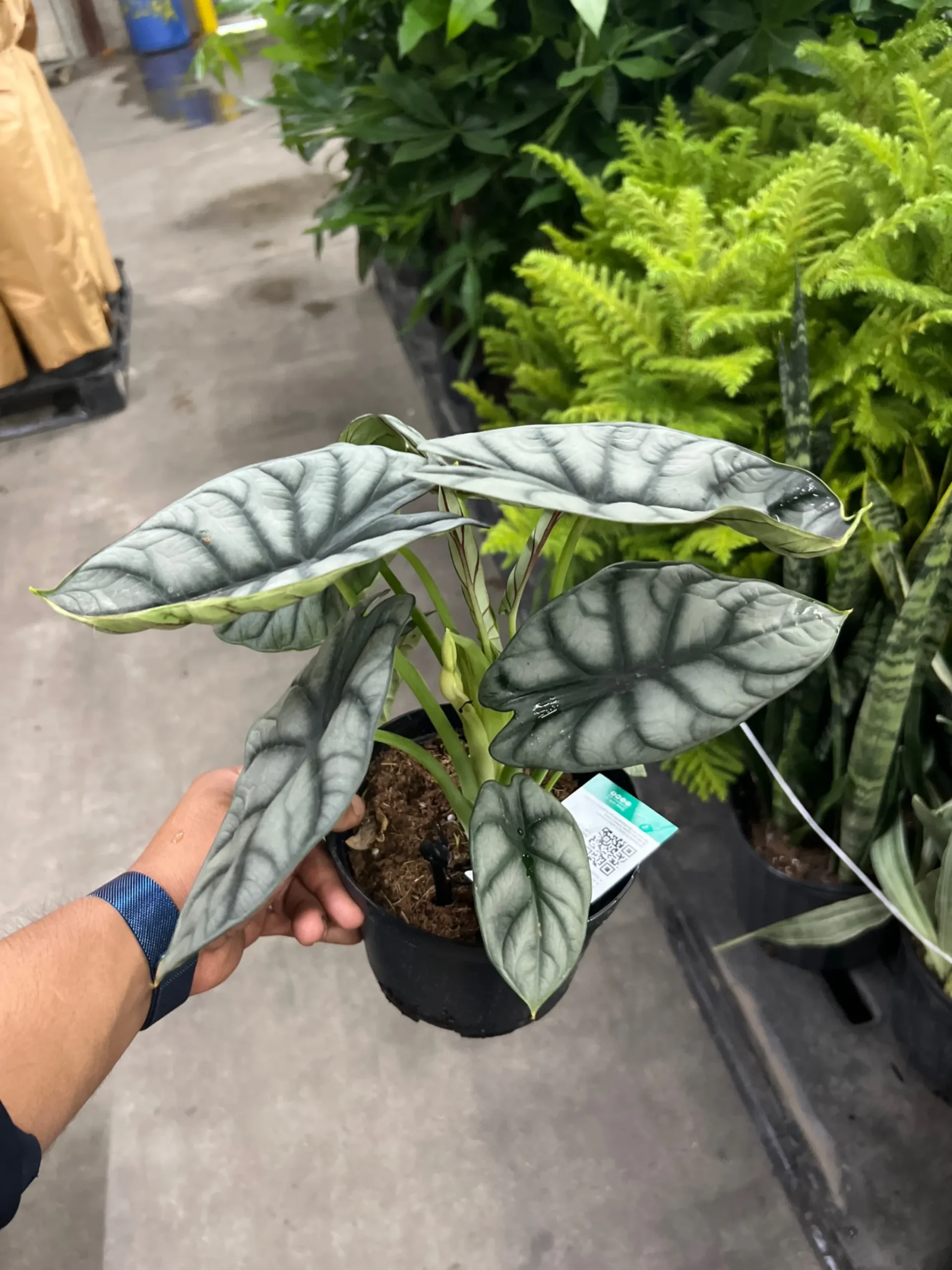
Light: protect contrast without bleaching the leaf
Give bright filtered or indirect light. In very dim placement, growth can slow and the pot can remain wet longer. Abrupt direct sun can heat or bleach exposed tissue. Increase light gradually and judge the newest hardened leaf, spacing and pot-drying pattern rather than choosing a window direction by rule.
More light does not guarantee a more silver plant; genetics, leaf age, surface moisture and photography all influence the look. If new leaves become progressively smaller, inspect roots, warmth, moisture and pests with the Alocasia growth diagnostic before adding fertilizer or light.
Watering and the compact root zone
Water thoroughly when the root zone is ready, then let excess drain. Check moisture below the surface and learn the difference between a freshly watered and ready-to-water pot. The top inch can dry while the center remains saturated; “once a week” cannot account for pot size, medium, roots, temperature and light.
Use a right-sized container and an open mix that retains useful moisture but regains air. After watering, a persistently heavy pot, sour odor or soft roots is more informative than a calendar. A small root system in an oversized decorative cachepot deserves particular attention to drainage and standing water.
Warmth, humidity, airflow and feeding
Keep conditions stably warm and avoid cold glass, air-conditioning and abrupt drafts. Humidity can slow water loss, but a universal percentage does not diagnose every home. Daily misting and pebble trays do not reproduce a controlled growing space; wet foliage can also hide the normal matte-to-satin surface and complicate pest checks.
Provide gentle air movement without a fan blasting one leaf. Feed a rooted, actively growing plant according to the fertilizer label and account for nutrients already present in fresh medium. A newly shipped, divided, root-injured or dormant plant usually needs stabilization before additional feeding.
| Observed pattern | Check first | Safer next step |
|---|---|---|
| Droop + light dry pot | Dryness at depth and water bypass | Rehydrate evenly, drain and reassess |
| Droop + heavy wet pot | Cold, drainage, odor and root texture | Restore warmth/air; inspect roots if decline spreads |
| Bleached tan patch | Recent light increase and leaf temperature | Reduce abrupt exposure and acclimate gradually |
| Crisp edge | Rapid drying, heat, roots and salt load | Stabilize supply; do not rely on misting |
| Curled new leaf | Pests, moisture swing, heat and mechanical damage | Use the leaf-curl diagnostic |
| Fine stippling/webbing | Mites under leaves and at petiole junctions | Isolate, identify and treat the pest |
Propagation: divide growth tissue, not a detached leaf
Propagate with a rooted offset, viable corm-like storage organ or division that retains basal growth tissue. A leaf or petiole cutting placed in water cannot rebuild a complete Silver Dragon. The Alocasia propagation guide shows the structures to locate before cutting.
Do not require every division to carry three to five leaves. Root and growth-point viability matter more than an arbitrary leaf count. After division, preserve healthy leaf area, use a small airy root zone and wait for recovery signals before feeding heavily.
Established plant or tissue culture?
An established pot lets you inspect several hardened leaves and the current root/medium relationship. Tissue culture can provide compact clean-start material, but the flask or plug stage cannot promise the exact mature contrast of every individual. Deflasking also needs the separate tissue-culture acclimation process, not this established-plant watering routine.
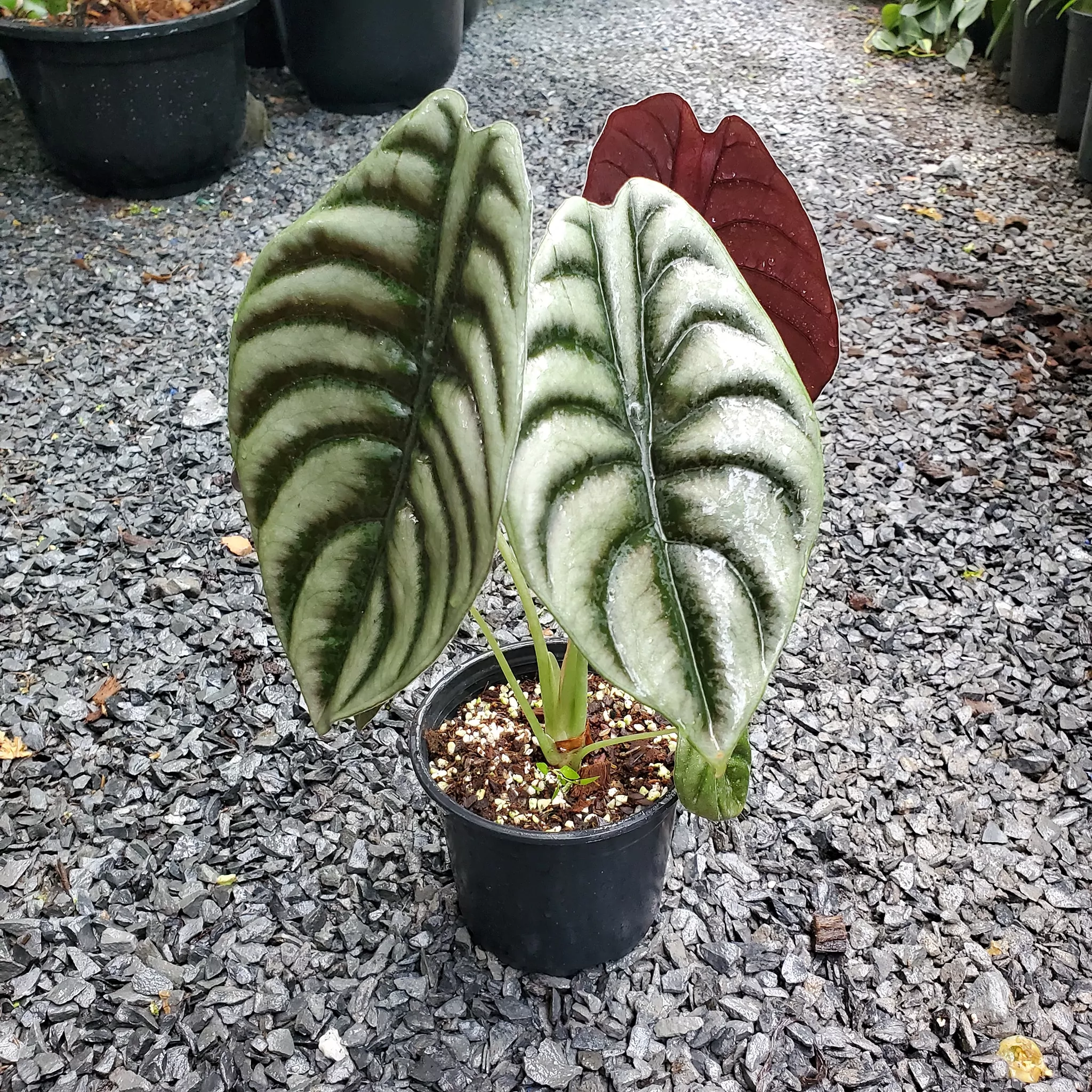
Buyer checklist
- Ask whether photos show the exact plant, a representative batch or a mother plant.
- Confirm several hardened leaves with the pale-panel/dark-vein pattern.
- Check whether the offer is established, rooted plug or in-vitro material.
- Ask for current root/medium status, plant count, scale and recent treatment.
- Use the established Silver Dragon listing or tissue-culture Silver Dragon listing only for current transaction facts.
- Use the Alocasia collection to compare current formats without merging their identities.
Safety
Alocasia contains irritating calcium oxalate crystals. Keep it away from chewing pets and children, wear gloves when dividing, and avoid sap contact with eyes or mouth. Seek veterinary or poison advice for chewing, oral pain, swelling, drooling, vomiting or difficulty swallowing.
Alocasia Silver Dragon FAQ
Is Silver Dragon a hybrid?
The available taxonomic records support association with Alocasia baginda, not the old page’s undocumented two-species Thai-hybrid story. Silver Dragon is best treated as a horticultural selection/trade label.
Is Silver Dragon the same as Dragon Scale?
They are closely associated with the same species-level identity, but Silver Dragon is selected for a much paler interveinal field. Standard Dragon Scale owns the darker comparison intent.
How often should I water it?
Use moisture at depth, pot weight, drainage, warmth and root volume. A universal weekly interval is not safe across containers and seasons.
Are the silver areas variegation?
No. Regular pale panels between dark veins are the baseline Silver Dragon look. Variegation creates irregular sectors beyond that repeated pattern.
Can I propagate it from a leaf cutting?
No. Keep basal growth tissue: use a rooted offset, viable storage organ or suitable division.
