Greenboog growth diagnostic
The useful question is not “How do I force faster growth?” It is “Which resource or recovery process is limiting this plant now, and can I improve it without creating a second problem?”
Read several signals together. A new leaf is visible growth, but it is not the only kind of progress.
| Signal | What it may mean | What it does not prove |
|---|---|---|
| New leaf forming | The crown has enough current capacity to initiate visible growth | That the same interval will repeat all year |
| Successive leaves enlarge | Roots, light and maturity are supporting stronger growth | That every cultivar will reach the same size indoors |
| Firm petioles and stable older leaves | Water supply and leaf demand are broadly balanced | That the root zone is perfect |
| Visible healthy roots | The plant is building support before or between leaves | That a larger pot is immediately needed |
| Basal offset activity | A mature, established plant has resources for lateral growth | That separating it now is safest |
| Seasonal pause | Cooler or darker conditions reduced demand | Dormancy if roots or the crown are declining |
How fast can Alocasia grow?
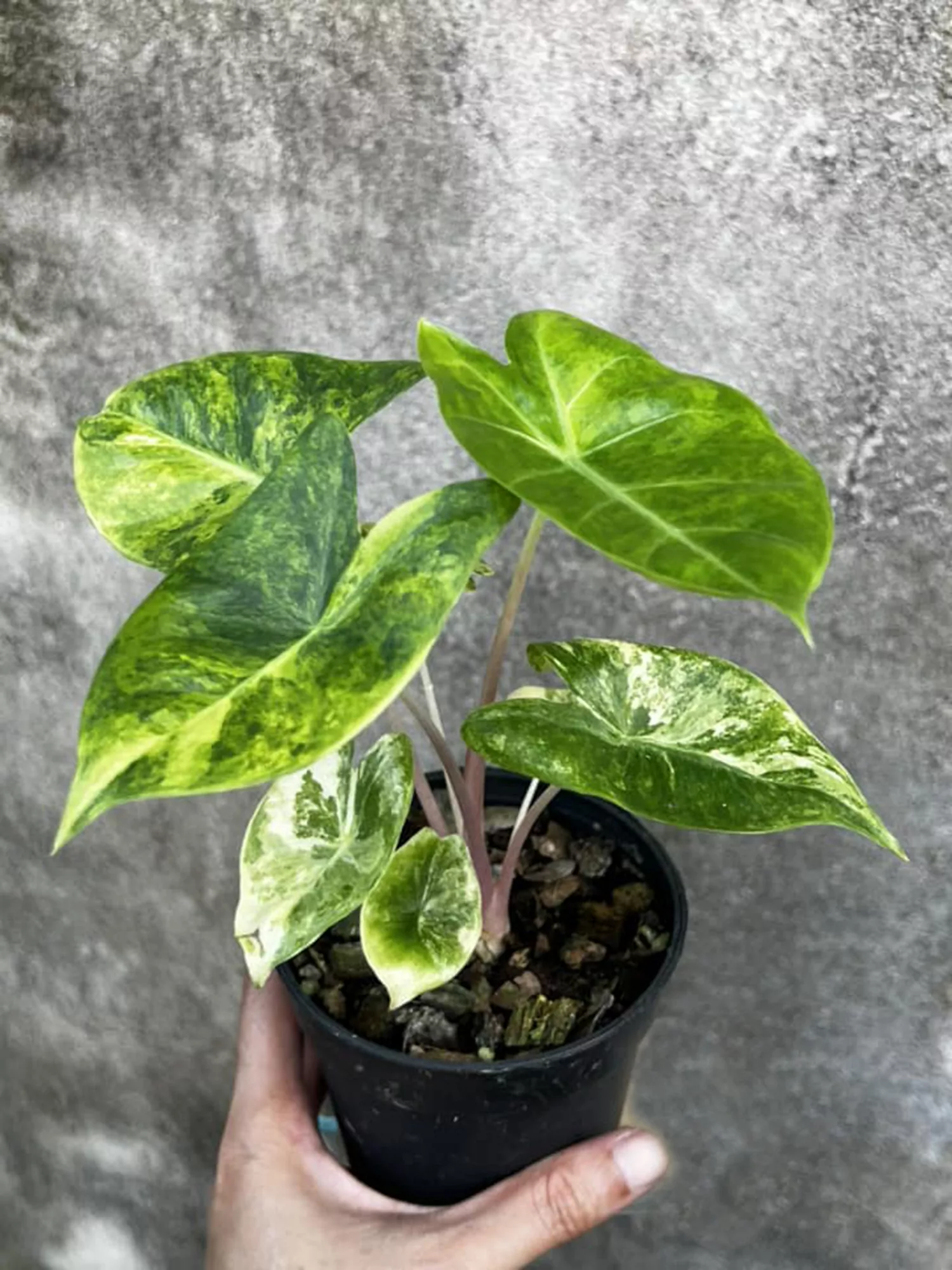
The honest range is wide. Alocasia includes plants with different mature sizes, leaf textures, habits and energy demands. A small juvenile rebuilding roots does not share the growth budget of an established specimen in a warm greenhouse. Variegated plants can also behave differently because pale tissue contributes less chlorophyll than green tissue.
The RHS Alocasia growing guide describes Alocasia as fast growing in summer and notes that plants can sometimes produce a leaf each week. That is a useful picture of favorable active growth, not a contractual schedule. The same guide explains that low light slows growth and winter may bring slower growth or dormancy.
NC State Extension also classifies the genus broadly as fast growing. Genus-level records span outdoor and indoor contexts, however, so use them to understand potential—not to declare an indoor plant unhealthy after eight leafless days.
Active growth, adjustment or real decline?
An actively growing Alocasia typically shows a sequence: a spear or rolled leaf emerges, expands and firms; roots continue exploring the medium; the next leaf may match or exceed the previous one when conditions remain supportive. A mature plant can also produce offsets. The pace often changes as days shorten, temperatures fall or a plant moves farther from its light source.
Adjustment follows a traceable event such as shipping, division, deflasking, repotting or a large change in room conditions. The plant may pause leaf production while roots restore water uptake. One older leaf can yellow as resources shift, but the crown should remain firm and the decline should not spread rapidly.
Concern rises when the pause arrives with a soft base, persistent sour or saturated medium, collapsing petioles, spreading yellowing, webbing, scale-like bumps, distorted new growth or roots that are brown and sloughing. “Dormant” should not become a label that hides active rot, cold damage or pests.
The seven controls on growth rate
1. Usable light
Light supplies the energy for leaf and root growth. Bright filtered light is a safer default than a dim interior corner or an abrupt move into hot direct sun. Watch the plant and the exposure: long weak petioles, smaller leaves and a consistently wet pot can accompany inadequate light; scorching or bleached patches after a move can indicate more intensity than the leaf was prepared to handle.
Move gradually and change one variable at a time. A brighter position can also increase water use, so yesterday’s watering interval may no longer fit. Clean dust from broad leaves so available light reaches the surface, but do not use leaf-shine products as a growth shortcut.
2. Temperature and seasonal rhythm
Alocasia is tropical and generally grows more actively in stable warmth. Cold windows, air-conditioning and cool wet substrate can slow roots before the leaves clearly show a problem. High heat can also suppress growth when roots cannot replace water lost through the foliage. Aim for stability rather than chasing one “perfect” number across every species and room.
3. Moisture plus oxygen
Roots need both water and air. Do not water twice weekly because a calendar says so, and do not wait for every plant to become bone dry. Check moisture below the surface, pot weight, drainage, temperature and root volume. Water thoroughly when the plant is ready, let excess drain and never let a decorative cachepot hold standing water around the nursery pot.
Persistent saturation slows gas exchange and can damage roots; repeated severe drying can stall a forming leaf and injure fine roots. Misting leaves does not correct a poorly watered root ball, and a pebble tray does not substitute for a stable room environment.
4. Root health and container fit
Inspect roots before assuming a tight pot is the cause. Healthy roots may circle or fill a container and justify a modest step up. A weak root system in a large volume of slow-drying medium needs less excess substrate, not more. Repotting repeatedly to “unlock growth” can reset the recovery clock and hide watering mistakes.
Use an airy, moisture-retentive mix appropriate to your conditions and a container with open drainage. Medium labels matter less than the result: the root zone should wet evenly, drain and regain air without becoming dust-dry immediately.
5. Nutrition matched to active growth
Fertilizer supplies nutrients; it does not replace light or healthy roots. Feed a rooted, actively growing plant with a balanced houseplant fertilizer at the label rate and adjust for the product, medium and watering frequency. Fresh mixes may already contain fertilizer. A newly divided, root-damaged, cold or light-starved plant cannot use an aggressive schedule simply because two weeks have passed.
Do not diagnose one yellow leaf as nitrogen deficiency or one curled leaf as a micronutrient problem. Root stress, pests, natural leaf turnover and environmental change can look similar. Review the whole pattern before adding anything.
6. Maturity, species and variegation
Juvenile plants often make smaller leaves while building roots. Large-growing species can accelerate after establishment; compact species may remain deliberately close-set. Highly variegated leaves have less green photosynthetic area, and an almost-white plant may grow more slowly or struggle to support its pale tissue. More fertilizer cannot manufacture chlorophyll.
If you are unsure which plant you own, use the Alocasia types and identification hub before applying a species-level size or speed claim.
7. Stress history and pests
Shipping, division, root pruning and rapid humidity changes can pause visible growth. Spider mites, thrips and scale can also divert resources and damage emerging leaves. Inspect the undersides, petiole junctions and new growth with good light. Isolate a suspect plant and identify the pest before choosing a treatment.
Diagnose slow growth in the right order
- Define the slowdown. Record the last new leaf, leaf-size trend and any older-leaf loss. “Not growing” may mean roots are active but no leaf is visible yet.
- List recent changes. Shipping, repotting, division, seasonal light loss, a new window or colder nights can explain the timing.
- Assess usable light. Compare duration and intensity with the plant’s previous position; avoid a sudden direct-sun jump.
- Check temperature and drafts. Feel the root zone near windows, vents and cold floors rather than relying only on a thermostat across the room.
- Read moisture at depth. Combine a finger or probe check with pot weight and drainage. Correct chronic wetness or repeated hard drying.
- Inspect pests and the crown. Look closely at new leaves, petiole bases and undersides. A soft crown or spreading collapse is urgent.
- Inspect roots when evidence justifies it. Unpot if there is a sour smell, persistent saturation, rapid wilt despite moisture or a strong reason to suspect root damage.
- Review nutrition last. Confirm the plant is rooted and actively growing, then use the fertilizer label instead of stacking products.
| Observed pattern | Check first | Safer next action |
|---|---|---|
| No new leaf, plant otherwise firm | Season, recent move, light duration and root activity | Stabilize conditions and track the trend before intervening |
| Smaller successive leaves | Usable light, root damage and feeding history | Correct the limiting factor; do not stack fertilizer |
| Yellowing + heavy wet pot | Drainage, temperature, root smell and texture | Restore air and warmth; remove only confirmed decayed roots |
| Droop + very light dry pot | Depth of dryness and whether water bypasses the root ball | Rehydrate evenly, drain and reassess before repeating |
| Curling or distorted leaves | Pests, heat/light load, moisture and airflow | Use the leaf-curl diagnostic |
| Pause after repotting or division | Root loss, pot size and moisture balance | Stop repeated disturbance and allow recovery |
| Soft crown or spreading collapse | Cold, saturation and active rot | Isolate and inspect immediately; this is not a routine growth pause |
Growth hacks that often backfire
Watering more often: more water does not create more growth when the root zone lacks oxygen. Correct the reason the medium stays wet or dries too fast.
Jumping to a much larger pot: excess slow-drying medium can keep a small root system saturated. Increase container size modestly only when roots and watering behavior justify it.
Feeding every two weeks regardless of conditions: fertilizer salts can accumulate while a cold, dim or damaged plant uses little. Follow the product label and active-growth signals.
Misting to raise humidity: a brief spray is not stable humidity and wet foliage can create spotting in low airflow. Improve the room environment if dry air is truly part of the pattern.
Cutting healthy older leaves: green leaves contribute energy. Remove a leaf for confirmed damage, disease management or practical balance—not to “redirect” growth based on a viral rule.
Changing everything at once: simultaneous repotting, relocation, fertilizing and pest treatment removes your ability to identify the cause and compounds stress.
Juvenile and tissue-culture Alocasia follow a different clock
A recently deflasked plantlet is changing how it controls water loss and uses its new environment. Its early leaves may be small, and root establishment is more important than matching the cadence of an established potted plant. High humidity can reduce initial water stress, but ventilation, light and humidity should transition gradually as functional roots and leaves develop.
Use the complete tissue-culture acclimation guide for that stage. Tissue-culture Alocasia listings belong in the tissue-culture Alocasia category; this article does not claim live stock, batch size or shipping readiness.
When growth creates offsets
Basal shoots and firm storage organs can appear as a mature plant establishes. Their presence is a growth signal, not an obligation to separate them. Keeping an offset attached can allow it to build more roots; dividing it creates a recovery event for both pieces. If you decide to separate, use the Alocasia propagation guide to confirm that the material has viable basal growth tissue and to balance roots with foliage.
Alocasia growth-rate FAQ
Can an Alocasia grow one leaf every week?
It can happen during favorable active growth, and the RHS notes that summer plants may sometimes produce leaves weekly. It is not a universal indoor standard. Species, maturity, roots, light, temperature, season and recent stress all change the interval.
Why is my Alocasia not growing after repotting?
It may be rebuilding disturbed roots, adapting to a larger moisture volume or responding to a simultaneous change in light and temperature. Check stability, pot size, drainage and root health. Do not repot again or add heavy fertilizer simply to restart the clock.
Does a bigger pot make Alocasia grow faster?
Only when the existing container genuinely restricts a healthy root system. A pot far larger than the roots can remain wet too long and slow growth. Inspect first, then step up modestly if needed.
Should I fertilize a slow Alocasia?
Only after light, temperature, moisture, pests and roots have been reviewed. Feed a rooted plant during active growth according to the label. Fertilizer cannot repair rot or compensate for inadequate light.
Is one yellow older leaf a bad sign?
Not by itself. An older leaf may be shed while a new one develops or after environmental change. Concern increases when yellowing spreads, the pot stays wet, petioles collapse, the crown softens or roots smell unhealthy.
Where can I compare current Alocasia formats?
Use the established Alocasia collection for current potted or established formats and the tissue-culture category for in-vitro or recently laboratory-propagated formats. Product pages own the live stock, size, price and shipping details.