
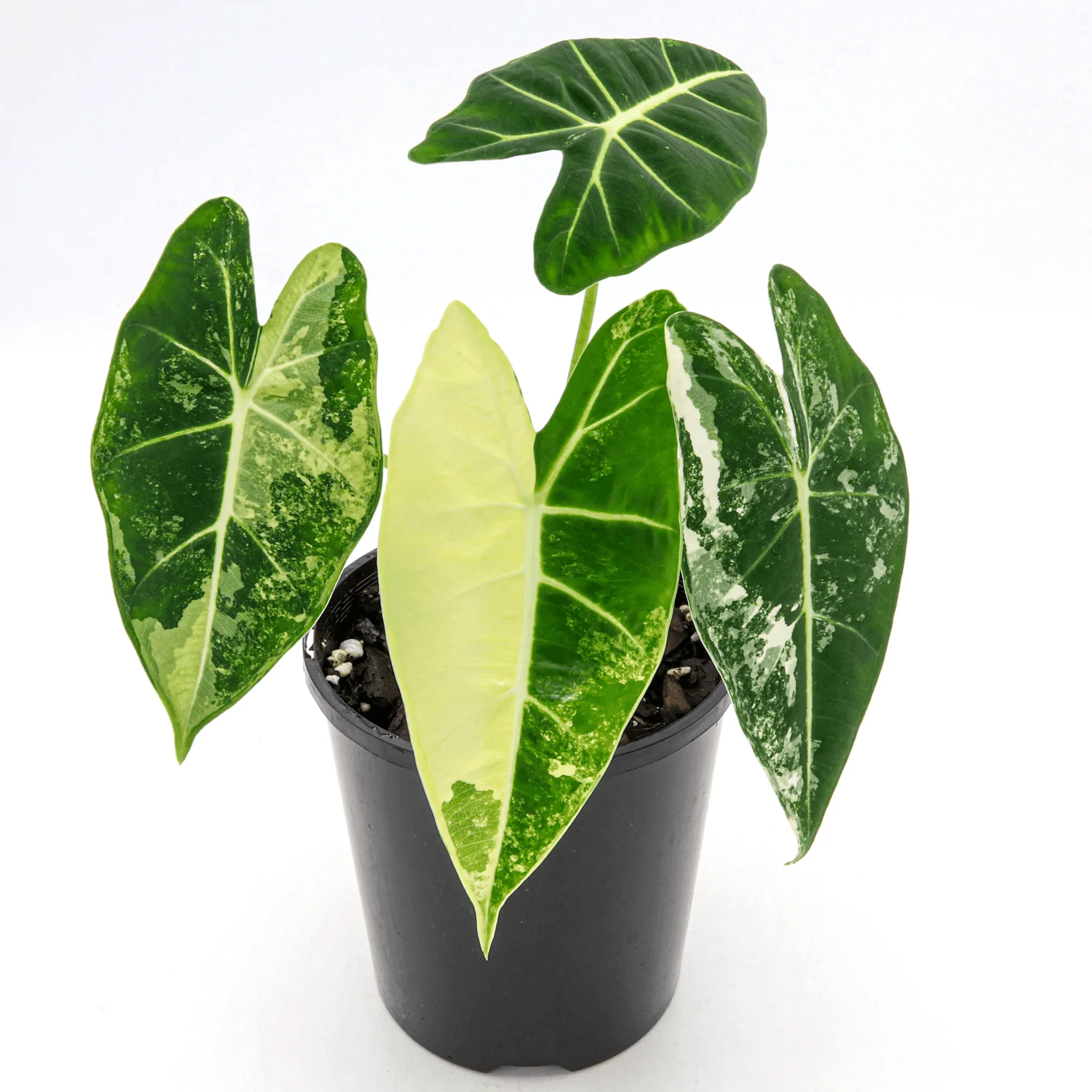
Alocasia Frydek Variegated is the trade name most growers use for a white- and green-variegated plant in the Alocasia micholitziana group. It should have arrow-shaped, velvet-textured leaves, prominent pale veins and a compact, self-heading growth point. The name is familiar; its formal horticultural status is less tidy. That distinction matters when you are identifying a plant, comparing a listing or deciding whether a tissue-culture plantlet is true to the form you expected.
This guide is for collectors who want to read the plant rather than follow a fixed calendar. Start with identity, then manage light and the root zone as one system. White tissue has less photosynthetic capacity and a smaller margin for error, but pushing a stressed plant into stronger light will not manufacture better variegation.
Alocasia Frydek Variegated at a glance
| Question | Practical answer |
|---|---|
| What is it? | A variegated trade plant associated with Alocasia micholitziana; the familiar Frydek name is not applied consistently by horticultural authorities. |
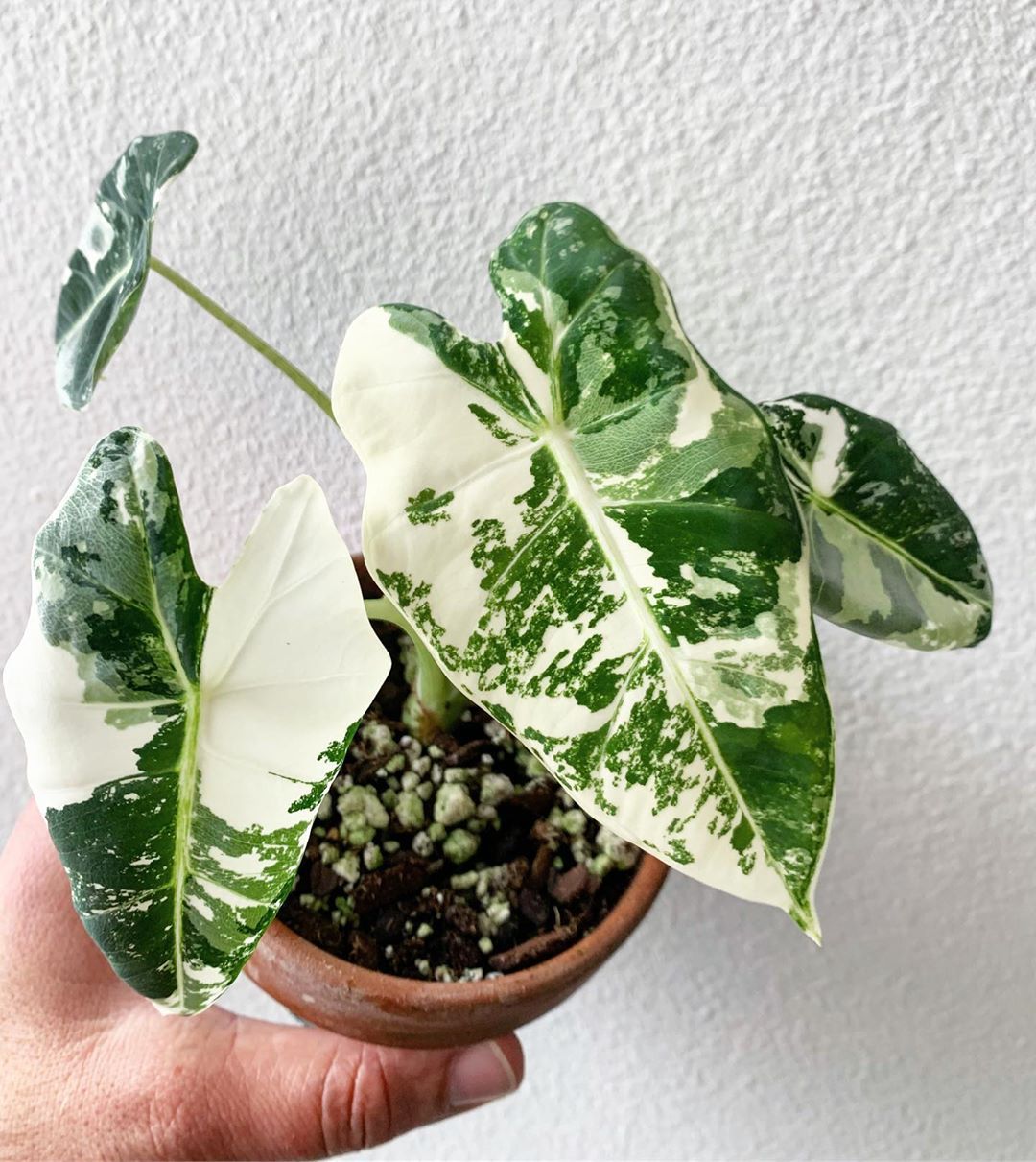
| How do I identify it? | Look for velvety sagittate blades, prominent pale primary veins, a basal sinus and white-to-cream sectors or marbling. Use several leaves and the growth habit, not one photo. |
| Best light? | Bright, indirect light that the plant has been acclimated to. Increase exposure gradually and watch the white tissue for bleaching or scorch. |
| When should I water? | When the upper root zone is drying and the pot is noticeably lighter, then soak evenly and drain completely. Recheck roots if a wet plant wilts. |
| How is it propagated? | By dividing viable offsets or cormels. A detached leaf or petiole is not a reliable route to a new whole plant. |
| Is it pet-safe? | No. Alocasia contains insoluble calcium oxalates and should be kept away from pets and children. |
What the Frydek name does—and does not—prove
Kew accepts Alocasia micholitziana Sander as a species native to Luzon in the Philippines. Its botanical description includes rich, velvety dark-green blades, pale primary veins and mottled petioles. That is useful species-level background; it does not, by itself, register every plant sold as Frydek Variegated.
Horticultural references show the naming problem openly. North Carolina Extension lists A. micholitziana ‘Frydek’ with narrow, arrow-shaped velvet leaves and bright veins. The RHS instead accepts the green plant as A. micholitziana ‘Maxkowskii’ and records green `Frydek` as a misapplied name. Its white-mottled `Freydyk` variegated profile is marked unresolved.
For that reason, this page uses Alocasia Frydek Variegated as the practical trade and search label. It does not call the plant a proven hybrid, invent a breeder or claim that the spelling settles its cultivar status. A good seller should be able to show the actual plant or representative mother stock, not rely on a name alone.
How to identify a variegated Frydek
Read several features together
- Blade: arrow-shaped to sagittate, with a defined basal sinus and a soft-looking, matte velvet surface rather than a uniformly glossy one.
- Venation: the midrib and major veins form a strong pale framework. Variegation may cross or follow that framework, but veins alone are not the variegation.
- Pattern: white, cream and paler green may appear as sectors, splashes or marbling. Each new leaf can express a different balance.
- Growth: leaves emerge from a compact cormous/rhizomatous center. This is not a climbing vine with nodes along an elongated stem.
- Petiole and underside: inspect these as supporting evidence, while allowing for age, light and individual variation.
Do not identify it from a single pale leaf
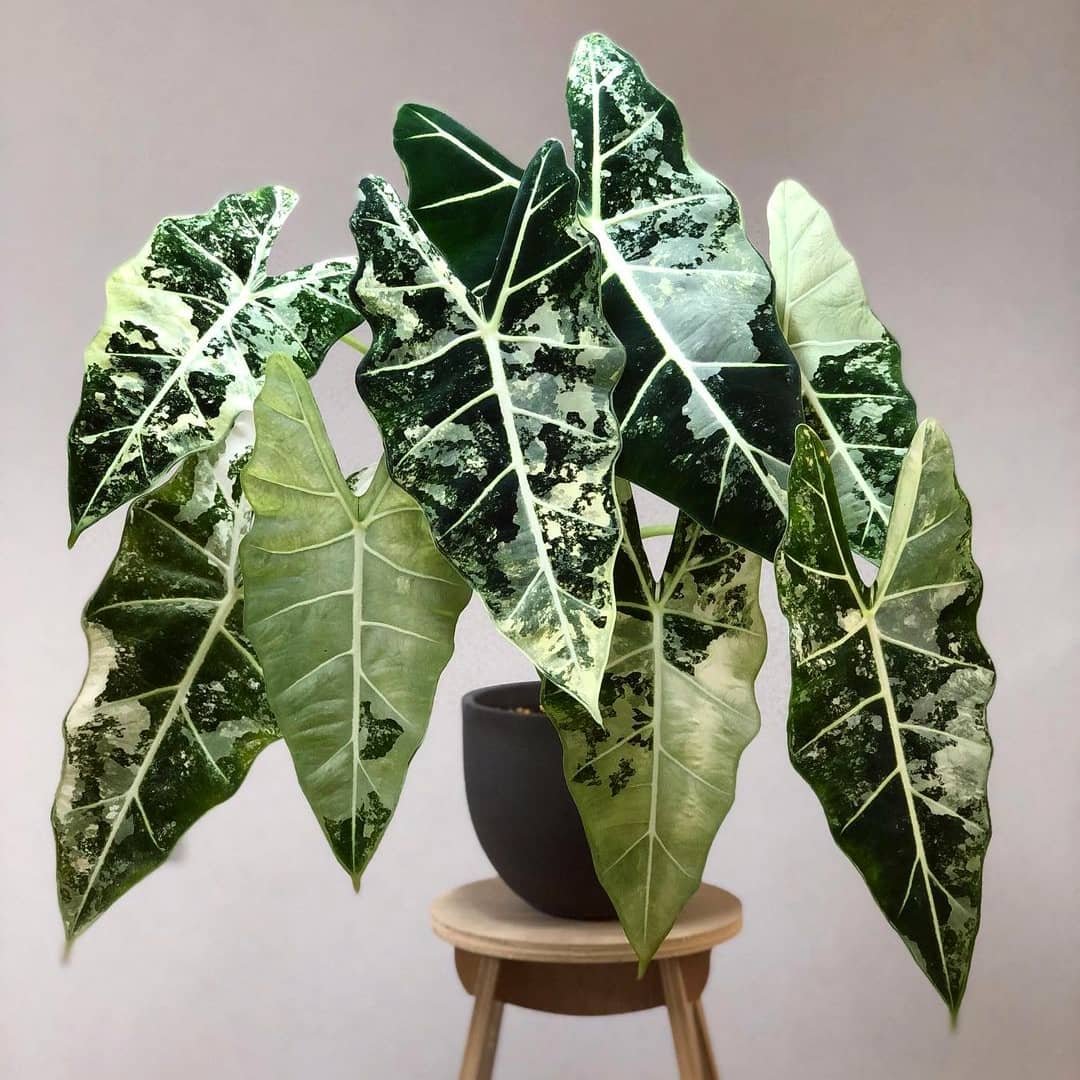
A very white juvenile leaf can harden greener, yellow from root stress or belong to a different variegated Alocasia. Compare a sequence of leaves, petiole attachment, texture and growth habit. The glossy, highly sculpted look of some Alocasia × amazonica forms is not the same as the characteristic velvet surface used to recognize the Frydek trade plant.
If you are learning how species-level evidence changes an identification, the updated Alocasia Jacklyn identity guide provides a useful comparison: it separates a published species name from the familiar trade label instead of treating seller language as taxonomy.
What variegation can tell you
White sectors contain little or no chlorophyll. They make the plant visually striking, but they do not add energy-producing capacity. A plant with enough green tissue can support its pale sectors; an almost-white plant has less reserve for shipping, root loss or a sudden light change.
Light affects how efficiently existing green tissue works and how a leaf acclimates. It does not reliably rewrite the underlying variegation pattern. Moving a green-looking plant into harsh sun will not force white sectors; it may simply scorch the leaf. Likewise, removing every greener leaf can weaken the corm without guaranteeing a more variegated replacement.
Light: protect the white tissue without starving the plant
Give the plant a bright view of the sky with filtered or indirect light. University of Minnesota Extension places Alocasia among medium-light indoor plants and emphasizes that distance, window exposure and supplemental-light placement all change the light actually reaching a leaf.
Use acclimation, not a window-direction slogan
- Start a newly arrived plant in stable indirect light, especially after dark transit.
- Move it closer to the light source in small steps over one to two weeks.
- Watch the newest mature leaf: stretching and progressively smaller blades suggest too little usable light; bleached tan patches on the exposed side suggest too much too quickly.
- Keep grow lights far enough away that leaves remain cool. Manufacturer wattage is not a leaf-level measurement.
Green tissue and white tissue can respond differently on the same leaf. Judge the most vulnerable sector and the plant’s overall growth together.
Water the root zone, not the calendar
Alocasia wants access to moisture and oxygen at the same time. Iowa State notes that Alocasia does not tolerate a persistently saturated root zone, while its houseplant diagnostic guidance recommends checking moisture before watering rather than watering on a schedule.
A repeatable watering decision
- Push a finger or wooden probe below the decorative surface. The top can look dry while the root ball remains wet.
- Lift the pot. Learn the difference between its recently watered and ready-to-water weight.
- If the upper zone is drying and the pot is lighter, water the entire root ball until water exits the drainage holes.
- Empty the saucer or cachepot. Do not leave the nursery pot standing in runoff.
- If a wet plant droops, stop adding water and inspect roots, temperature and the corm.
Frequency will change with leaf area, pot size, substrate, temperature, light and root health. That is why `every seven days` is not a care rule.
Substrate and pot: build an air–water balance
Use a clean, structurally open houseplant mix that wets evenly but does not collapse around the corm. Fine components retain moisture; bark, coarse mineral material and other stable particles preserve air spaces. The right ratio depends on your climate and watering behavior, so test the finished mix rather than copying a universal recipe.
- Choose a pot with real drainage holes and only modest extra room around the current roots.
- Keep the crown and growth point above the substrate surface; bury roots, not the center of new leaves.
- Repot when roots are crowded, the mix stays wet much longer than before, or water bypasses a shrunken root ball—not merely because a date arrived.
- Do not put gravel in the bottom as a substitute for drainage or an airy mix.
Temperature, humidity and airflow
Keep an actively growing Frydek warm and away from cold glass, air-conditioner discharge and sharp temperature swings. The RHS Alocasia guide uses above 16°C (60°F) as its warm-season baseline and recommends bright indirect light with medium-to-high humidity.
Humidity helps leaves lose water at a manageable rate, but saturated air around wet foliage can increase disease pressure. A room humidifier with air movement is more controllable than repeatedly wetting the leaves. If you use a cabinet, add ventilation and verify humidity with a meter rather than assuming `higher is always better`.
Seasonal slowdown is not automatically death
Growth may slow when light and temperature fall. Reduce water and fertilizer in proportion to the plant’s lower demand. A dormant or semi-dormant corm can lose leaves, but a cold, mushy corm is not healthy dormancy. Keep checking the root zone and growth point.
Feeding and leaf management
Feed only while the plant is producing roots and leaves. Start with a complete houseplant fertilizer at a conservative label rate after an established plant has resumed growth. Flush accumulated salts periodically with a thorough watering and pause fertilizer when roots are damaged or the plant is acclimating.
Do not remove a leaf just because it is greener than the others. Green leaves finance the corm. Remove a leaf when it is fully spent, diseased or physically failing, using a clean tool and avoiding the central growth point.
Diagnose the signal before treating it
| Signal | Check first | Useful response |
|---|---|---|
| Yellow lower leaf | Normal turnover versus long-wet mix, low light or damaged roots | Inspect moisture and roots before changing fertilizer. |
| Whole plant droops | Dry root ball, saturated root ball, cold shock or recent root disturbance | Use pot weight and root condition; do not assume every wilt needs water. |
| Tan patch on white sector | Recent light increase, heat, dry root episode or salt stress | Stabilize conditions; damaged white tissue will not turn green again. |
| Leaf curls inward | Water imbalance, heat, mites, damaged roots or low humidity | Inspect undersides and roots; use the broader leaf-curl diagnostic before treating. |
| Fine stippling or webbing | Spider mites, especially on leaf undersides and petiole junctions | Isolate, rinse if appropriate and apply a labeled control repeatedly according to its directions. |
| No new growth | Light, temperature, seasonal slowdown, root loss or a compromised corm | Check the corm and roots before feeding or repotting again. |
How to propagate Alocasia Frydek Variegated
Propagate this plant from an offset, cormel or viable divided section. It is not a Philodendron: a leaf and petiole do not contain the climbing node needed to rebuild the plant. The genus-level Alocasia propagation guide covers the underlying offset and corm workflow in more detail.
Separate an offset with the least root damage
- Work when the parent is actively growing and hydrated, but not sitting in saturated mix.
- Slide out the root ball and locate an offset or cormel attached to the main corm.
- Preserve existing roots. If separation requires a cut, use a clean blade and make one deliberate cut rather than tearing the tissue.
- Pot a rooted offset at its original depth in a small, airy container. Keep the growth point above the mix.
- For an unrooted cormel, use a clean, lightly moist medium and a warm, humid but ventilated enclosure. Condensation should not translate into a waterlogged base.
- Wait for active roots and a stable leaf before moving into ordinary room conditions gradually.
An offset can express a different amount or pattern of variegation from the parent. A pale first leaf is not proof of permanent high variegation, and a green first leaf does not justify repeated disturbance. Evaluate a sequence of growth.
Acclimating a tissue-culture Frydek
A plantlet leaving sterile culture is physiologically different from an established pot plant. UF/IFAS describes Stage IV as the point where tropical foliage microcuttings must overcome weak water regulation and reduced photosynthetic competence. It also cautions that micropropagation alone is not an automatic disease-free guarantee; specific pathogen-elimination methods may be required.
- Read the seller’s stage: a sealed in-vitro plant, freshly deflasked plantlet and hardened liner need different handling.
- Clean gently: if deflasking is required, remove culture gel without crushing fine roots and discard any plantlet with obvious rot.
- Use a clean, pre-moistened, airy medium: the small container should match the tiny root system.
- Start protected: give stable warmth, modest light and high humidity with some gas exchange. Avoid intense window sun.
- Reduce humidity gradually: lengthen ventilation in steps only when leaves remain firm and roots are active.
- Delay fertilizer and repotting: wait until the plant is rooted and growing; repeated `help` can be more damaging than a stable setup.
Greenboog’s tissue-culture Frydek format is the transactional owner for current pack details. This guide explains the acclimation logic, not what is in stock today.
Buying checks: established plant or tissue culture?
| Check | Established plant | Tissue culture |
|---|---|---|
| Identity evidence | Ask for the actual plant, several leaves and the growth point. | Ask for the lab line/trade label, representative mother material and whether the photo is representative. |
| Variegation | Look for enough green tissue plus pattern near the active point; do not buy a promise about the next leaf. | Expect variation among plantlets and during juvenile growth; do not assume every flask peer will match. |
| Root condition | Check for a firm corm, active roots and no sour, saturated substrate. | Confirm whether it is sealed, freshly deflasked or hardened, and whether roots are visible. |
| Transition risk | Main risks are shipping shock, light change and hidden root damage. | Main risks are water-balance failure, contamination after opening and changing humidity too fast. |
For a larger, rooted format, use the current established Alocasia Frydek Variegated listing. To compare other transaction owners without turning this guide into a stock page, browse the Alocasia collection.
Safety around pets and children
The ASPCA lists Alocasia as toxic to dogs and cats because of insoluble calcium oxalates. Chewing can cause oral pain, swelling, drooling, vomiting and difficulty swallowing. Place the plant where it cannot be mouthed, wear gloves if sap irritates your skin and wash tools after division. If a pet chews the plant or has trouble swallowing or breathing, contact a veterinarian or animal poison service promptly.
The collector’s decision rule
Buy and grow Frydek Variegated for the plant you can verify, not for a guaranteed future leaf. Confirm the velvety micholitziana-type architecture, accept that the trade name is taxonomically untidy, preserve enough green tissue and change one environmental variable at a time. A stable root system under useful light will do more for the next leaf than any fixed schedule or variegation hack.
Sources and evidence boundary
- Kew Plants of the World Online: Alocasia micholitziana — accepted species, Luzon range and morphology.
- RHS: A. micholitziana ‘Maxkowskii’ and variegated `Freydyk` profile — conflicting/misapplied and unresolved naming boundary.
- North Carolina Extension: Alocasia — morphology, indoor/landscape context and offset division.
- UF/IFAS: Alocasia spp. — listed variegated Frydek form, size, pests and root-rot risk.
- University of Minnesota Extension: lighting for indoor plants.
- Iowa State Extension: elephant ears as houseplants — moisture and drainage distinction.
- UF/IFAS: commercial production of ornamental tropical foliage plants — micropropagation and Stage-IV acclimation.
- ASPCA: Alocasia toxicity.
Evidence note: the accepted species, range and general Alocasia culture are supported by botanical and extension sources. `Frydek Variegated` remains a practical trade label with inconsistent horticultural treatment; no breeder registration or guaranteed variegation mechanism is asserted here.

1 thought on “Alocasia Frydek Variegated: ID, Care & Propagation”