Greenboog phenotype-first tissue-culture guide
The most expensive-looking leaf is not automatically the strongest buy. Phenotype evidence, rooting stage and a realistic acclimation plan matter more than a pink, gold or “aurea” label.
Use this decision frame before opening a vessel or comparing listings.
| Buyer question | Evidence-led answer |
|---|---|
| Accepted species | Alocasia reginula A.Hay |
| Is it Alocasia Polly? | No. Polly belongs to the separate Alocasia × amazonica horticultural group |
| Veins or variegation? | Normal veins repeat along leaf structure; variegation forms irregular sectors, splashes or marbling beyond them |
| Pink, gold or aurea? | Commercial phenotype labels; verify the exact batch, mother line and current plant count |
| Pattern guaranteed? | No. Clonal production aims for similarity, but off-types, somaclonal change and unstable variegation can occur |
| First care priority | Match care to an unacclimated plantlet, acclimated starter or established potted plant |
What is Alocasia Black Velvet Variegated?
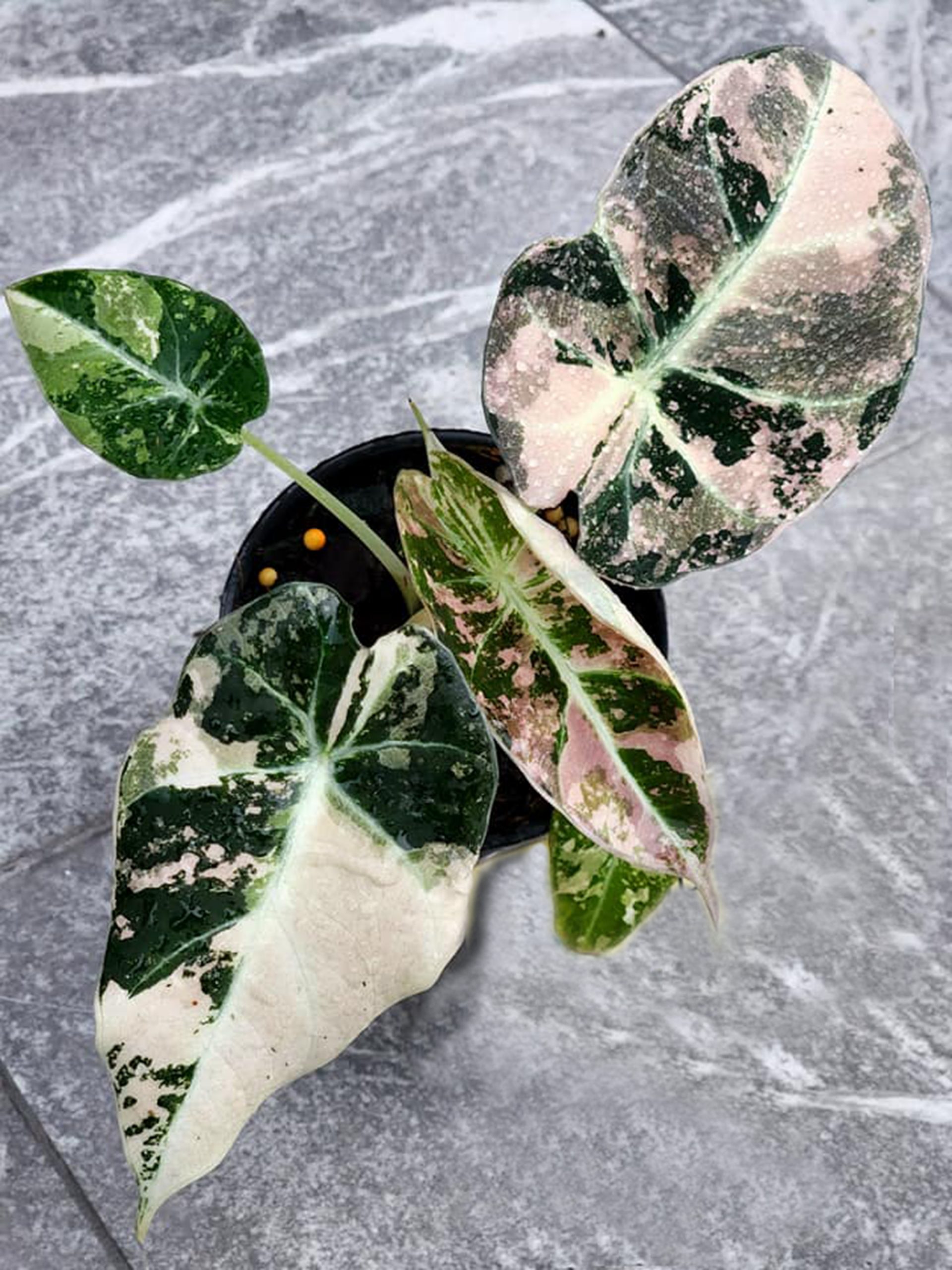
Kew’s Plants of the World Online accepts Alocasia reginula A.Hay and gives its native range as likely Borneo. IPNI records its 1998 publication and a cultivated type specimen. “Black Velvet” is the familiar horticultural name for the compact, dark-leaved plant; “variegated” describes selected cultivated material with additional areas of reduced or altered green pigment.
That distinction matters. The variegated plant is not a newly discovered pink or gold species from the wild. A seller may use “pink”, “gold” or “aurea” to describe the color seen in a propagated line, but those labels alone do not establish a registered cultivar, a genetic mechanism or long-term stability.
Black Velvet is not Alocasia Polly
Black Velvet and Polly can both look dark with pale veins, which likely caused the old article’s confusion. Black Velvet is associated with A. reginula: compact, broad-ovate leaves with a soft-looking dark surface. Polly is associated with Alocasia × amazonica and typically has longer, more arrow-shaped, strongly lobed and wavy-edged leaves. Do not buy or identify one from a keyword-stuffed “Polly Black Velvet” label.
If your plant is ordinary green Black Velvet and already established in a pot, use the dedicated Alocasia Black Velvet care guide. This page owns variegated identification, tissue-culture buying and acclimation.
How to tell pale veins from true variegation
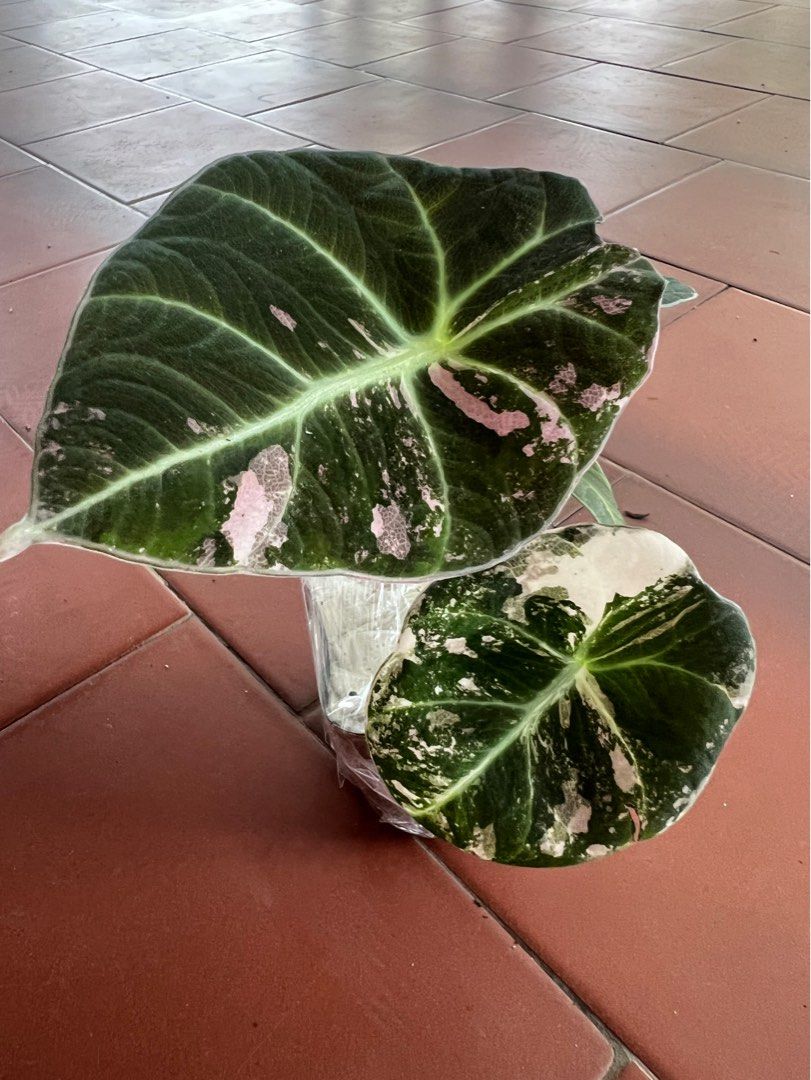
Normal A. reginula foliage has a repeatable network of pale primary and secondary veins. That contrast is part of the standard leaf pattern. Variegation interrupts the background tissue: an irregular sector may cross between veins, a cream or pink splash may sit within one side of the blade, or marbling may differ substantially from leaf to leaf.
- Normal venation: symmetrical or structurally repeated lines that follow the vein network.
- Sectoral variegation: a larger block of cream, pink, yellow or pale green that cuts across the normal background.
- Marbled or splashed variegation: irregular small-to-medium patches distributed through the blade.
- Not proof: flash glare, water spots, edema, pest stippling, nutrient damage or image color grading.
Ask for photos in neutral light of the exact mother stock or exact sale batch. One highly variegated mother-plant photo cannot prove that every small plantlet will mature with the same color or coverage.
What tissue culture does—and does not—promise
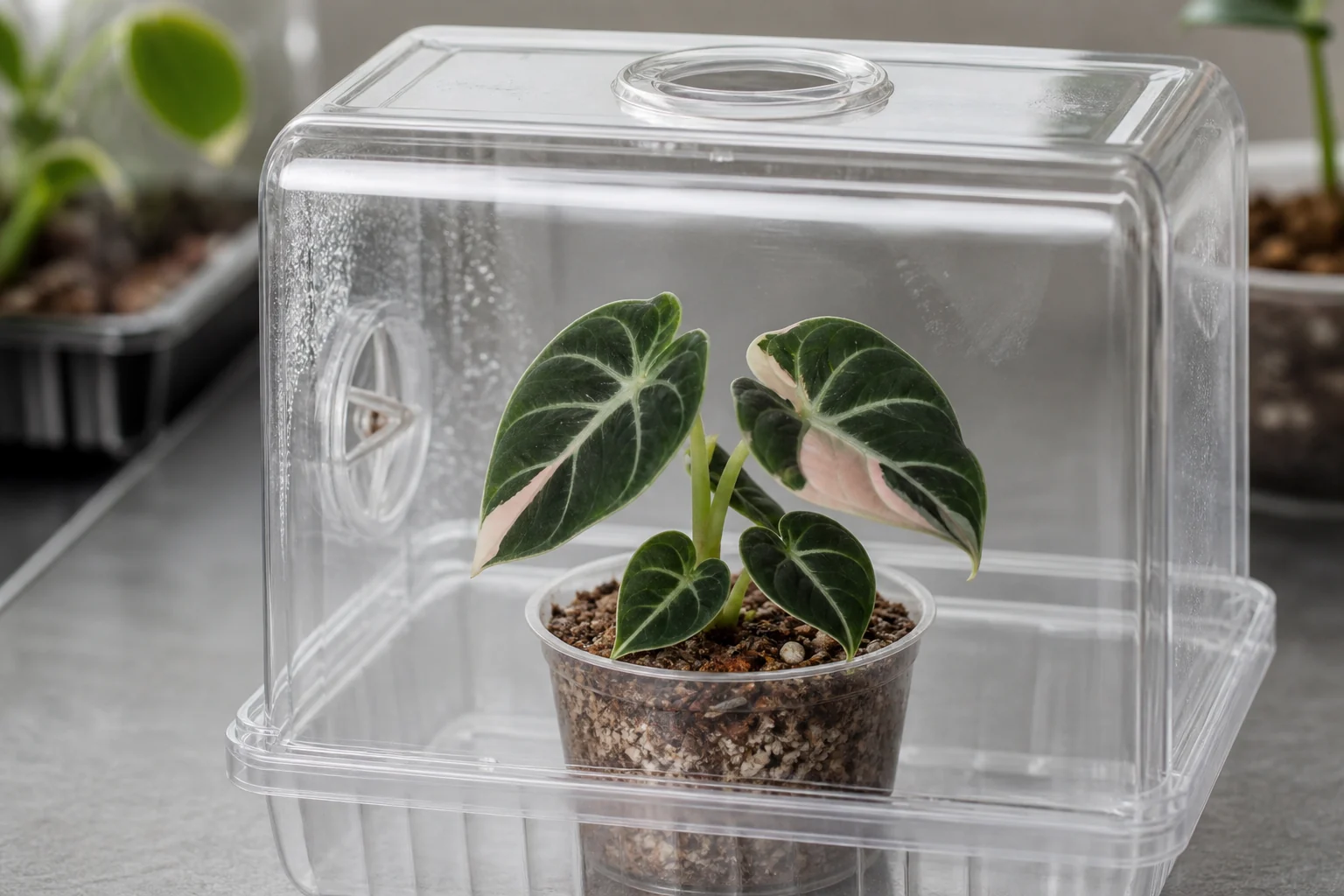
Tissue culture is a commercial propagation system performed in controlled laboratory stages. It can multiply selected material efficiently and begins in an aseptic vessel. The buyer normally receives a rooted or rooting plantlet and performs, or completes, Stage IV acclimatization; the buyer is not “growing the plant using tissue culture methods” at home.
UF/IFAS explains that commercial micropropagation generally aims for true-to-type, uniform plants, but somaclonal variation can occur in tissue culture. It is more likely in some regeneration pathways and over older culture cycles. An off-type can be useful to a breeder or unwanted to a buyer. This is why a responsible listing describes the source line and batch without guaranteeing future variegation.
A clean sealed vessel also does not create lifetime immunity. After opening, plantlets encounter ordinary fungi, bacteria, algae, mites, thrips and handling risks. Clean technique lowers avoidable contamination; it does not make the plant permanently disease- or pest-resistant.
Before opening the vessel: verify the sale format
The same plant name can arrive with very different acclimation responsibility.
| Format | Confirm before arrival | Care on arrival |
|---|---|---|
| Sealed in-vitro plantlets | Plant count, contamination policy, root stage, phenotype line and opening instructions | Prepare clean cells, a ventable humidity enclosure and stable warmth first |
| Deflasked starter | Time since opening, current venting, root activity and substrate | Match the seller’s present conditions; do not automatically reseal it |
| Established potted plant | Exact plant photos, roots, pests, shipping conditions and recent repotting | Quarantine and stabilize with established-plant care, not a deflasking protocol |
Do not open a healthy vessel only because it arrived. Follow the laboratory or seller’s viable-hold guidance, inspect for cloudiness or rapidly spreading contamination, and prepare the next environment first. If the vessel is cracked, leaking or visibly contaminated, photograph it immediately and follow the seller’s arrival policy.
How to acclimate a Black Velvet tissue-culture plantlet
UF/IFAS describes acclimatization as the final stage of micropropagation. New microplants initially need protection from desiccation in shade and high humidity while functional roots develop. There is no universal seven-day or two-week recipe: plant size, rooting, vessel conditions, substrate, temperature and your enclosure all change the pace.
- Prepare first. Use clean small cells, clean tools, fine airy substrate, labels and an enclosure that can be vented gradually.
- Remove the medium gently. Rinse off gel without tearing the crown or fine roots. Separate plantlets only when they release without damage.
- Pot at the correct depth. Support roots in lightly moist substrate while keeping the crown above the surface. Oversized wet pots create an unnecessary anaerobic zone.
- Begin protected. Give stable warmth, high humidity and low-to-moderate diffused light. Avoid sun, fertilizer and strong airflow.
- Vent by plant response. Increase ventilation in small steps. If leaves collapse quickly, return to the last stable stage rather than alternating between sealed and fully open.
- Brighten after function improves. A firm new leaf and active roots are better evidence than a calendar. Increase light before considering dilute feeding.
- Graduate only when stable. Move to normal room care after the plant holds turgor through ordinary ventilation and the root ball dries at a controlled rate.
Change one major variable at a time. Opening the enclosure, doubling light, repotting and fertilizing together makes failure impossible to diagnose.
Care after acclimation
Light and variegation
The Royal Horticultural Society recommends bright indirect light for Alocasia and warns that strong sun can scorch foliage. Variegated tissue has less chlorophyll, so a heavily pale plant may grow more slowly, but intense light does not manufacture genetic variegation. Acclimate any increase gradually and judge it by leaf temperature, bleaching and growth—not by a promise that “more light makes more pink.”
Water and substrate
During active growth, water an established plant thoroughly after the upper root zone has dried somewhat and the pot feels lighter. Let excess drain completely. Reduce moisture when cool or dim conditions slow growth. Never use a fixed weekday schedule or let a decorative cachepot hide standing water.
Use a moisture-retentive but oxygen-rich mix: fine-to-medium bark, quality coco/peat-free houseplant substrate and mineral aeration can work when adjusted to your climate and watering style. A small root system belongs in a small pot. Variegation does not protect the corm from rot.
Humidity, airflow and temperature
Established Alocasias appreciate medium-to-high humidity, but stagnant wet leaves and saturated media invite problems. Use gentle airflow and a hygrometer if conditions are uncertain. Keep the plant away from cold glass, drafts and sudden air-conditioning. RHS advises warmth above 16°C/60°F during active growth; cooler and lower-light conditions can trigger slowdown and require much less water.
Feeding and repotting
Feed conservatively only after an acclimated plant is actively rooting and making leaves, following the fertilizer label. Do not fertilize a newly deflasked, dry, cold or rotting plant to “boost” it. Repot when roots are genuinely crowded, the substrate has collapsed or drainage has failed—not on a fixed calendar.
Will the pink or gold variegation stay stable?
No honest seller can guarantee the exact future pattern of every leaf. Variegation can strengthen, weaken, shift color as leaves harden or revert toward green. A tiny plantlet also has too few leaves to demonstrate a mature pattern. Evaluate several new leaves under stable care before deciding that the line has changed.
Do not cut a small Alocasia repeatedly in the way you might prune a vining aroid. Black Velvet grows from a corm/rhizome system with limited active points. Preserve healthy green tissue: an almost-white plant may look valuable but can lack enough photosynthetic area to sustain growth.
Troubleshooting by symptom and stage
A symptom means something different in a newly opened plantlet and an established pot.
| Pattern | Check first | Best next step |
|---|---|---|
| TC leaves collapse after opening | Humidity drop, light jump, root function and heat | Return to the last stable intermediate stage; vent more slowly |
| Translucent or mushy crown | Standing water, damaged tissue, temperature and spreading rot | Isolate, remove only confirmed rot and restore oxygen/warmth |
| Established plant droops wet | Roots/corm, drainage, cold and oversized pot | Stop calendar watering; correct the root-zone cause |
| Brown pale sectors | Direct sun, abrupt humidity drop, root failure and salts | Stabilize conditions; damaged tissue will not turn green again |
| Distorted or curled new leaf | Mites, thrips, roots, humidity swing and trapping | Use the leaf-curl diagnostic before spraying |
| Less variegation | Several-leaf trend, plant health, lineage and photo lighting | Do not overlight or overfeed; document stable new leaves before judging |
Choose the correct Greenboog format
The informational guide and product listings have different jobs. Use the listing that matches phenotype and acclimation responsibility:
- standard variegated Black Velvet tissue culture for the current standard line and vessel details;
- pink-variegated Black Velvet tissue culture for the pink-line batch and plant count;
- gold-variegated Black Velvet tissue culture for the gold/aurea-labeled line; and
- potted pink-variegated Black Velvet when an established format is listed.
Availability, count, size and acclimation stage can change; the current product page is the transactional source. Ask for exact-batch photos, vessel status, arrival terms, phytosanitary documentation and temperature-safe shipping. The broader Alocasia collection guide helps decide whether the genus fits your space without inventing medical or air-cleaning benefits.
Safety around pets and children
ASPCA Animal Poison Control lists Alocasia as toxic to dogs, cats and horses because of insoluble calcium oxalates. Chewing can cause oral pain and swelling, drooling, vomiting and difficulty swallowing. Wear gloves around sap and keep plants, corms and pot debris away from children and pets; contact a veterinarian or poison-control service after exposure.
FAQ
Is Alocasia Black Velvet Variegated a separate species?
No. It is cultivated variegated material associated with the accepted species Alocasia reginula. Pink, gold and aurea are commercial phenotype labels unless documented as formal cultivar names.
Is Black Velvet a type of Alocasia Polly?
No. Black Velvet is associated with A. reginula; Polly belongs to the distinct Alocasia × amazonica horticultural group.
Are the white veins variegation?
No. Pale contrasting veins are normal on Black Velvet. True variegation adds irregular sectors, splashes or marbling outside the repeated vein network.
Does tissue culture guarantee pink or gold leaves?
No. Tissue culture aims to multiply selected material, but off-types, somaclonal variation and unstable patterns can occur. Verify the exact line and judge several new leaves after acclimation.
How long should I keep a plantlet in high humidity?
There is no universal number of days. Vent according to root activity, turgor and new growth, changing humidity and light in stages instead of following a fixed countdown.
Can more light create more variegation?
Light supports photosynthesis but does not create a genetic variegation pattern. Excess direct light can scorch pale tissue; increase useful diffused light gradually.
Is a tissue-culture plant pest-free forever?
No. A healthy sealed vessel begins under aseptic conditions, but after opening the plant is exposed to ordinary pests, pathogens and handling. Quarantine and inspection still matter.
Sources and evidence boundaries
- Kew POWO: accepted A. reginula name and likely Borneo range
- IPNI: 1998 publication and cultivated type record
- UF/IFAS: somaclonal variation in tissue culture
- UF/IFAS: Stage IV acclimatization principles
- RHS: genus-level light, temperature and watering guidance
- ASPCA Animal Poison Control: Alocasia toxicity