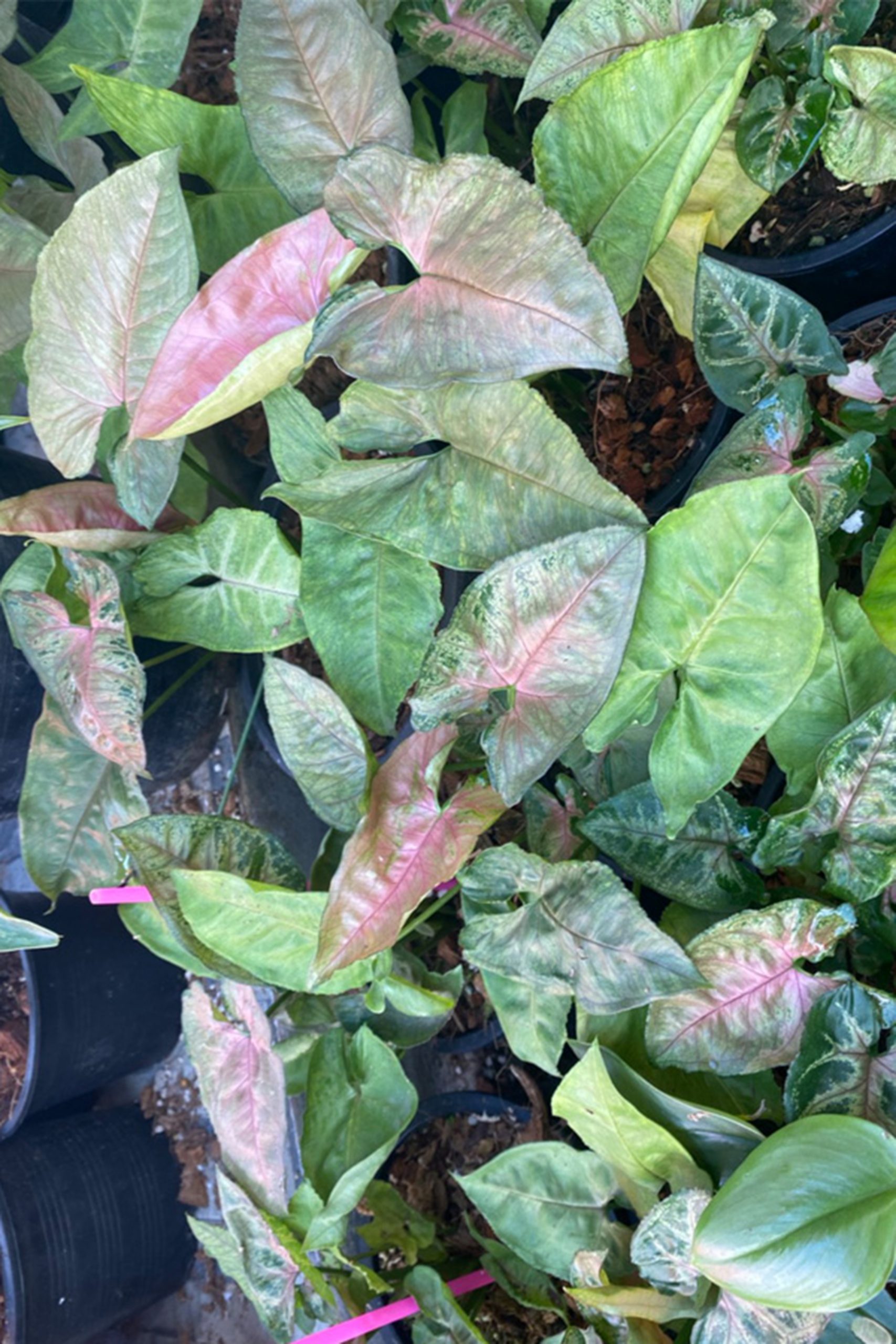
Syngonium types are best compared by leaf pattern, plant structure and name evidence—not by the brightest listing photo. “Syngonium” may refer to a botanical genus, an accepted species, a documented cultivar or an informal seller label. Before choosing a plant, compare several hardened leaves, trace the stem and nodes, check the source record and decide whether you need a variety overview, an entity guide, propagation help or a live product page.
Syngonium types at a glance
| Type or label | Pattern cue | Name evidence / next guide |
|---|---|---|
| Batik | Green arrowhead leaves with a fine pale vein network | Trade/cultivar label; use the Batik guide |
| Christmas-labelled material | Variable pale green, cream or pink-green plants sold under a seasonal label | Seller label; require actual-plant and provenance evidence |
| Mojito | Irregular green, mint and cream mottling | Marketplace label; use the Mojito ID guide |
| Pink Allusion | Pastel pink and green juvenile foliage | RHS-accepted cultivated name |
| Berry Allusion | Olive, cream and berry-pink presentation | Seller/cultivation label unless documentation accompanies the plant |
| Maria Allusion | Bronze-green to pink leaves with a pink midrib or flush | Seller/cultivation label unless documentation accompanies the plant |
| Pink Spot | Pale cream, green or blush base with deeper pink spotting | Use the Pink Spot ID guide |
| Pink Splash | Green base with irregular pink splashes, flecks or spots | Documented as a comparison cultivar in patents; use the Pink Splash guide |
| Confetti / Milk Confetti | Light green or milkier base with scattered pink flecks | Patent evidence exists for Confetti, not every Milk Confetti listing; use the Milk Confetti guide |
| Strawberry Ice | Green, cream and strawberry-pink sectors or marbling | Marketplace label; use the Strawberry Ice guide |
First, separate species from cultivated names
Syngonium is a botanical genus. Kew accepts Syngonium podophyllum as a species from Mexico to Tropical America and describes it as a wet-tropical liana. That species record supports the arrowhead-vine structure, but it does not prove that every named plant in a shop is correctly assigned to that species or to a particular cultivar.
A cultivated name identifies a selected plant line. The International Aroid Society is the official cultivar registrar for Araceae, so a registry entry, patent, breeder publication or other traceable record carries more weight than a marketplace title. An informal trade name can still be useful, but it should be treated as a label to verify rather than a botanical fact.
This prevents two common errors. First, a cultivar is not a separate wild species. Second, a species’ tropical range does not become the origin story of a nursery-produced cultivar. Never infer wild collection, a breeder, a country of origin or hybrid parents from leaf color alone.
A five-step Syngonium identification workflow
- Read the whole label. Record the genus, species claim, cultivated name, seller and date instead of keeping only a screenshot.
- Trace the structure. Find the stem, nodes, buds or active tips, petiole sheaths and adventitious roots.
- Compare several leaves. Use hardened leaves on the same axis; a new leaf may change color as it opens.
- Separate pattern from damage. Stable flat color differs from expanding, wet, soft, scarred or pest-associated tissue.
- Match evidence confidence. A registry/patent/RHS record is not the same as an unlabeled social-media photo or stock image.
NC State Extension documents that juvenile S. podophyllum leaves are simple and arrow-shaped while mature climbing leaves can become lobed or divided. A shape change on an older supported vine can be normal maturation rather than a new type.
Green and cream Syngonium patterns
Batik: a vein-led pattern
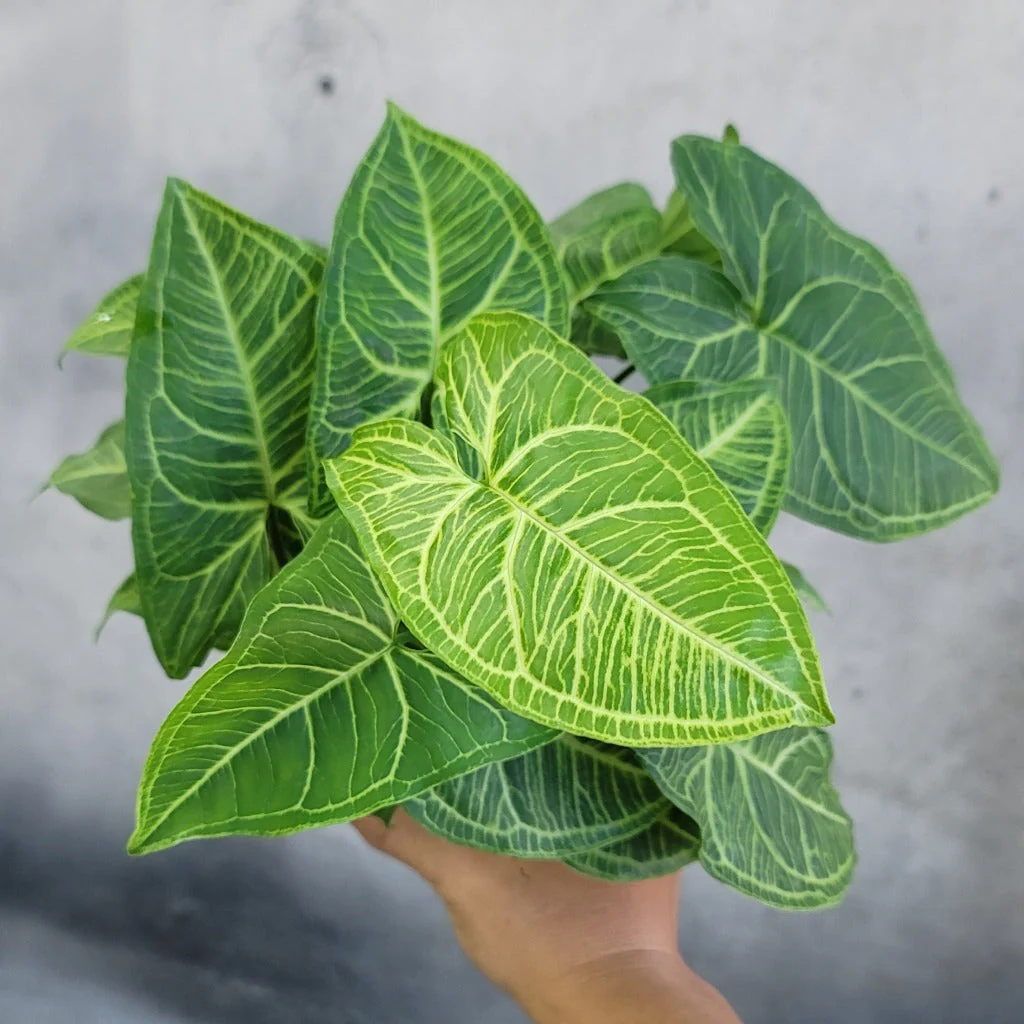
Batik is sold for a fine pale or yellow-green network that follows the primary and secondary veins. Check whether that network repeats across several hardened leaves and whether the plant has a normal Syngonium stem. Do not confuse uneven yellowing, mite stippling or nutrient stress with the organized vein-led pattern.
Christmas-labelled material: a low-confidence trade label
“Christmas” appears in marketplace filenames and listings, but the name may be applied to visually different plants. Treat it as low-confidence until the seller provides a consistent mother-plant sequence or published reference. A mixed tray, stock photo or media filename cannot establish cultivar identity.
Mojito: green, mint and cream mottling
Mojito is typically sold with irregular mottling rather than vein-following lines. The useful clues are a repeated green-to-pale sequence, visible nodes and a traceable source. Do not use one pale leaf as proof, and do not assume that more light can paint mottling onto another plant.
Pink and olive Allusion-type patterns
Pink Allusion: a documented pink-green name
The RHS accepts Syngonium podophyllum ‘Pink Allusion’ and describes an evergreen climber with pastel pink and green foliage. That is stronger name evidence than a seller-only label, but an actual plant still needs to match a multi-leaf description.
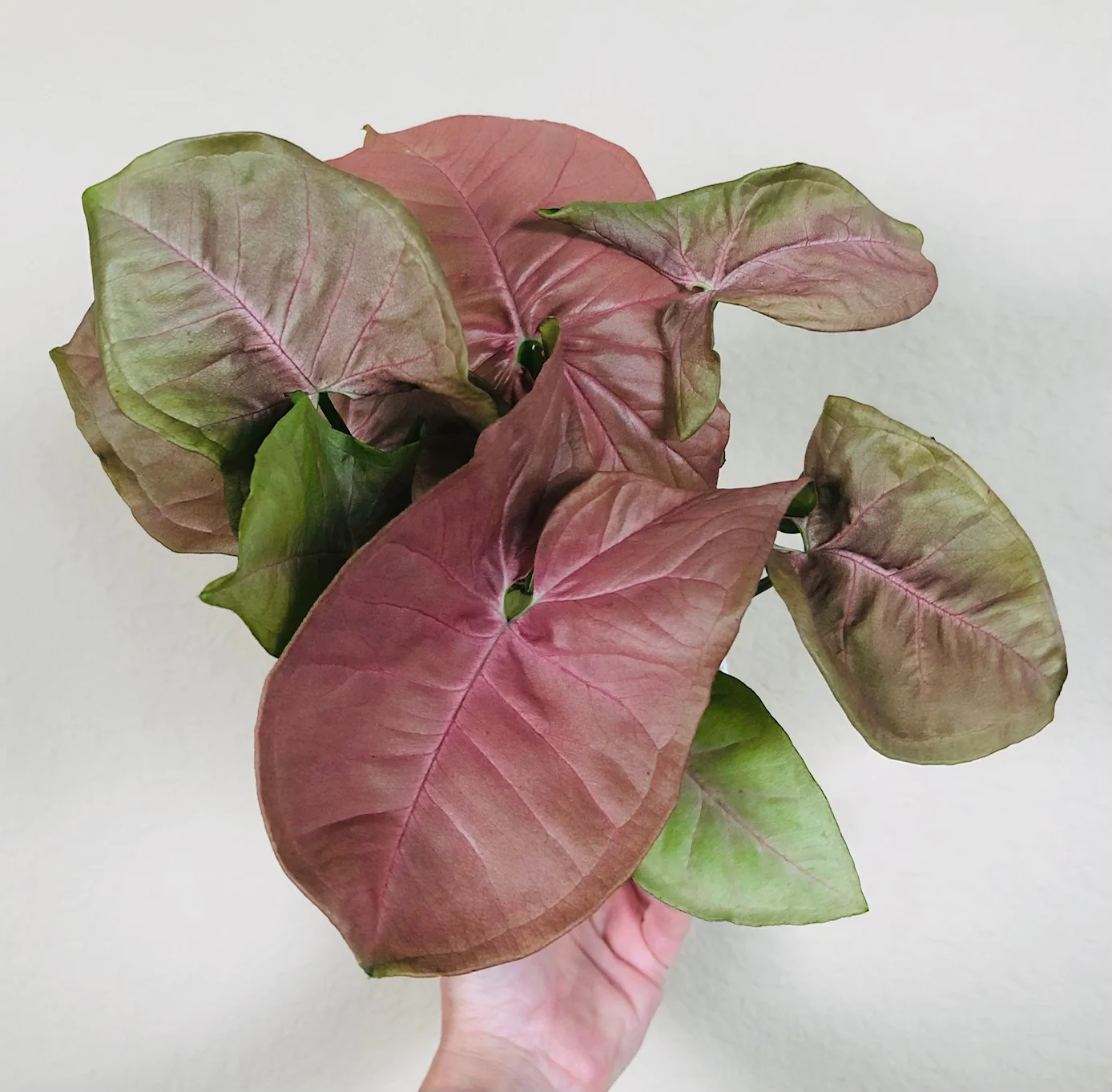
Do not convert the RHS’s UK-oriented size, hardiness or schedule fields into universal indoor rules. Use its record to support the cultivated name and broad plant description.
Berry Allusion: berry-pink over olive and cream
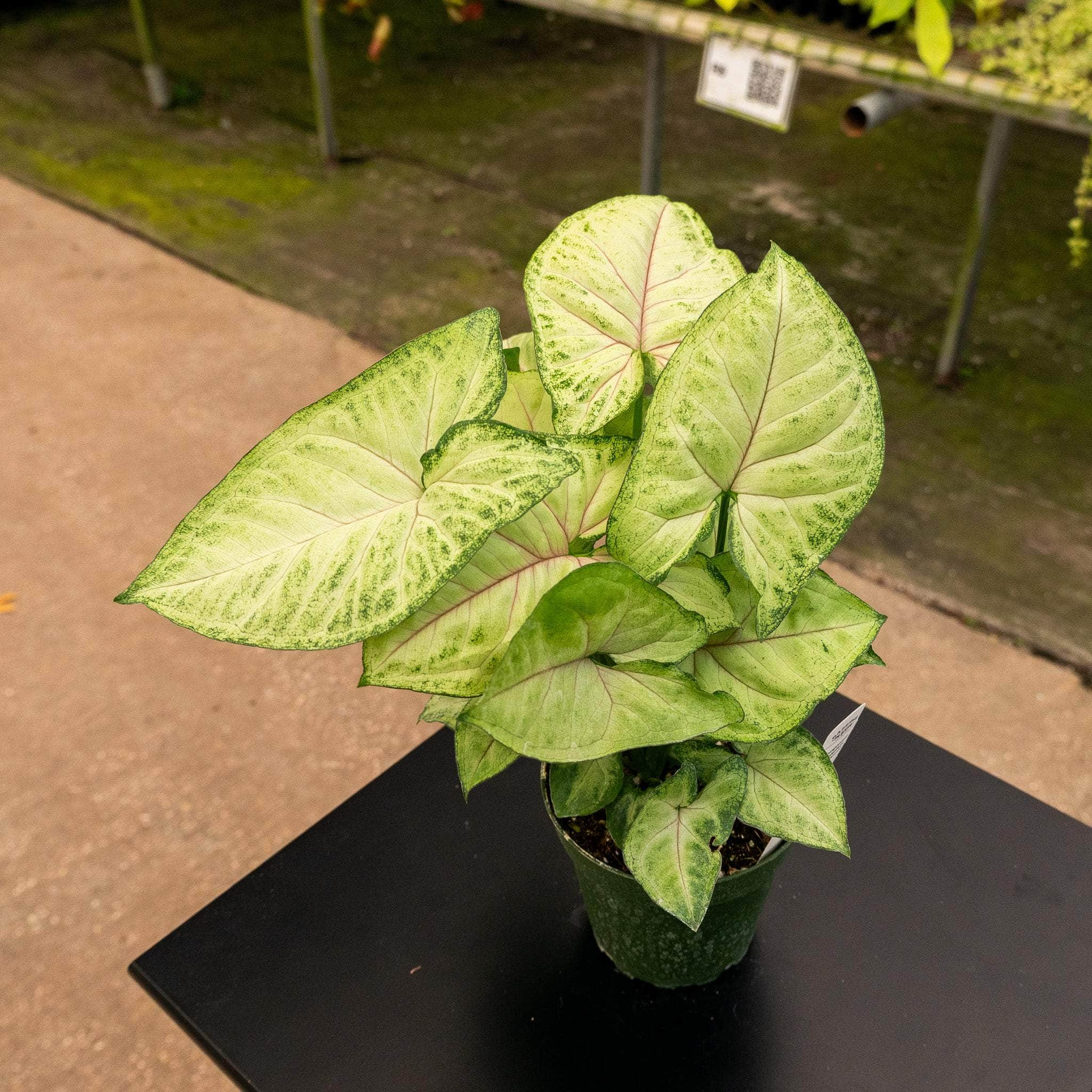
Berry Allusion is commonly presented with an olive, cream and muted berry-pink balance. Compare the pink distribution, midrib, green margin and sequence after the leaves harden. Without a registry, patent or breeder record attached to the offer, keep origin and parentage open.
Maria Allusion: bronze-green and pink flushing
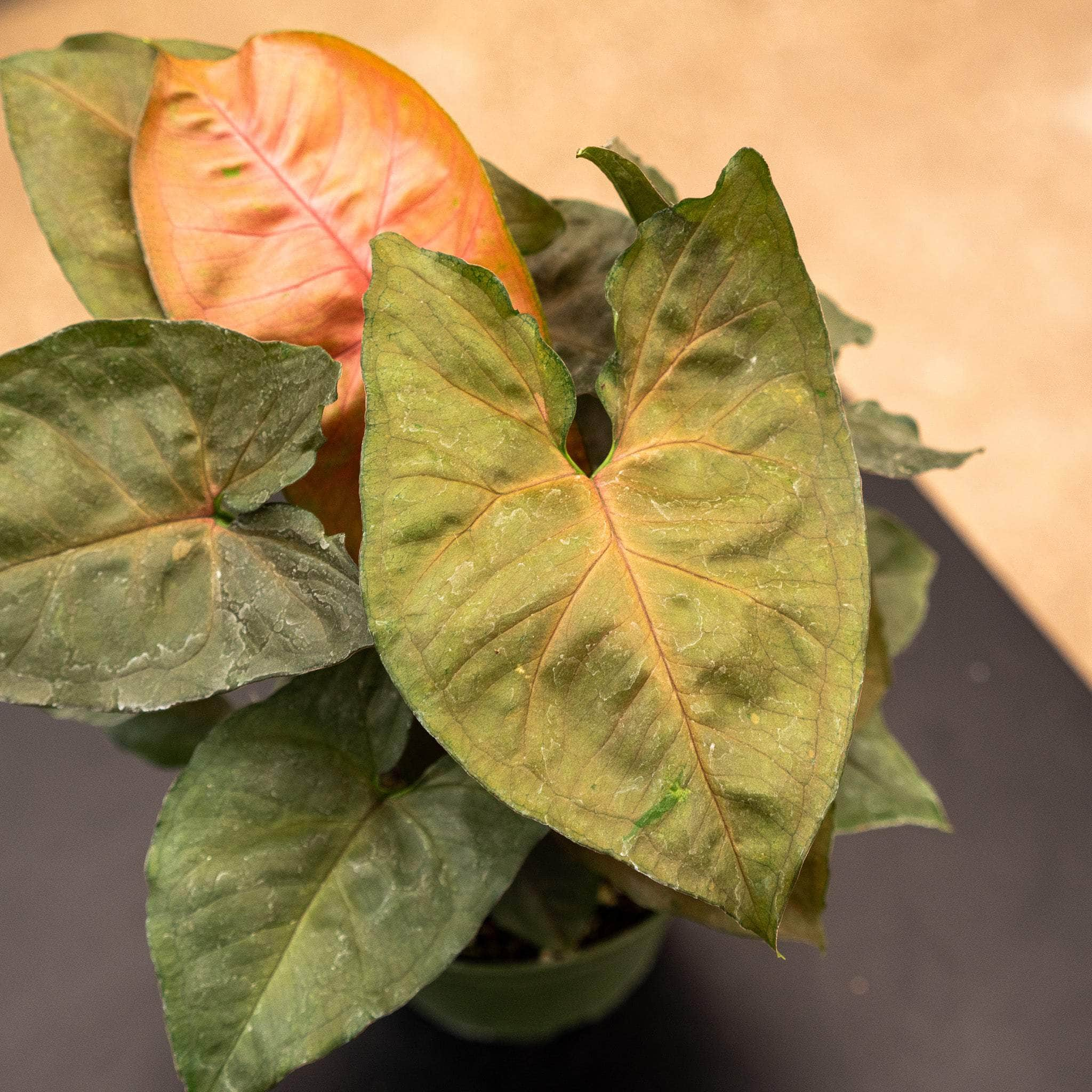
Maria Allusion is marketed with darker bronze-green foliage and pink to copper flushing. Color temperature, white balance and leaf age can exaggerate differences, so request neutral-light photos and a current whole plant. “Award-winning,” exact height and fixed mature color should not be repeated without a source.
Speckled, splashed and sectoral pink types
Pink Spot and Pink Splash
Pink Spot is generally sold with a paler base and deeper pink spotting. Pink Splash is commonly shown with a greener base and irregular pink splashes. These are useful marketplace cues, not a one-leaf key.
A 2024 plant patent for a different cultivar, ‘CLA 20230912’, records direct comparisons with unpatented Pink Splash and Red Spot Tricolor. It describes Pink Splash as the parent and distinguishes leaf colors, which confirms that the names existed as comparison material; it does not turn an unrelated Greenboog or marketplace plant into the patented cultivar.
Confetti versus Milk Confetti
US plant patent PP18016 documents S. podophyllum ‘Confetti’ as a stable tissue-culture-propagated whole-plant mutation of Regina Red with light-green leaves and random pink splashes, flecks and spots. It also compares Confetti with Pink Splash.
“Milk Confetti” is a separate marketplace name and should not automatically inherit that patent’s mutation history or exact description. Use the dedicated Milk Confetti guide to keep documented Confetti evidence separate from visual resemblance and seller terminology.
Strawberry Ice: sectoral green, cream and pink
Strawberry Ice is commonly presented with larger cream and pink sectors or marbling over green. Because light, editing, leaf age and tissue-culture variation can change the presentation, ask for several current leaves and the actual stem. Keep product format and acclimation separate from the entity name.
Which Syngonium type fits your intent?
| Your priority | Start with | Verify before buying |
|---|---|---|
| Graphic green-and-pale venation | Batik | Repeated vein network, not generalized yellowing |
| Soft pink-green foliage with a documented name | Pink Allusion | Multi-leaf match and seller provenance |
| Muted olive or bronze-pink foliage | Berry or Maria Allusion labels | Neutral-light current photos and whole-plant sequence |
| Pale leaf with deep pink spots | Pink Spot | Actual plant, green-tissue balance, nodes and roots |
| Green leaf with random pink splashes | Pink Splash | Several leaves; do not rely on one edited photo |
| Fine pink flecks on light green | Confetti / Milk Confetti screening | Whether the offer claims documented Confetti or a Milk Confetti seller label |
| Green, mint and cream mottling | Mojito | Repeating mottled sequence and source history |
| Large cream-and-pink sectors | Strawberry Ice screening | Current plant, viable green tissue and stable new growth |
Shared care boundary without a universal schedule
Most Syngonium in this guide are climbing or trailing tropical aroids. Give them usable filtered light, a warm stable room, a draining container and a root zone that retains moisture without staying airless. Water according to pot weight, moisture below the surface, root mass and recent dry-down—not the type’s marketing name.
University of Minnesota Extension notes that insufficient light can lengthen internodes and accompany green reversion in variegated plants, while too much light can scorch or bleach leaves. This supports gradual light adjustment; it does not mean light can create a named pattern.
For propagation, a new vine needs a stem node and viable bud or an active tip. The UF/IFAS Syngonium guide describes nodal cuttings, tip cuttings and air layers. Use Greenboog’s Syngonium propagation guide for the complete node-mapping workflow rather than repeating it on every entity page.
Buyer checklist for named Syngonium
- Request current photos of the actual plant, not only a mother plant or stock image.
- Compare at least three hardened leaves on the same active stem.
- Inspect the stem, nodes, active growth point and roots.
- Ask whether the name is supported by a registry, patent, breeder record or only the seller’s label.
- Check pale tissue for burn, wet lesions, scars, webbing and residue.
- Confirm whether the offer is an established plant, rooted cutting, fresh cutting or tissue-culture plantlet.
- Read seller terms, weather policy and import requirements before payment.
The product category owns current availability. Entity guides own identity and care. A product owns its changing price, variants, stock and checkout. This separation keeps the hub useful even when inventory changes.
Safety
Keep Syngonium away from chewing pets and young children. ASPCA lists S. podophyllum as toxic to cats, dogs and horses because of insoluble calcium oxalates. Suspected exposure warrants a veterinarian or poison-service call; do not induce vomiting unless a professional directs it.
Syngonium types FAQ
How many Syngonium species are there?
Counts change as taxonomic work progresses. Use a current botanical database for species-level questions. The many labels in houseplant commerce are not all separate species.
Is every named Syngonium a registered cultivar?
No. Names may be formally documented cultivars, patented cultivars, older nursery names or informal seller labels. Ask what evidence supports the exact offer.
Can leaf color alone identify the type?
No. Use several hardened leaves, stem and node structure, petioles, roots and source history. Light, camera settings, leaf age and stress can alter the presentation.
Does low light preserve a compact pink plant?
Not reliably. Inadequate light can stretch internodes and weaken growth; a variegated plant may trend greener. Adjust light gradually and judge the full plant.
Can a leaf-only cutting make a new Syngonium?
Not without viable stem tissue and a node or active growth point. A leaf may remain alive or root without producing a new vine.
Why does the same label look different between sellers?
The plants may be different lines, mislabeled, photographed under different conditions or shown at different leaf ages. Actual-plant provenance matters more than the label alone.