

Greenboog cultivar evidence guide
Syngonium Strawberry Ice is best treated as a horticultural label for pink, cream and green arrowhead-vine plants—not as a botanical species or a color guarantee. To identify one responsibly, compare several hardened leaves, the petiole and sheath, the plant’s growth habit and its source history. One unusually pink leaf is not enough.
Syngonium Strawberry Ice at a glance
| Check | What supports the label | What does not prove it |
|---|---|---|
| Leaf sequence | Several leaves repeat a pink-to-blush, pale cream/green and deeper-green mix | One pink new leaf or one seller photo |
| Pattern | Diffuse mottling, marbling or broader sectors can recur in changing proportions | A promise that every future leaf will look alike |
| Plant structure | Juvenile arrow-shaped leaves on a sheathing, climbing Syngonium stem | Leaf color without a stem, node or petiole view |
| Name evidence | A traceable mother plant and consistent label history | “Japan,” “rare,” “premium” or a high price by itself |
The accepted species Syngonium podophyllum is a wet-tropical liana native from Mexico to Tropical America. That species record explains the climbing body plan; it does not document where the Strawberry Ice selection arose.
Is Strawberry Ice an official cultivar?
The International Aroid Society cultivar guidance says a cultivar should be distinguishable, uniform and stable through appropriate propagation. Greenboog does not currently hold a public registration, patent or breeder record proving the old story that Strawberry Ice began as a spontaneous Pink Splash mutation. That absence is not proof that no record exists; it means the pedigree should not be presented as fact.
For practical buying and care, use “Strawberry Ice” as the horticultural label on the plant you can document. Ask for the actual plant or mother plant, compare a sequence rather than the most colorful leaf, and retain the seller invoice or label. Do not turn a marketplace name into a species epithet.
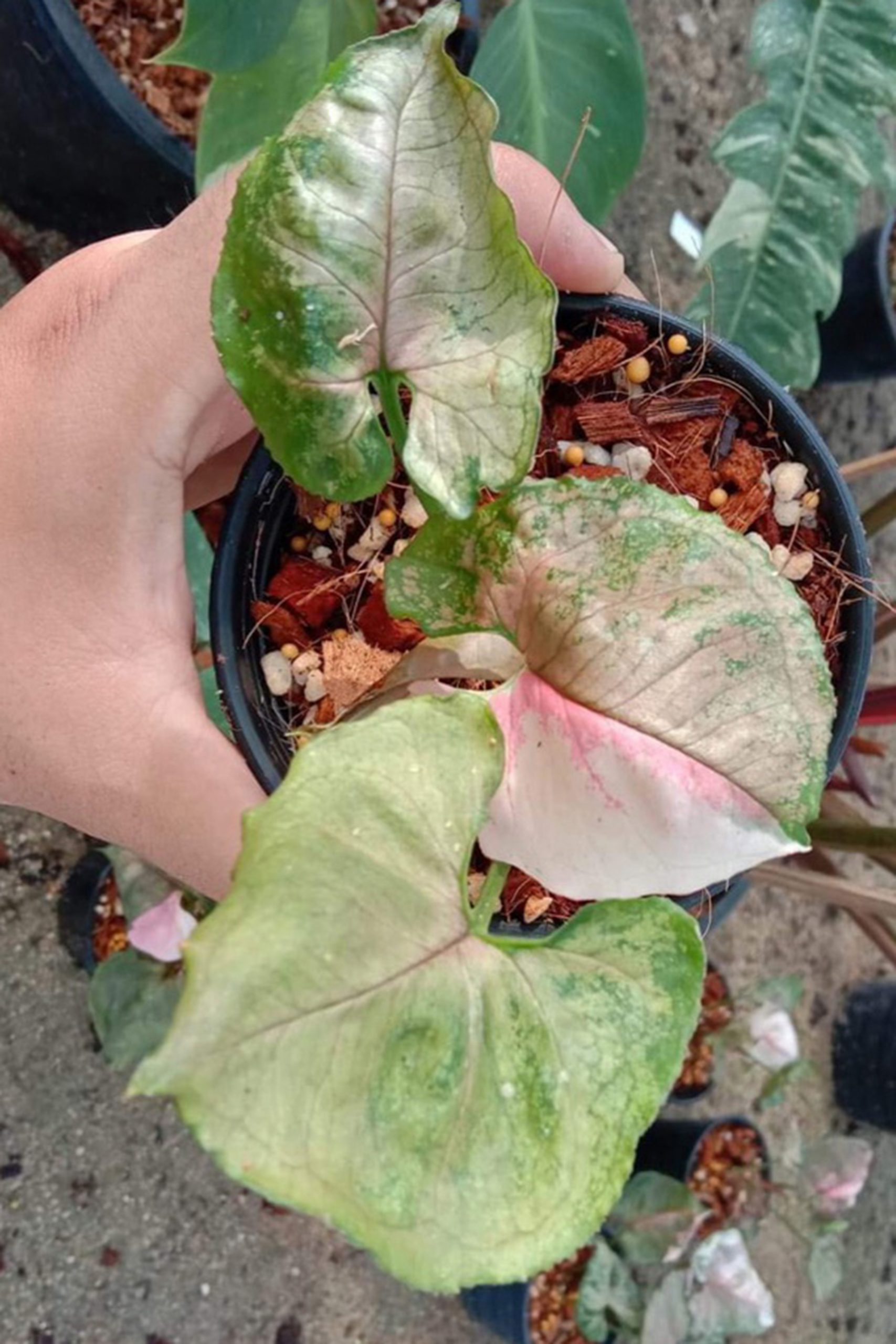
Strawberry Ice vs similar pink Syngonium labels
Pink Syngonium names overlap in trade. Use the table as a screening tool, then check the dedicated guide and the plant’s provenance. It is not a cultivar key.
| Label | Useful marketplace screen | Best next check |
|---|---|---|
| Strawberry Ice | Blush or pink, pale cream/green and deeper green repeating as diffuse marbling or sectors | Compare three to five hardened leaves and the mother-plant history |
| Pink Splash | Often sold with a greener field and sharper pink splashes or flecks | Use the Pink Splash guide; do not infer parentage |
| Pink Spot | A seller label used for pink spotting, mottling or sectors in varying proportions | Compare whole-plant evidence in the Pink Spot guide |
| Milk Confetti | Usually screened by a pale milk-green field with scattered pink flecks | Check petiole, sheath and label boundaries in the Milk Confetti guide |
If two plants cannot be separated consistently across several leaves and growing conditions, the honest answer may be “label unresolved.” More confident wording does not create better evidence.
Why new leaves can look different
Color and contrast can shift while a leaf expands and hardens. Age also changes Syngonium structure: the NC State Extension profile describes juvenile simple arrow-shaped leaves, transitional lobing and more divided mature foliage on a climbing plant. A shape change is therefore not automatically mislabelling.
Use a three-to-five-leaf pattern log
- Photograph each new leaf after it has hardened, in similar neutral light.
- Record which node produced it and whether the stem sector near that node shows green and pale tissue.
- Note changes in light, root moisture, temperature, feeding, repotting or pest pressure.
- Make pattern decisions from the sequence, not from one leaf.
Pattern change, stress or reversion?
| Observation | First interpretation | Next action |
|---|---|---|
| One greener leaf after several mixed leaves | Normal variation is possible | Keep logging; do not prune immediately |
| Several greener leaves from one stem sector | Possible sector-level reversion | Inspect nodes and wait for enough sequence evidence before cutting |
| Pale new growth with weak stems | Light, roots or nutrient uptake may be limiting | Check the whole growing system rather than chasing pink |
| Crisp bleached patches on the window side | Exposure or heat stress is more likely than desirable variegation | Move back or filter light gradually |
| Wet translucent spots or yellow halos | Possible bacterial disease pattern | Isolate, keep foliage dry and diagnose before treatment |
Light: preserve function before chasing pink
Give the plant enough indirect light to support compact growth and usable green tissue, but do not promise that brighter light will manufacture pink. The University of Minnesota indoor-light guide places arrowhead plants among lower-light-tolerant foliage plants while stressing that indoor light should match the plant and location. A highly variegated individual may need a brighter practical position than a solid-green one, but direct hot sun can still scorch pale tissue.
- Too little usable light: longer internodes, smaller leaves, slower drying and weak new growth.
- Too much exposure too fast: bleached or crisp patches concentrated on the exposed side.
- Better decision: change distance, curtain filtering or grow-light duration gradually; then compare the next two leaves.
Water the root zone, not the calendar
Check the root zone before watering. Pot size, substrate, root mass, light, airflow and season change drying speed, so “weekly” and “when the top inch is dry” are not universal rules.
- Lift the pot and check moisture deeper than the decorative surface layer.
- If the root zone is still evenly wet and the pot remains heavy, wait and improve airflow or drainage if drying is persistently slow.
- If much of the root zone is approaching dry and the pot is light, water thoroughly and let excess drain.
- Do not leave the nursery pot standing in a cachepot of runoff.
Use an airy but water-retentive mix appropriate to your conditions. Large bark and mineral particles increase air spaces; finer organic components hold moisture. The right ratio is the one that lets the rooted volume hydrate evenly and then regain air before roots stay oxygen-starved.
Support, temperature and humidity
Syngonium is a climber, not a permanently compact rosette. The UF/IFAS Syngonium production guide notes that upright plants need a totem, trellis or other support. Tie the stem rather than the leaf petioles and let aerial roots meet a support if you want steadier climbing growth.
Aim for stable household warmth, avoid cold drafts and do not press pale leaves against hot or cold glass. Humidity can slow water loss, but it does not compensate for a saturated root zone. If you raise humidity, keep air moving and avoid leaving leaves wet.
Feeding and repotting decisions
Feed only when the plant is actively growing and the root system is functioning. Start with the fertilizer label rather than a universal monthly dose; reduce strength or frequency if growth is slow, the mix stays wet or salts accumulate. Flush accumulated salts with suitable water and free drainage when needed.
Repot for evidence: a root mass that no longer wets evenly, rapidly recurring drought despite thorough watering, a degraded mix, or roots crowding the available volume. Move up modestly. A much larger pot can keep uncolonized media wet for too long.
Propagate Strawberry Ice with a node
A leaf without a viable stem node cannot produce a new Syngonium vine. UF/IFAS documents nodal cuttings, tip cuttings and air layering for Syngonium. Choose a healthy node with a visible bud area; if pattern preservation matters, map the stem sector and recent leaves before cutting.
- Use a clean tool and cut with at least one sound node.
- Root in water or an airy medium while keeping the node moist but oxygenated.
- Provide stable warmth and gentle light; avoid sealing a wet, unventilated chamber around damaged tissue.
- Transfer only after roots have branched enough to support the cutting, then change conditions gradually.
For node anatomy, rooting routes and transfer decisions, use the dedicated Syngonium propagation guide. A cutting can carry the parent clone, but no responsible seller should guarantee the exact pink percentage of every future leaf.
Troubleshoot symptoms before treating
| Symptom | Check first | Low-risk response |
|---|---|---|
| Yellowing plus persistently wet mix | Root color, smell, firmness, drainage and pot size | Correct the root environment; remove only dead tissue |
| Dry brown margins | Rapid drying, salt buildup, root damage, heat and low humidity | Correct the confirmed driver; do not diagnose from color alone |
| Fine stippling or webbing | Leaf undersides and petiole junctions for mites | Isolate, rinse where appropriate and use a correctly labelled control |
| Cottony clusters or sticky residue | Nodes, sheaths and leaf undersides for mealybugs or other sap feeders | Isolate and repeat inspection/treatment across the pest life cycle |
| Translucent margin spots with yellow halos | Recent overhead watering and spread to adjacent leaves | Follow the Penn State Syngonium disease symptom boundary; isolate and keep foliage dry |
| Soft, foul-smelling dark tissue | Stem and petiole collapse | Isolate promptly; avoid spreading contaminated water or tools |
Buyer checklist: plant, cutting or tissue culture
Current price, stock, pot size and delivery terms belong on the offer, not in an evergreen care article. Check the current Strawberry Ice product page or the broader Syngonium collection, then verify what the listing actually includes.
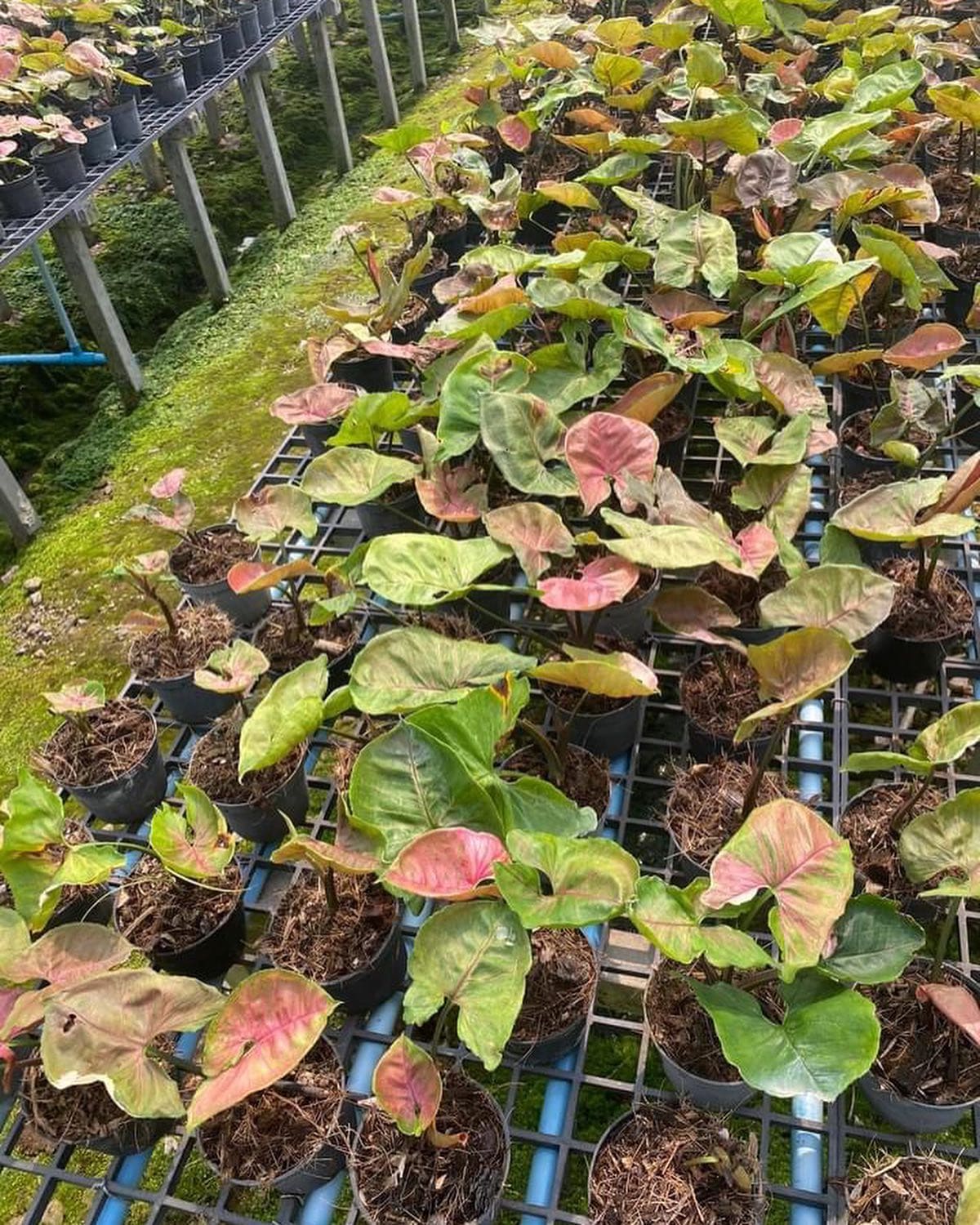
- Established plant: request current whole-plant photos, several leaves, the stem base, pot and roots if available.
- Cutting: confirm the actual node, bud area, root status and which photographed mother plant it came from.
- Tissue culture: confirm quantity, vessel/flask status, acclimation stage and whether the image shows the shipped material or a mature reference.
- Every form: read the seller’s live-arrival, refund, phytosanitary, import and weather-delay terms for your destination before checkout.
On arrival, document the closed package and plant condition, then isolate the plant from the collection while you inspect roots, sheaths and leaf undersides. Do not repot, fertilize and increase light all on the same day unless a confirmed root emergency requires intervention.
Safety around people and pets
The ASPCA lists Syngonium podophyllum as toxic to cats and dogs because of insoluble calcium oxalates. Keep plants and cuttings out of reach, wear gloves if sap irritates your skin, and avoid contact with eyes and mouth. If a pet chews the plant or develops oral pain, drooling, swelling, vomiting or difficulty swallowing, contact a veterinarian or poison-control service promptly.
Frequently asked questions
Does more light make Strawberry Ice pinker?
Not reliably. Light supports growth and can change contrast, but genetics, stem sector and leaf development also influence pattern. Increase usable light gradually and judge the next several leaves; stop if pale tissue scorches.
Is Strawberry Ice the same as Pink Splash?
Do not assume so. They are used as separate marketplace labels, but color can overlap. Compare multiple leaves, petioles, stems and source history; use unresolved wording when the evidence cannot separate them.
Should I cut off a green Strawberry Ice leaf?
Not because of one leaf. First confirm whether several leaves from the same stem sector are becoming solid green. Preserve enough healthy green tissue for the plant to function, and map the node before any corrective cut.
Can a Strawberry Ice leaf cutting grow?
A detached leaf without a viable stem node cannot start a new vine. Buy or take a cutting only when the node and bud area are present and healthy.
What should I do first after delivery?
Photograph the package and plant, inspect for pests and root problems, then isolate it. Stabilize light, temperature and moisture before stacking elective changes such as repotting and feeding.
