
Greenboog cultivar evidence guide
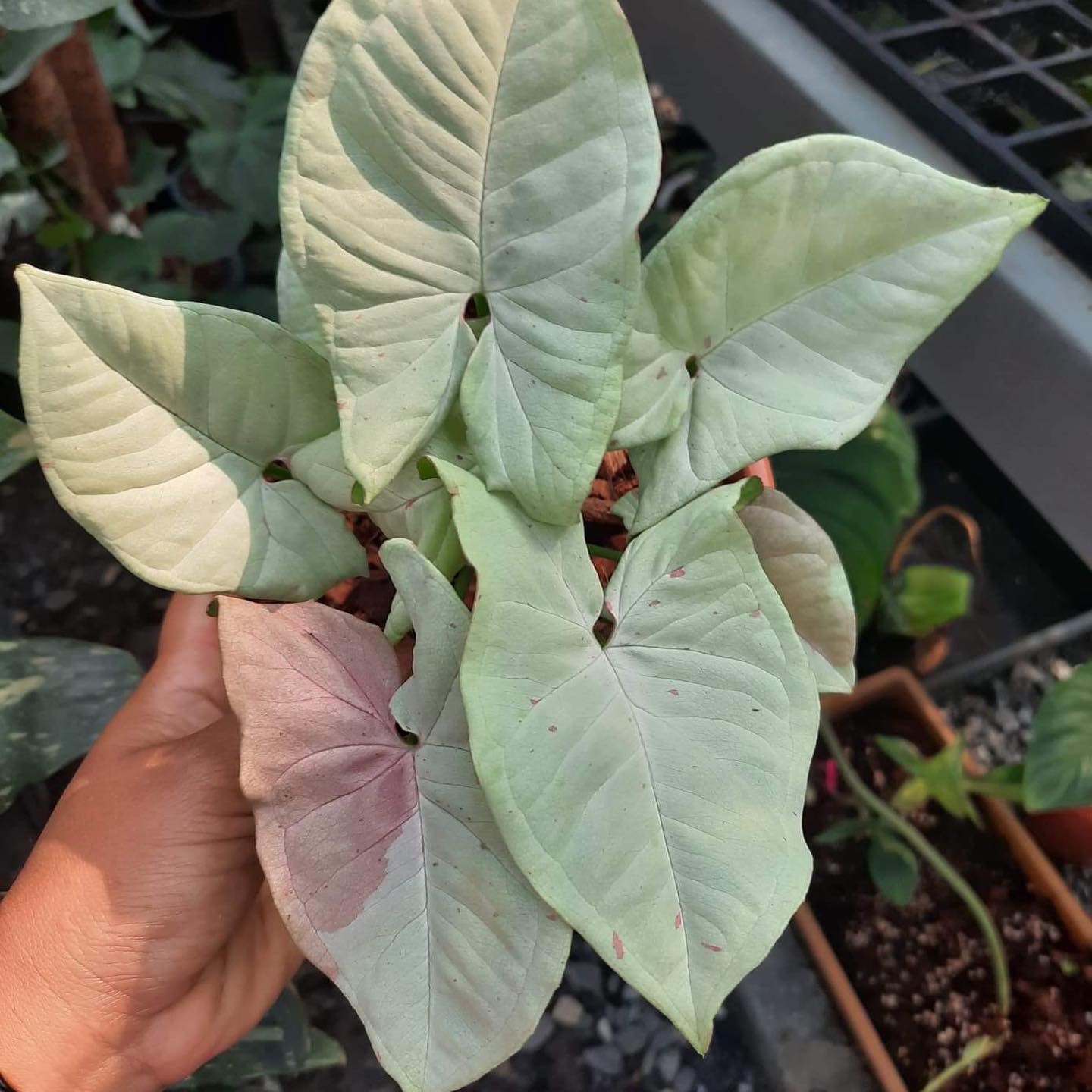
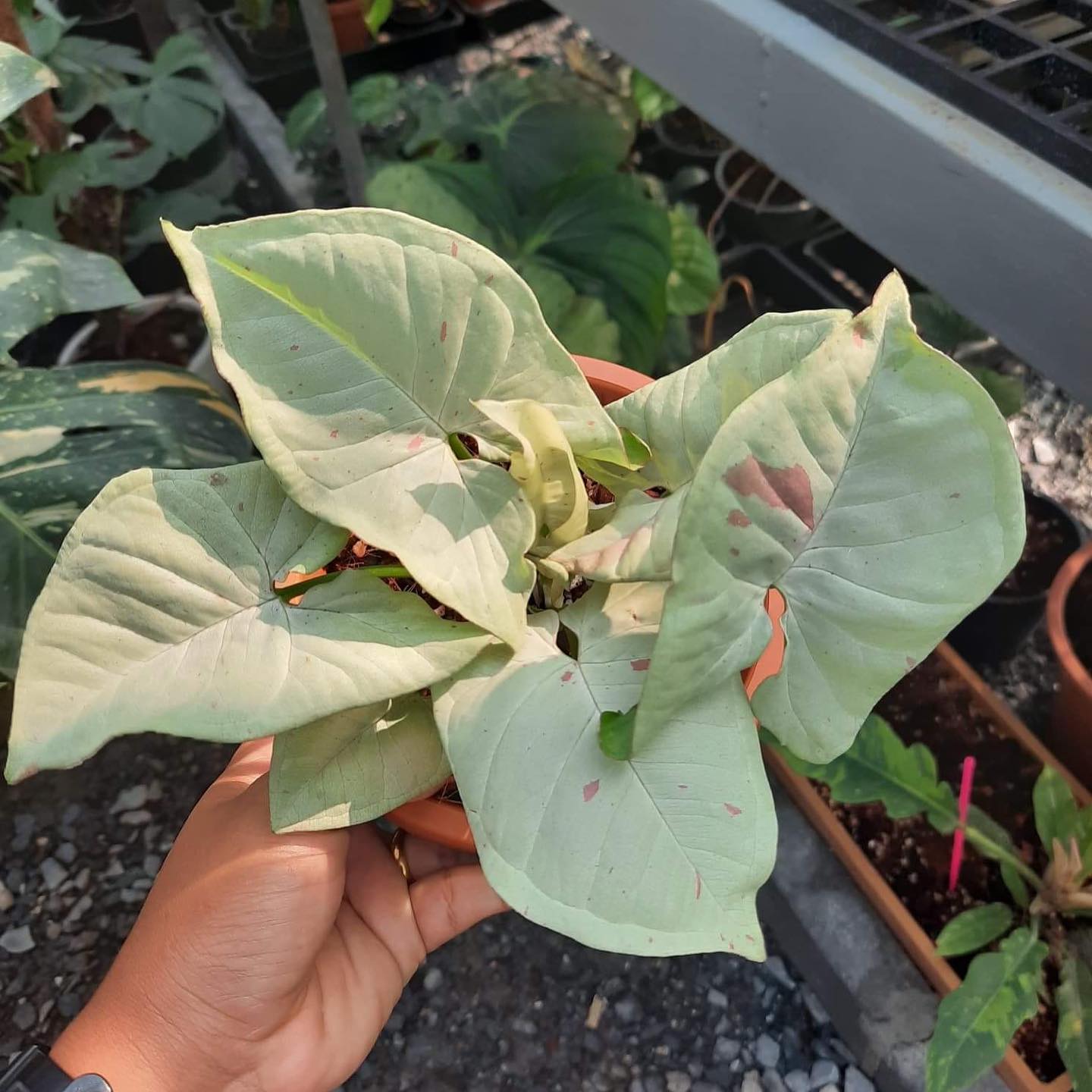
Syngonium Milk Confetti is a trade cultivar label used for an arrowhead vine with a pale, milky green leaf field and scattered pink marks. The most useful identification is not one photogenic leaf: compare several hardened leaves, the petiole sheath, the active stem and the plant’s propagation history.
Milk Confetti quick ID
| Feature | Useful Milk Confetti evidence | What it cannot prove alone |
|---|---|---|
| Leaf field | Pale cream-green, mint or milky green across several hardened leaves | One pale new leaf can change as it hardens |
| Pink pattern | Small flecks, spots or short splashes repeat through the leaf sequence | More pink does not automatically mean a better or truer plant |
| Petiole sheath | A pale sheath with pink spotting is a useful market heuristic | It is not an authoritative published diagnostic for an unresolved name |
| Growth | Juvenile arrow-shaped leaves arise along a stem that can trail or climb | A compact pot does not mean the plant is naturally self-heading |
| Health | Firm growth point, functioning roots and new leaves that harden without expanding damage | Uniform color alone does not establish health |
| Provenance | Seller can show the exact plant/lot and distinguish established, cutting or tissue-culture material | A stock photo or name tag cannot confirm the individual plant |
What the name records actually say
RHS lists Syngonium ‘Milk Confetti’ and describes the genus as evergreen aerial-rooting climbers whose juvenile ovate or arrow-shaped leaves can become pedately lobed as plants mature. The cultivar-name status on that record is Unresolved. It does not supply a breeder, parentage or formal description that lets us authenticate every plant sold under the name.
Kew accepts Syngonium podophyllum as a wet-tropical liana native from Mexico to Tropical America. That supports the species’ climbing architecture. It does not prove that Milk Confetti arose in the wild, came from a specific country or was produced by a particular cross.
The International Aroid Society’s cultivar guidance emphasizes distinctness, stability and uniformity through appropriate propagation. Until a reliable record connects an individual plant to a documented clone, use `Milk Confetti` as a careful horticultural label rather than a complete pedigree.
Milk Confetti vs Confetti
`Confetti` is better documented. US plant patent PP18016 identifies Syngonium podophyllum ‘Confetti’ as a whole-plant mutation selected from ‘Regina Red’. It records light-green leaves with random bright-pink splashes, flecks and spots, plus green petiole wings. The patent also reports that its traits remained stable through tissue-culture propagation. Those facts belong to ‘Confetti’; they should not be copied into Milk Confetti’s history.
| Label | Evidence-led comparison | Confidence boundary |
|---|---|---|
| Milk Confetti | Trade plants are usually selected for an overall milky/pale leaf field, fine pink marks and often a pale spotted sheath | RHS name unresolved; verify a sequence and provenance |
| Confetti | Patent documents light-green leaves, random bright-pink splashes/flecks/spots and green petiole wings | Use the combined patented traits, not pink spots alone |
| Red Spot Tricolor | Trade plants commonly show more discrete green, cream and pink sectors or patches | Seller usage varies; compare the actual stem and several leaves |
| Pink Splash | Trade usage generally favors a greener field with stronger pink splashes | Not every `pink splash` label has documented provenance |
When two plants look close, start at the oldest healthy leaf and follow the stem toward the active tip. Record the background color after each leaf hardens, the size/distribution of pink marks and the color/pattern of the sheath. If the traits conflict, keep the seller label in quotation marks and describe the plant instead of forcing an ID.
For a focused look at the adjacent label, see our Syngonium Red Spot Tricolor guide. The Syngonium variety overview is the better owner for browsing additional cultivar directions.
Use the whole plant, not a single leaf
- Check leaf age. A new leaf can be lighter, softer or less settled than it will be after hardening.
- Compare a sequence. Use at least three healthy leaves when possible; note whether the pale field and pink marks repeat.
- Inspect the sheath and stem. Photograph the petiole base rather than relying only on the blade.
- Separate pattern from damage. Stable pink tissue differs from expanding tan scorch, water-soaked lesions or fine pest stippling.
- Ask for provenance. Record seller, source plant or tissue-culture lot, date received and any original label.
Juvenile leaves can change shape
Milk Confetti is normally sold in its juvenile arrowhead form. North Carolina Extension describes juvenile S. podophyllum leaves as ovate, heart- or arrowhead-shaped and adult climbing leaves as increasingly lobed or pedate. A mature shape change is therefore not automatically a reversion or a different plant.
To keep a compact display, prune at planned nodes and root the removed sections. To observe more mature architecture, give the stem a stable pole, board or trellis. Attach the stem between nodes with soft ties; do not bind petioles or an unfurling leaf.
Light: support growth, do not force pink
Begin with bright indirect light and acclimate the plant in stages. University of Minnesota lists arrowhead plant among foliage plants suited to indoor light categories; the useful measure is what reaches the foliage, not a window direction by itself.
More light does not manufacture genetic pink pattern. It can support shorter internodes and stronger growth, and it can change how color appears to the eye or camera. Abrupt exposure can also bleach or scorch foliage. Move the plant gradually, then compare the next two or three leaves rather than chasing color week by week.
Water from root-zone evidence
Water thoroughly enough to wet the root ball, let excess leave through the drainage holes and wait for an appropriate dry-down. Probe below the decorative surface and learn the pot’s weight. A fixed `top inch` rule ignores pot depth, root density, substrate, light and season.
Iowa State Extension explains that watering frequency changes with light, temperature, humidity, container, media, plant size and season. If the mix remains wet while the plant uses little water, inspect drainage, pot size, light and root health before watering again.
Build an air-water system around the roots
Use a clean container mix that wets evenly but regains air as it dries. Bark or coir/peat-based materials can hold water; perlite, pumice or other coarse components can increase air space. There is no universal ratio because a warm bright growing area and a cool dim room do not dry at the same rate.
- Choose a pot only modestly larger than the functioning root mass.
- Keep drainage holes open and never leave the inner pot standing in collected water.
- Repot for a collapsed mix, root decline or an unmanageable wet-dry cycle—not automatically every two years.
- Use fertilizer only during active growth and follow the product label; reduce or pause it when roots are stressed or salts accumulate.
Our general Syngonium growing guide owns the broader light, container and routine-care framework.
Can you make Milk Confetti more pink?
You can improve the conditions for healthy expression, but you cannot order a particular splash pattern. UF/IFAS documents several biological causes of variegation, including pattern genetics, chimeras, transposons and pathogen-associated color. Appearance alone does not establish which mechanism applies to this clone.
- Photograph each hardened leaf under similar light.
- Confirm roots and growth are functioning before changing fertilizer or exposure.
- Judge three leaves, not one.
- If growth becomes uniformly green, trace the active stem and available nodes before pruning.
- If growth becomes nearly colorless, prioritize the remaining green tissue and plant energy rather than cutting for maximum pink.
A green leaf still contributes photosynthesis. A pale leaf is not `better` if the plant lacks enough green tissue to sustain the shoot.
Propagate from a viable node
UF/IFAS commercial Syngonium guidance describes nodal cuttings, tip cuttings and air layers. For a home cutting, identify the node and growth point first. A detached blade and petiole are not an equivalent plant-producing unit.
- Select a healthy stem section and map the node, leaf and bud.
- Use a clean sharp tool; keep the original plant with at least one viable growth point.
- Root the node in clean water or an aerated moist medium.
- Keep it warm and bright without abrupt sun; balance moisture with oxygen.
- Pot up only after roots can support the cutting, using a small container rather than a large wet volume.
Use our Syngonium propagation owner for the complete cutting workflow. Divide only when the pot contains genuinely separate rooted crowns; tearing one connected stem mass is not `division`.
Established plant or tissue culture?
| Route | Best for | Main verification |
|---|---|---|
| Established plant | Buyer who wants visible current foliage and a functioning root system | Exact-plant photos, hardened leaf sequence, roots, pests and shipping size |
| Stem cutting | Propagator comfortable rooting one documented node | Node/growth point, source plant, rooting stage and pattern history |
| Tissue-culture plantlets | Grower equipped for acclimatization and batch variability | Lot label, vessel condition, plantlet count/size, rooting and post-flask protocol |
The established Syngonium Milk Confetti product page owns current plant size, stock, price and fulfillment. The tissue-culture Milk Confetti product page owns the current batch quantity and shipping offer. Verify those live details on the product page rather than relying on a static care article.
Acclimating tissue-culture Milk Confetti
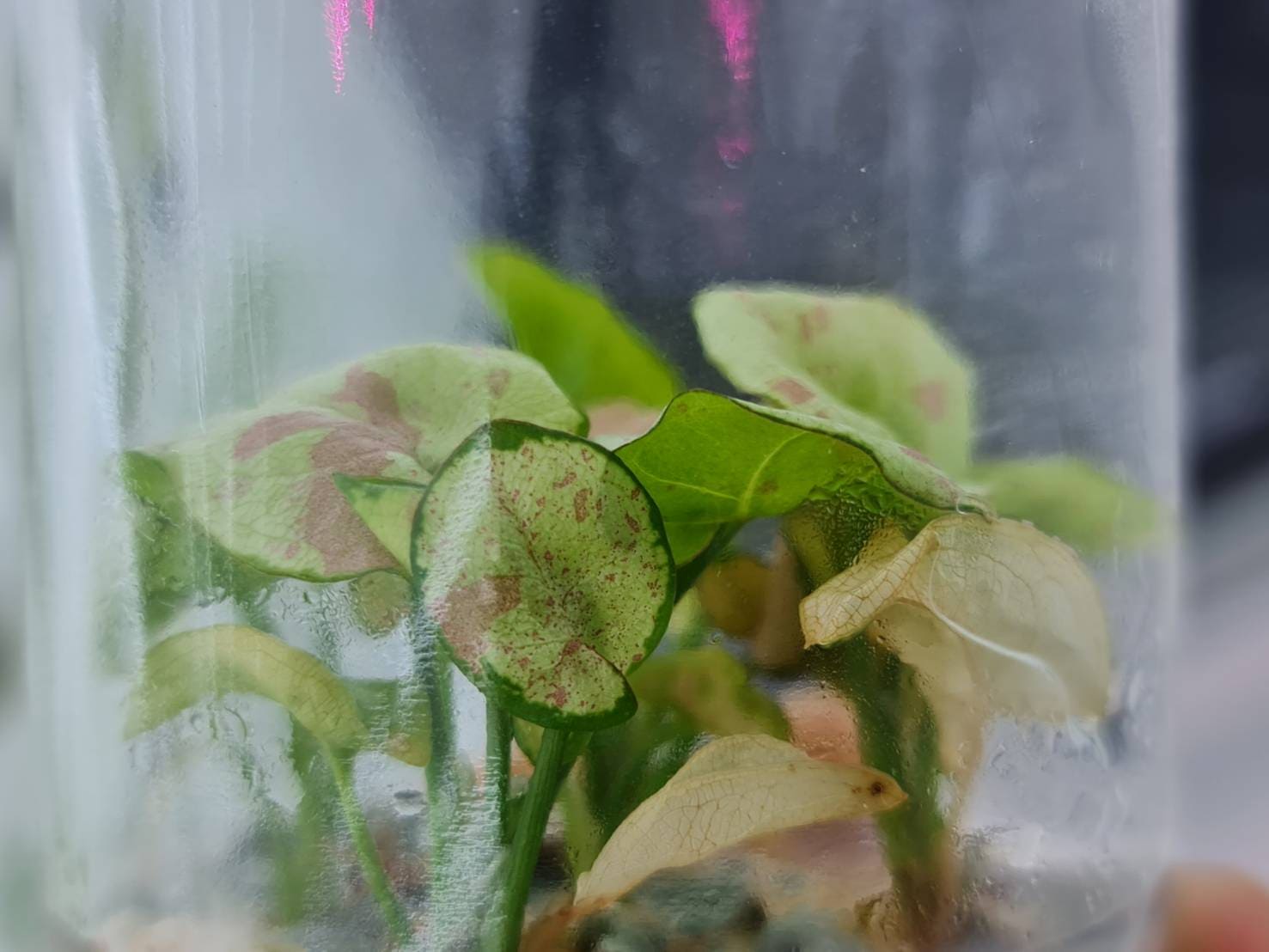
UF/IFAS defines acclimatization as the final stage of micropropagation: rooted microplants move into a small clean medium and initially need protection from desiccation in shade and high humidity while functional roots and leaves adapt.
- Inspect before opening. Photograph the vessel/pack, label, condensation, plantlets and any obvious collapse or contamination.
- Prepare first. Use clean tools, small cells, a fine aerated substrate and a humidity enclosure before removing plants.
- Handle roots gently. Remove culture medium according to the supplier’s protocol without crushing fine roots or crowns.
- Begin shaded and humid. Avoid direct sun and fertilizer while plantlets are adapting.
- Reduce humidity gradually. Vent in small steps, watching turgor and new growth rather than following a rigid universal day count.
- Increase light after stability. New functional leaves are stronger evidence of progress than the appearance of in-vitro foliage.
Tissue culture is a propagation method, not an automatic guarantee about the retail label, future pink percentage or post-shipping health. Keep the lot record and compare several new ex-vitro leaves before judging expression.
Troubleshooting by next check
| Observation | Check next | Avoid |
|---|---|---|
| Leaves greener than the listing photo | Leaf age, camera/light difference, several-leaf sequence and provenance | Moving directly into harsh sun to force pink |
| Pink/pale area turns tan and crisp | Recent exposure change, heat at glass/lamp and root-zone dryness | Calling stable dead tissue new variegation |
| Several leaves yellow in wet mix | Drainage, pot size, root firmness/odor and total light | Watering again by weekday |
| Fine pale stippling or distorted new leaf | Undersides with magnification; isolate and identify the pest | Assuming every pale mark is cultivar pattern |
| Long internodes and smaller leaves | Usable light, root function and support | Fertilizing before diagnosing the limiting factor |
| Plantlet wilts after deflasking | Humidity transition, root injury, substrate contact and heat/light | Opening the enclosure fully or soaking the medium reflexively |
| Older leaf becomes lobed | Climbing maturity and leaf sequence | Calling normal adult morphology reversion |
Frequently asked questions
Is Milk Confetti the same as Confetti?
Treat them as separate labels. ‘Confetti’ has a documented patent description and history; RHS lists Milk Confetti with unresolved name status. Pale foliage and a pale pink-spotted sheath are useful Milk Confetti market clues, but verify several leaves and provenance.
Is Milk Confetti a Syngonium podophyllum cultivar?
It is widely sold that way, but RHS currently records the name under Syngonium with unresolved status. Kew’s accepted S. podophyllum record describes the species, not Milk Confetti’s breeder or parentage.
Why is my new leaf almost white?
Wait for it to harden, then assess how much green tissue remains and compare the next leaf. A very pale leaf can contribute less energy; do not increase fertilizer or light abruptly to recolor it.
Does Milk Confetti revert?
Pattern expression can shift. Do not call one green leaf reversion. Track several hardened leaves, trace the active stem and only consider a cut when a repeatably green shoot and a viable patterned node are both clear.
Can Milk Confetti grow in low light?
It may persist in lower light, but growth can slow and internodes may lengthen. Provide enough usable light for active growth, measured by the plant’s response, while acclimating it away from sudden direct exposure.
Is Syngonium Milk Confetti safe for pets?
No. ASPCA lists Syngonium podophyllum as toxic to dogs, cats and horses because of insoluble calcium oxalates. Keep the plant out of reach and contact a veterinarian or animal poison service if chewing or ingestion is suspected.
Evidence-first takeaway
Identify Syngonium Milk Confetti through a repeatable combination: a milky leaf field, pink marks across hardened foliage, supporting sheath/stem evidence and a traceable source. Keep the unresolved-name boundary visible, use the documented ‘Confetti’ patent only for that cultivar, and manage light, roots and acclimatization for plant function rather than chasing a fixed pink percentage.
