
Syngonium collector guide
Syngonium Red Spot Tricolor is sold for variable green, cream and pink foliage. The useful evidence is not a perfect three-way color split: it is a repeated multi-leaf sequence attached to a viable stem, node, growth point and root system.

- Leaf sequence: compare several hardened leaves, not the pinkest new leaf.
- Stem and node: confirm viable shoot structure rather than a detached leaf.
- Growth point: locate the active tip or bud that will produce the next leaf.
- Roots and format: established pot, cutting and tissue-culture plantlet carry different risks.
- Photo scope: ask whether the image is exact, representative of a lot or a mother plant.
Species evidence and commercial name
Kew accepts Syngonium podophyllum as a liana native from Mexico into tropical America. That species evidence supports the arrowhead-vine structure, but it does not make Red Spot Tricolor a separate wild species or prove that a nursery selection was collected in a particular country.
Red Spot Tricolor functions as a commercial selection name. A 2024 plant patent for a different cultivar lists Red Spot Tricolor as unpatented comparison material. That is useful evidence that the name exists in cultivation; it does not register every marketplace plant or prove that unrelated listings share one source line.
What “tricolor” should—and should not—mean
| Observation | Reasonable reading | Do not assume |
|---|---|---|
| Green + cream + pink on several leaves | Current tricolor expression on the photographed plant. | An equal ratio or identical next leaf. |
| One mostly pink leaf | A pink-dominant leaf in the current sequence. | Greater rarity, permanent color or stronger plant health. |
| One mostly green leaf | A green-dominant leaf that needs sequence context. | Confirmed reversion from one observation. |
| Several pale leaves + weak growth | Possible low photosynthetic capacity or root/environment stress. | That fertilizer will restore green sectors. |
| Edited/high-saturation photo | Color appearance is not yet reliable. | That red/pink hue matches neutral daylight. |
Authentic group photo shows lot variation
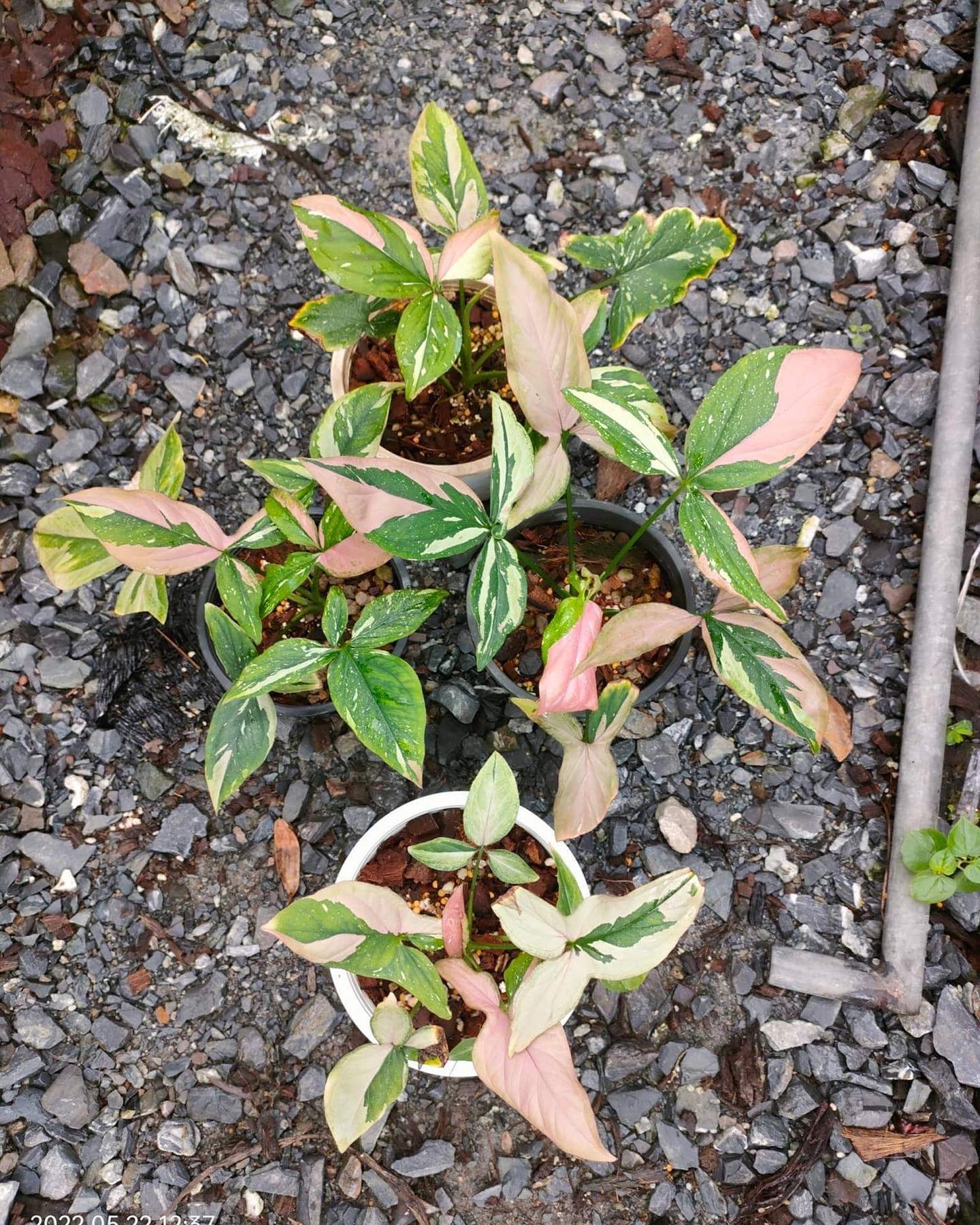
The historical Greenboog group photograph shows several potted plants with sectoral, splashed and pink-dominant leaves. Some leaves also show edge damage or yellowing. That makes the image valuable evidence: decorative pattern and plant condition must be judged separately.
Buyer checklist: potted plant, cutting or tissue culture
- Request current neutral-light photographs and confirm exact versus representative scope.
- Inspect several hardened leaves, stem pattern near the growth point, node and roots.
- Record quantity, pot/plantlet size, rooting status and whether leaves shown are mother-plant examples.
- For tissue culture, ask for current batch images and acclimation stage; do not treat one plantlet as a mature-pattern guarantee.
- Separate transit or root decline from an off-type claim and photograph arrival before trimming.
- Use live product pages for current stock, price, quantity and shipping terms.
Compare the potted Red Spot Tricolor offer with the tissue-culture Red Spot Tricolor offer. These formats should not be evaluated by the same leaf count or recovery timeline.
Care differences without repeating the general hub
The Syngonium care hub owns the complete light, watering, root-zone and troubleshooting workflow. For Red Spot Tricolor, prioritize gradual changes and a dated leaf record so scorch, bleaching, stress yellowing and new pattern are not confused.
Use bright filtered light, but do not raise exposure abruptly to chase pink. Water from pot weight, moisture at depth and root activity rather than a fixed top-inch calendar. Feed conservatively only when established roots and active growth are present; extra fertilizer cannot manufacture sectors.
Pattern problem or health problem?
| Sign | Check | Response |
|---|---|---|
| Stable flat cream/pink sector | Margin remains unchanged as leaf hardens. | Photograph as pattern evidence. |
| Dry expanding edge | Recent heat, direct sun, transit and root stress. | Stabilize conditions; do not label damage as color. |
| Wet or soft lesion | Progression, crown, nearby leaves and airflow. | Isolate and diagnose before propagation or sale. |
| Droop with wet pot | Drainage and root/crown firmness. | Do not automatically add water. |
Choose the next page by decision
Sources and evidence boundaries
- Kew Plants of the World Online: Syngonium podophyllum — accepted species, liana habit and native range.
- NC State Extension: Syngonium podophyllum — developmental form, climbing/propagation and safety context.
- US Plant Patent 36,275 — Red Spot Tricolor appears as comparison material for a different cultivar; it does not authenticate current lots.
Evidence limit: photographs document photographed phenotype and condition. They do not prove genotype, future color ratio, breeder history or the performance of a different production batch.
