
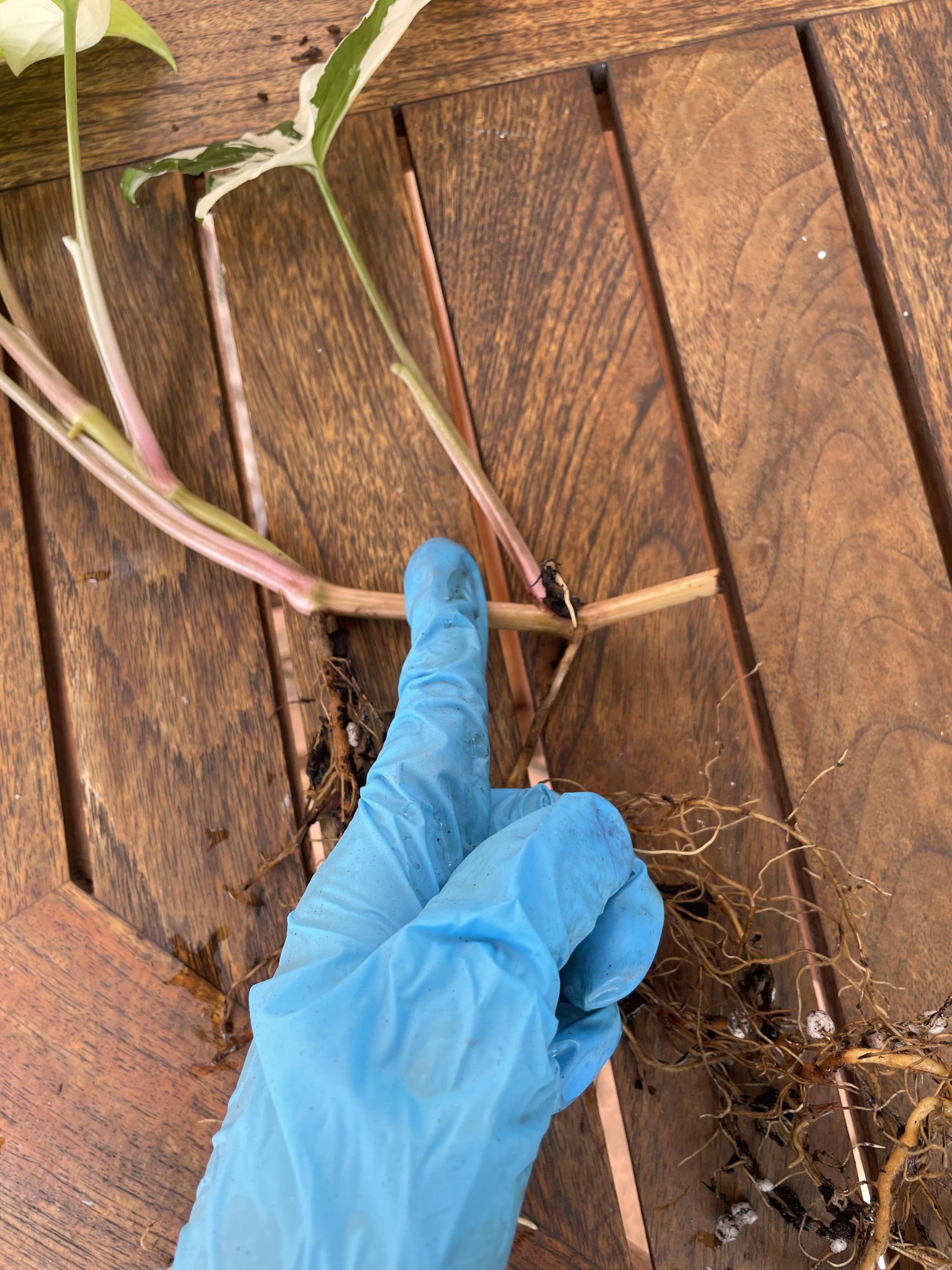
Greenboog propagation procedure
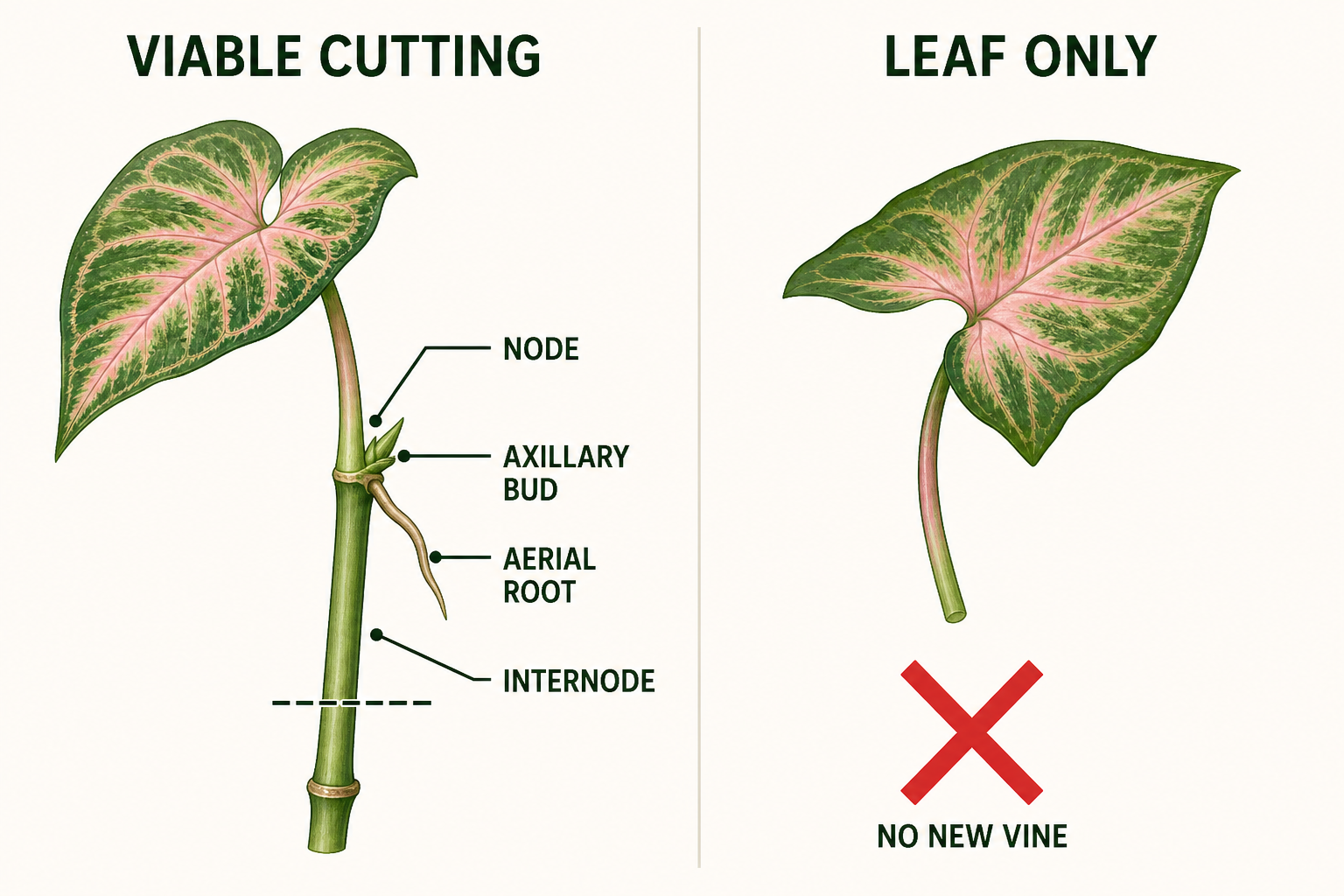
Syngonium propagation works when the cutting includes a viable stem node and bud. A leaf and petiole alone may stay green or form callus for a time, but without stem meristem tissue it cannot produce a new vine. For most owners, the practical choices are a node cutting rooted in water or an airy medium, division of a genuinely multi-rooted clump, or air layering before the stem is detached.
Find the node before you cut
| Part | What it looks like | Why it matters |
|---|---|---|
| Node | A joint or slightly thickened section where a leaf/petiole and bud attach | Produces roots and a new shoot; the cutting must retain one |
| Axillary bud | A small raised eye near the leaf attachment | Potential growth point for the next vine |
| Internode | The stem section between two nodes | A safe place for the cut line without slicing through the bud |
| Aerial root | A root nub or longer root emerging near a node | Helpful but not a substitute for a viable bud |
| Petiole | The stalk connecting leaf blade to stem | Is not a stem node by itself |
The UF/IFAS Syngonium production guide documents nodal cuttings, tip cuttings and air layers, including single-node or “single-eye” material. It also identifies Syngonium as a climber, which explains why nodes, aerial roots and stem support matter.
Choose a healthy mother plant
Propagation copies both strengths and problems. Start with a plant that is hydrated but not waterlogged, actively stable and free of obvious pests or spreading disease. The Penn State houseplant propagation guide likewise recommends healthy, unstressed material, clean tools and sterile or pathogen-free media.
- Inspect leaf undersides, sheaths, nodes and the stem base.
- Delay elective cutting if the plant has soft stem tissue, widespread wet spotting or an active pest outbreak.
- Clean the blade before the first cut and between plants.
- Plan which node will stay with the mother plant and which will travel with the cutting.
Take a Syngonium node cutting
- Trace the vine from a healthy leaf down to its node and visible or plausible bud area.
- Choose a cut line through the internode below that node. Leave enough stem to handle without damaging the joint.
- Make one clean cut rather than crushing or repeatedly sawing the stem.
- Remove only leaves that would sit in water or buried medium. Keep useful leaf area if the cutting can support it.
- Label the cutting immediately if cultivar identity or stem sector matters.
There is no universal requirement for a 3–6-inch cutting, several leaves or a long aerial root. The non-negotiable part is a sound node and bud; cutting size depends on internode length, plant vigor and the rooting setup.
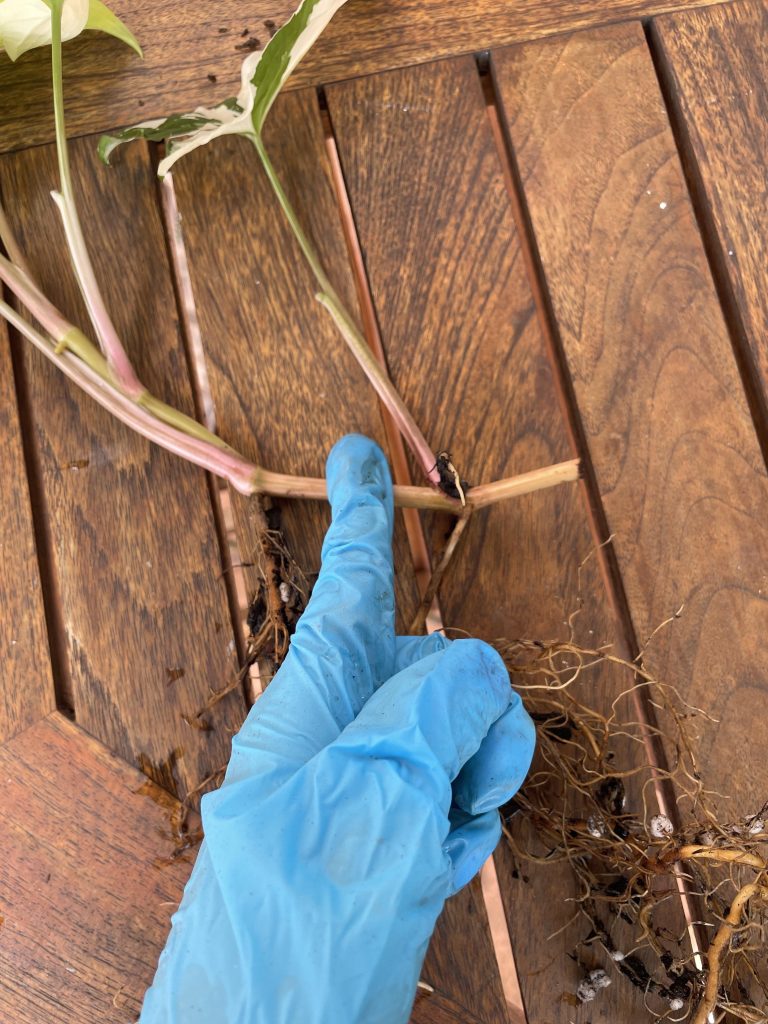
Water or rooting medium?
| Method | Advantages | Main risk | Best for |
|---|---|---|---|
| Water | Node and root growth remain visible; easy to inspect | Low oxygen, dirty container or delayed transfer can damage tissue | Beginners who will monitor the vessel |
| Airy medium | Roots begin in a solid, aerated environment closer to the final pot | Moisture is less visible; saturated media can rot the node | Growers comfortable checking media moisture |
| Air layering | Roots form while the stem remains attached and supported | Wrapped material can stay too wet or hide damage | Long vines or higher-value nodes |
| Division | Each section already has roots and shoots | Tearing a single crown/root mass causes unnecessary damage | True multi-stem or multi-rooted clumps |
Missouri Extension’s home propagation guide lists Arrowhead/Nephthytis for herbaceous cuttings, layering and division and notes that its cuttings may root in water. The method is a management choice, not a test of cultivar quality.
Root a Syngonium cutting in water
- Use a clean vessel and enough water to cover the node or aerial-root area without submerging the leaf blade.
- Place it in warm, bright indirect light. Avoid hot direct sun on the vessel and leaf.
- Inspect the node and water. Replace water when it becomes cloudy, develops odor or accumulates debris; do not rely on a fixed calendar.
- Discard soft, spreading dark tissue with a foul smell. A firm callused surface or normal pigment is not the same as rot.
- Transfer after several roots have begun to branch and can anchor the cutting, rather than chasing one exact root length.
Water roots can be visually easy to manage, but the move into potting mix changes oxygen and moisture conditions. Prepare the destination pot before removing the cutting and keep the first transition steady.
Root directly in an airy medium
- Choose a small clean container with drainage and a fresh medium that is moist, not saturated.
- Position at least the root-producing node against or just within the medium while keeping the bud oriented so it can emerge.
- Support a top-heavy cutting so movement does not tear new roots.
- Maintain gentle warmth and indirect light. Check actual moisture below the surface.
- Use a loose humidity cover only when the cutting is losing water faster than it can replace it, and ventilate to prevent stagnant wet foliage.
Penn State lists water, perlite, vermiculite, bark and combinations as possible propagation media and warns that excessive humidity can encourage disease. Garden soil and dense reused media are poor choices because they can be pathogen-rich or poorly aerated.
Know when the cutting is ready to pot
Readiness is a root-system decision, not a day count. Look for several firm roots with some branching, a stable node and no spreading soft tissue. A new leaf is encouraging but not required before transfer if roots can support the plant.
- Choose a modest pot around the root volume, not an oversized container.
- Arrange roots without sharp bends and settle an airy mix around them.
- Water thoroughly, let excess drain and keep conditions stable.
- For the first weeks, monitor root-zone moisture more closely without keeping the mix continuously saturated.
- Delay fertilizer until roots are functioning and the cutting resumes growth.
Missouri Extension describes the transition from high-humidity, moist rooting conditions to a normal pot as one of the most critical phases. Gradual change matters more than a “fertilize immediately” rule.
Divide a Syngonium only when it can divide
Division is appropriate when the pot contains separable rooted stems, offsets or clumps. It is not the same as cutting one vine’s tangled roots in half.
- Slide the plant out and identify natural groups of stems and roots.
- Tease apart loose roots first. Cut only where groups cannot separate cleanly.
- Make sure each division retains both live roots and a viable shoot/node.
- Pot each section close to its root volume and stabilize it.
- Expect temporary pause or leaf loss; division does not guarantee “rapid growth.”
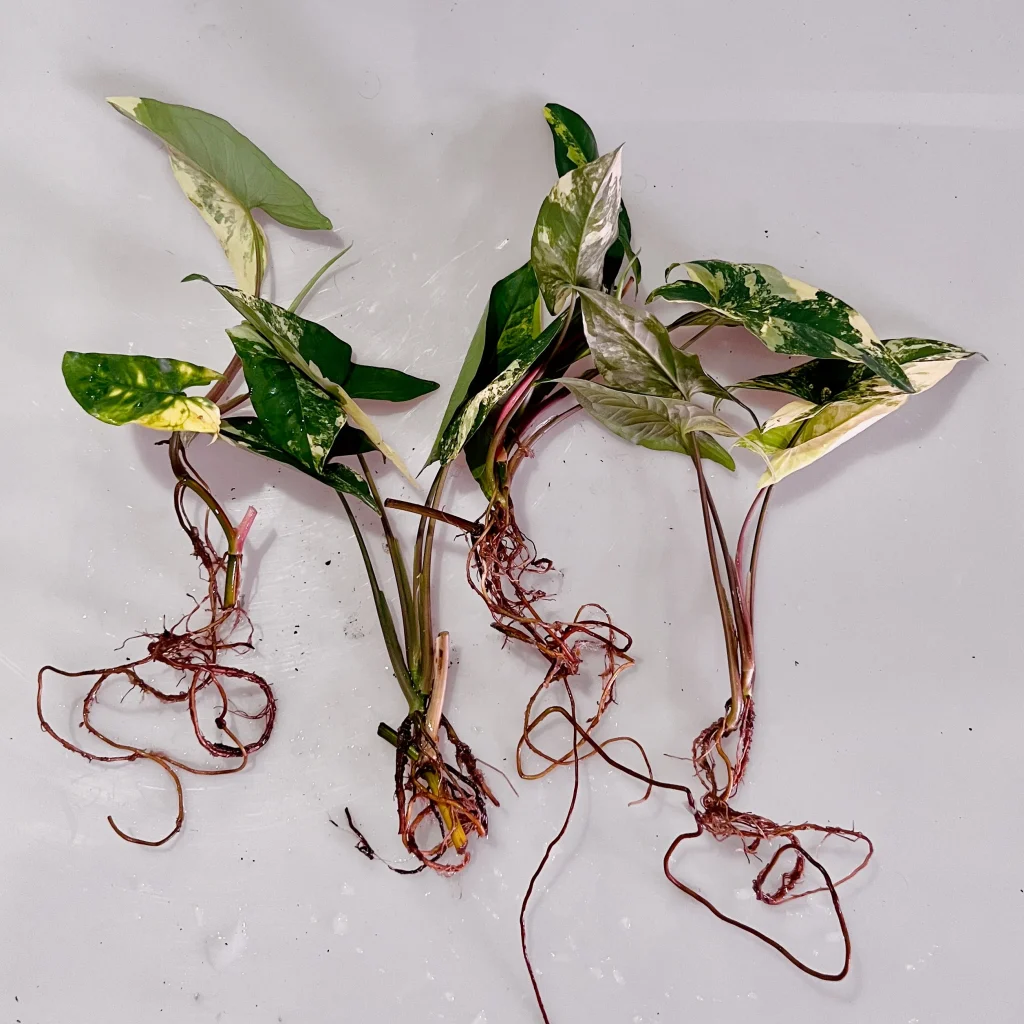
Air-layer a long vine before cutting
Air layering lets a node produce roots while it remains attached to the mother plant. Place clean moist propagation material around a node with a bud/aerial-root area, secure it without crushing the stem and keep it moist but aerated. Cut below the rooted node only after you can see or feel an adequate root system.
This method reduces the period in which a leaf must survive without roots, but it still requires hygiene and moisture control. Do not seal visibly diseased tissue inside a wrap.
Preserve pattern on variegated cultivars
A named or variegated Syngonium is normally preserved by vegetative propagation, but no cutting can guarantee the exact color percentage of every future leaf. Map the recent leaf sequence and the stem sector around the chosen node.
- The Mojito guide explains mottled pattern decisions.
- The Milk Confetti guide separates registered Confetti evidence from marketplace Milk Confetti and tissue-culture material.
- The Pink Spot guide, Strawberry Ice guide and Pink Splash guide each define their own label and pattern boundary.
A very pale leaf on a stem with no viable green sector may root poorly because the cutting has limited photosynthetic capacity. A solid-green cutting can be vigorous but may continue producing green growth from that sector. Choose a functional balance rather than the pinkest photograph.
Seeds and tissue culture: different workflows
Seed is sexual propagation. Seedlings can differ genetically from the parent and should not automatically carry a named cultivar label. UF/IFAS notes that some Syngonium cultivars are propagated by seed, but commercial production has largely shifted to tissue-culture liners. The International Aroid Society requires distinct cultivar characters to persist through an appropriate propagation method.
Do not use the old “brown pod splits, dry and refrigerate for a year” recipe: this article’s evidence pack does not support it for Syngonium. Without verified species, pollination and fresh-seed provenance, a home seed protocol would create false confidence.
Tissue culture is a laboratory multiplication method, not a shortcut to apply to a household cutting. A deflasked plantlet needs gradual humidity, light and root-zone acclimation; it should not be treated as an established potted division.
Troubleshoot stalled or failing cuttings
| Signal | Check | Response |
|---|---|---|
| Node turns soft, dark and foul-smelling | Oxygen, contaminated water/media and damage depth | Remove spreading dead tissue with a clean tool; restart from sound material if no viable node remains |
| No roots but node remains firm | Bud viability, temperature, light and time | Keep conditions stable; do not fertilize an unrooted cutting |
| Leaf yellows while node stays firm | Normal resource draw versus excessive wetness or stress | Protect the node; a lost leaf does not automatically mean the cutting is dead |
| White surface growth or algae | Light on water, stagnant humidity and dirty surfaces | Clean the vessel/setup and improve hygiene/air exchange without desiccating the node |
| Cutting wilts after potting | Root branching, root damage and abrupt humidity/light change | Stabilize conditions and reduce stress; avoid another immediate repot |
| Wet translucent spots or soft stem rot | Spread to adjacent tissue and overhead wetting | Use the Penn State Syngonium disease guide; isolate and keep foliage dry |
Safety and cleanup
The ASPCA lists Syngonium podophyllum as toxic to cats and dogs because of insoluble calcium oxalates. Keep cuttings, water vessels and discarded leaves out of reach. Avoid sap contact with eyes and mouth, clean the work surface and wash tools after use.
Frequently asked questions
Can Syngonium grow from a leaf only?
No new vine can form without a viable stem node and bud. A leaf may remain alive temporarily, but it is not a complete propagation unit for Syngonium.
Is water or soil better for Syngonium propagation?
Both water and an airy rooting medium can work. Water improves visibility; medium avoids a later water-to-mix transition. Choose the method you can keep clean, moist and oxygenated.
How long does Syngonium take to root?
There is no reliable household day count. Cultivar, node condition, temperature, light, medium and root-zone oxygen all matter. Judge firm branching roots and node health rather than a calendar.
Can I divide one Syngonium vine?
Not by cutting its roots arbitrarily. Division needs separable rooted stems or clumps, with viable shoot tissue and roots in each section. A single vine is better propagated by node cuttings or air layering.
Will a variegated cutting stay variegated?
Vegetative propagation preserves the clone, but the chosen stem sector and future growth still affect visible pattern. No responsible guide can guarantee an exact color percentage.

2 thoughts on “How to Propagate Syngonium: Node, Water & Soil”