
Syngonium cultivar guide
Syngonium Batik is recognized in trade by an organized pale network that follows the veins across green arrowhead leaves. Verify that pattern on several hardened leaves, then inspect the stem, node, growth point and roots before treating a label or bright photograph as identity evidence.
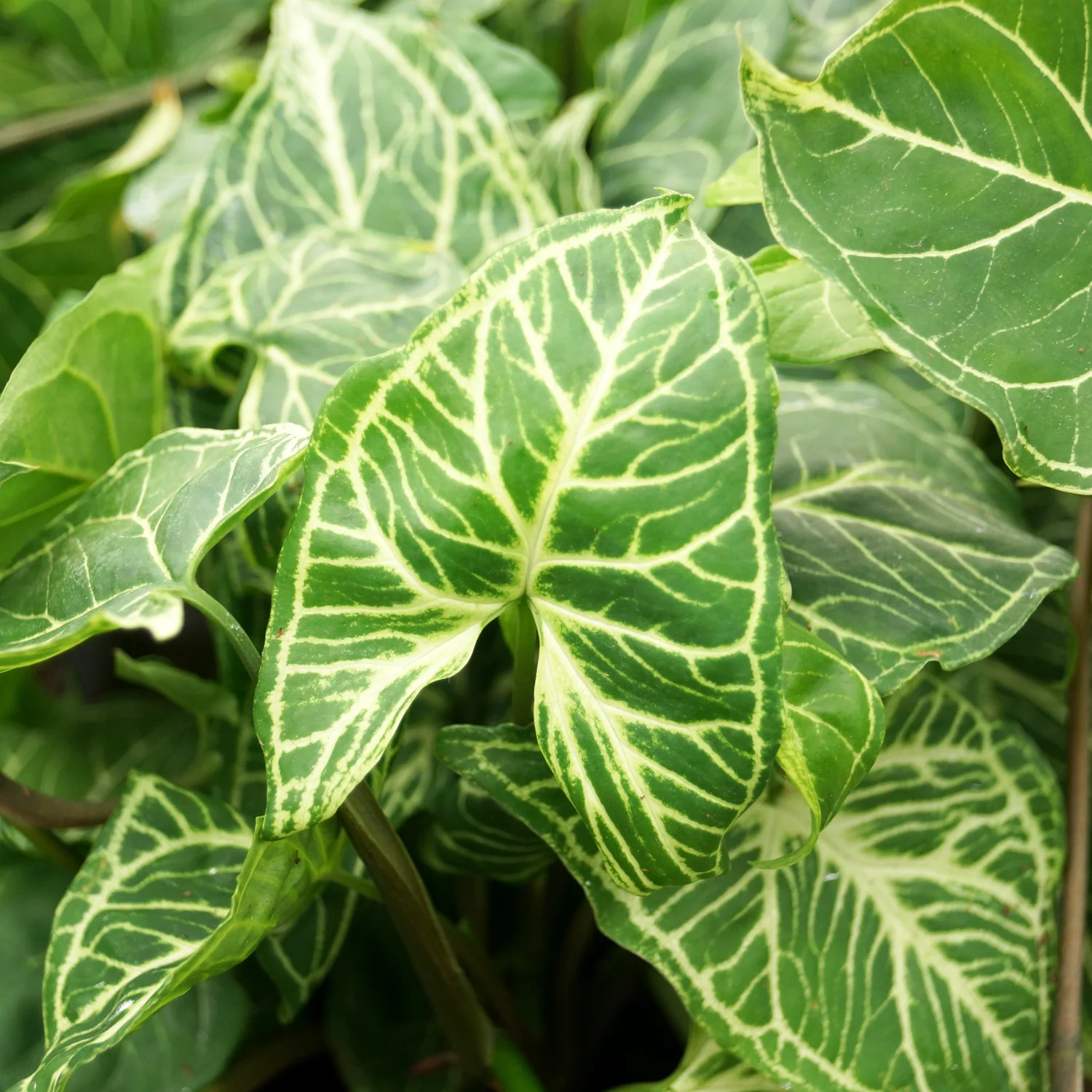
- Pattern: pale lines track primary and secondary veins.
- Repetition: the network appears across several hardened leaves, not only one new leaf.
- Structure: the plant has a Syngonium-type stem, nodes, petiole sheaths and an active growth point.
- Source: the seller can show a current whole plant, format and provenance rather than only a stock image.
Species evidence and the Batik trade label
Kew accepts Syngonium podophyllum as a tropical American liana. That species record supports the climbing arrowhead-vine framework, but it does not make Batik a separate wild species or prove a particular breeder, parentage or country of origin for a nursery plant.
Greenboog markets this selection as Syngonium Batik. Use “Batik” as the commercial selection label attached to the photographed plant and product record. Unless a registry, breeder publication or other traceable record accompanies an offer, keep the name useful but the origin story open.
What the authentic photographs support
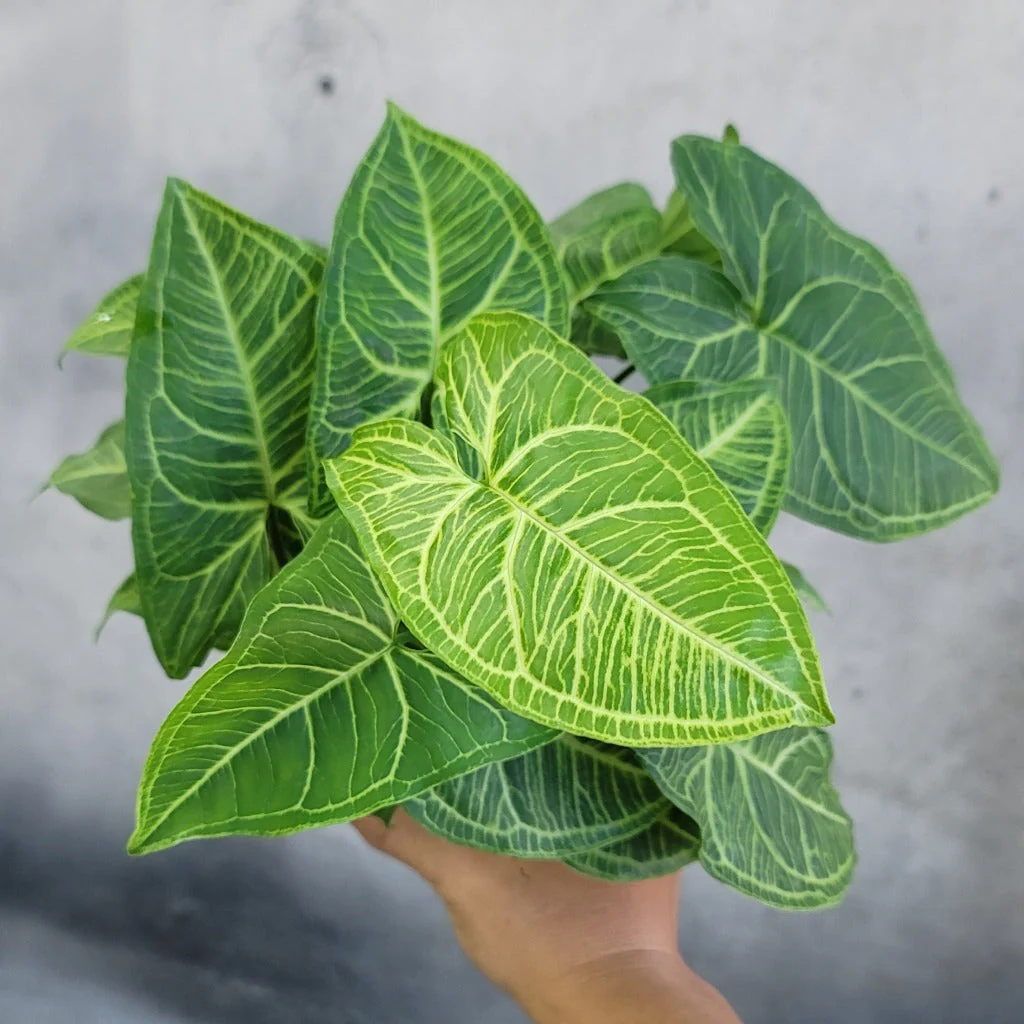
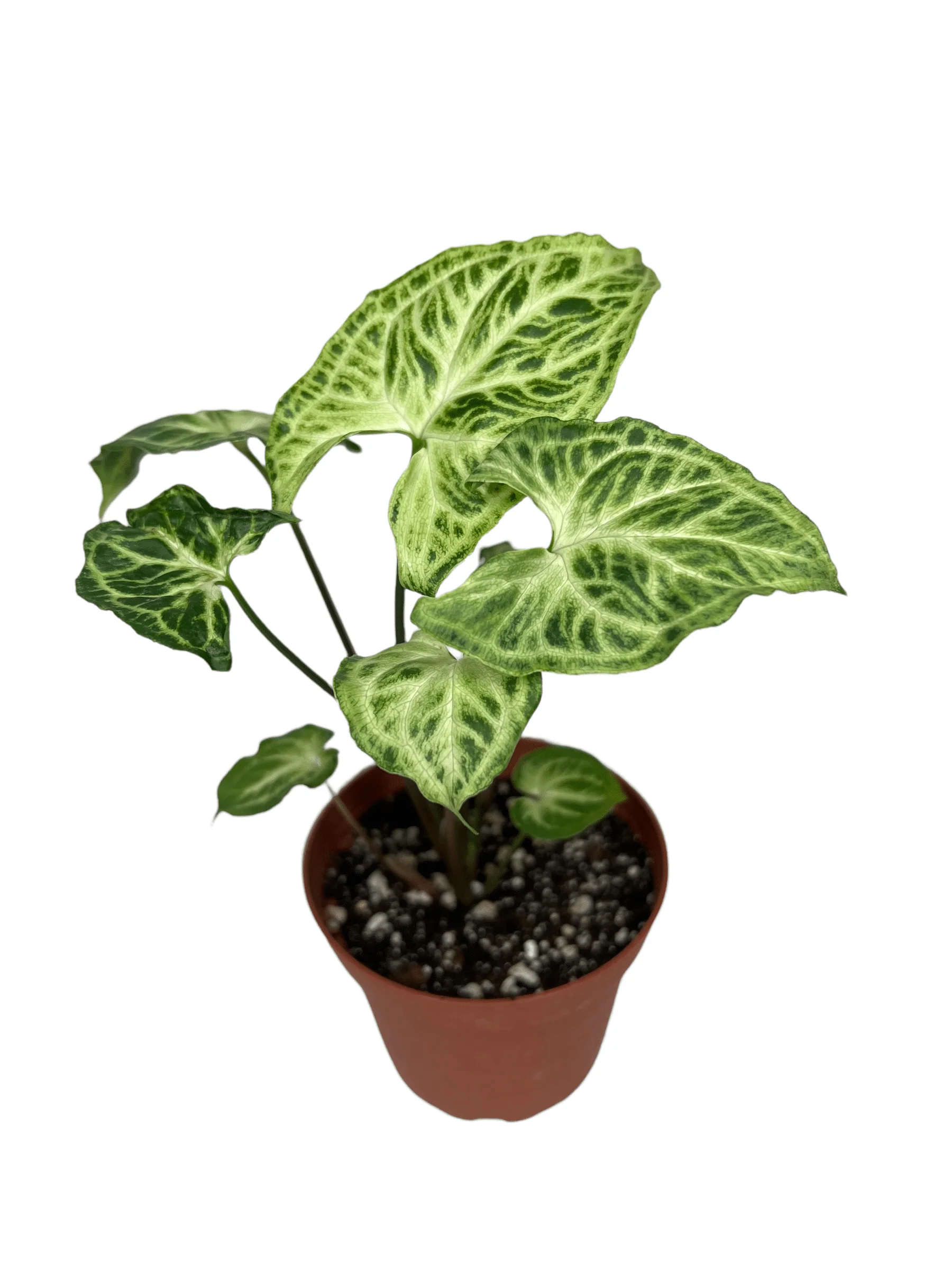
The three Greenboog photographs show a consistent pale vein network on multiple green juvenile leaves. They support current photographed expression. They cannot guarantee the next leaf, the exact contrast of a shipped plant or that every similar-looking listing shares the same source line.
Batik pattern or a plant-health symptom?
| What you see | Most useful distinction | Next check |
|---|---|---|
| Fine pale network | Lines consistently follow primary and secondary veins. | Confirm the pattern across several hardened leaves. |
| Whole leaf fading | General loss of green is not the same as organized venation. | Review root condition, light change, leaf age and feeding history. |
| Yellow between veins | Interveinal chlorosis changes tissue fields, not just a stable line network. | Inspect roots and the sequence; avoid diagnosing a nutrient from one image. |
| Tiny pale dots | Stippling is scattered and may accompany webbing, residue or pests. | Inspect both leaf surfaces and isolate a suspect plant. |
| Expanding brown/wet patch | A progressing lesion is damage or disease evidence, not decorative pattern. | Track the margin, moisture, crown and nearby leaves. |
Buyer checklist for a Batik-labelled plant
- Ask whether photographs show the exact plant or a representative mother/lot.
- Request one neutral-light whole-plant image and close views of several hardened leaves.
- Confirm an active growth point, viable node and root status.
- Record whether the offer is established, rooted cutting, fresh cutting or tissue culture.
- Compare line geometry; do not use image brightness as the main identity cue.
- Check leaf undersides, petiole bases and new growth for pests or lesions.
- Use the live listing for current size, quantity, stock, price and shipping terms.
For the current offer, see the Syngonium Batik product page. For side-by-side pattern discovery, use the Syngonium types hub.
Care differences that preserve readable pattern
The Syngonium care hub owns the complete light, watering, root-zone, support and symptom workflow. For Batik, prioritize stable filtered light and gradual acclimation so new scorch or bleaching is not confused with the pale vein network.
Water from pot weight and moisture at depth rather than a fixed top-inch rule. Keep useful moisture without persistent saturation, and feed conservatively only when roots are healthy and active growth is visible. Extra fertilizer cannot create Batik venation or repair damaged roots.
Support an established vine if mature growth is the goal. Loosely guide the stem without pinching petioles; do not interpret developmental leaf-shape change as loss of the Batik label.
Propagation: preserve a node and record the source
A viable new vine needs stem tissue with a node and active bud or growth point. Photograph the parent and cutting before separation, use clean tools and label the date/source. A detached leaf may persist or root but cannot replace the missing shoot structure.
Do not place every cutting on the same calendar. Rooted divisions, fresh cuttings and tissue-culture plantlets carry different reserves and moisture risks. The Syngonium propagation guide provides the node-mapping workflow; this page keeps the Batik pattern record attached to it.
Choose the next page by intent
This page owns Batik pattern verification. The general hub owns care and troubleshooting; the types hub compares labels; the category and product pages own current shopping information.
Sources and evidence boundaries
- Kew Plants of the World Online: Syngonium podophyllum — accepted species, liana habit and native range.
- NC State Extension: Syngonium podophyllum — juvenile/adult leaf change, climbing habit, propagation and calcium-oxalate safety context.
Evidence limit: species sources do not register or authenticate the Batik trade label. Greenboog photographs document the pictured plants; they do not guarantee a future leaf or every current lot.

1 thought on “Syngonium Batik: Pattern, Identity & Care Differences”