Greenboog hybrid identity & care field guide
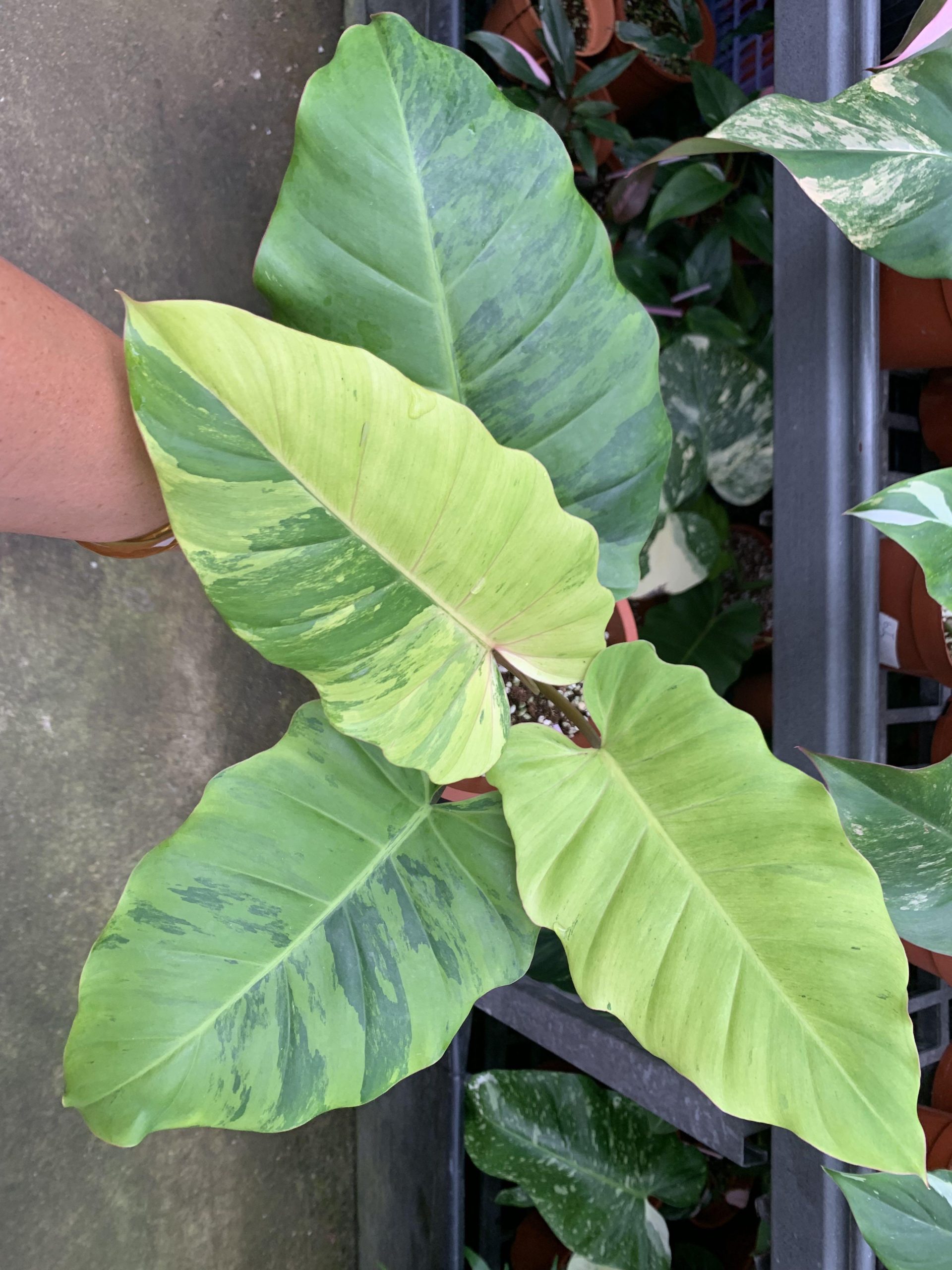
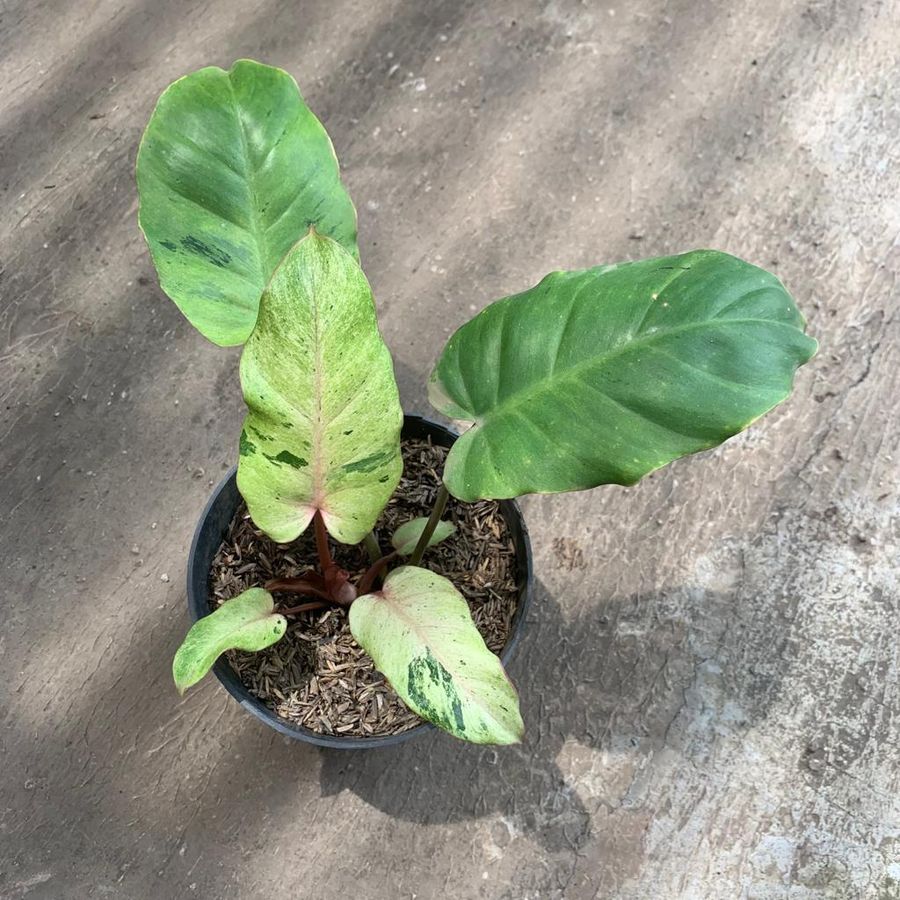
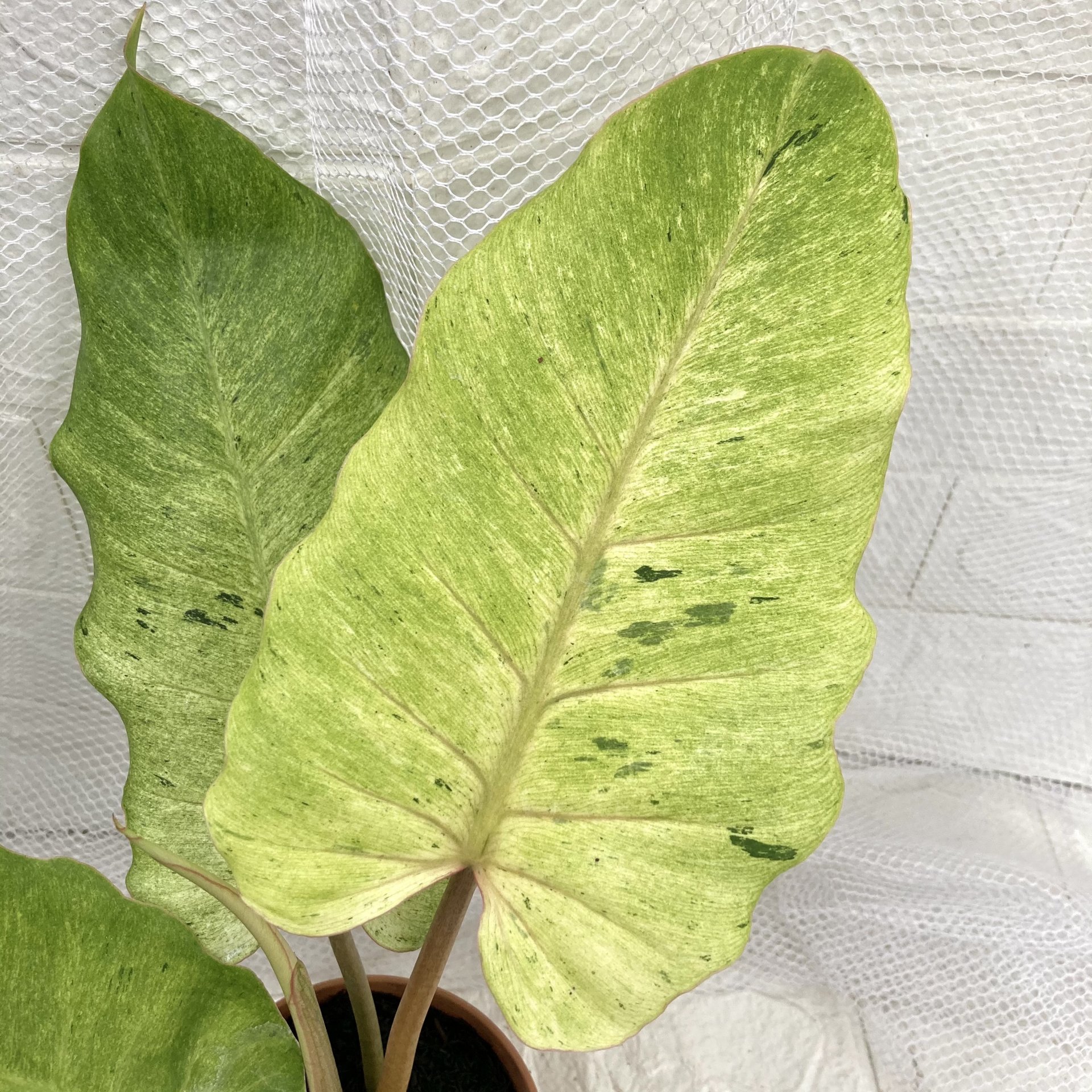
Snowdrift is best recognized from a sequence: pale cream-to-mint new leaves, fine green flecking, and older leaves that often settle greener. One bright leaf is not the whole identity.
This guide owns Snowdrift identity, colour progression and plant-specific care. For broad collector comparison, open the rare Philodendron varieties guide.
Philodendron Snowdrift at a glance
| Question | Evidence-led answer |
|---|---|
| Name type | Horticultural hybrid/trade name, not an accepted species binomial |
| Colour sequence | New leaves may open cream, yellow-green or mint with darker flecks, then gain green as they harden |
| Leaf shape | Juvenile blades are simpler; established leaves may broaden and develop uneven or shallow lobing |
| Habit | Begins as a compact upright crown; an older stem may lengthen, so judge the whole plant before choosing support |
| Reported parentage | P. pinnatifidum × P. giganteum is widely repeated but remains unconfirmed here |
| Safety | Philodendron tissue contains irritating insoluble calcium-oxalate crystals |
What the Snowdrift name proves—and what it does not
‘Snowdrift’ is a cultivated name used in the plant trade. It is not a wild species with a documented native range of its own. Calling it “native to South America” confuses the broad genus with this particular horticultural selection.
Current search results repeatedly give P. pinnatifidum and P. giganteum as the parents. That may be a useful lead, but repetition is not a breeder record. Until a primary origin document is located, the careful description is Philodendron hybrid sold as ‘Snowdrift’.
Identify Snowdrift from a leaf sequence
Start with several leaves at different ages. The strongest recurring visual stack is a pale emerging blade, fine green speckles or brush marks, and more green in the hardened foliage. Soft pink can appear around the midrib, petiole or young tissue on some plants, but it is a supporting clue rather than a requirement.
| Check | Stronger evidence | Weak evidence |
|---|---|---|
| Leaf sequence | Several leaves repeat pale emergence, fine green flecking and greener hardening | One washed-out or yellow leaf |
| Plant structure | Compact young crown plus a traceable older stem and growth point | A cropped leaf with no stem or provenance |
| Pattern | Fine, distributed green marks visible in neutral light | Colour judged through a heavy filter or grow-light cast |
| Condition | Firm leaves, active growth and functioning roots | Stress chlorosis sold as “more variegated” |
Normal greening is not automatically reversion
A Snowdrift leaf can gain chlorophyll and look greener as it expands and hardens. Compare the newest fully hardened leaf with several earlier leaves, not with the few hours after unfurling. A run of fully green growth may justify checking identity, light, roots and the actual growth point, but one greener mature leaf is not enough to declare permanent reversion.
Light: support the plant, do not chase white leaves
NC State Extension recommends bright indirect light for Philodendron generally. For Snowdrift, the practical goal is enough filtered light to support the plant’s green tissue without bleaching or scorching pale sections. Light cannot be used as a dial that guarantees a whiter next leaf.
- Possible shortage: progressively smaller leaves, longer leaning petioles and slower drying after root health is checked.
- Possible excess: dry tan patches concentrated on the window-facing side, especially in pale tissue.
- Safer adjustment: change curtain filtering, window distance or lamp duration gradually, then judge the next two hardened leaves.
The Philodendron care guide owns broader room-level acclimation. Avoid moving a greenhouse-grown plant directly into harsh sun, even if the seller used “high light” in its description.
Build a root zone that drains and re-aerates
Use a container with open drainage and a medium that holds useful moisture while returning air after watering. Bark, coarse mineral material and coco- or peat-based components can all play a role, but no fixed recipe works independently of pot size, climate and watering style.
- Water thoroughly across the root ball and let excess leave the pot.
- Learn the pot’s weight after watering and after much of the rooted volume has dried.
- Check below the decorative surface; a dry top layer can hide a saturated core.
- Water again from the combined evidence of pot weight, root-zone moisture and active growth—not a weekday.
For wet-versus-dry diagnosis, water quality and pot behavior, use the Philodendron watering guide. Yellowing and drooping can occur with both drought and oxygen-starved roots, so the leaf alone is not a watering instruction.
Warmth, humidity, feeding and support
Keep the plant warm and away from cold drafts or hot vents. Average household humidity can be workable when watering and roots are stable. If measured humidity is persistently low and edges crisp across multiple plants, a clean humidifier is more effective than routine misting; airflow still matters.
Feed modestly during active growth according to the fertilizer label. Pause and diagnose when roots are injured or growth has slowed from cold or low light. Repot when roots densely occupy the container, the medium collapses or drainage behavior changes—not automatically every year. Increase pot size conservatively so an unrooted wet buffer does not surround a small root ball.
Young Snowdrift often presents as a tight upright crown. If an established stem begins to lengthen and lean, add a stable stake or board without crushing petioles. Current pages conflict on “self-heading” versus “climbing”; let the actual stem and roots decide whether support is useful.
Symptom table
| Signal | Check first | Safer response |
|---|---|---|
| One greener hardened leaf | Normal age sequence and several previous leaves | Observe the next growth; do not cut immediately |
| Several fully green leaves | Plant identity, growth point, usable light and root health | Correct verified stress gradually; cut only with a viable node plan |
| Pale leaf becomes uniformly yellow | Root condition, pot weight, cold and nutrition history | Separate chlorosis from cultivar pattern before treating |
| Crisp tan patch | Window-facing exposure, uneven hydration and heat load | Filter exposure and stabilize watering; damaged tissue will not turn green |
| New growth distorted | Inspect emerging tissue and leaf undersides for pests; check root function | Isolate if needed and identify the cause before spraying |
Propagation without a colour promise
A detached leaf and petiole cannot reproduce a complete Snowdrift. A cutting needs viable stem tissue with a node and usable bud or growth point. Because young plants can have short internodes, do not cut until the anatomy is visible; air layering can reduce risk on a valuable established stem.
Use clean tools and healthy stock. Choose water or an airy moist medium based on the cutting, then protect it from saturation while roots form. The Philodendron propagation guide owns the complete node, top-cut, mid-cut and transfer workflow. Even a correctly selected cutting cannot guarantee a fixed amount of pale colour on the next leaf.
Buyer checklist
- Request an unfiltered whole-plant photo plus several leaves at different ages.
- Look for fine green flecking within pale new growth and a credible hardening sequence.
- Ask for the stem, growth point and roots—not just one cut leaf.
- Treat exact parentage and “guaranteed white” claims as unverified unless documentation is supplied.
- Do not pay more for yellowing caused by weak roots, pests or nutrient stress.
Use the Jungle Boogie guide for that separate serrated-leaf cultivar; neither trade label should borrow the other’s identity. The Philodendron collection owns current inventory, while this page stays focused on Snowdrift evidence and care.
Safety
Philodendron tissue contains insoluble calcium-oxalate crystals that can irritate the mouth and digestive tract when chewed. Keep plants and cut material away from children and pets; contact a veterinarian or poison service after suspected ingestion.
Philodendron Snowdrift FAQ
Is Philodendron Snowdrift a species?
No. Snowdrift is a horticultural hybrid/trade name, not an accepted species binomial with its own native range.
What are the parents of Philodendron Snowdrift?
P. pinnatifidum × P. giganteum is widely repeated online, but this audit did not locate a primary breeder or registration record confirming the formula. Treat it as reported, not proven.
Why does my Snowdrift turn greener?
Leaves often gain green as they expand and harden. Compare several leaves and inspect light and roots before calling one greener leaf a reversion.
Can brighter light make Snowdrift whiter?
No light level guarantees a whiter leaf. Use bright filtered light to support the plant, and increase exposure gradually to protect pale tissue from scorch.
Is Snowdrift self-heading or climbing?
Young plants form a compact upright crown, while an older stem may lengthen and lean. Current sources use both labels, so choose support from the actual plant structure rather than a generic tag.
Sources and evidence boundaries
- NC State Extension: Philodendron habit and genus-level care
- UF/IFAS: genetic chimera concepts and their limits
- UF/IFAS: genetic variegation mechanisms
- Penn State Extension: healthy stock, clean tools and propagation environment
- ASPCA Animal Poison Control: Philodendron calcium-oxalate exposure
- Proven Winners: current branded Snowdrift hybrid description, not universal origin proof