Greenboog species field guide
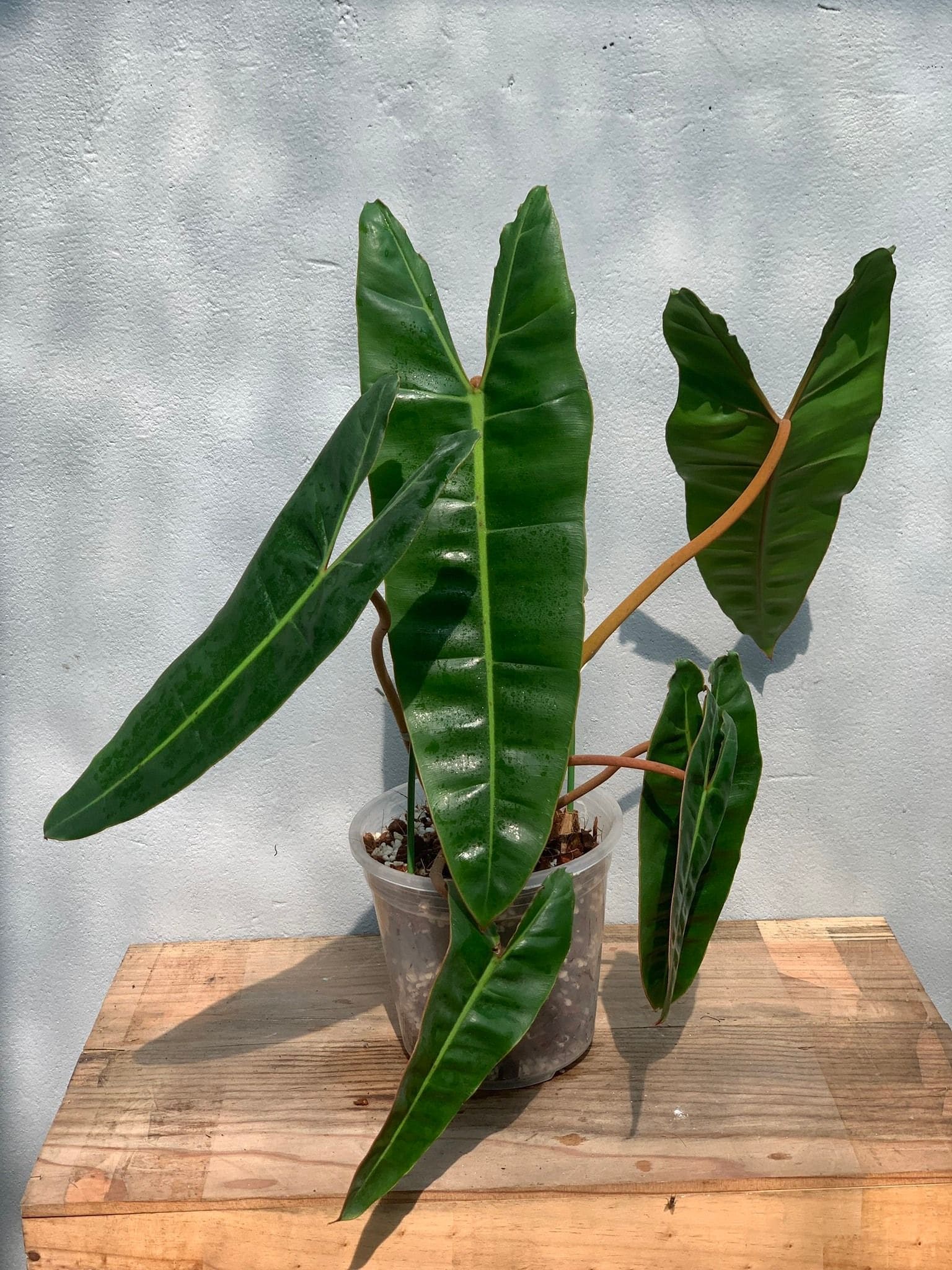
The orange petiole gets attention, but a reliable Billietiae identification comes from the whole climbing plant: petiole, blade, sinus, stem, leaf sequence and source record.
| Feature | Useful evidence | What it cannot prove alone |
|---|---|---|
| Name | Accepted species, P. billietiae Croat | That every seller-labeled plant is correctly identified |
| Petiole | Warm orange, ochre or yellow-orange on typical plants | Species identity without blade, stem and provenance |
| Blade | Elongated spear/arrow-like glossy green blade with wavy ridged margin | Future mature size or a specific clone |
| Habit | Climbing stem with nodes and potential aerial roots | That a juvenile or imported plant is ready to size up |
| Variegation | Bounded cream/yellow pattern across several leaves and stem/bud | That pale stress or one damaged leaf is a variegated line |
What official records establish
Kew accepts Philodendron billietiae Croat, first published in 1995, and records a native range in French Guiana, Guyana and Pará in northern Brazil. The plant is a wet-tropical climber. IPNI confirms the authorship, publication and type distribution.
The Royal Horticultural Society describes glossy dark-green, spear-shaped leaves with wavy ridged margins and distinctive orange-yellow leaf stalks. Mature specimens can carry very long blades, but a maximum in a profile is not a promise for every indoor plant. Root health, light, support, source material and time influence what develops.
For the wider distinction between botanical species, hybrids and trade labels, use the Philodendron discovery guide.
Identify the whole plant
Petiole: strong clue, not final answer
Warm orange petioles are the most memorable field cue. Color still changes with age, light and photography, and other plants can carry warm petiole tones. Photograph a hardened petiole beside its entire blade, plus the attachment to the stem.
Blade and sinus
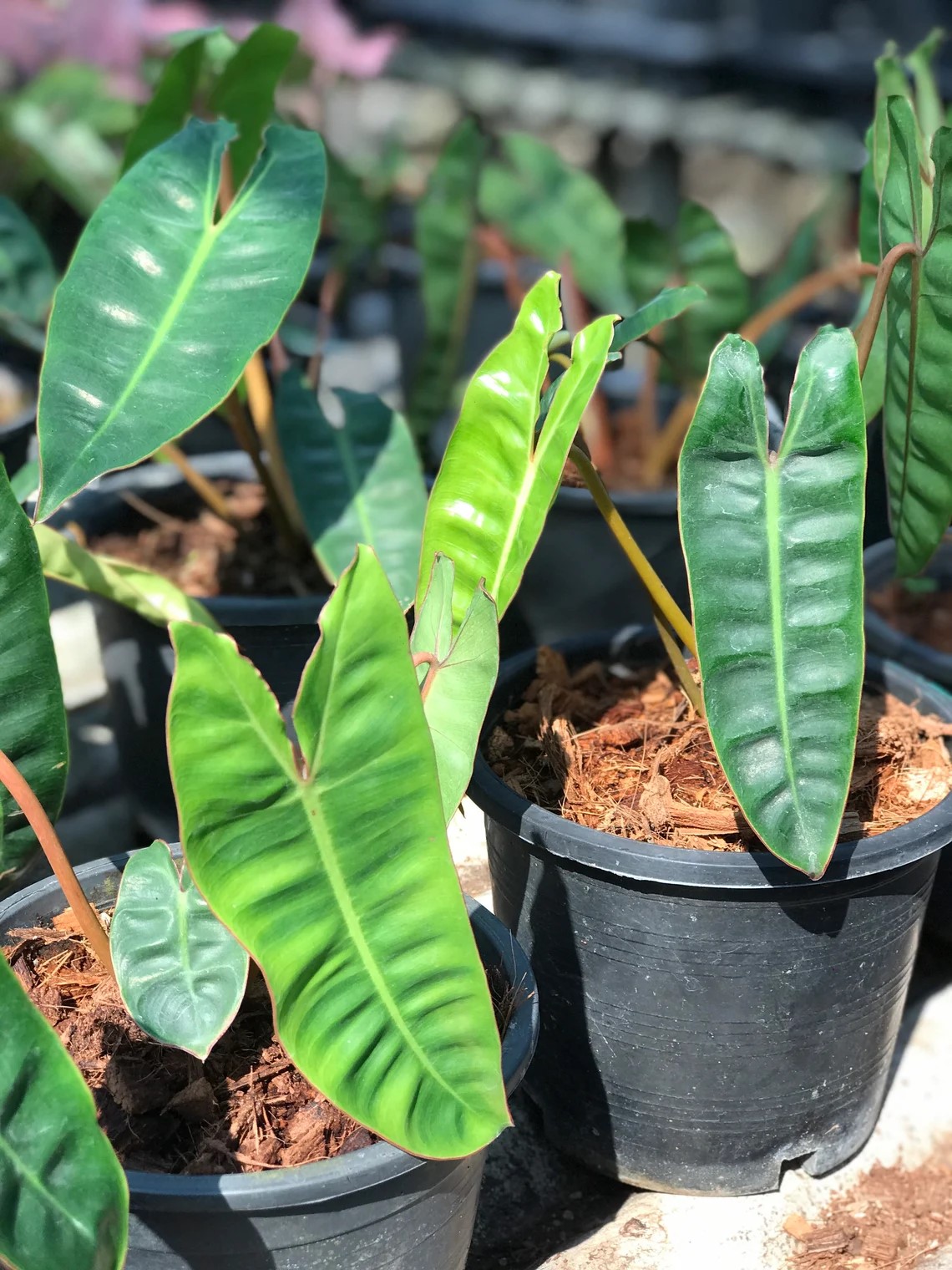
Look for a long, relatively narrow blade that hangs or projects from the support, with a glossy surface and visibly wavy/ridged edges. The rear lobes create a basal sinus; proportions change as the plant develops. Avoid reducing Billietiae to a “heart-shaped leaf,” which loses the elongation and wavy-margin cues that make the species useful to recognize.
Stem and leaf sequence
Follow several connected leaves and trace each petiole to the climbing stem. A starter may show shorter juvenile foliage; an import may pause or produce a temporary smaller leaf after root loss. Judge the plant after it establishes rather than forcing a mature-label decision from one leaf.
Green Billietiae versus variegated Billietiae
The green species page owns identity and general care. A variegated plant adds a separate problem: reduced-green tissue, uneven pattern, propagation risk and confusion between variegation and chlorosis. Those decisions belong to the variegated Billietiae guide.
Do not diagnose variegation from generalized yellowing. A failing root system, nutrient imbalance, strong exposure or damage can pale a blade. Variegation is more convincing when bounded pattern repeats in different arrangements and connects to the stem or active growth point.
Light and support form one system
RHS recommends bright but diffused light under glass. Start there and acclimate any brighter position gradually. Healthy useful light supports firm leaves and manageable stem gaps. Bleached or crisp patches on the window-facing side after a move point to excessive abrupt exposure.
Place a stable board, pole or trellis near the active stem. Secure the stem loosely without tying a new petiole or unfolding leaf. A climber can keep producing leaves without perfect attachment, but usable support makes the stem easier to manage and creates better conditions for mature architecture.
Build a well-drained, moisture-retentive root zone
RHS describes an open medium that holds moisture while draining well. In practice, combine a moisture-retentive base with coarse bark and a porous mineral component, then adapt particle size to climate, pot depth and watering habits. The goal is even wetting followed by recovery of air around the roots.
Choose a container with open drainage and modest extra room beyond healthy roots. An oversized pot or decomposed fine medium can remain saturated at the bottom while the surface looks dry. A clear pot can make trends easier to observe, but it does not replace drainage.
Water by the root zone, not a weekday
RHS advises allowing the surface to become just dry before thoroughly watering during active growth, while avoiding standing water. Translate that into observation: compare pot weight, moisture deeper in the medium, light, temperature and root activity; then water the whole root ball and drain excess.
If the pot remains heavy for many days, investigate drainage, particle collapse, pot size and root health. If it becomes light unusually fast, check for a compact dry core, hot exposure or a root system that has outgrown the container. The Philodendron watering guide owns the detailed tests.
Temperature, humidity and feeding
Keep conditions warm and protect fresh leaves from cold drafts and hot glass. Stable humidity can help tender tissue open, but a fixed percentage is less useful than observing the new leaf while maintaining airflow. Misting cannot correct dry roots or damaged root function.
Feed while the plant is actively producing healthy growth, following the product label and accounting for fertilizer already present in the medium. Reduce or pause when growth slows or roots are compromised. The complete Philodendron care guide owns the genus-wide routine.

Troubleshoot before treating
| What you see | Check first | Reasonable next action |
|---|---|---|
| Lower leaf yellows | Root texture/odor, pot weight and number affected | Correct the observed saturation or severe dry cycle |
| New leaf is smaller | Recent import/repot, roots, light and support | Stabilize the limiting condition and assess another leaf cycle |
| Leaf sticks or tears | Root hydration, drafts, pests and physical obstruction | Stabilize conditions; do not pull the leaf open |
| Brown exposed patch | Timing after a light move and window-facing position | Reduce abrupt exposure and acclimate more slowly |
| Stippling, webbing or residue | Leaf backs, petiole bases and neighboring plants | Isolate, identify the pest and follow a labeled control |
Propagation needs viable stem tissue
RHS lists stem-tip or leaf-bud cuttings. Whatever method is used, the propagation unit needs viable stem/growth-point anatomy; a blade and petiole alone cannot rebuild a climbing stem. Locate the node or bud before cutting and preserve provenance for a named or variegated line.
The Philodendron propagation guide owns method choice, node checks, rooting and transfer.
Buyer and arrival checklist
Verify plant, format and roots
- Photo role: ask whether images show the exact plant, a representative batch or a mature reference.
- Whole plant: compare multiple blades, orange-yellow petioles, sinus, stem and active growth point.
- Roots: confirm established, recently cut, freshly imported or tissue-culture/acclimation status.
- Color: inspect neutral-light images; direct sun and saturation alter orange and green.
- Variegation: require repeated bounded pattern plus stem/bud evidence, not generalized yellowing.
- Live terms: confirm size, documents, shipping and return conditions on the current listing.
Use the Greenboog Philodendron collection for current inventory and formats. Product pages own price, stock and fulfillment; this article remains the stable species and care reference.
Frequently asked questions
Is Philodendron billietiae a climbing plant?
Yes. Kew records it as a climber. Provide stable support near the active stem rather than managing it as a self-heading rosette.
Are orange petioles enough to identify Billietiae?
No. They are a strong clue, but color changes with age, light and photography. Confirm elongated wavy blades, sinus, climbing stem, several leaf stages and source provenance.
Where is Philodendron billietiae native?
Kew records French Guiana, Guyana and Pará in northern Brazil. The legacy Colombia/Ecuador range should not be repeated for this species.
How often should I water Billietiae?
Use root-zone evidence rather than a weekly interval. Compare pot weight and deeper moisture; water thoroughly when ready, let excess drain and do not leave the plant sitting in water.
Can a Billietiae leaf cutting grow?
A blade and petiole alone cannot rebuild a climbing stem. Use material that includes viable stem and an appropriate growth point, or another botanically viable propagation unit.
Is Philodendron billietiae safe for pets?
Philodendron tissue contains irritating calcium oxalate crystals. Keep plants and pruning debris away from children and pets, wash after handling sap and contact an appropriate veterinarian, poison-control service or medical professional after concerning exposure.
Sources and further reading
- Kew Plants of the World Online: accepted Philodendron billietiae record
- International Plant Names Index: authorship, publication and type record
- Royal Horticultural Society: Billietiae identity and cultivation
- Singapore NParks: Billietiae care and propagation profile
- UC Statewide IPM: houseplant symptoms and pest diagnosis
- ASPCA: Philodendron toxicity