
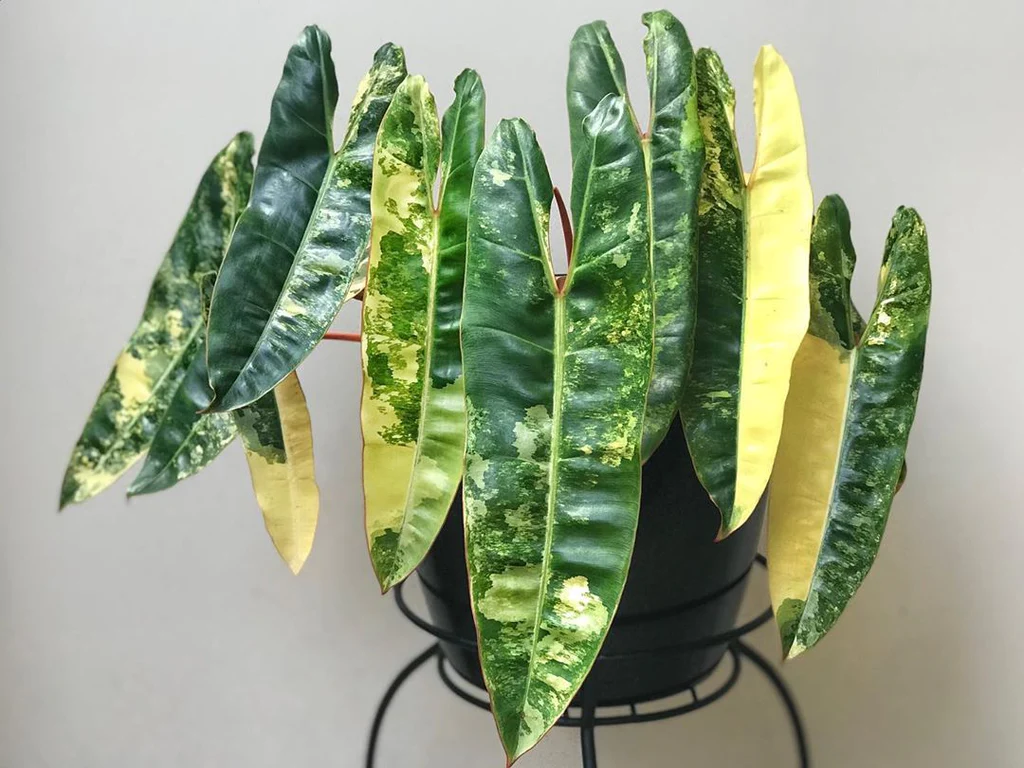
Greenboog variegated-aroid field guide
Identify the Billietiae architecture first, then read variegation across several leaves, the stem and the active growth point.
Philodendron Billietiae Variegated at a glance
| Question | Practical answer |
|---|---|
| What is it? | A variegated horticultural form of the accepted species Philodendron billietiae Croat. RHS maintains a separate profile for the variegated form. |
| Best identity clues? | Appressed climbing stem, short internodes, long narrow sagittate blades, a tight sinus and yellow-green to orange petioles, plus a pattern visible across several leaves. |
| Does it need support? | Yes. It is a climber, not a compact rosette. A stable vertical support helps the stem, aerial roots and long blades display normally. |
| How much light? | Bright, diffused light after gradual acclimation. Watch pale sectors for scorch and the stem for stretch; more light cannot command a specific pattern. |
| When should I water? | When the upper root zone is drying and the pot is lighter, then soak fully and drain. Inspect roots before treating every droop as thirst. |
| Can I propagate a leaf? | No. Use a stem section with a viable node/growth point or air-layer a node before cutting. |
| Is the pattern guaranteed? | No. Pattern can change from leaf to leaf and after propagation or acclimation. Judge a sequence, not one sale photo. |
| Is it pet-safe? | No. Philodendron contains insoluble calcium oxalates and should not be chewed. |
The accepted species and the variegated-form boundary
Kew accepts Philodendron billietiae Croat, first published in 1995, with a native range covering the Guianas and Brazil (Para). It is a wet-tropical climber, not a hybrid invented for the houseplant market.
Thomas Croat’s original Novon description records an appressed-climbing hemiepiphyte with short internodes, narrow triangular to sagittate blades, a narrow sinus and greenish-yellow, pale-orange or sometimes reddish petioles. The species was first collected by H. A. Gleason in Guyana in 1921 and was named for Frieda Billiet, who studied it in French Guiana and brought it into cultivation.
RHS has a correct-name profile for the green species and a separate correct-name profile for Philodendron billietiae variegated. That supports using “variegated” as a horticultural foliage-form label. It does not document a breeder, a pedigree, a patent or a promise that every leaf will repeat one pattern, so this page invents none of those claims.
How to identify a variegated Billietiae
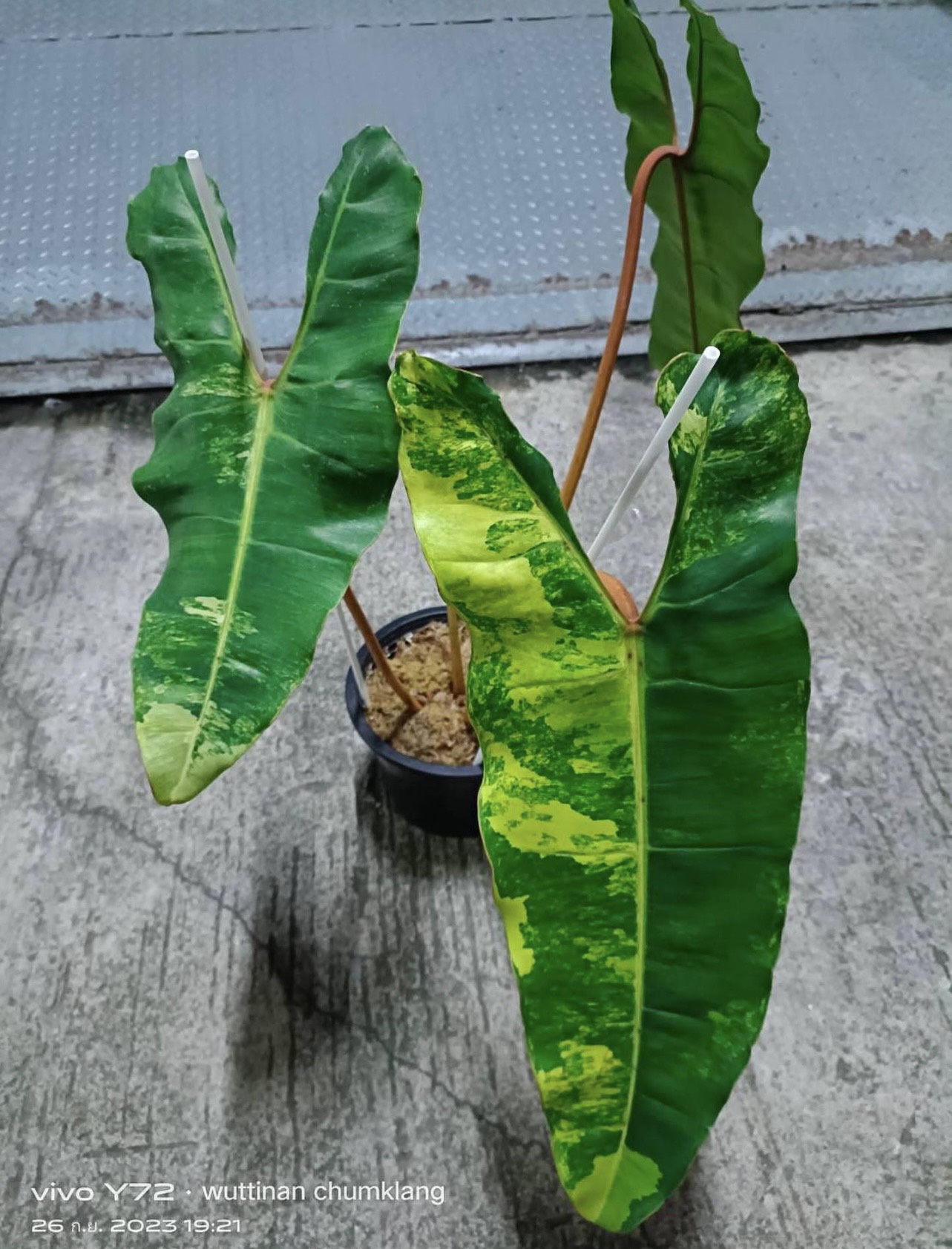
Check structure before color
- Stem: a climbing axis with nodes, short internodes, cataphylls and aerial roots. A leaf emerging from a corm-like base points elsewhere.
- Petiole: yellow-green, ochre or pale orange is a strong Billietiae clue. Color varies with age and light, so it is not a one-feature verdict.
- Blade: elongated, narrow triangular to arrow-shaped, with the rear lobes forming a relatively tight sinus.
- Display: long blades may hang or project away from the support rather than forming a compact tabletop mound.
- Pattern: cream, yellow-green or yellow areas should be integrated into otherwise healthy tissue across more than one leaf.
- Sequence: compare the newest leaf, two hardened leaves, the stem and the active bud. One bright photo cannot establish the plant or future pattern.
Variegation is not the same as chlorosis
Variegation usually forms bounded sectors, marbling or flecks that repeat in different arrangements. Root stress, nutrient imbalance or damaged roots can make an entire blade pale between veins, yellow from an edge or decline together with the petiole. If several unrelated leaves yellow quickly, investigate the root zone before calling the change desirable color.
The green form has its own Philodendron Billietiae species and general-care guide. This article stays narrow: it adds decisions created by reduced-green tissue, variable pattern and expensive propagation material.
Read variegation as an energy budget
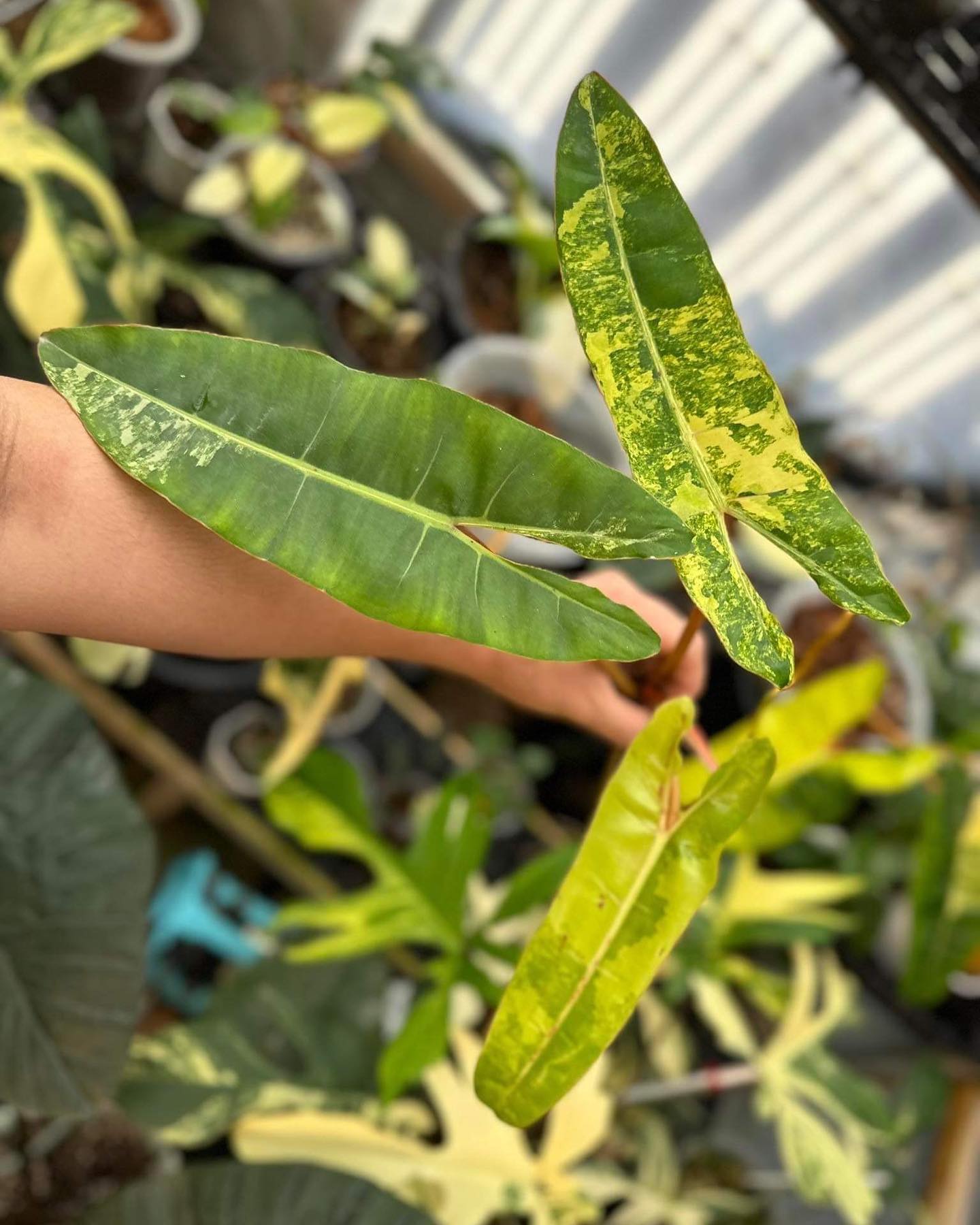
Green tissue contains chlorophyll and supplies most of the leaf’s photosynthetic capacity. The University of Minnesota Extension notes that insufficient light reduces chlorophyll and energy production, may stretch internodes and can coincide with greener reversion in variegated plants; excessive light can scorch or bleach foliage.
- Keep productive leaves: do not remove every green or greener leaf merely to make the plant look more yellow. Those leaves fund roots, the growth point and future patterned leaves.
- Assess the active stem: a greener leaf does not prove permanent reversion. Watch several consecutive leaves and the visible pattern near the active bud.
- Do not chase color with sun: stronger light can support compact growth, but it cannot genetically order the next sector. A sudden move can burn pale tissue first.
- Protect nearly colorless growth: a leaf with very little green is fragile and may contribute little energy. Judge the whole plant rather than trying to preserve one unsustainable leaf at any cost.
- Prune only with a mapped goal: before cutting back greener growth, locate viable buds and any visible patterned stem tissue. The next leaf remains uncertain.
Support a climber instead of keeping it compact
The original species description calls Billietiae an appressed climber, and RHS lists a climbing habit. Give the main stem a stable plank, pole or slab that can carry increasing leaf mass. Place the active growth point toward the support and secure the stem loosely between nodes; never tie a soft new petiole.
Regular trimming every few months is not required. If internodes lengthen and new leaves stay small, first check light, root health and whether aerial roots can contact support. Cutting a stressed plant removes stored resources and does not solve the cause.
Light without forcing the pattern
Start with bright diffused light, then acclimate in steps. A useful location casts a defined but soft shadow and does not heat the pale leaf surface. Move the plant closer to a window or increase grow-light duration gradually, checking the newest leaf after each change.
| Signal | Likely reading | First response |
|---|---|---|
| Longer internodes, smaller new blade | Light or support may be insufficient; roots may also be weak | Check roots/support, then increase diffused light gradually |
| Tan dry patch on pale sector | Heat, direct-sun scorch or abrupt acclimation | Reduce peak exposure; do not darken the plant completely |
| Several greener leaves | Pattern shift, low-light response or normal variability | Review light and active stem across multiple nodes before pruning |
| Bleached area plus hot leaf | Excess intensity or heat load | Increase distance or diffusion and maintain airflow |
Water the root zone, not the calendar
The old once-a-week rule ignores pot size, substrate, temperature, root mass and airflow. Iowa State Extension recommends checking the plant and root ball rather than watering on a weekday: saturate thoroughly, let excess drain and never leave the inner pot standing in water.
- Lift the pot and feel the upper root zone, not only a dry decorative surface.
- If the mix is still cool, wet and heavy, wait and preserve gas exchange.
- If the upper zone is drying and the pot is lighter, water the full root ball until runoff.
- Empty the saucer or cachepot and confirm the mix drains evenly.
- After droop, inspect moisture and roots before adding more water; wet-root wilt and dry-root wilt need opposite responses. Use the Philodendron watering guide for the full wet-versus-dry diagnosis.
Substrate, pot and root inspection
Use an open but moisture-retentive aroid mix. Fine bark or coco chips provide structure, pumice or perlite preserves air space, and a smaller water-holding fraction prevents a recently watered pot from drying instantly. The exact recipe matters less than how it behaves in your room.
- Choose a pot only modestly wider than the active root mass, with unobstructed drainage.
- Keep the crown and lower stem above a permanently wet layer.
- Repot when roots have occupied the mix, the structure has collapsed, salts have accumulated or the plant dries far faster than its root mass can use water.
- After import or deflasking, avoid combining a large pot, dense mix, high fertilizer and high light in one transition.
Temperature, humidity, airflow and feeding
RHS treats the species as a warm under-glass plant and recommends temperatures above 15 C. Avoid cold windows, air-conditioner jets and abrupt hot-dry exposure. Moderate-to-high humidity can slow moisture loss from a new leaf, but stagnant saturated air can favor pests and disease. Air movement should be gentle enough that a soft leaf does not flap or dry at the edge.
Feed only while roots and leaves are actively growing. Begin with a dilute complete fertilizer, observe one or two cycles and reduce it if tips burn or salts accumulate. More fertilizer cannot create variegation. Pause or reduce feeding after root loss, import shock, deflasking or a pronounced seasonal slowdown. The complete Philodendron care guide owns the genus-wide routine.
Troubleshooting by symptom
| Symptom | Check first | Useful response |
|---|---|---|
| Whole older leaf yellowing | Root moisture, root firmness, normal age, recent repot | Correct the root-zone cause; do not treat diffuse decline as desirable variegation |
| Dry brown pale sector | Direct sun, leaf temperature, abrupt light change, dry root episode | Diffuse peak light and stabilize watering; damaged tissue will not turn green again |
| Droop in wet mix | Root odor/color, pot drainage, compacted substrate | Stop reflex watering, restore air space and remove only clearly dead roots |
| Droop in dry light pot | Whether the whole root ball accepts water | Re-wet thoroughly and drain; review why the pot dried too quickly |
| Curled or distorted new leaf | Thrips/mites, moisture swings, low airflow, root stress | Inspect leaf undersides and cataphylls; use the leaf-curl diagnostic guide |
| Several all-green leaves | Light, active stem/bud, overall vigor, sequence length | Document several nodes before deciding whether and where to cut back |
| Tiny leaves and long gaps | Support contact, light, root mass, recent stress | Correct support/root limits before pruning or feeding harder |
Propagation requires a viable node
A detached blade and petiole may remain green or even root temporarily, but it does not contain the climbing stem’s growth point. Use a top or mid-stem section with a viable node and bud, or air-layer a node before separation. The broader Philodendron propagation guide covers tools, media and aftercare.
- Choose a healthy stem and map the node, bud, aerial root and pattern near the cut.
- If the plant or cutting is valuable, root the node while it remains attached by air layering.
- Use a clean blade and keep orientation clear on a mid-cut.
- Root in airy, evenly moist media with warmth, diffused light and gas exchange.
- Wait for active roots and new growth before increasing fertilizer or pot size.
Penn State Extension defines the node as the stem area where a leaf or bud attaches and describes both stem cuttings and air layering. Vegetative propagation carries parent material forward, but it does not guarantee that the next Billietiae leaf will copy the mother leaf’s exact cream-to-green ratio.
Tissue-culture acclimation is a separate stage
UF/IFAS describes Stage IV micropropagation as acclimatization: plantlets must transition from protected in-vitro conditions to a potting mix and ordinary atmosphere. That transition is a root, humidity and gas-exchange problem before it is a mature-color verdict.
- Confirm whether the purchase is sealed in vitro, freshly deflasked or already hardened.
- If deflasking, remove gel gently and discard tissue with obvious rot.
- Use a small clean container and pre-moistened airy medium.
- Begin with protected humidity, warmth, modest light and some ventilation.
- Increase ventilation and light in steps only when leaves remain firm and roots are active.
- Delay strong fertilizer, a large pot and repeated handling until growth is stable.
The live Philodendron collection owns current format and availability details. A single in-vitro leaf cannot guarantee the mature pattern, and “tissue culture” alone is not proof that a plantlet is automatically disease-free or true-to-type.
Buyer checks for established and jumbo plants
- Actual plant: ask whether the photograph shows the exact plant, a representative mother or a batch.
- Identity: look for the long narrow blade, tight sinus, warm petiole and climbing stem before judging pattern.
- Leaf sequence: request the newest leaf and at least two hardened leaves.
- Active point: confirm a viable bud and inspect pattern near it; do not buy a leaf-only piece as a propagatable plant.
- Roots and transition: ask whether it is rooted, freshly imported, recently potted or still acclimating.
- Format: compare established, larger-specimen and tissue-culture options on current size, root condition and actual-plant evidence rather than assuming the same transition risk.
Pet and handling safety
Philodendron is not pet-safe. The ASPCA lists Philodendron varieties among plants containing insoluble calcium-oxalate raphides. Chewing can cause mouth pain, drooling, retching, vomiting and, more rarely, swelling that interferes with swallowing or breathing. Keep the plant out of reach and contact a veterinarian or animal poison service after a concerning exposure.
Sources and evidence
- Kew POWO: Philodendron billietiae Croat – accepted name, publication, range and habit.
- Croat, Novon 5 (1995) – original species description, morphology, collection and naming record.
- RHS: Philodendron billietiae – climbing form, orange-yellow petioles, cultivation, propagation and safety.
- RHS: Philodendron billietiae variegated – separate variegated-form record.
- University of Minnesota Extension: indoor-plant lighting.
- Iowa State Extension: condition-based houseplant care.
- Penn State Extension: nodes, cuttings and air layering.
- UF/IFAS EP520: tropical-foliage micropropagation and acclimation.
- ASPCA: Philodendron calcium-oxalate exposure.
Evidence note: the species and its morphology are documented in the 1995 description and accepted by Kew. RHS recognizes a separate variegated horticultural form. No authoritative breeder, pedigree, patent or fixed pattern was found for the trade plant, so this guide makes no such claim.

Philodendron billietiae variegated has a very high mortality rating cuttings. While the main plant is an awesome grower, and not too picky, the cuttings are very picky!
My plant is beautiful and I’ve had it for a year now. I haven’t planted in straight. Pumice with layers of worm castings. Each week will water it. I had a handful of worm castings, and I wonder with boiled rainwater that I’ve added Super Thrive drops to. It puts out a leaf a month! This plant is gorgeous and I bought it with two leaves and now it has 10! It’s done amazingly well and I have reposted it three times because its roots are very fast growing!
However, I don’t agree with your pruning method. This plant has a mutant gene meaning it puts on nodes that are very short and compact together. An entire inch of growth on the stem could be a year worth of growing! That’s why it’s so expensive, high mortality rate and short notes You need to cut 4 to 6 notes to get even a small cutting and they do not like to root. You need a large propagation box with hummus and Leca at the bottom and fresh clean moss on top. It’s going to need a lot of humidity and a lot of light! A lot a lot
This plant brings me great joy and I love it dearly. The electric red and orange edges of the leaves, and the stems are amazing contrast to the beautiful yellow cream and white and multicolored green speckles, which to me look like a camouflage pattern! Has not given me a single reverted leaf, but is just looking full and beautiful. So whoever wrote this article hasn’t grown this plan they’ve just read about it. But it needs extra humidity and very strong light!I have it with 2 T10 2’ Barrina grow lights (Amazon) and the plant is about 6 inches from leaf to light. This plant works extra well from side lighting! Overhead lights will make the leaves so you can’t see them, but if you use vertical lights, the leaves will face vertically and you can see its exquisite pattern and color much better
I would love to post pictures, but unfortunately, you can’t do that here. But this is a great plant. I don’t suggest shipping it or buying one that is unrooted! You’re throwing your money away if you ship it in conditions, other than perfect spring or fall temperatures. In the heat of summer, it’s worth a drive to get your baby.