Greenboog identity & vine-care guide
“Variegated heartleaf Philodendron” is a useful market label, not proof of one named cultivar. Identify the vine first, then protect roots and green tissue without chasing a perfect pattern.
This page owns the generic variegated-heartleaf identity and care intent. The rare Philodendron guide owns broad comparison.
Identity at a glance
| Question | Evidence-led answer |
|---|---|
| Accepted species | Philodendron hederaceum (Jacq.) Schott |
| Habit | Trailing or climbing vine with roots at nodes |
| Generic “variegated” | Market phenotype; formal cultivar boundary unresolved |
| Brasil | Named cultivar; do not apply from colour alone |
| Root goal | Even hydration followed by reliable return of air |
Species first, pattern second
Kew accepts P. hederaceum and three infraspecific varieties. NC State describes a glossy heartleaf vine that trails or climbs and separately identifies `Brasil` as a cultivar. This keeps three labels apart: species, botanical variety and horticultural cultivar.
Identify a whole vine
Use a stack: slender flexible stem, clear nodes, aerial-root nubs, petioles and broadly heart-shaped blades. Pattern should be integrated into healthy tissue. Wipeable residue, raised scale, mite stippling and nutrient chlorosis are not variegation.
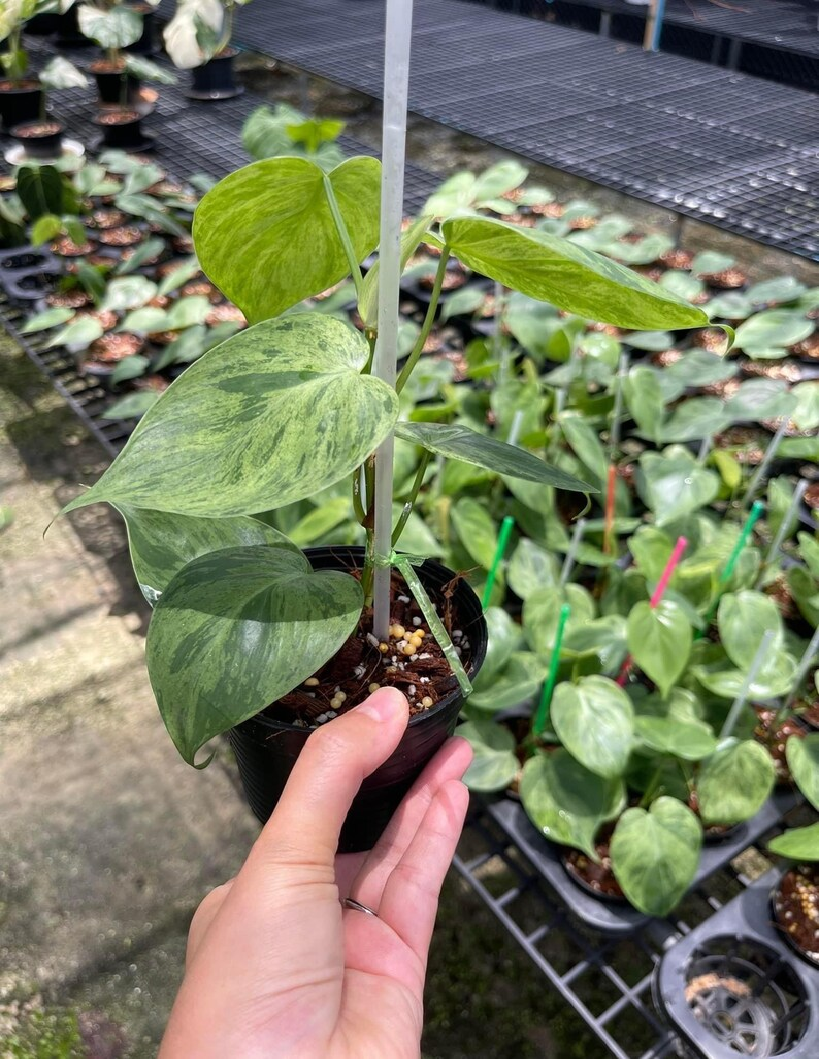
Trail or climb?
The species can do either. A hanging basket displays trailing stems; a support lets nodes attach and can encourage a different mature presentation. Neither method proves a cultivar. Tie stems loosely, keep the crown open, and never force petioles flat against a pole.
Light without pattern promises
Use bright filtered light and acclimate gradually. Pale tissue contributes less chlorophyll, so a heavily patterned vine has less green area available for growth. However, low light does not prove genetic reversion and brighter light cannot guarantee a chosen pattern. Track several hardened leaves from the same growth point.
The Philodendron care guide owns broad acclimation.
Water the rooted volume
- Water thoroughly and drain excess.
- Learn the pot’s wet weight.
- Check moisture within the rooted volume, not only one surface inch.
- Water again from pot weight, warmth, roots and active growth.
The watering guide owns wet-versus-dry diagnosis. Yellow leaves can reflect age, drought, root loss, cold or pests as well as excess moisture.
Root zone, warmth and feeding
Use an airy medium and open drainage. Bark, coarse mineral material and coco- or peat-based components can work when particle size matches the pot and room. Keep the vine warm and away from cold drafts or hot vents. Measure humidity before adding a clean humidifier; routine misting is not a root-care strategy. Feed modestly during active growth according to the label.
Pattern and symptom checks
| Signal | Check first | Response |
|---|---|---|
| One green leaf | Hardened sequence from same tip | Observe before cutting |
| Several all-green nodes | Growth point, roots and usable light | Preserve a viable patterned node before pruning |
| Brown pale sector | Sun, drought, roots and salts | Correct verified stress |
| Raised pale dots | Scale, mites or residue | Identify before treating |
Propagation boundary
A leaf and petiole alone cannot rebuild the vine. A cutting needs viable stem, a node and a usable bud/growth point. Pattern inheritance is not guaranteed from a vague “variegated” label. Map the vine before cutting and keep tools clean. The propagation guide owns the rooting workflow.
Buyer checklist
- Request the whole vine, several leaves and rooted nodes.
- Confirm genus and species rather than “variegated heartleaf” alone.
- Separate generic marbling from a named `Brasil` claim.
- Check green tissue, active growth and pests.
- Treat stability and pedigree claims as unverified without provenance.
The Philodendron collection owns live inventory.
Safety
Philodendron tissue contains irritating calcium-oxalate crystals. Keep plants and cut material away from children and pets; contact a veterinarian or poison service after suspected ingestion.
FAQ
Is variegated heartleaf the same as Brasil?
Not automatically. `Brasil` is a named cultivar; the generic market label can cover other patterns.
Can it climb?
Yes. P. hederaceum can trail or climb when nodes meet a suitable support.
Does low light cause reversion?
Low light can weaken growth, but it does not prove a genetic switch. Track multiple leaves from one tip.
Can one leaf root into a new vine?
Only a cutting with viable stem, node and bud/growth-point tissue can rebuild the vine.