Horticultural label, changing leaf form and climbing care
Philodendron Jerry Horne is a horticultural hybrid label in the aroid trade, not an accepted species name. Identify the sold line through provenance, a connected leaf sequence and climbing architecture; do not turn an unverified parentage story into botanical fact.

Treat Jerry Horne as a horticultural label
Hawaii certified-nursery lists document Jerry Horne as a name in commercial circulation. One government-hosted inventory uses the wording Bipennifolium Jerry Horne, while specialist nursery descriptions say the origin is unknown and only believe P. bipennifolium may be involved.
No breeder publication, patent, cultivar-registration entry or traceable cross record was located. The responsible wording is therefore horticultural hybrid of unresolved parentage. Inventory shorthand can document market use; it cannot prove a parent formula.
Read the leaf sequence, not one silhouette
Compare the newest expanding leaf, a recently hardened leaf and an older mature blade. Greenboog nursery images show simple or lightly shouldered juvenile leaves beside later blades with a long narrow central section and paired lateral wing-like lobes. The amount and angle of lobing can change as the vine matures.
Do not identify Jerry Horne only by three visible points. Bipennifolium, Mexicanum, Panduriforme, long-lobed species and other horticultural hybrids can overlap in cropped images. Add stem extension, petiole structure, cataphylls, source history and several connected leaves.
| Evidence | What it supports | Boundary |
|---|---|---|
| Traceable nursery label | The propagated line sold as Jerry Horne. | It does not prove breeder or parentage. |
| Connected leaf sequence | Transition toward the mature wing-lobed form. | One juvenile leaf may be non-diagnostic. |
| Stem, nodes and cataphylls | Climbing architecture and present condition. | A detached leaf hides this evidence. |
| Whole-plant and root photos | Current format, vigour and acclimation needs. | Representative images may not show the shipped plant. |
Keep similar labels separate until evidence agrees
Jerry Horne and P. bipennifolium should not be used as automatic synonyms. The repeated association in trade is worth noting, but a believed contribution is different from a documented cross or accepted botanical identity.
When buying, ask whether the image shows the exact plant, a representative juvenile or a mature reference. Preserve the seller label while later connected leaves develop rather than renaming the plant from a single comparison photo.
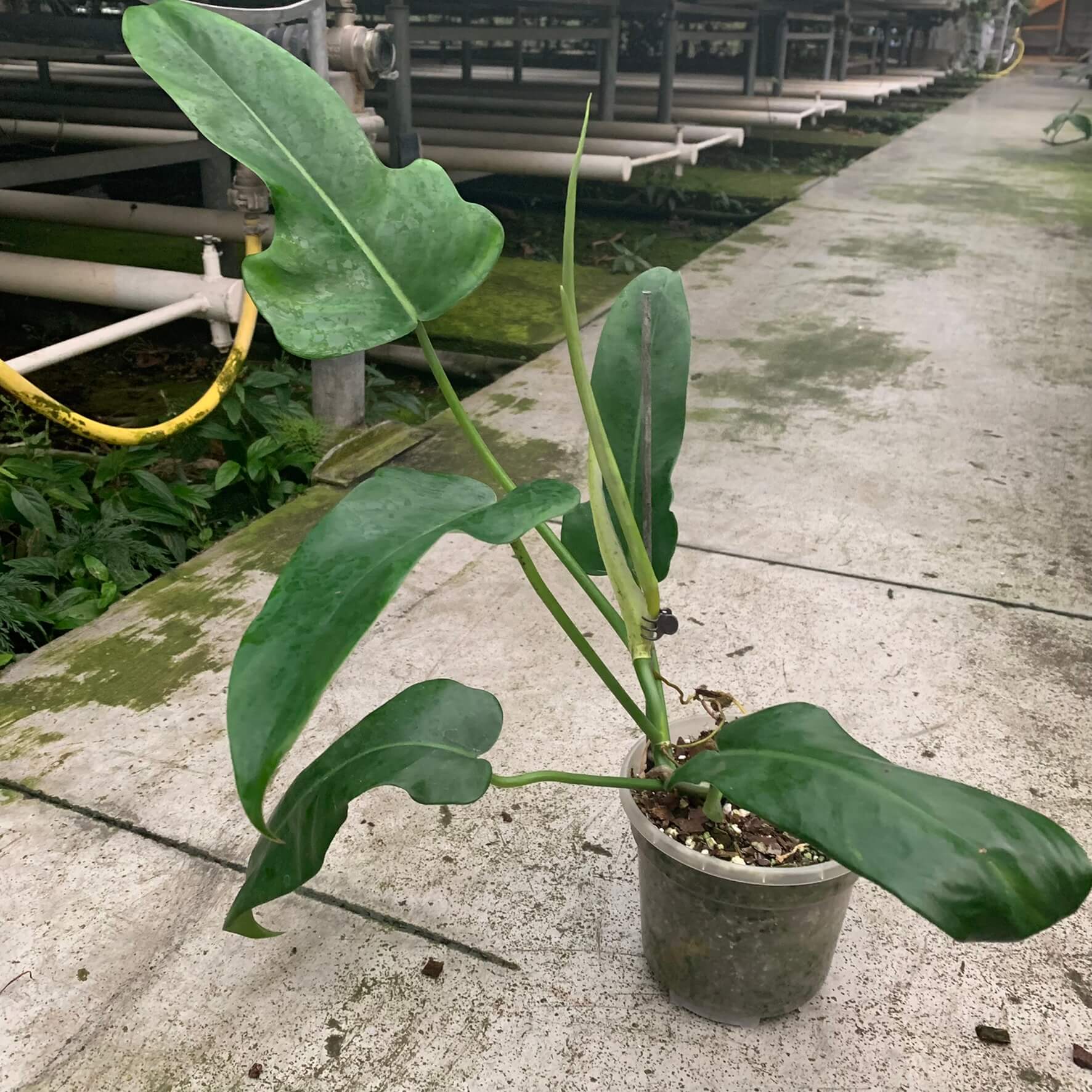
Place support beside the active stem
Position a pole, plank or other vertical surface beside the active stem. Tie the stem loosely and leave petioles free to orient leaves. Aerial roots need contact near a node; fastening only a petiole does not train the next internode.
Guide the newest flexible section first if the vine has sprawled. Support, usable light and healthy roots work together, so a pole alone cannot correct a dim location or failing root zone.
Balance light, warmth and root-zone air
Start with bright indirect light. Increase exposure gradually if later internodes stretch or leaves become smaller. Abrupt hot sun can mark foliage, while a dim position slows water use and keeps the medium wet for longer.
Use a loose, free-draining medium and a pot only modestly larger than the root mass. Check below the surface and lift the container. Water thoroughly after part of the root zone has dried, then let excess drain. Pot material, roots, airflow, light and temperature determine the interval; a weekly rule cannot.
Keep the plant warm and away from cold drafts. Feed lightly only during active rooted growth. Fertilizer cannot replace usable light or repair damaged roots, and routine misting does not substitute for airflow.
Diagnose patterns before treating
| Pattern | Check first | Measured response |
|---|---|---|
| Later leaves stay smaller | Support contact, light trend and roots. | Correct the limiting factor and judge later nodes. |
| Yellowing with wet medium | Drainage, pot size, temperature and root texture. | Restore warmth and aeration; remove only confirmed rot. |
| Pale crisp patches | Recent sun increase, heat and spray history. | Move back from stress and acclimate gradually. |
| Distorted new growth | Growth point, thrips, mites, roots and recent products. | Isolate and identify before stacking treatments. |
Philodendron tissue contains calcium oxalate crystals. Keep the plant away from children and pets that chew foliage, wear gloves when sap contact is likely, and seek appropriate medical or veterinary guidance for significant mouth swelling, drooling or swallowing difficulty.
Propagate a node and retain the source history
A climbing stem cutting needs a real node and usable stem tissue. A leaf and petiole alone cannot produce a new vine. Division applies only when a pot contains separate rooted stems.
- Photograph the mother plant, label and connected leaf sequence.
- Locate a healthy node, growth point and usable stem section.
- Use a clean tool and keep the base warm, airy and not saturated.
- Pot only after functional roots are present.
- Retain the Jerry Horne label while later leaves develop.
Use the rare Philodendron guide for broader comparison, the general Philodendron care guide for shared decisions, and the propagation guide before taking a cutting.
Sources
- Hawaii certified nursery list: Jerry Horne market-name circulation
- Hawaii certified nursery list: Bipennifolium Jerry Horne inventory wording
- International Aroid Society: cultivar evidence and registration principles
- Specialist trade record: unknown origin and bounded bipennifolium belief
- RHS: Philodendron light, support and root-zone guidance