Greenboog cultivar-first identification & care guide
White Wizard rewards observation more than rigid rules. Identity depends on repeated plant-level traits; good care depends on roots, usable light and enough green tissue to keep the plant growing.
Use these signals as a starting point, then adjust to your room and plant.
| Question | Practical answer | Evidence to watch |
|---|---|---|
| Is it White Wizard? | Broad unlobed foliage; green-and-white sectors; mostly green petioles/stem | Several leaves, the active stem, provenance and mature growth |
| Where should it sit? | Bright indirect or filtered light, acclimated gradually | Stretch and small leaves versus pale-sector scorch |
| When should I water? | After the upper root zone dries somewhat; soak evenly and drain | Pot weight, moisture below the surface and root condition |
| What mix works? | Airy, moisture-balanced substrate in a draining pot | Dry-down speed, room temperature, light and root mass |
| How do I protect variegation? | Keep healthy green tissue and judge repeated growth | Stem pattern and successive leaves from one growth point |
What is Philodendron White Wizard?
White Wizard is a cultivated name used in the houseplant trade. Reliable public records do not establish it as a separate botanical species with its own native range, and this guide does not invent a breeder or parent formula. Writing Philodendron ‘White Wizard’ keeps that boundary clear.
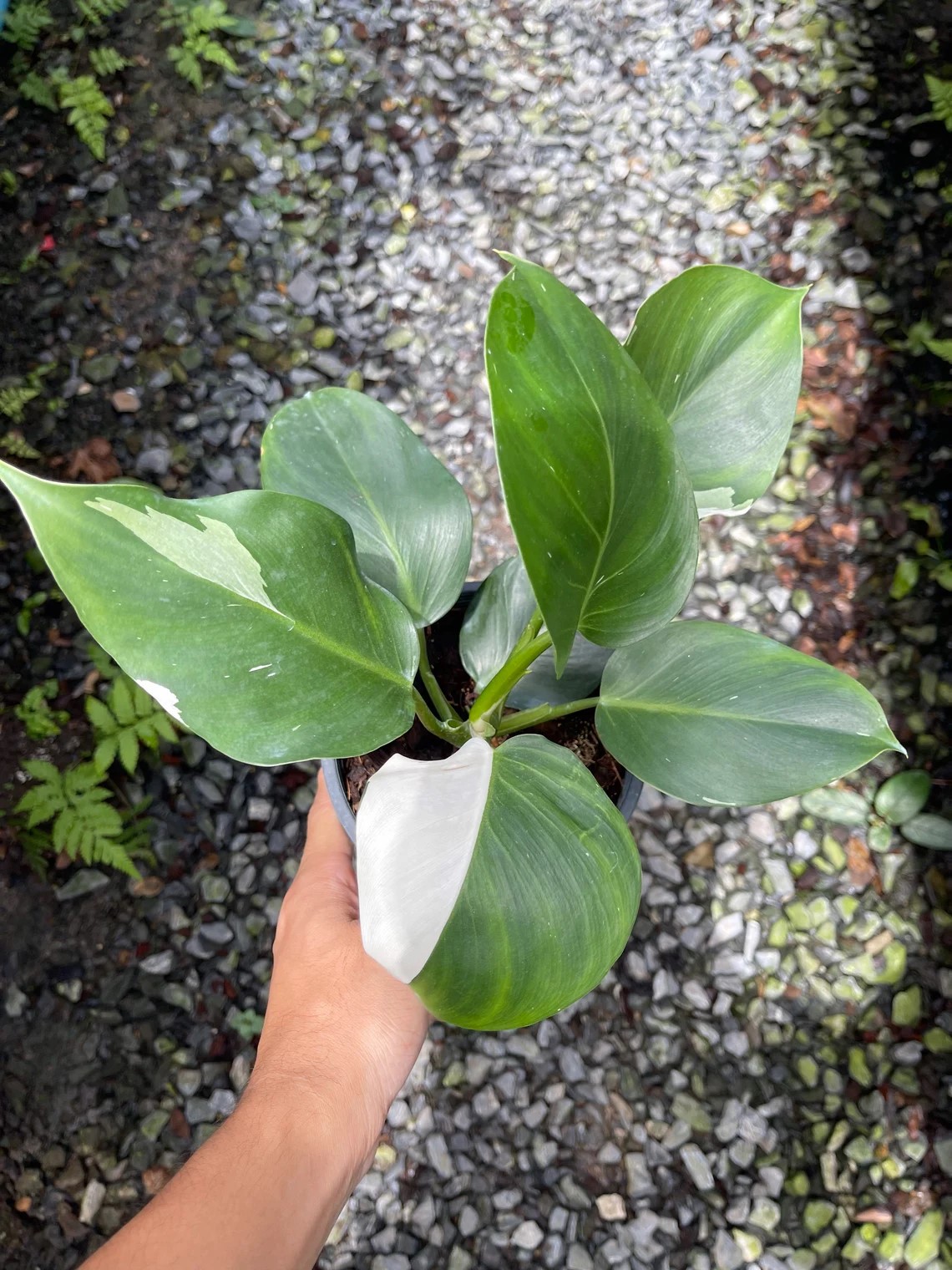
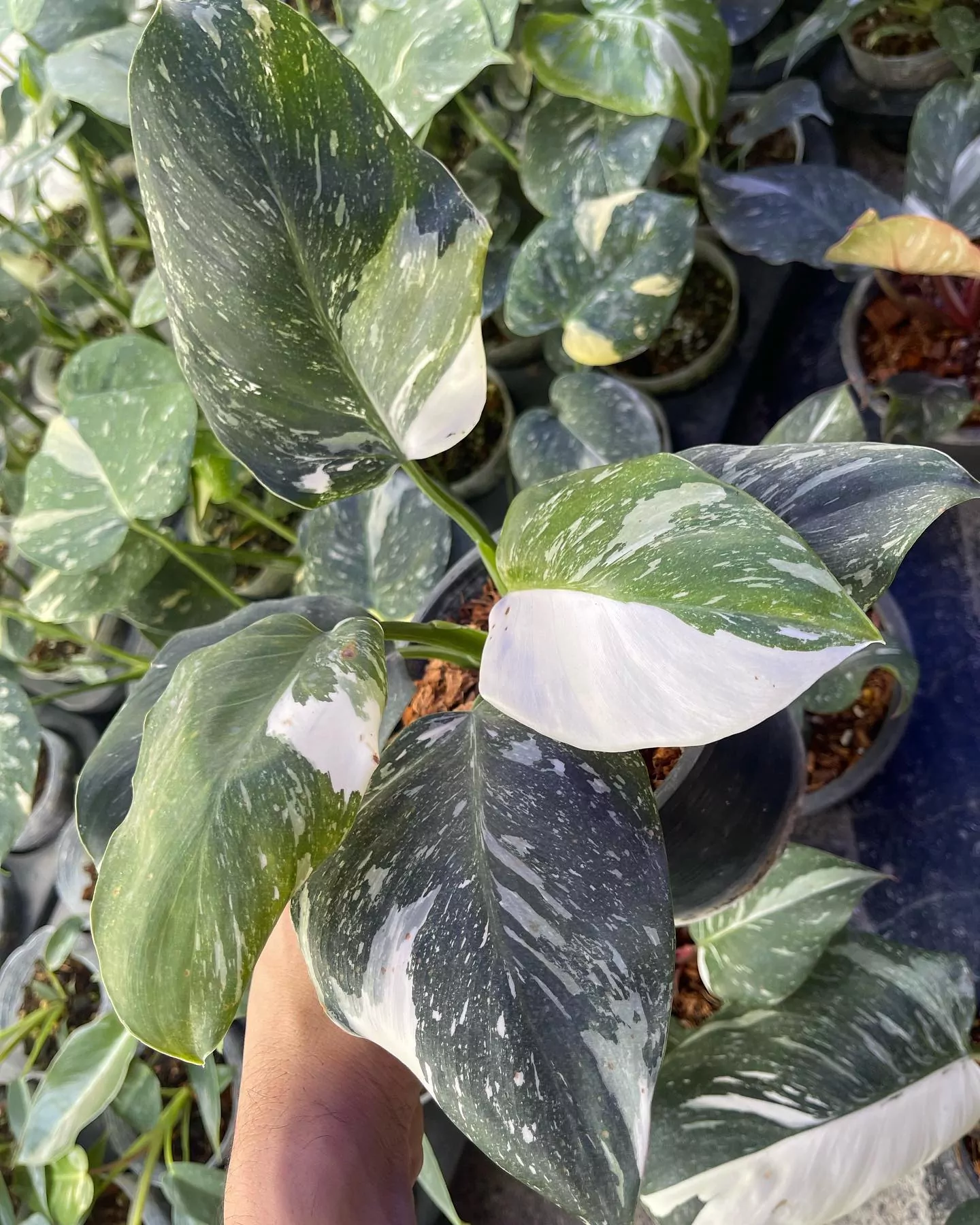
Typical foliage is broad and entire rather than deeply lobed. Green leaves carry white sectors, splashes or marbling; a new leaf can open lighter and change tone as it hardens. Predominantly green petioles and stem are useful screening clues, but age, nursery conditions and mislabeled stock mean color alone is not an identity test.
White Wizard vs White Knight vs White Princess
These are market diagnostics, not definitive botanical authentication without provenance.
| Trade name | Common clue | What can mislead you |
|---|---|---|
| White Wizard | Mostly green/pale stem and petioles; broad green-white leaves | A green stem does not prove the label; compare repeated growth and source |
| White Knight | Deep red to burgundy stem with white-variegated leaves | RHS lists the name status as unresolved; inspect the whole stem |
| White Princess | Green petioles/stem often edged or marked pink/red | Pink varies, juvenile plants are ambiguous and seller labels can be swapped |
The RHS White Knight record describes deep red stems, so burgundy is a useful exclusion clue when comparing a likely White Wizard. “White Wizard Marble,” “high variegation” and similar modifiers usually describe a seller selection or grade—not a separate wild species and not a promise about the next leaf.
Light: support growth without promising more white
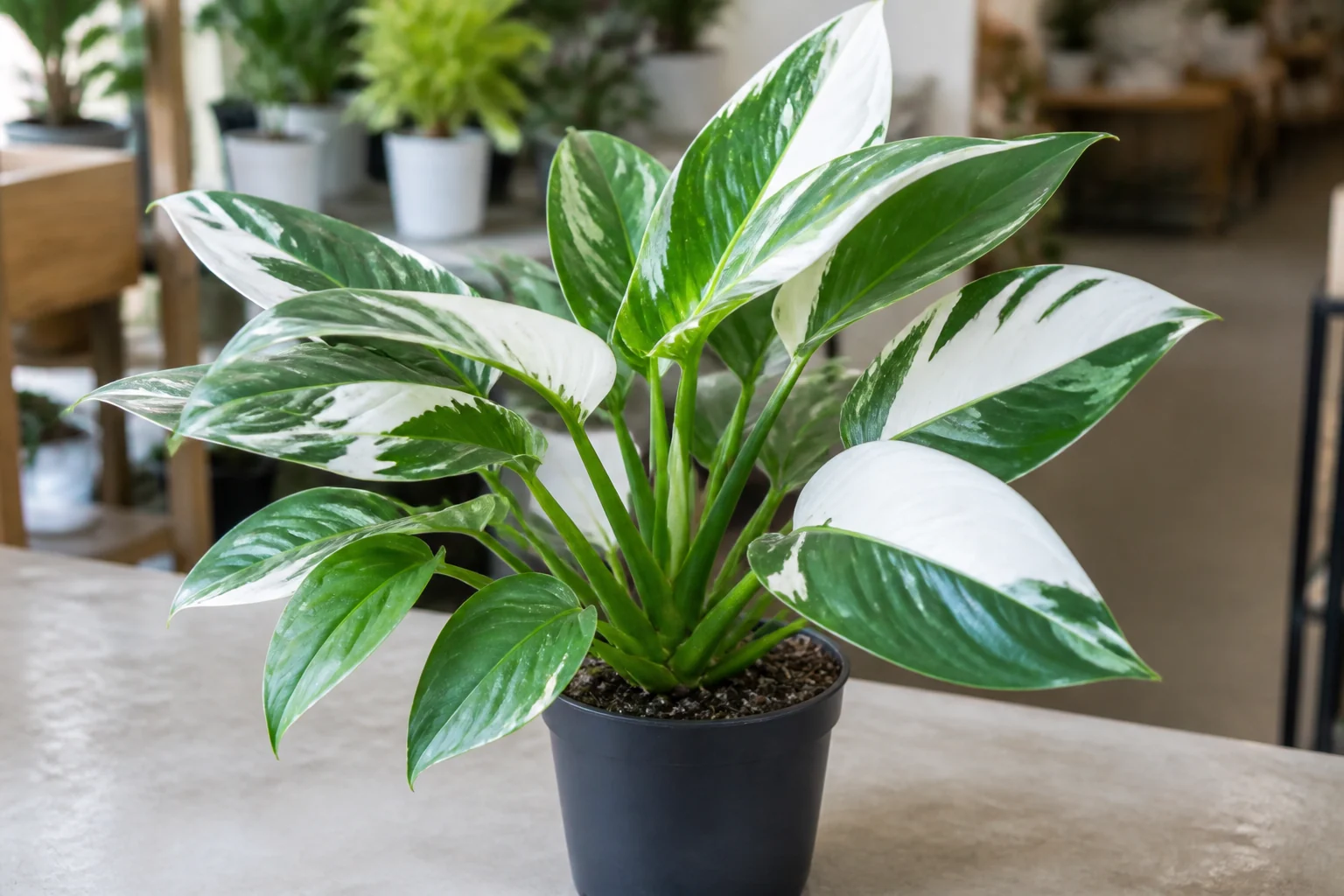
Bright indirect or filtered light is the safest starting point. The RHS Philodendron growing guide warns that direct summer sun can scorch foliage; white tissue is especially unforgiving because it lacks protective chlorophyll. Acclimate after shipping or any major move instead of placing the plant against hot glass on day one.
Light supports photosynthesis in existing green tissue. It can improve compact growth and help a variegated plant use the pattern it already carries, but it cannot manufacture the underlying mutation or guarantee that the next leaf will be whiter.
- Move the plant in small distance or exposure increments.
- Wait for environmental stability and at least one hardened leaf before drawing conclusions.
- Rotate for balanced growth, while keeping the active point away from harsh midday sun.
- With grow lights, track distance, duration and leaf temperature—not brightness by eye alone.
Water the root ball, not the calendar
Check below the surface and lift the pot. When the upper root zone has dried somewhat and the container feels lighter, water the whole root ball until excess exits, then empty the saucer. Do not convert “somewhat dry” into a universal number of days or an exact dry percentage.
A small root system in an oversized pot can stay wet while the surface appears dry. Persistent saturation displaces oxygen and raises rot risk; repeated bone-dry cycles damage fine roots and can crisp pale margins. Stable, oxygenated roots matter more than finding a perfect interval.
Pot and substrate
Choose a container with open drainage only modestly larger than the healthy root ball. An airy blend can combine quality potting substrate or coir with coarse bark and mineral aeration such as perlite or pumice. Adjust the water-holding component to your climate and room instead of copying a universal recipe.
Repot when roots are densely circling, the medium has collapsed, drainage has become uneven, or a confirmed root problem requires intervention. Avoid stacking arrival stress, aggressive root cleaning, a large pot upgrade and fertilizer in one day.
Temperature, humidity and airflow
Keep White Wizard above 15°C/59°F and away from cold glass, hot radiators and direct HVAC drafts. NC State Extension notes that Philodendron generally prefers warmth, bright indirect light and moist well-drained soil while adapting to average household humidity.
Humidity has no single magic target. Penn State Extension explains that misting raises humidity only briefly and pebble trays have little room-level effect. If a hygrometer confirms persistently dry air, a clean humidifier is more dependable. Pair humidity with airflow; wet leaves in crowded stagnant conditions are not a substitute for healthy roots.
Support, pruning and leaf care
A juvenile plant can look compact, but its stem may lengthen. Add a stake, plank or pole when the top becomes unstable, tying the stem loosely without trapping petioles or the active point. Support is optional until the plant needs it; it is not evidence of cultivar identity.
Keep functional green leaves because they fund new growth. Remove a leaf when it is badly damaged, diseased or fully senescent—not because its pattern is less collectible. Wipe dust with a damp cloth and avoid leaf-shine products that obscure pests.
Feed active growth, not white sectors
Use a complete houseplant fertilizer according to its label during active growth, at a conservative rate suitable for your substrate and watering. Reduce or pause when growth slows in low light; that may coincide with winter in some homes but not all climates or grow-light setups. Fertilizer cannot create white tissue, and excess salts can damage roots.
If growth stalls, inspect light, temperature, roots, pests and shipping history before adding nutrients. Flush accumulated salts only when the root zone drains freely; do not leach an already waterlogged pot.
Reversion and overly white growth
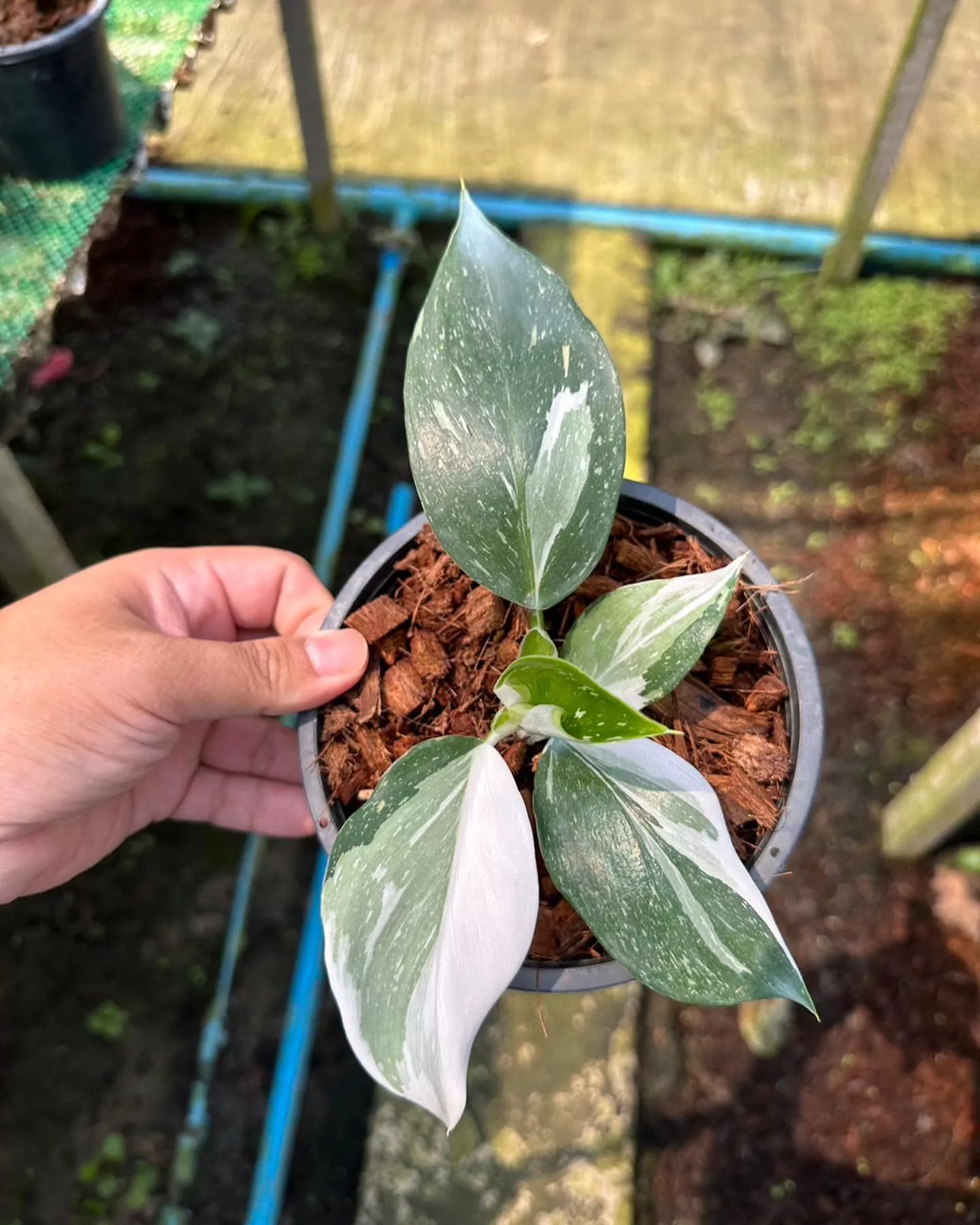
One green leaf does not prove permanent reversion. Watch several leaves from the same active point and inspect the stem pattern. Green shoots can outgrow weaker variegated tissue, while nearly all-white shoots may lack enough chlorophyll to sustain themselves.
- Repeated all-green shoot: confirm light and roots; if the same shoot stays green, consider pruning to a viable node with visible variegated stem tissue.
- Repeated almost-white shoot: preserve older green leaves and consider returning to a more balanced node before the plant exhausts its reserves.
- Mixed new leaf: let it harden before judging; pale tissue often changes tone.
Pruning selects a different growth point; it never guarantees an exact white percentage on the next leaf.
How to propagate White Wizard
A complete new Philodendron needs viable stem tissue containing a node and axillary bud. A leaf and petiole alone, an aerial root alone, or a root-ball piece without a growth point is not a reliable route to a new vine.
- Start with a hydrated, pest-free plant that is not already stressed.
- Locate the node and bud before cutting; do not guess below a petiole.
- Use a sharp, sterile blade and preserve a functional leaf when practical.
- Root in clean water or an airy, lightly moist medium in warmth and bright indirect light.
- Maintain humidity without sealing saturated media and stagnant air around the cut.
- Transplant after roots branch and new growth is stable, not at a fixed week count.
Penn State Extension’s propagation guidance likewise prioritizes healthy stock, clean tools, bright indirect light and moist rather than saturated media. For a more detailed node workflow, use Greenboog’s Philodendron propagation guide.
Troubleshooting by pattern
Confirm roots and recent environmental change before treating a leaf symptom.
| Pattern | Check first | Do next |
|---|---|---|
| Yellow lower leaves; wet mix | Root color and smell, pot size, drainage and cold | Restore oxygen; remove only confirmed rot; do not add fertilizer |
| Crisp white sectors | Sudden light increase, dry root ball, hot glass or draft | Stabilize watering and reduce harsh exposure gradually |
| Small, leggy growth | Usable light, roots, support and pests | Correct the strongest evidence first, then observe new growth |
| Distorted or curling leaf | Thrips, mites, roots and a trapped unfurling leaf | Use the leaf-curling diagnostic before spraying |
| No growth after shipping | Root viability and acclimation stage | Hold conditions steady; avoid repotting, feeding and pruning together |
What to check before buying
- Is the photo the exact plant, a batch example or only a mature reference?
- Can the seller show current roots, the viable growth point and several stem/petiole angles?
- Is it potted, a rooted cutting, recently deflasked or still in sterile tissue-culture medium?
- Does variegation repeat across nodes, rather than appearing as one damaged or fading patch?
- Are pest disclosure, weather packing, phytosanitary documents and arrival terms clear?
Use the rare Philodendron comparison hub to compare cultivar-level options. Stock, price, plant format and shipping terms belong on the exact potted White Wizard product page or White Wizard tissue-culture product page.
Safety
Philodendron tissue contains insoluble calcium oxalate crystals and can irritate skin, eyes and the mouth. Keep plants, cuttings and pot debris away from children and pets. Wear gloves if sap irritates you; after chewing or exposure symptoms, contact a veterinarian or local poison-control service rather than improvising treatment.
FAQ
Is White Wizard a Philodendron species?
No. It is a cultivated trade/cultivar name. Do not assign White Wizard its own wild native range without documented parent or species evidence.
Does White Wizard have lobed leaves?
Not as a defining trait. Typical White Wizard foliage is broad and entire; deeply split or lobed leaves suggest a different identity.
Can more light make White Wizard whiter?
Light supports growth and expression of existing variegated tissue, but it cannot create the mutation in green tissue. Increase exposure gradually to protect pale sectors.
How often should I water it?
Use root-zone moisture, pot weight and dry-down—not a fixed interval. Water thoroughly after the upper mix dries somewhat, then let the container drain.
Can it grow from a leaf cutting?
A reliable new plant needs stem containing a node and viable growth point. A leaf and petiole alone cannot reliably regenerate a complete Philodendron.
Sources and evidence boundaries
- Royal Horticultural Society: Philodendron light, temperature, watering, humidity and feeding
- Royal Horticultural Society: White Knight stem description and unresolved name status
- NC State Extension: genus-level habit, growing conditions and calcium-oxalate safety
- Penn State Extension: household humidity, misting and pebble-tray limits
- Penn State Extension: healthy stock, sterile tools and propagation environment