
Greenboog collector field guide
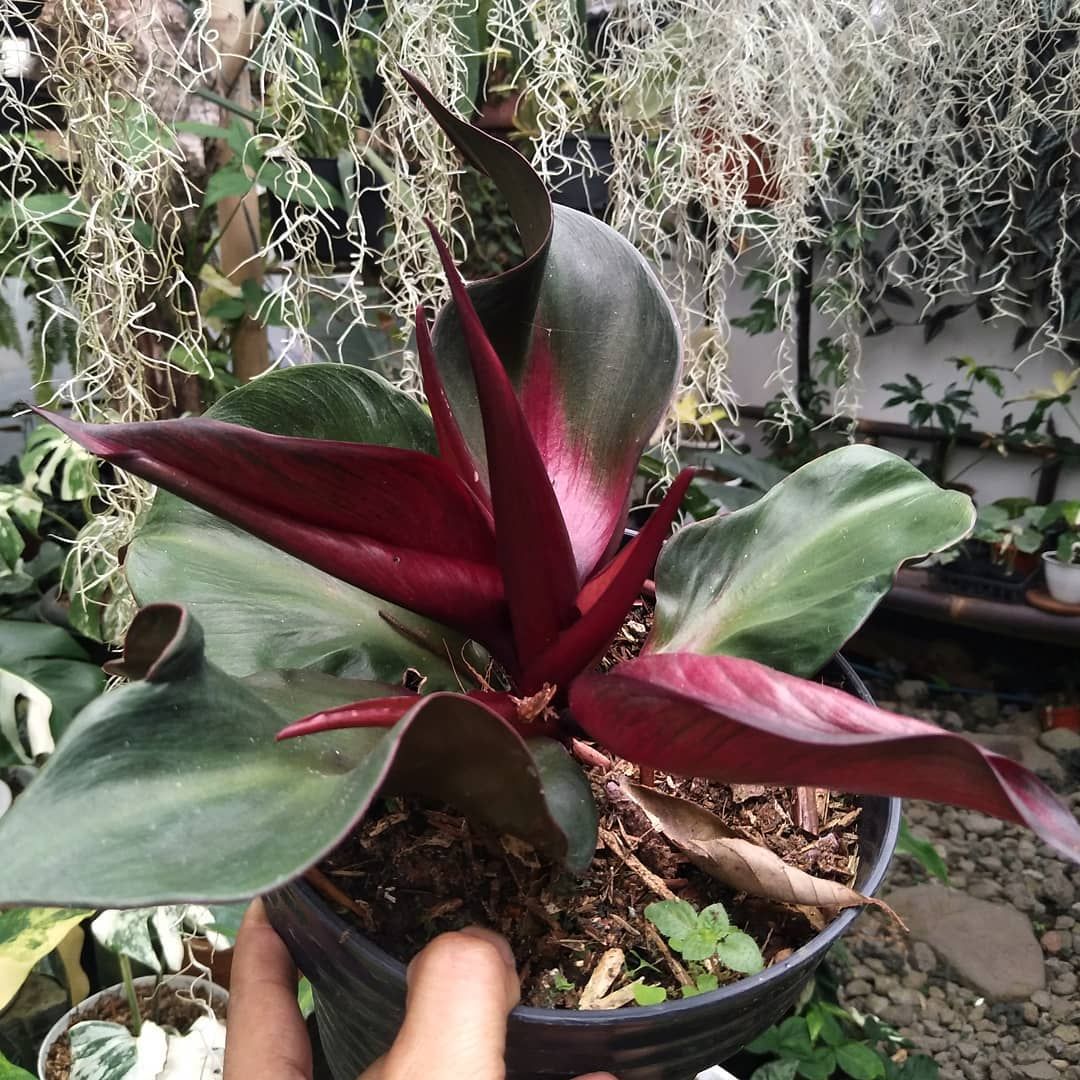
The useful question is not whether one leaf looks red enough. It is whether the label, compact crown, emerging tissue, mature foliage and source history describe the same plant.
| Question | Evidence-led answer | Common overclaim |
|---|---|---|
| What kind of name? | A horticultural or cultivar-style label in current trade | Presenting Red Heart as an accepted species |
| Growth habit? | Compact, upright/self-heading in Greenboog media and nursery listings | Promising permanent size or bushiness |
| Where is the red? | Strongest on emerging tissue, cataphylls and petioles; blades mature greener/darker | Expecting every hardened leaf to stay scarlet |
| Main ID risk? | Several red-emergent Philodendron labels overlap visually | Naming a plant from one cropped or saturated leaf |
| Main care risk? | Forcing color with harsh sun, heavy feeding or a wet oversized pot | Treating redness as a simple care dial |
What the Red Heart name proves
Kew’s botanical backbone does not establish a species named Philodendron red heart. The label does appear in current nursery and collector lists, which supports real horticultural use. That does not identify a breeder, patent, formal registration, clone or parentage by itself.
Some sellers describe Red Heart as a mutation of Black Cardinal or connect it to P. erubescens. This audit found no primary breeder, plant patent or authoritative cultivar-registration record that verifies that story. Preserve any lineage supplied with the actual plant, but introduce undocumented ancestry as a seller claim—not a botanical fact.
Use the Philodendron names and varieties guide when you need the wider boundary between species, hybrids, cultivars and trade labels.
Identify the whole plant, not the reddest leaf
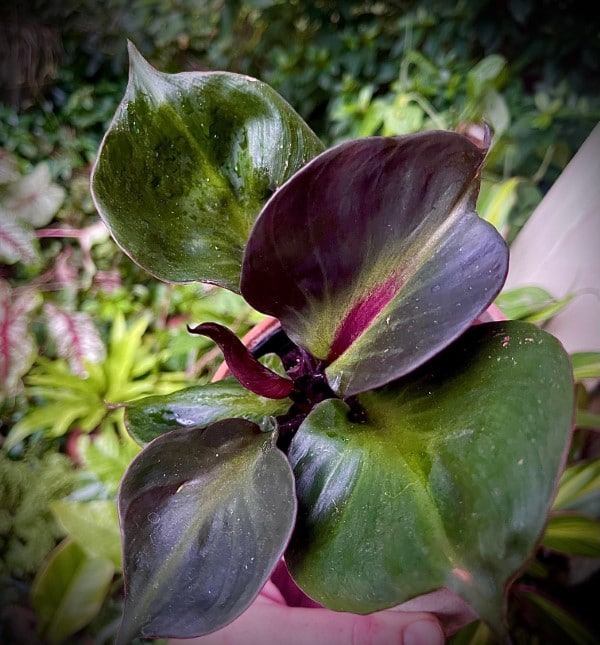
North Carolina Extension notes that young and mature Philodendrons can look quite different. Red Heart adds another moving part: fresh tissue may be burgundy or red, while hardened blades read greener and darker. Photograph the same leaf as it opens and after it hardens, then compare it with older foliage.
Read the crown and petioles
Ask for a view into the center of the plant. A compact self-heading crown, short stacked growth, colored cataphylls and petiole bases are more useful than an isolated leaf. A stretched plant, a cropped frame or a photograph pushed toward magenta can hide the architecture needed for comparison.
Compare several red-emergent labels
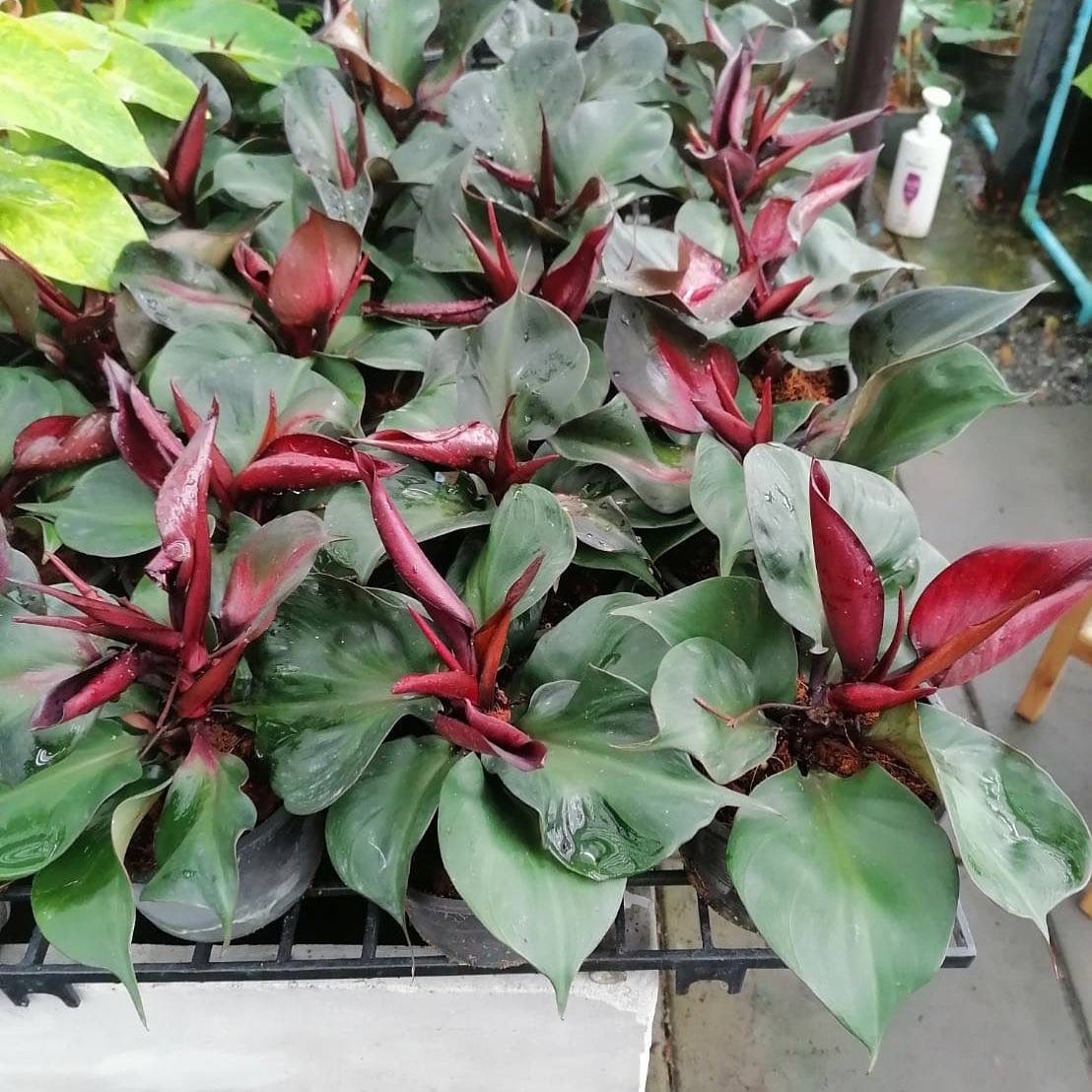
Black Cardinal, Imperial Red, Rojo Congo and other cultivated Philodendrons can produce bronze, burgundy or red new growth. Their sale names are not interchangeable, but color alone cannot separate them reliably. Compare growth habit, leaf proportions, multiple stages and source history. This article deliberately does not invent a parentage table where authoritative lineage is missing.
Care for compact, healthy emergence
A stable plant produces better identification evidence than a stressed one. Start with the genus-level routine supported by extension sources, then judge the next leaves and roots. Color is an outcome to document, not something to force.
Light: bright enough for form, filtered enough for safety
Start with moderate to bright indirect light. Watch the crown’s direction, new-leaf size and any window-facing damage. Leaning or looser growth after establishment may justify a gradual increase in useful light. Bleached or sharply scorched patches after a move indicate too much abrupt direct exposure. Harsh sun is not a responsible method for deepening red.
Water from evidence below the surface
Use a container with open drainage and a porous mix that wets evenly, drains and regains air. Check moisture below the top layer and compare pot weight instead of watering every seven days. When the root zone is ready, water thoroughly and empty standing runoff.
Wilt in wet media can reflect root failure rather than thirst. The Philodendron watering guide owns dry-versus-wet wilt, pot-weight checks and salt investigation.
Warmth, humidity and airflow
Keep warm indoor conditions stable and protect fresh leaves from cold drafts, air-conditioning outlets and hot glass. Higher humidity may help delicate growth open, but it does not replace airflow, clean foliage or healthy roots. Misting only wets a surface briefly and is not a reliable room-humidity system.
Feeding and repotting
Feed lightly while roots are healthy and the plant is actively growing, following the fertilizer label and accounting for any fertilizer already in the mix. Do not use Epsom-salt sprays as a universal color treatment. Repot when roots, substrate or container no longer function together, moving up only enough volume for the current root system.
The complete Philodendron care guide owns the longer routine. This Red Heart page stays focused on interpreting emergence, compact architecture and identity risk.
Preserve self-heading architecture
Give leaves physical clearance and rotate gradually only when the plant leans toward light. Remove a leaf when it is irreversibly damaged, diseased or blocking a necessary inspection. Cut the petiole cleanly without injuring the compact stem or center growth point.
Do not pinch the crown to make a self-heading Philodendron “bushier.” Removing the active point changes the plant’s structure and can sacrifice the form you wanted. Several crowns in one pot may be multiple plants or offsets, not proof that routine pruning created branches.
Diagnose before treating
| What you see | Check first | Safer response |
|---|---|---|
| New leaf is greener | Leaf stage, source history, light, roots and photo conditions | Stabilize care and evaluate another complete leaf cycle |
| Leaf sticks or tears | Root hydration, abrupt humidity shift, pests and obstruction | Stabilize conditions; do not pull the leaf open |
| Lower leaf yellows in wet mix | Drainage, root firmness, odor and pot size | Inspect roots before watering or feeding again |
| Crown becomes loose | Light direction, duration of change and maturity | Increase useful light gradually and monitor new growth |
| Brown margins | Dry cycles, salts, roots, hot glass and humidity | Correct the highest-confidence cause, then document the next leaf |
| Stippling, webbing or residue | Both leaf surfaces, petiole bases and crown | Isolate and identify the pest before using a labeled control |
UC Statewide IPM emphasizes that water, roots, light, temperature, humidity, fertilizer and pests can produce overlapping symptoms. Diagnose before applying soap, oil or another pesticide, and follow the product label for indoor use, target pest and plant.
Propagation requires visible stem anatomy
A compact self-heading plant may not offer an easy vine for routine cuttings. Propagate only when you can identify viable stem tissue and a usable growth point, or when a separable offset/division has its own roots. A red leaf and petiole are not a propagation-ready plant by themselves.
Before cutting or division, photograph the original label, whole mother plant and intended growing point. That record helps preserve the source line. The Philodendron propagation guide owns method choice, stem/node anatomy, rooting and transfer.
Buyer checklist for Philodendron ‘Red Heart’
Check six things before choosing
- Exact image role: ask whether the photo shows the exact plant, a representative batch or a mother plant.
- Several stages: compare one emerging blade, one hardened blade, the petioles, cataphylls and whole crown.
- Format: confirm whether it is one crown, multiple plants, a division, cutting or tissue-culture plantlet.
- Provenance: request the source nursery and any documented meaning of the Red Heart label.
- Roots: confirm current root condition and medium; dramatic color cannot compensate for a failing root system.
- Live terms: verify current size, acclimation, documents, shipping and returns on the listing.
Use the live Greenboog Philodendron collection for current inventory and plant formats. Product pages own price, stock, shipping and exact-plant promises; this article owns the evaluation method.
Frequently asked questions
Do Philodendron Red Heart leaves stay red?
Expect the strongest red or burgundy in emerging tissue, with blades generally becoming greener or darker as they harden. Expression varies by plant, leaf stage, environment, photography and source line. Compare several stages.
Is Red Heart a Philodendron species?
No accepted species named Philodendron red heart is established in Kew’s botanical backbone. Treat Red Heart as a horticultural label, write it in single quotation marks and preserve provenance.
Is Red Heart a Black Cardinal mutation?
That claim appears in commercial descriptions, but this audit did not locate a primary breeder, patent or authoritative registration record that verifies it. Do not present the lineage as fact without documentation for the actual line.
Why is my Red Heart losing compact form?
Review light direction, root health, recent feeding, pot size and plant maturity. Make gradual changes and assess subsequent growth rather than cutting the crown to force bushiness.
Can I propagate it from a leaf?
A leaf and petiole alone are not enough. You need viable stem tissue and a usable growth point, or a genuine offset/division with roots. Self-heading architecture can make cutting destructive, so locate the anatomy before making a cut.
Is Philodendron Red Heart safe for pets?
Philodendron tissue contains irritating calcium oxalate crystals. Keep plants and pruning debris away from children and pets, wash after handling sap and contact an appropriate veterinarian, poison-control service or medical professional after a concerning exposure.
Sources and further reading
- Kew Plants of the World Online: botanical name and taxonomy resource
- North Carolina Extension Plant Toolbox: Philodendron habit, care and safety
- Iowa State University Extension: condition-based Philodendron care
- Friends of the National Arboretum: current horticultural use of Philodendron ‘Red Heart’
- UC Statewide IPM: houseplant symptom and pest diagnosis
- ASPCA: houseplant exposure and pet-safety guidance

My red heart philo has been dropping leaves. Can you suggest why it may be doing this?
When a Philodendron Red Heart drops leaves, it’s usually a sign of stress. Here are some possible reasons and solutions:
Overwatering
Symptoms: Yellowing leaves before dropping, soggy soil.
Solution: Ensure the soil dries out partially between waterings. Use well-draining soil and a pot with drainage holes.
Underwatering
Symptoms: Crispy or curled leaves that fall off.
Solution: Water the plant thoroughly when the top 1-2 inches of soil feel dry. Avoid letting it dry out completely for extended periods.
Lighting Issues
Too little light: Leaves may drop due to insufficient photosynthesis.
Too much direct sunlight: Scorched leaves can drop.
Solution: Place the plant in bright, indirect light. Avoid prolonged exposure to harsh direct sunlight.
Temperature Stress
Symptoms: Sudden leaf drop can occur due to exposure to drafts, cold temperatures, or extreme heat.
Solution: Maintain a stable environment with temperatures between 65–80°F (18–27°C). Keep the plant away from cold drafts or heating vents.
Humidity Levels
Symptoms: Dry, crispy leaves in low humidity.
Solution: Increase humidity by misting the plant, using a humidifier, or placing it near a pebble tray filled with water.
Nutrient Deficiency or Excess
Symptoms: Discolored or weak leaves before falling off.
Solution: Feed the plant with a balanced liquid fertilizer diluted to half-strength once a month during the growing season (spring and summer).
Pests or Disease
Symptoms: Yellowing, spots, or webbing on leaves before they drop.
Solution: Inspect the plant for pests like spider mites, mealybugs, or scale. Treat with insecticidal soap or neem oil. Check for signs of fungal diseases like root rot and address accordingly.
Natural Aging
Symptoms: Older leaves near the base drop occasionally.
Solution: This is normal. Focus on new growth to assess overall health.
Check these conditions one by one to determine what might be causing the problem. Adjust care practices accordingly, and your Philodendron Red Heart should recover and thrive.