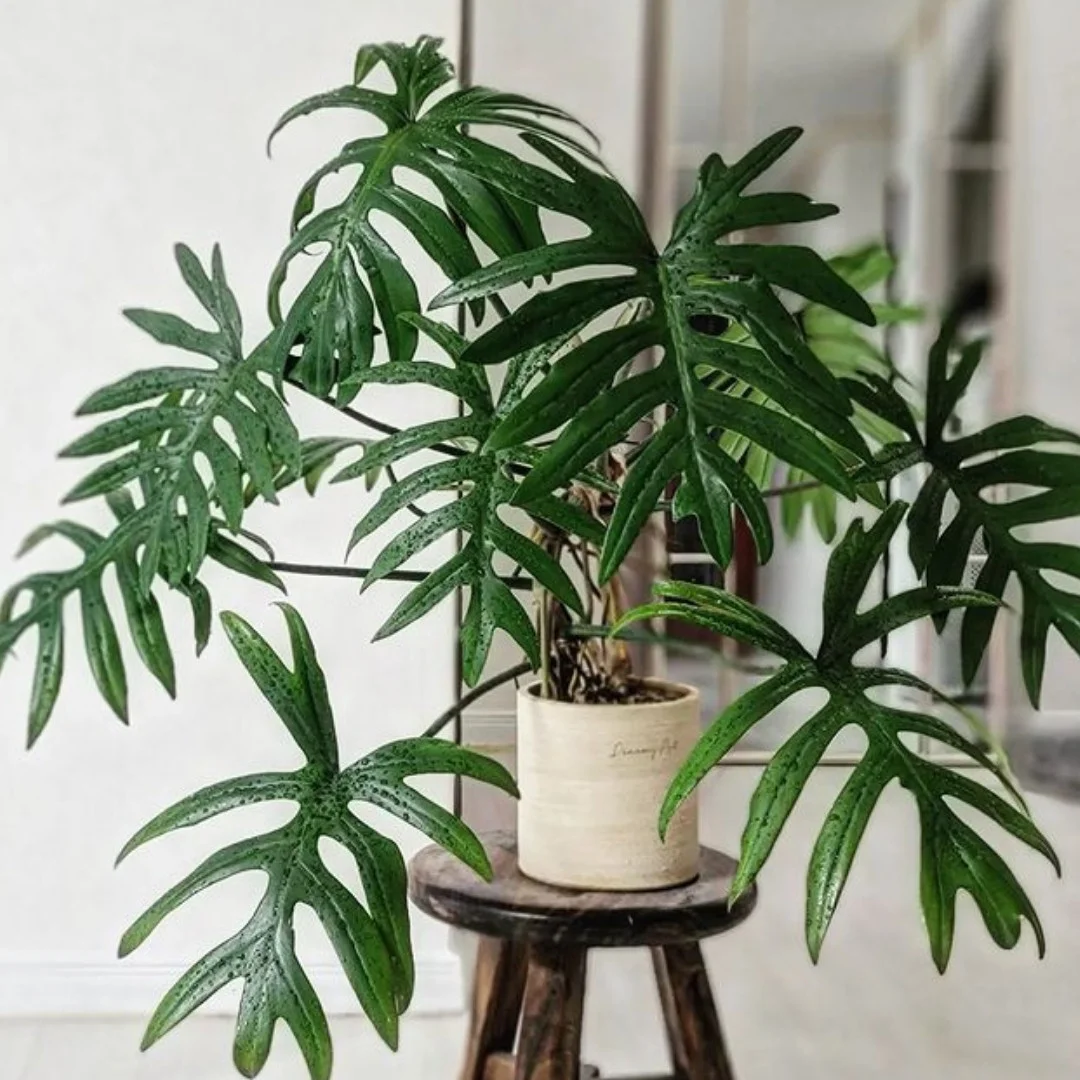
Philodendron mayoi is an accepted species from central Brazil, recorded by Kew from Brasília D.F. and Goiás in a seasonally dry tropical biome. Kew describes it as a scrambling subshrub with deeply divided mature leaves and green petioles marked by red verrucosities. That is a different story from the old “southeastern rainforest vine” description.
Identify Mayoi from a sequence of leaves, petioles, stem and source history—not from one fingered leaf or a seller’s “Tahiti” tag. Once the label is credible, give the plant bright filtered light, an airy root zone and support that fits its outward, scrambling growth.
Philodendron mayoi at a glance
| Question | Evidence-led answer |
|---|---|
| Accepted name | Philodendron mayoi E.G.Gonç.; first published in 2000 |
| Recorded native range | Brazil: Brasília Federal District and Goiás |
| Recorded habit/biome | Scrambling subshrub; seasonally dry tropical biome |
| Mature leaf clue | Pinnatifid blade with several narrow lateral lobes; examine a leaf sequence |
| Petiole clue | Green petiole with red verrucosities in Kew’s description |
| “Mayoi Tahiti” | Use as a horticultural/seller label unless provenance establishes a particular lineage; it is not the accepted scientific name |
| Main buyer risk | Purchasing from a leaf-only photograph without petiole, stem, roots or source label |
Name, range and growth habit
Kew Plants of the World Online accepts Philodendron mayoi E.G.Gonç. and cites its first publication in Kew Bulletin in 2000. GBIF links the name to E. G. Gonçalves’s paper “Two New Species of Philodendron (Araceae) from Central Brazil.” These records are the basis for the name and distribution boundary; an online shop description is not.
The native-range correction matters for care language. A seasonally dry tropical record does not mean a potted Mayoi should be left bone-dry or placed in harsh sun. It means the species should not be marketed with an invented Espírito Santo/Rio de Janeiro rainforest story. Indoor care still depends on the roots, container, light and recent growth.
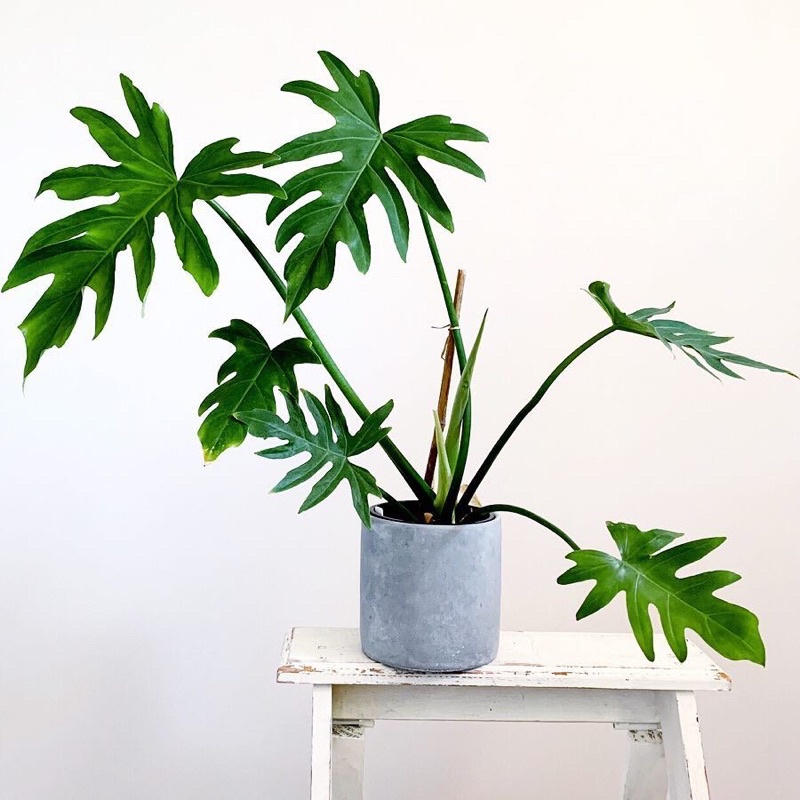
Kew calls the plant a scrambling subshrub. Give an established specimen physical room and a stable stake, plank or other support if the stems lean outward. Do not force petioles upright; secure the stem loosely and let each leaf orient toward light.
How to identify Philodendron mayoi
Read the leaf sequence
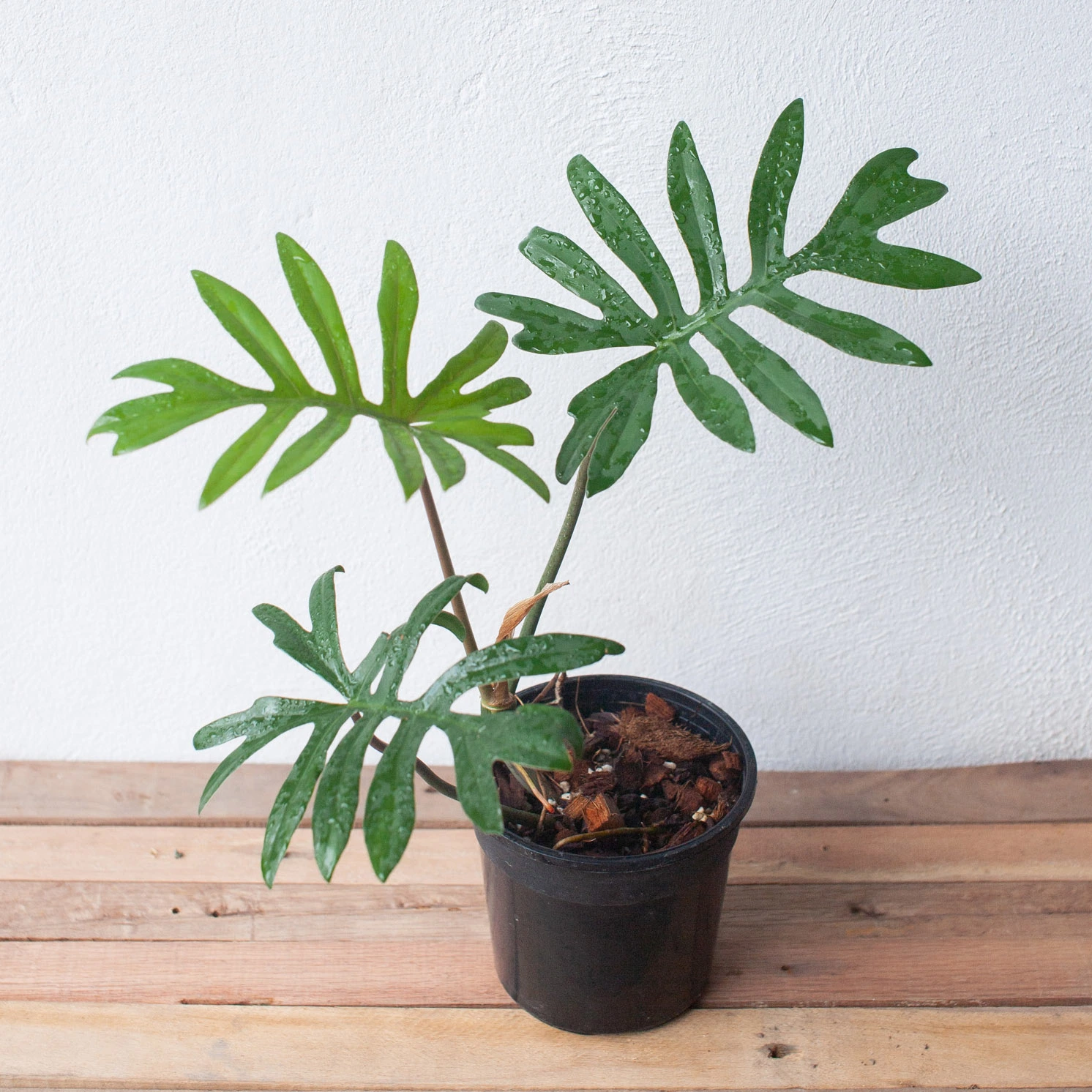
Kew describes the blade as pinnatifid and ovate in outline, with four to six primary lateral lobes per side in the referenced mature description. Wild/source-description dimensions reach roughly 30–60 × 28–50 cm (about 12–24 × 11–20 in), but an indoor juvenile, cutting or recently stressed plant may be smaller and less divided.
Photograph the oldest sound leaf, several intermediate leaves and the newest hardened leaf. A sequence shows whether division and proportion are changing with maturity; a single leaf can hide juvenile form, damage or another lobed Philodendron.
Inspect the petiole and stem
The Kew description records green petioles with red verrucosities and slight flattening on the upper side. Photograph petiole bases and surfaces in neutral light; red texture is more useful when it repeats across suitable mature growth than when it appears as one shadow or injury.
Also record the stem, node spacing, cataphyll remains and growth direction. Do not call any red-petioled, divided-leaf plant Mayoi. The Philodendron name and variety guide explains why accepted species, formal cultivar names and marketplace labels need different evidence.
Know the limit of visual comparisons
Kew notes P. radiatum as a close species but lists diagnostic differences that include ovule number and internal inflorescence characters—not details a buyer can confirm from an attractive leaf listing. Use comparison posts to decide what to inspect, not to replace a botanical determination. The Pedatum ‘Glad Hands’ label guide is an adjacent example of whole-plant and provenance checks for a deeply lobed Philodendron; it does not imply the labels are interchangeable.
What does “Philodendron Mayoi Tahiti” mean?
“Tahiti” appears in horticultural listings, but Kew’s accepted-name record does not list it as the scientific name or a botanical synonym of P. mayoi. Treat “Mayoi Tahiti” as seller-supplied horticultural language unless the seller can document what that label means in its source line.
- Keep the original nursery label and receipt.
- Ask whether “Tahiti” denotes a clone, trade selection or simply another sales name.
- Request mother-plant, petiole, stem and leaf-sequence photographs.
- Do not promise that every plant sold under the label is one uniform registered cultivar.
- Describe the received plant’s observable traits separately from the label claim.
Care for the plant you can observe
The Philodendron care hub owns the full genus-level decision sequence. For Mayoi, pay particular attention to leaf progression, stem support and the root zone rather than using its native biome as a rigid indoor recipe.
Light
Start with moderate to bright indirect light. Evaluate the next hardened leaves: increasingly long weak growth and smaller, less divided leaves can justify a gradual increase, while bleaching or sharply scorched window-facing patches indicate excessive or abrupt exposure. A seasonally dry habitat record is not permission to move an indoor-grown plant directly into hot full sun.
Water and root zone
Use a container with drainage and a porous mix that rewets evenly, drains and regains air. Check moisture below the surface, pot weight and recent drying time. Water thoroughly when the root zone is ready, then empty standing runoff. Wilt in wet media can indicate root failure rather than thirst.
The Philodendron watering guide covers wet-versus-dry diagnosis, tap-water salt investigation and water-culture boundaries in detail.
Temperature, humidity and airflow
Keep the plant in stable warm indoor conditions and protect it from cold drafts and rapid transitions. Philodendrons often appreciate humidity but can adapt to ordinary homes. If humidity is increased, maintain air movement and sanitation; routine misting is not a dependable substitute for room humidity and can keep foliage wet.
Feeding and repotting
Feed lightly while healthy roots are supporting active growth, following the product label and accounting for fertilizer already present in the mix. Pause when the plant is newly shipped, waterlogged, root-damaged or otherwise stressed. Repot because roots/media no longer function well—not because four weeks or two years have passed.
Troubleshoot by evidence
| What you see | Check before acting | First response |
|---|---|---|
| New leaves less divided | Plant maturity, light change, root health and recent stress | Stabilize care and evaluate the next leaf; do not relabel from one leaf |
| Long, leaning growth | Light direction and whether the stem has usable support | Increase useful light gradually and support the stem, not petioles |
| Yellow leaves in wet mix | Drainage, root color/firmness, odor and pot size | Inspect roots before adding water or fertilizer |
| Wilt in a light pot | Dryness at depth, heat and root condition | Water thoroughly if roots/mix are sound, then drain |
| Brown margins | Dry cycles, salts, fertilizer, hot glass, root health and humidity | Change the highest-confidence cause, not every variable |
| Stippling, webbing or sticky residue | Leaf undersides, new growth, petiole bases and stems | Isolate and identify mites, scale, mealybugs or aphids |
UC Statewide IPM emphasizes that watering, roots, light, humidity, fertilizer and pests can produce overlapping houseplant symptoms. Isolate a suspect pest, identify it and use only a treatment labeled for indoor use, the target organism and the plant. “Neem oil fixes every pest” is not a diagnostic plan.
Propagate from documented stem anatomy
Use a stem cutting that includes a node and viable axillary bud or active growing point. A leaf, petiole or aerial root does not replace the required stem anatomy. Photograph the source leaf sequence, petiole, stem, node and label before separating a valuable plant.
Choose water, an airy moist medium or air layering based on the cutting and risk tolerance. The Philodendron propagation guide owns the full top-versus-mid cutting, rooting and transfer procedure.
Buyer checklist
- Ask for the whole plant and several hardened leaves, not only one divided leaf.
- Request close views of green petioles, any repeating red texture, stem and nodes.
- Confirm whether the offer is an established plant, top cut, mid cut or tissue-culture plantlet.
- Ask what “Tahiti” means in that seller’s records and preserve the source label.
- Check root condition, current medium and recent propagation or import history.
- Keep current price, stock, plant format and shipping details on the live Philodendron collection, not in an evergreen guide.
Philodendron mayoi FAQ
Is Philodendron mayoi a climber?
Kew describes it as a scrambling subshrub. Indoors, an outward-leaning specimen can benefit from stable support, but avoid rewriting that documented habit as a generic canopy-climbing story.
Is Mayoi Tahiti the accepted botanical name?
No. The accepted botanical name is Philodendron mayoi E.G.Gonç. “Tahiti” should be treated as horticultural or seller language unless reliable provenance defines a particular line.
Why are new Mayoi leaves less divided?
Check maturity, light, root health, recent shipping/repotting and support. One less-divided leaf does not prove a wrong identity; photograph a sequence and evaluate growth after conditions stabilize.
Can a leaf cutting make a new Mayoi plant?
Plan on viable stem tissue with a node and bud/growth point. A detached leaf and petiole may remain attractive temporarily but should not be sold as equivalent to a propagation-ready node cutting.
Safety
Philodendron tissue contains irritating calcium oxalate crystals. Keep the plant, pruning debris and propagation vessels away from children and pets, wash after handling sap and contact an appropriate veterinarian, poison-control service or medical professional after a concerning exposure.
Sources
- Kew Plants of the World Online: Philodendron mayoi E.G.Gonç.
- GBIF: Philodendron mayoi species record and publication reference
- Iowa State University Extension: How do I care for a philodendron?
- UC Statewide IPM: Houseplant problems
- Penn State Extension: Propagating houseplants
- ASPCA: Is your houseplant safe for your pets?