
Greenboog horticultural identity & care guide
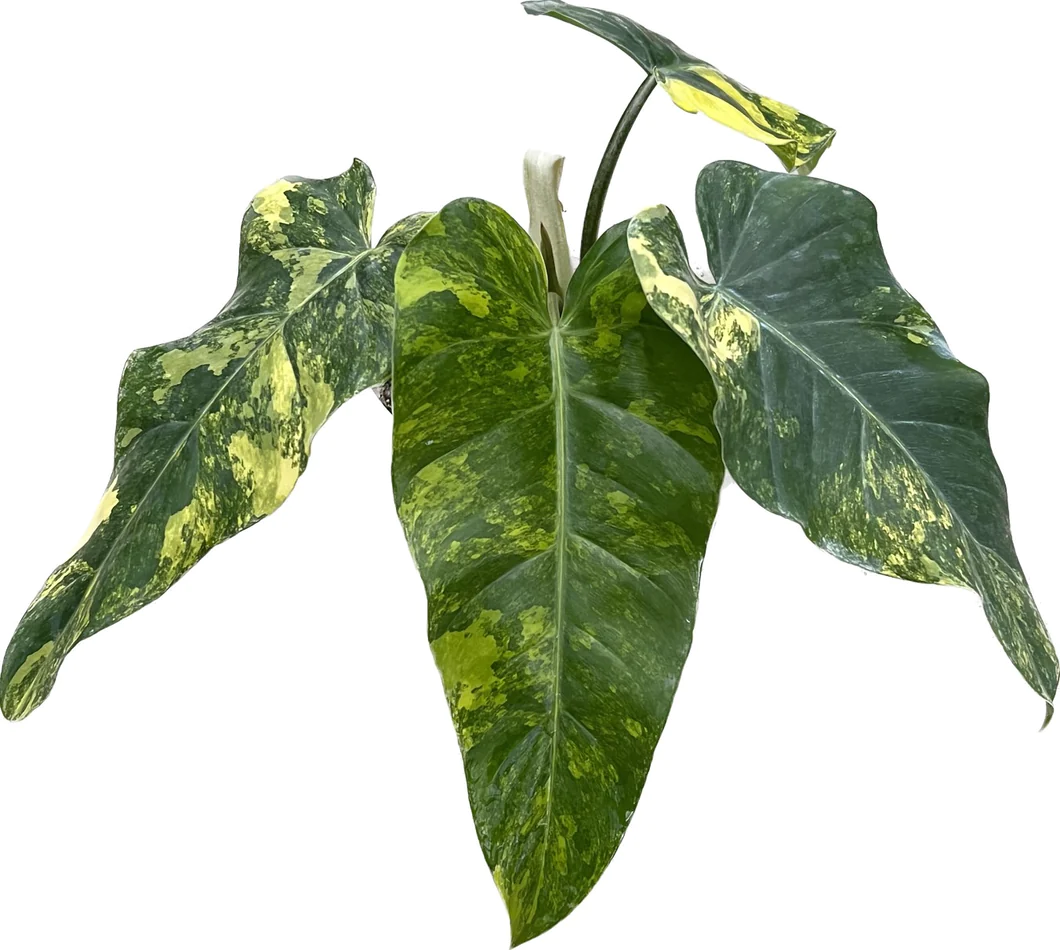
Domesticum is a useful trade identity, but its taxonomy is not a settled wild-species story. Read the spade-shaped leaf sequence, stem, growth point and provenance before judging the variegation.
This page owns variegated Domesticum identity and care. The rare Philodendron guide owns broader cultivar comparison.
Variegated Domesticum at a glance
| Question | Evidence-led answer |
|---|---|
| Kew status | Artificial hybrid: Philodendron × domesticum G.S.Bunting |
| RHS status | Domesticum / spade-leaf profile exists, but the name is marked unresolved |
| Parentage | Not supplied by Kew’s record; do not invent a formula |
| Native range | Not applicable as a documented wild range for this artificial hybrid |
| Field identity | Glossy elongated spade/arrow leaf sequence, stem/growth point, provenance and repeated pattern |
| Safety | Philodendron tissue contains irritating insoluble calcium-oxalate crystals |
What the name proves—and what remains open
Kew records Philodendron × domesticum G.S.Bunting, published in 1966, as an artificial hybrid. Its current record does not show a hybrid formula. RHS uses the spade-leaf common name but marks the botanical name unresolved.
That evidence does not invalidate the established horticultural trade identity. It does mean the careful article should not present Domesticum as a wild species native to Central or South America, claim known parents or treat every similar juvenile leaf as authenticated.
Identify leaf sequence, stem and pattern together
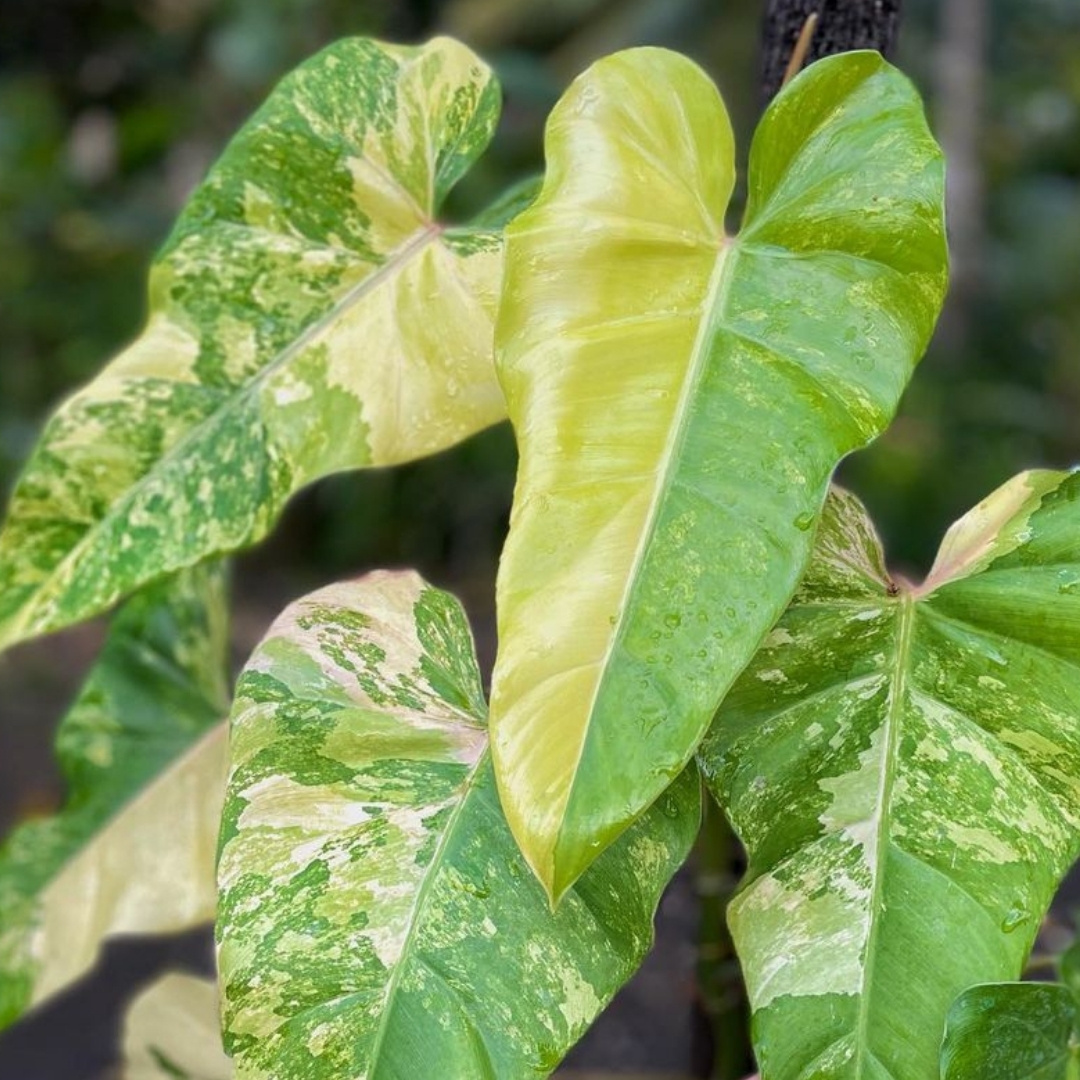
Established Domesticum in trade commonly develops elongated glossy blades with a pointed tip and basal shoulders or lobes, creating a spade or arrow outline. Juvenile leaves can be simpler and broader. Assess several hardened leaves before relying on that name.
| Check | Stronger evidence | Weak evidence |
|---|---|---|
| Leaves | Several hardened elongated spade/arrow blades with recurring basal form | One rounded juvenile leaf |
| Stem | Visible nodes, growth point and the plant’s actual climbing/upright progression | A detached leaf and petiole |
| Pattern | Repeated yellow/cream/green sectors or marbling in neutral light | One newly unfurled pale leaf |
| Provenance | Traceable mother-plant photos and consistent label history | Seller price or image-search match |
| Taxonomy | Kew artificial-hybrid record with unresolved parent formula | An invented wild native range |
Juvenile plants require patience
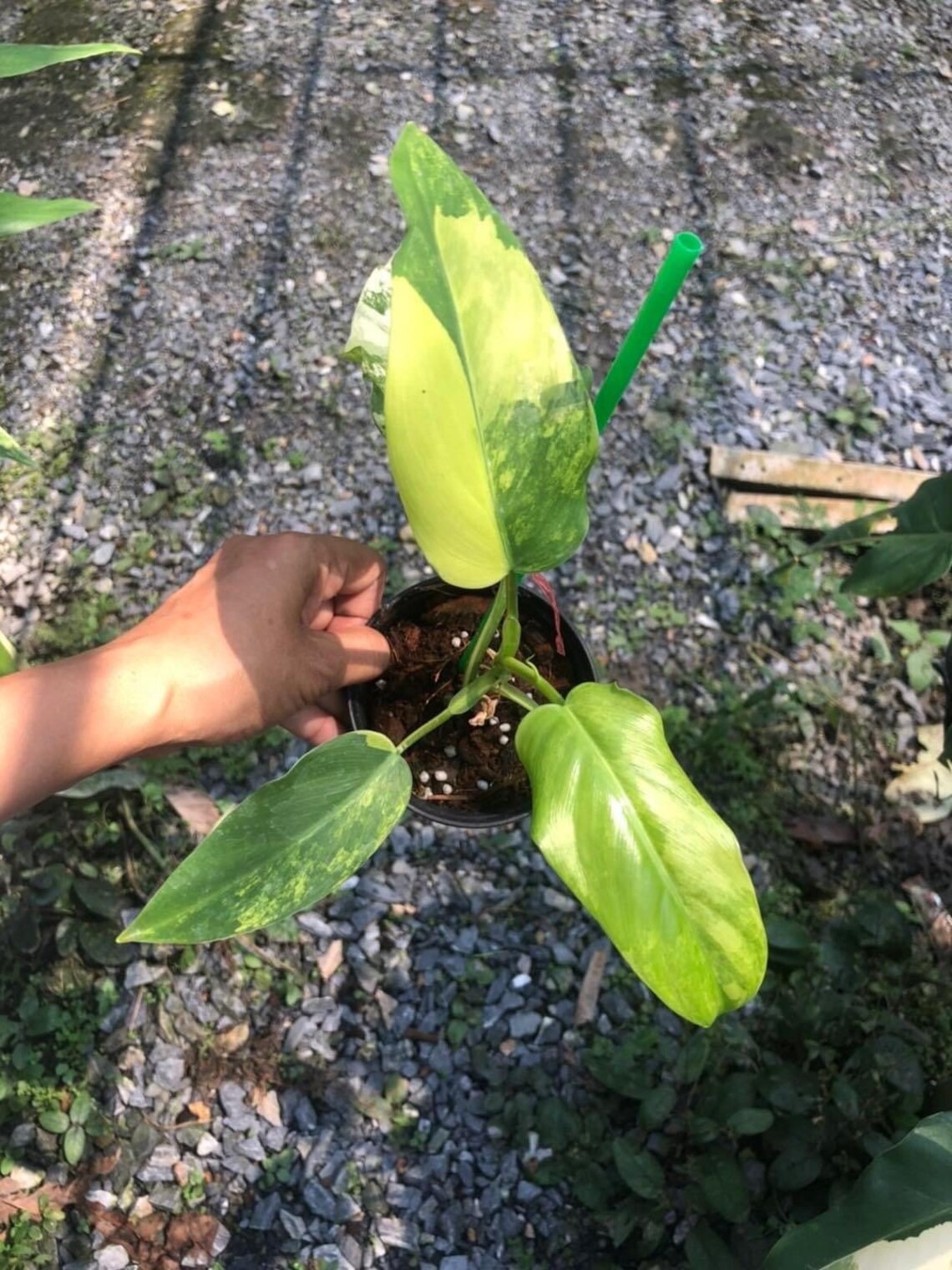
Colour also changes as a new leaf hardens. One greener leaf does not prove permanent reversion, while general yellowing from weak roots is not desirable variegation. Track the same growth point across several leaves.
Light supports growth; it does not guarantee pattern
RHS recommends bright indirect light for Philodendron generally. Give variegated Domesticum enough filtered light to support its green tissue without scorching pale areas. Low light may lengthen growth and slow the root zone; harsh sun can leave dry tan patches.
- Possible shortage: progressively smaller leaves, leaning, long gaps and slower drying after roots are checked.
- Possible excess: bleaching or crisp injury on the exposed side.
- Safer adjustment: change curtain filtering, distance or lamp duration gradually, then judge hardened new growth.
Use the Philodendron care guide for room-level acclimation. No light setting can promise more cream or yellow on the next leaf.
Support the stem you actually have
Domesticum is often trained upright in horticulture. If the stem elongates and produces attachment roots, give it a stable board or pole, tie the stem loosely and keep petioles free. If a compact juvenile has no usable climbing axis yet, do not bury the crown or force leaves against a support.
Replace or extend the structure before the top becomes unstable. Support can improve orientation and help maintain larger foliage, but it cannot resolve an uncertain label or guarantee mature shape.
Root-zone and watering decisions
Use a pot with open drainage and a medium that holds useful moisture while regaining air after watering. Bark, coarse mineral material and coco- or peat-based components can all contribute. Avoid placing a small root ball in a pot two or three times wider; that leaves a wet unrooted buffer.
- Water across the root ball and allow excess to leave.
- Learn the pot’s weight after watering and as the rooted volume approaches dry.
- Check below the decorative surface rather than relying on a top-inch rule.
- Water again from root-zone moisture, warmth and active growth—not once a week.
The Philodendron watering guide owns detailed wet-versus-dry and water-quality diagnosis. A yellow leaf can occur with both dry roots and oxygen-starved damaged roots.
Warmth, humidity, feeding and repotting
Keep the plant warm and away from cold drafts or hot vents. Average household humidity may work when roots are healthy. If measured humidity is persistently low and leaves stick while unfurling, a clean humidifier is more useful than routine misting; maintain airflow.
Feed modestly during active growth according to the label. Pause when growth slows from cold, low light or root injury. Repot when roots densely occupy the container, the medium collapses or drainage behavior changes; move up conservatively.
Symptom table
| Signal | Check first | Safer response |
|---|---|---|
| One greener leaf | Hardening stage and previous growth-point sequence | Observe before cutting |
| Several all-green leaves | Growth point, provenance, light and root health | Correct verified stress; cut only with a viable-node plan |
| Pale area turns tan | Direct exposure, heat and hydration swings | Filter exposure and stabilize roots |
| Whole leaf yellows | Root condition, pot weight, age and nutrition history | Separate chlorosis from pattern before treating |
| Distorted new growth | Inspect emerging tissue and undersides for pests | Isolate if needed; identify before spraying |
Propagation and node selection
A detached leaf and petiole cannot rebuild the plant. A cutting needs viable stem tissue with a node and usable bud or growth point. Photograph the stem pattern and preserve aerial roots where possible. Air layering can reduce risk by establishing roots before separation.
The Philodendron propagation guide owns top-cut, mid-cut, node and transfer decisions. Neither node position nor light guarantees the next leaf’s pattern.
Buyer checklist
- Request unfiltered whole-plant and mother-plant photos.
- Inspect several hardened spade/arrow leaves, the stem, nodes and growth point.
- Ask for roots and enough green tissue—not only the palest leaf.
- Do not accept a claimed wild range or parent formula without documentation.
- Compare juvenile lookalikes before paying a label premium.
The Philodendron collection owns live inventory. Product pages own format, price and availability; this guide owns Domesticum evidence and care.
Safety
Philodendron tissue contains insoluble calcium-oxalate crystals that can irritate the mouth and digestive tract when chewed. Keep plants and cut material away from children and pets; contact a veterinarian or poison service after suspected ingestion.
Variegated Domesticum FAQ
Is Philodendron domesticum a wild species?
Kew currently treats Philodendron × domesticum as an artificial hybrid, and RHS marks the name unresolved. Do not assign the hybrid a wild native range.
What are its parents?
Kew’s current record does not provide a parent formula. Claims need a primary breeder or registration record.
Can brighter light increase variegation?
Bright filtered light supports green tissue, but it cannot guarantee or create the next leaf’s pattern.
Is a juvenile plant easy to identify?
No. Simpler juvenile leaves overlap with other variegated Philodendron. Use mother-plant evidence and the developing leaf sequence.
Can I propagate one leaf?
No. A complete shoot requires viable stem, node and bud or growth-point tissue.
Sources and evidence boundaries
- Kew POWO: artificial-hybrid status
- IPNI: 1966 name-publication record
- RHS: spade-leaf context and unresolved name status
- RHS: genus-level light, watering and support
- Penn State Extension: healthy stock, clean tools and propagation environment
- ASPCA Animal Poison Control: Philodendron calcium-oxalate exposure
wanted to see a pic of the spathe flower