Greenboog cultivar identity & crown-care guide
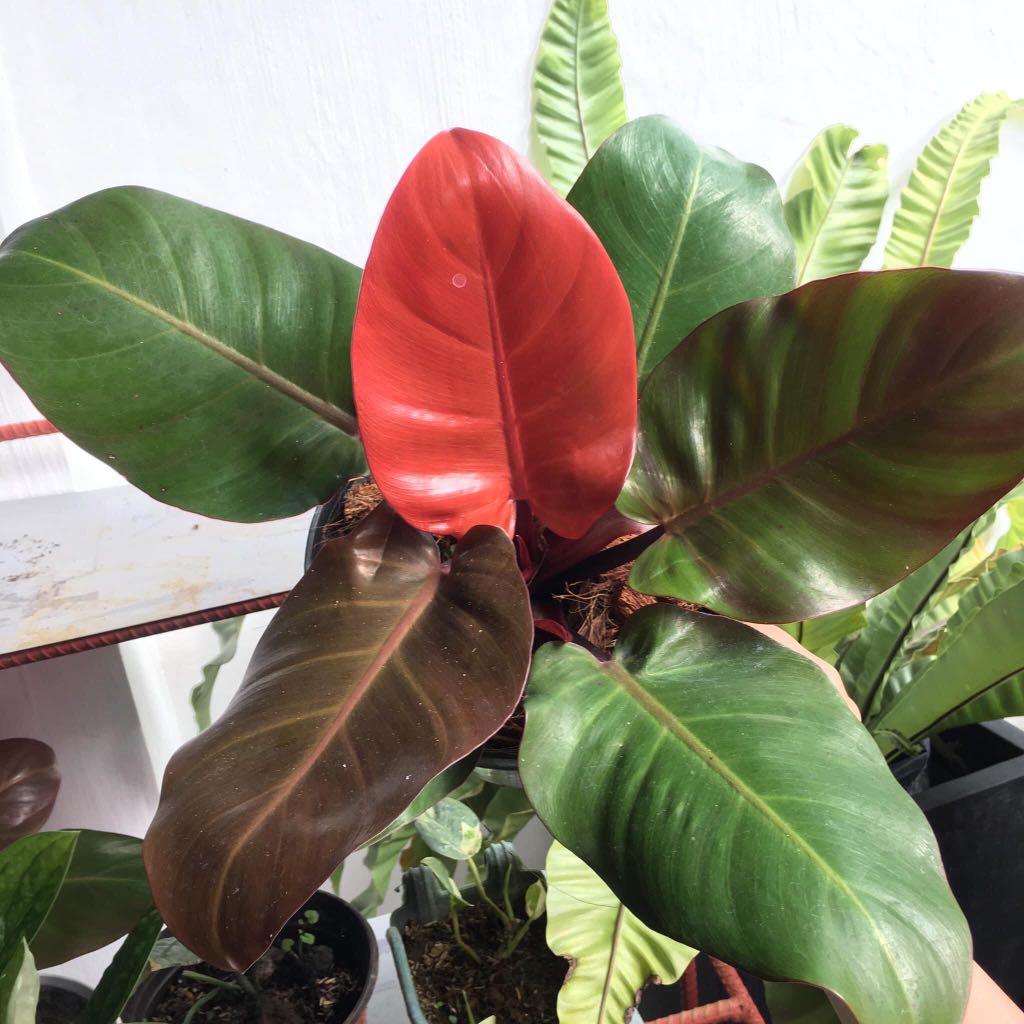
Cherry Red is a nursery label with a documented connection to McColley’s Finale—but one red leaf cannot authenticate a clone. Read the whole crown and its colour sequence.
This page owns Cherry Red label verification and crown care. The rare Philodendron guide owns broad comparison.
Cherry Red identity at a glance
| Question | Evidence-led answer |
|---|---|
| Historical identity | Earlier industry name for ‘McColley’s Finale’ PP12144 |
| Parentage | Unknown complex hybrid parentage |
| Habit | Compact self-heading rosette, not a vine |
| Colour sequence | Rich red → deep chestnut → medium green with red shading |
| Modern label | Used inconsistently; clonal identity needs provenance |
The McColley’s Finale connection
US Plant Patent 12,144 records Cora McColley’s hybrid as self-heading, stocky and compact, with rich chestnut-red new foliage, dark cataphylls and red-black petioles. AG3 lists McColley’s Finale as previously known to the industry as Cherry Red.
Identify the crown, not one red leaf
Look for short internodes around one central growth point, thick glossy ovate leaves, dark cataphylls, red-black petioles and several leaf ages at once. A new red blade should move through chestnut toward green. Red Congo, Imperial Red, Prince of Orange and other self-heading hybrids can overlap in juvenile colour, so a single photograph is weak evidence.
| Check | Stronger evidence | Weak evidence |
|---|---|---|
| Habit | Compact rosette with short internodes | A pole added by a seller |
| Colour | Several leaves showing the patent sequence | One bright red unfurling leaf |
| Petioles | Consistently red-black on the same crown | Lighting tint in a stock photo |
| Name | Traceable clone/source record | “Cherry Red” label alone |
Light for colour and compact form
Use bright filtered light and acclimate gradually. Intense sun can damage foliage; insufficient usable light can slow growth and keep the pot wet longer. Light supports healthy new growth but does not authenticate the clone or guarantee a particular shade.
The Philodendron care guide owns the broader acclimation workflow.
Pot a self-heading crown
Use a stable pot with open drainage and keep the central growth point unobstructed. McColley’s Finale is not a trailing or climbing vine, so a moss pole is unnecessary. A discreet stake can temporarily stabilise a leaning crown without binding petioles together.
Choose a substrate that holds useful moisture yet returns air after watering. Bark, coarse mineral material and coco- or peat-based fractions can all contribute; particle behavior and pot volume matter more than a fixed recipe.
Water from roots and pot weight
- Water thoroughly and drain excess.
- Learn the pot’s wet weight.
- Check moisture in the rooted volume, not only the surface.
- Water again from pot weight, roots, warmth and active growth.
The watering guide owns wet-versus-dry diagnosis. Yellowing can follow drought, root damage, cold, age or excess moisture.
Warmth, humidity, feeding and repotting
Keep the crown warm and away from cold drafts or hot vents. Measure room humidity before adding a clean humidifier; misting does not replace root hydration or airflow. Feed modestly during active growth according to the label. Repot when roots fill the pot, drainage changes or the medium collapses—not by a fixed annual calendar.
Symptom checks
| Signal | Check first | Response |
|---|---|---|
| New leaf turns green | Normal leaf-age sequence | Do not diagnose reversion |
| Crown opens or leans | Light direction and roots | Rotate gradually or stabilise |
| Yellow lower leaf | Age, pot weight, roots and cold | Correct verified cause |
| Soft central growth | Trapped water, roots and tissue | Isolate and diagnose |
Propagation boundary
A detached leaf cannot rebuild this compact crown. Viable propagation requires meristematic growth tissue; the patent records crown offshoots and organogenesis tissue culture. Do not cut blindly into short internodes. The propagation guide owns general node and hygiene principles.
Buyer checklist
- Request a whole-crown photo with several leaf ages.
- Confirm self-heading architecture and short internodes.
- Check dark cataphylls and red-black petioles.
- Ask whether Cherry Red means documented McColley’s Finale stock.
- Keep Red Congo, Imperial Red and Prince of Orange labels separate.
The Philodendron collection owns live inventory.
Safety
Philodendron tissue contains irritating calcium-oxalate crystals. Keep plants and cut material away from children and pets; contact a veterinarian or poison service after suspected ingestion.
FAQ
Is Cherry Red the same as McColley’s Finale?
Historically, AG3 says McColley’s Finale was known to the industry as Cherry Red. Modern usage is inconsistent, so provenance still matters.
Is Cherry Red a climbing Philodendron?
A verified McColley’s Finale is a self-heading rosette, not a vine.
Why does the red leaf become green?
That is the documented maturation sequence, not automatically a care failure.
Can one leaf propagate it?
No. Regrowth requires viable meristematic growth tissue.