Greenboog species identity & care field guide
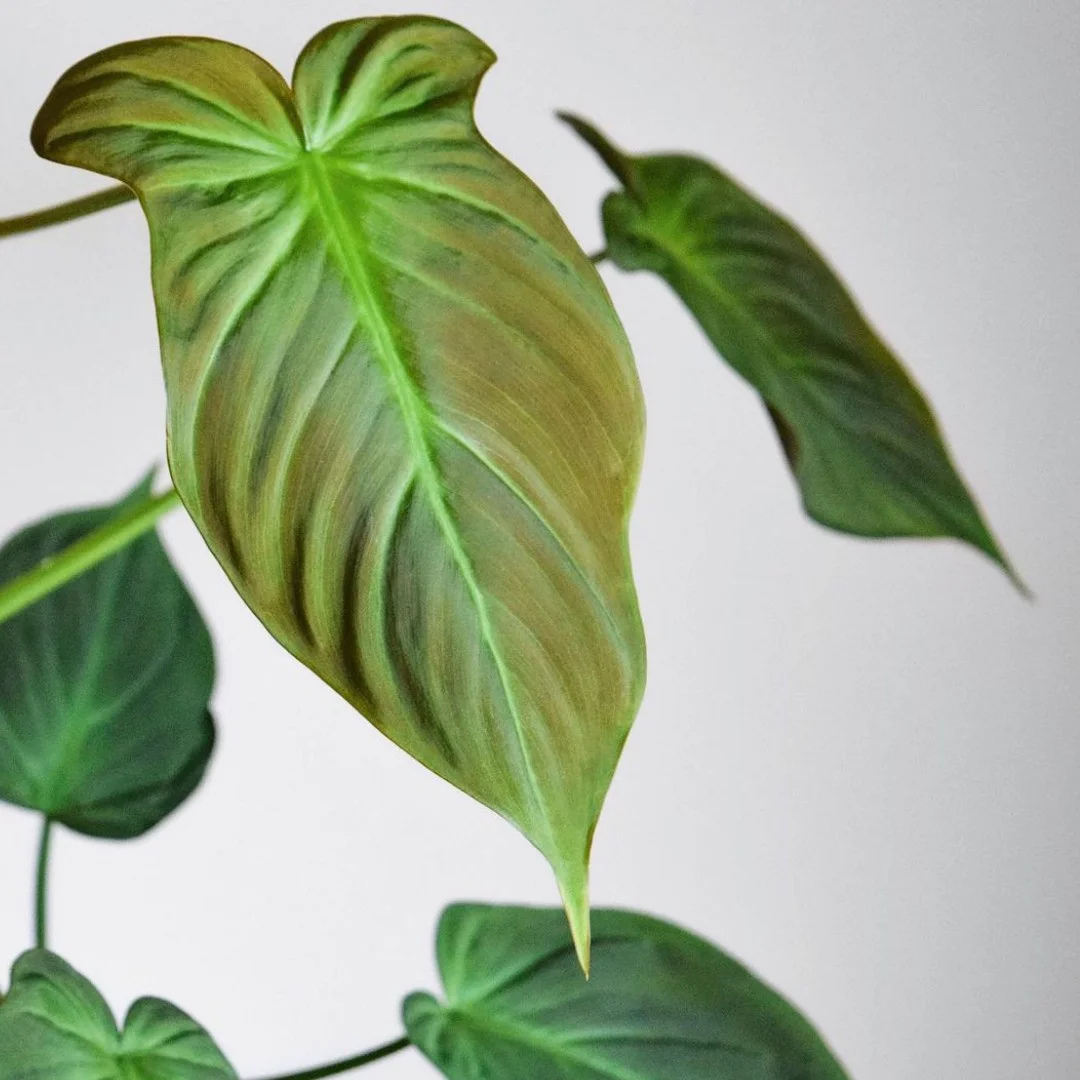
Camposportoanum can look like two different plants across its life: soft, entire juvenile leaves give way to a climbing stem and a divided adult blade. Track the sequence before trusting a single-leaf ID.
This page owns species identity, juvenile-to-adult progression and specific care. The rare Philodendron guide owns broad comparison across the collection.
Philodendron camposportoanum at a glance
| Question | Evidence-led answer |
|---|---|
| Taxonomic status | Accepted species: Philodendron camposportoanum G.M.Barroso |
| Published | 1956; type material is recorded from Nova Xavantina, Mato Grosso, Brazil |
| Native range | Southern tropical America according to Kew; not a cultivar or hybrid trade name |
| Habit | Climber with a scandent stem that can root at nodes |
| Leaf progression | Velvety entire juvenile blades can progress to an adult tripartite blade |
| Safety | Philodendron tissue contains irritating insoluble calcium-oxalate crystals |
Taxonomy: an accepted species, not “Campo Pothos”
Philodendron camposportoanum G.M.Barroso is accepted by Kew and was first published in 1956. Kew records it as a climber of wet tropical biome in southern tropical America. Brazilian herbarium records include type material from Nova Xavantina in Mato Grosso.
“Campo Pothos” is an informal trade nickname, not a botanical synonym. It can mislead buyers toward Epipremnum care or identity. Use the accepted Philodendron name and verify the stem and leaf progression.
Why juvenile and mature leaves look so different
A peer-reviewed flora treatment notes that the species is extremely variable. Juvenile blades may be velvety and constricted just above the base, with pale lines visible on the upper surface. Bronze, olive or green tones can shift as a new leaf hardens, but colour alone is not a dependable ID.
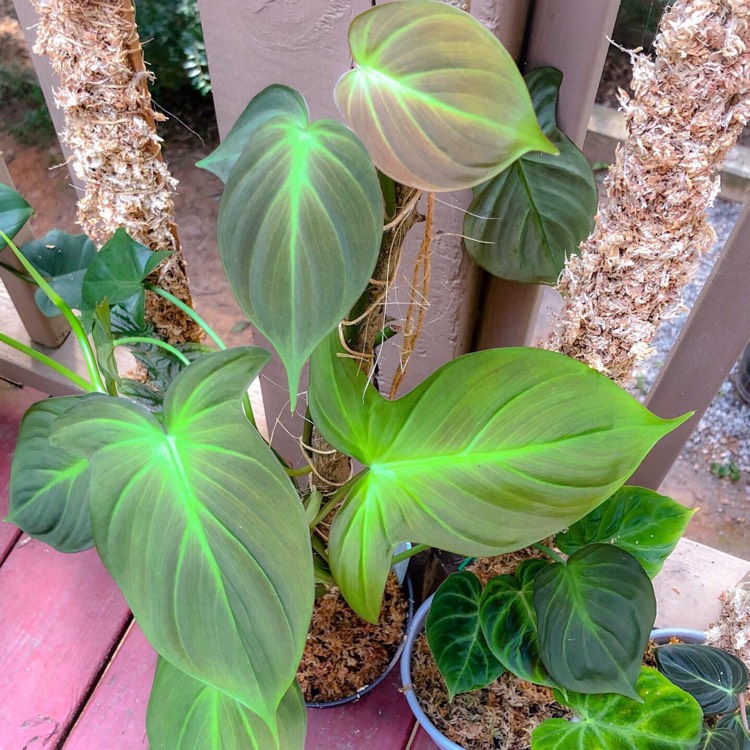
Kew’s botanical description records a mature blade divided into three main parts: an elliptic central segment and two lateral segments separated by rounded sinuses. That adult architecture is more informative than a claimed eight-inch maximum, “yellow border” or one heart-shaped cutting.
| Stage or feature | What to look for | What not to conclude |
|---|---|---|
| Juvenile blade | Entire, often velvety, sometimes constricted above the base with pale upper lines | That every heart-shaped velvet Philodendron is camposportoanum |
| Transition | Repeated change across successive leaves while stem climbs and roots function | That one irregular leaf proves mature form |
| Adult blade | Tripartite outline with central and two lateral segments | That a support guarantees this shape on schedule |
| Stem | Scandent axis with nodes and potential attachment roots | That it is a self-heading rosette |
| Provenance | Traceable mother plant and multi-stage photos | That seller price authenticates species |
Support is part of the identity workflow
The botanical record describes a climbing, node-rooting stem. Give it a stable board, pole or other vertical surface before the stem repeatedly bends away. Tie the stem loosely rather than strapping petioles, and guide a node toward the support. Replace or extend the structure before the top becomes unstable.
Support improves orientation and can help the plant maintain climbing growth, but leaf maturation also depends on plant age, roots, light and uninterrupted growth. If a top cutting returns to smaller entire leaves, that can be a temporary juvenile-like reset while roots and attachment re-establish.
Light for progression, not instant lobes
NC State Extension recommends bright indirect light for Philodendron generally. Low light may sustain a leaf for a while yet still produce a longer, weaker stem and smaller successive blades. Harsh direct exposure can bleach or scorch soft juvenile tissue.
- Possible shortage: widening gaps between leaves, leaning growth, smaller new blades and slower drying after roots are checked.
- Possible excess: crisp tan injury concentrated on the exposed side.
- Safer adjustment: change filtering, distance or grow-light duration gradually and assess the next two hardened leaves.
Use the Philodendron care guide for the complete light, warmth and acclimation workflow. Do not move a greenhouse plant directly into strong sun to force adult form.
Root-zone and watering decisions
Use a pot with open drainage and a medium that keeps useful moisture while regaining air after watering. Bark, coarse mineral components and coco- or peat-based material can all help, but particle behavior and pot size matter more than a branded “aroid mix.”
- Water across the root ball and let excess leave the pot.
- Learn the container’s weight after watering and after much of the rooted volume has dried.
- Check below the surface; a dry top layer can cover a wet compacted core.
- Water again from pot weight, root-zone moisture, warmth and active growth—not once a week.
The Philodendron watering guide owns detailed wet-versus-dry diagnosis and water-quality checks. Yellowing, drooping and stalled leaves can occur with both drought and oxygen-starved damaged roots.
Warmth, humidity, feeding and repotting
Keep the plant warm and away from cold drafts or hot vents. Average household humidity may work when roots are stable. If measured humidity is persistently low and multiple leaves stick or crisp, a clean humidifier is more useful than routine misting; airflow still matters.
Feed modestly during active growth according to the product label. Pause when growth stops from cold, low light or root injury. Repot when roots densely occupy the pot, the medium collapses or drainage behavior changes. Increase size conservatively so a small root system is not surrounded by a large wet buffer.
Symptom table
| Signal | Check first | Safer response |
|---|---|---|
| Small entire leaves continue | Plant age, attachment, light and roots | Stabilize support and care; do not promise a maturity deadline |
| Yellow lower leaf | Age pattern, pot weight, roots and recent feeding | Treat the confirmed cause instead of watering automatically |
| Brown margin or tip | Uneven hydration, salts, heat/light load and roots | Correct one verified variable at a time |
| Long bare internodes | Light direction, support contact and root health | Improve usable light gradually and retrain the stem |
| Distorted new leaf | Inspect emerging tissue and leaf undersides for pests | Isolate if necessary; identify before spraying |
Propagation: the node is non-negotiable
A detached leaf and petiole cannot rebuild this climbing species. A cutting needs stem tissue with a viable node and usable bud or growth point. Select healthy stock, use clean tools and preserve any attached aerial roots. A top cutting may be simpler to orient, while a mid-cut requires clear node and bud identification.
Water, airy moist medium and air layering can all work when matched to the cutting and rot risk. The Philodendron propagation guide owns the full node, top-cut, mid-cut and transfer process. Root formation does not guarantee that the first new leaf will be adult-shaped.
Buyer checklist
- Request unfiltered photos of the stem, nodes and several leaves—not one bronze heart.
- Ask whether the mother plant has produced the adult tripartite blade.
- Check for a living growth point, functional roots and a clean pest inspection.
- Do not treat “Campo Pothos,” fixed eight-inch size or low-light claims as taxonomy.
- Choose a specimen whose stage and support needs fit your space.
The Philodendron collection owns live inventory and availability. Product pages own the offer; this guide remains the species identity and care owner.
Safety
Philodendron tissue contains insoluble calcium-oxalate crystals that can irritate the mouth and digestive tract when chewed. Keep the plant and cut material away from children and pets; contact a veterinarian or poison service after suspected ingestion.
Philodendron camposportoanum FAQ
Is Philodendron camposportoanum an accepted species?
Yes. Kew accepts Philodendron camposportoanum G.M.Barroso, first published in 1956.
Why does a juvenile plant not have three-part leaves?
Juvenile blades can be entire and velvety. Adult botanical descriptions record a tripartite blade, but progression depends on age, roots, light, support and uninterrupted growth.
Is Campo Pothos the correct name?
No. It is an informal trade nickname. The accepted botanical name places the species in Philodendron, not Epipremnum.
Will a moss pole force mature leaves?
No. A suitable support helps a climbing stem orient and attach, but it cannot guarantee a mature shape or timeline.
Can I propagate one leaf?
No. A complete new shoot requires viable node and bud or growth-point tissue, not a detached leaf and petiole.
Sources and evidence boundaries
- Kew POWO: accepted name, range, climbing habit and adult botanical description
- Rodriguésia: peer-reviewed juvenile morphology and distribution discussion
- Brazilian Virtual Herbarium: type-specimen records
- NC State Extension: genus-level light, root-zone and growth-habit care
- Penn State Extension: healthy stock, clean tools and propagation environment
- ASPCA Animal Poison Control: Philodendron calcium-oxalate exposure