Name boundary, venation and close-support care
Burle Marx Fantasy circulates under several incompatible identity stories. Treat it as a horticultural label unless a source record connects the plant to a published species, then care for the actual silver-green, reticulate-veined climber in front of you.
Keep the horticultural name and the species record separate
Burle Marx Fantasy is a horticultural name, not proof of parentage. Longwood’s accession shows institutional use of the cultivar-style label, but the record does not publish a cross. The common melanochrysum × hederaceum story in the old article was not supported by a primary source and should not be repeated as fact.
Philodendron hopkinsianum is different evidence: Kew accepts it as a species first published in 2001, native to northern Brazil and a wet-tropical climber. Some sellers equate it with Burle Marx Fantasy; others call the trade plant a hybrid or undescribed collection plant. Do not transfer a species record through a marketplace synonym.
| Evidence | What it supports | Boundary |
|---|---|---|
| Burle Marx Fantasy label | A horticultural propagation line or sales identity. | It does not publish parentage or wild origin. |
| P. hopkinsianum record | Facts about the accepted northern Brazilian species. | A traceable identification is needed before synonymy. |
| Current whole-plant images | Visible form, condition, scale and image scope. | Images cannot resolve an undocumented cross. |
Compare venation across several leaves
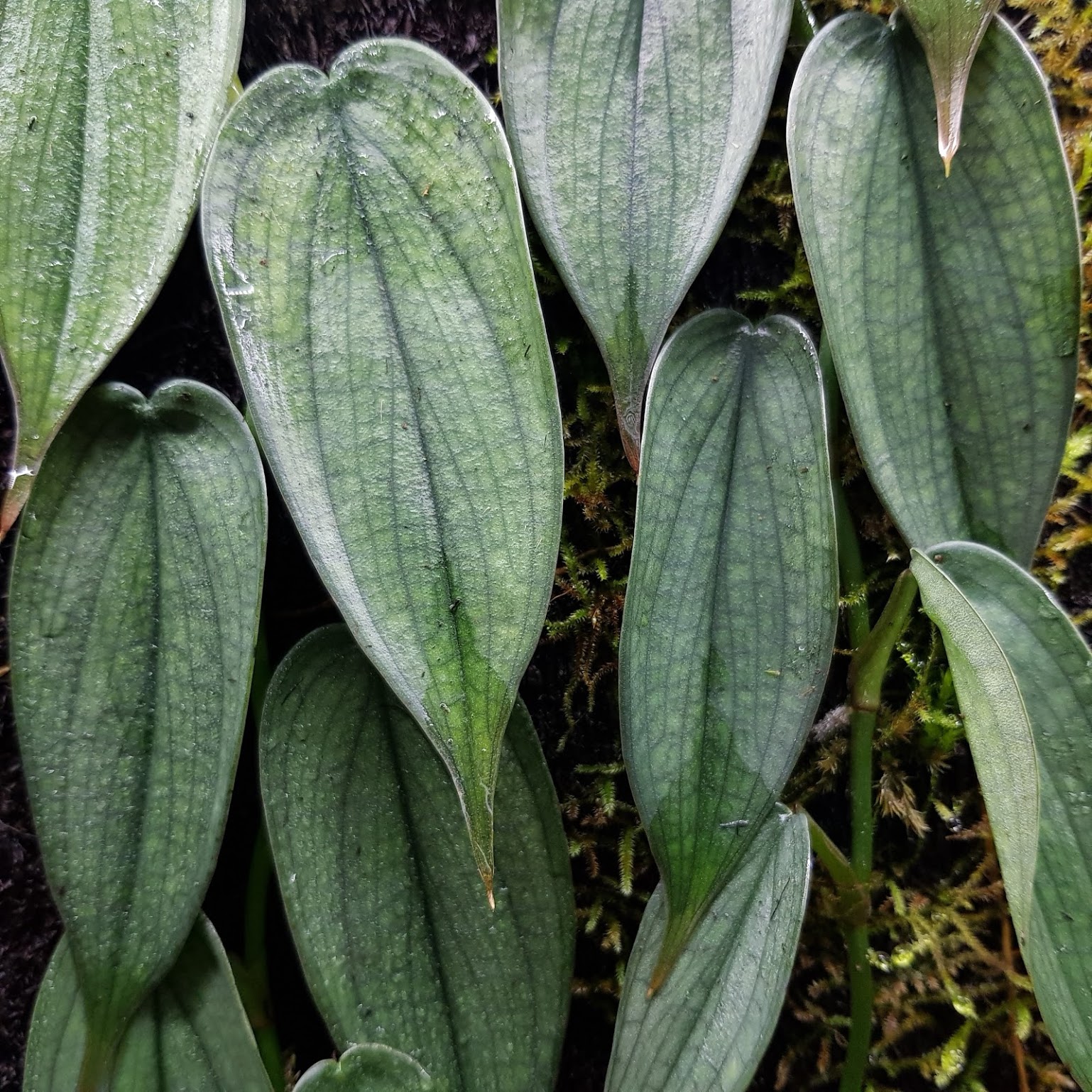
The Greenboog photographs show elongated silver-green blades with darker longitudinal and reticulate veins. Compare the newest hardened leaf with two older leaves under the same light. Surface sheen, camera exposure and water droplets can exaggerate silver colour, while stress can reduce size.
Inspect the stem between leaves, aerial roots and how the plant meets a surface. A close-clinging or shingling juvenile can change presentation as it matures. Let the architecture choose the support instead of assuming it should trail freely from a shelf.
Give the stem close, continuous support
Use a narrow plank, slab or fine-textured pole that can sit close to the active stem. Let the stem make close contact with the support. Secure the stem loosely and keep petioles free; the goal is consistent node-to-surface contact, not tying each leaf flat.
Smaller plants and cuttings can lose progress when the stem repeatedly detaches. Add support early, guide the next node and keep the structure stable through watering. If a mature section is stiff, train the new growth rather than sharply bending the old stem.

Balance filtered light with root-zone air
Start with medium to bright indirect light and change exposure gradually. Strong hot sun can mark a thin or recently unfurled leaf; very weak light slows water use and can reduce growth. Judge the next two leaves and internodes instead of chasing a single colour photograph.
Use an airy, moisture-retentive medium in a pot sized to the roots. Check below the surface and use pot weight. Water thoroughly when the root zone has partly dried, then let excess drain. A tiny cutting in a large container can remain wet long after the surface looks dry.
Keep the root zone warm and feed lightly only during active rooted growth. Fixed every-two-week feeding and routine misting are not requirements. Stable roots, usable light, close support and airflow give clearer feedback.
Diagnose the pattern, stem and roots in order
| Pattern | Check first | Measured response |
|---|---|---|
| Smaller, flatter new leaves | Root health, light trend and support contact. | Correct the limiting factor and judge later nodes. |
| Yellowing with wet medium | Pot size, drainage, root texture and temperature. | Restore warmth and aeration; remove only confirmed rot. |
| Brown edge or patch | Sun change, dry root zone, salts and handling. | Correct the observed cause; do not assume low humidity. |
| Stem detaches from support | Surface distance, tie placement and new-root contact. | Guide the next node closely without trapping petioles. |
Philodendron tissues contain calcium oxalate. Keep foliage away from children and pets that chew plants, wear gloves when sap contact is likely, and seek appropriate medical or veterinary guidance for significant mouth swelling, drooling or swallowing difficulty.
Buy the identity evidence and format
- Confirm exact-plant, representative-batch or mature-reference image scope.
- Request the current leaf count, stem, growth point, roots and support history.
- Ask which source name the seller uses and whether any species synonym is traceable.
- Check whether the item is rooted, a cutting or tissue culture before applying established-plant care.
- Review destination and arrival terms before checkout.
Use the rare Philodendron guide for broader label comparison, the general Philodendron care guide for shared root and light decisions, and the propagation guide before cutting a node.