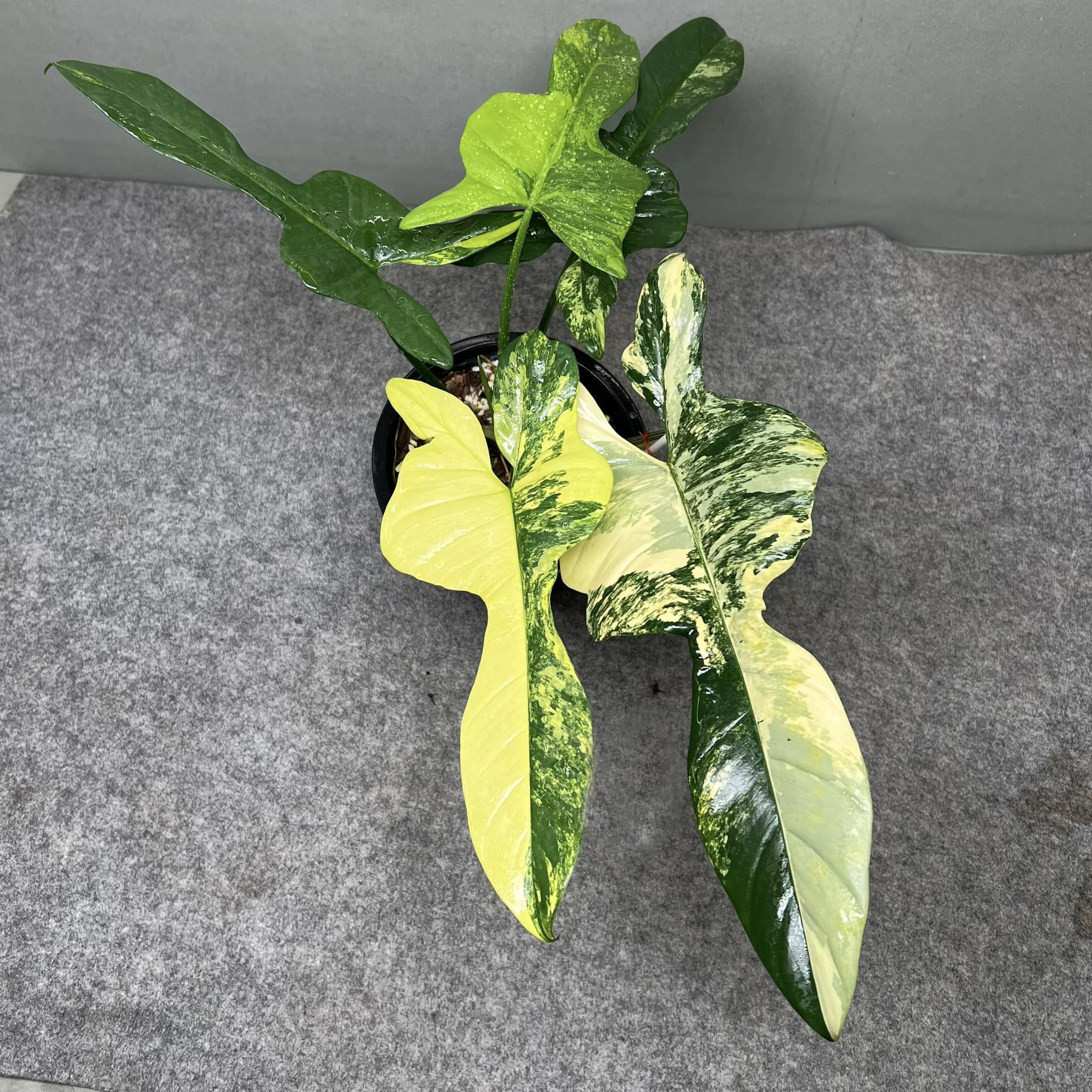
Greenboog variegated species field guide
Read a variegated Violin Philodendron from the whole vine: species-level leaf shape, node and support first; yellow-green pattern and seller name second.
This page owns variegated bipennifolium identity and care. For broader collector comparison, use the rare Philodendron guide.
Variegated bipennifolium at a glance
| Question | Evidence-led answer |
|---|---|
| Species status | Philodendron bipennifolium Schott is accepted by Kew |
| Variegated name | Horticultural/trade descriptor; no separate accepted species or verified breeder record found |
| Native range | Green species: southern Venezuela to northern and eastern Brazil |
| Habit | Wet-tropical climber; mature size depends heavily on support and growing conditions |
| Identity stack | Climbing stem, smooth petioles, progressive violin/horsehead blade shape, provenance and repeated pattern |
| Safety | Philodendron tissue contains irritating insoluble calcium-oxalate crystals |
Start with the accepted species
Kew accepts Philodendron bipennifolium Schott, first published in 1855. It is a climber native from southern Venezuela to northern and eastern Brazil. Kew describes variable blades: lower leaves may be oblong and slightly cordate, upper leaves panduriform, and uppermost leaves hastate or divided into three to five lobes.
UF/IFAS uses Horsehead and Fiddleleaf Philodendron for the green species and emphasizes its vining habit and support-dependent size. “Violin,” “Golden Violin,” “aurea” and “variegated” help describe plants in commerce, but they do not replace the accepted species identity.
Identify the vine before the variegation
One juvenile leaf may be broad and only lightly lobed. As the vine climbs, later blades can narrow at the middle and extend into the violin or horse-head outline. Use several hardened leaves, the smooth petioles, climbing stem, nodes and provenance together.
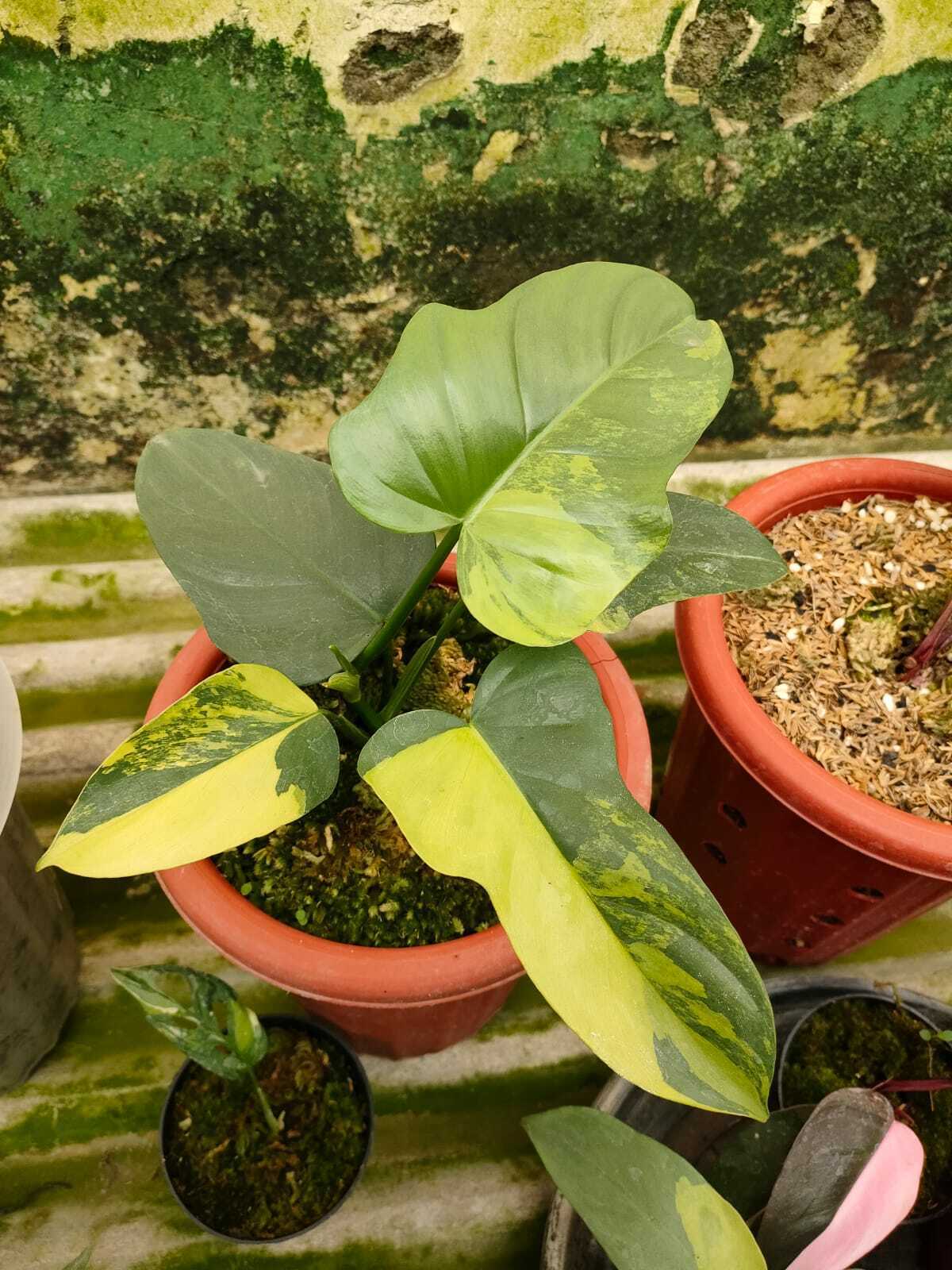
| Check | Stronger evidence | Weak evidence |
|---|---|---|
| Leaf sequence | Several leaves progress toward panduriform, hastate or 3–5-lobed form | One broad juvenile leaf |
| Stem | Traceable climbing axis with viable nodes and growth point | A detached leaf and petiole |
| Pattern | Repeated sectors or marbling assessed on hardened leaves in neutral light | A newly unfurled yellow-green leaf |
| Green tissue | Enough chlorophyll across the plant to support growth | Price based only on the palest leaf |
| Provenance | Mother-plant images and consistent seller history | “Golden Violin” used as genetic proof |
Normal hardening, stress or reversion?
New leaves can change shade as chlorophyll develops. Compare only after hardening, and track several leaves from the same growth point. A single greener leaf is not proof of permanent reversion; a yellowing leaf with declining roots is not stronger variegation.

Light supports green tissue; it does not paint a leaf
Use bright filtered light to support the plant’s chlorophyll-bearing tissue while protecting pale sectors from scorch. Low light can reduce growth and lead to longer gaps between leaves; harsh sun can create dry tan damage. Neither exposure can be used as a guaranteed colour control.
- Possible shortage: progressively smaller leaves, longer internodes, leaning and slower drying after roots are checked.
- Possible excess: bleaching or crisp patches concentrated on the exposed side.
- Safer adjustment: change filtering, distance or lamp duration gradually and judge the next two hardened leaves.
The Philodendron care guide owns the full room-level acclimation process.
Support the climbing stem
Give the vine a rigid board, pole or other vertical surface before it repeatedly bends. Tie the stem loosely and keep petioles free to orient. Guide nodes toward the support and extend it before the top becomes unstable. Mature size depends on the structure, light, roots and uninterrupted growth—not a fixed six-foot indoor maximum.
A pole can improve orientation and help maintain larger climbing growth, but it cannot guarantee a mature violin leaf or a yellow percentage. After a major cut or root setback, smaller leaves may return temporarily.
Root zone and watering
Use a draining container and a medium that holds useful moisture while returning air after watering. Bark, coarse mineral components and coco- or peat-based material can all contribute. Pot volume and particle structure matter more than a branded mix.
- Water the complete root ball and allow excess to drain.
- Learn the pot’s weight after watering and as the rooted volume approaches dry.
- Check below the surface rather than relying on a top-inch rule.
- Water again from pot weight, root-zone moisture, warmth and active growth—not a calendar.
Use the Philodendron watering guide for detailed wet-versus-dry diagnosis. Yellowing and drooping can occur with both dry roots and oxygen-starved damaged roots.
Warmth, humidity, feeding and repotting
Keep the plant warm and away from cold drafts or hot vents. Average household humidity may be workable when roots are healthy. If measured humidity is persistently low and emerging leaves stick, use a clean humidifier while maintaining airflow; routine misting is not a root-care substitute.
Feed modestly during active growth according to the label. Pause when growth slows from cold, low light or root injury. Repot when roots densely occupy the pot, the medium collapses or drainage changes. Increase size conservatively to avoid a wet, unrooted buffer.
Symptom table
| Signal | Check first | Safer response |
|---|---|---|
| One greener leaf | Hardening stage and previous growth-point sequence | Observe the next leaf; do not cut immediately |
| Several all-green leaves | Growth point, provenance, usable light and roots | Correct verified stress; cut only with a viable-node plan |
| Pale tissue turns tan | Direct exposure, heat and hydration swings | Filter light and stabilize roots; damaged tissue will not recover |
| Smaller, less lobed leaves | Support, light, roots and recent cutting | Re-establish climbing growth without forcing fertilizer |
| Distorted new growth | Inspect emerging tissue and undersides for pests | Isolate if needed and identify before spraying |
Propagation and growth-point choices
A detached leaf and petiole cannot reproduce the vine. A cutting needs stem tissue with a viable node and bud or growing point. On a valuable variegated stem, photograph the pattern around the node and preserve aerial roots. Air layering can reduce risk by developing roots before separation.
Water and airy moist media are both valid when managed for oxygen and cleanliness. The Philodendron propagation guide owns the complete top-cut, mid-cut, node and transfer workflow. No cutting position guarantees the next leaf’s colour.
Buyer checklist
- Request unfiltered whole-vine photos plus several hardened leaves.
- Verify the bipennifolium leaf progression, smooth petioles, nodes and climbing stem.
- Ask for the exact growth point and roots, not only the brightest leaf.
- Look for enough green tissue to support establishment.
- Treat clone, “natural cultivar” and guaranteed future-colour claims as unverified without records.
The Philodendron collection owns live inventory. Product pages own current format, price and availability; this page owns variegated bipennifolium identity and care.
Safety
Philodendron tissue contains insoluble calcium-oxalate crystals that can irritate the mouth and digestive tract when chewed. Keep the plant and cut material away from children and pets; contact a veterinarian or poison service after suspected ingestion.
Variegated Philodendron bipennifolium FAQ
Are Violin and Horsehead Philodendron the same species?
Both common names are widely used for Philodendron bipennifolium. Variegated and aurea descriptors refer to horticultural colour forms, not separate accepted species.
Can brighter light create more yellow variegation?
No. Bright filtered light supports existing green tissue, but it cannot guarantee or paint the next leaf’s pattern.
Why are juvenile leaves not violin-shaped?
The species has variable lower and upper leaves. Climbing support, plant age, light and roots influence progression, but no setup guarantees a deadline.
Is one greener leaf a reversion?
Not necessarily. Let it harden and compare multiple leaves from the same growth point before making a cut decision.
Can I propagate a leaf without a node?
No. A complete shoot requires viable stem, node and bud or growth-point tissue.
Sources and evidence boundaries
- Kew POWO: accepted name, range, climbing habit and leaf progression
- UF/IFAS: Horsehead/Fiddleleaf Philodendron form, support and culture
- UF/IFAS: chimera concepts and why visible pattern alone is insufficient
- Penn State Extension: healthy stock, clean tools and propagation environment
- ASPCA Animal Poison Control: Philodendron calcium-oxalate exposure