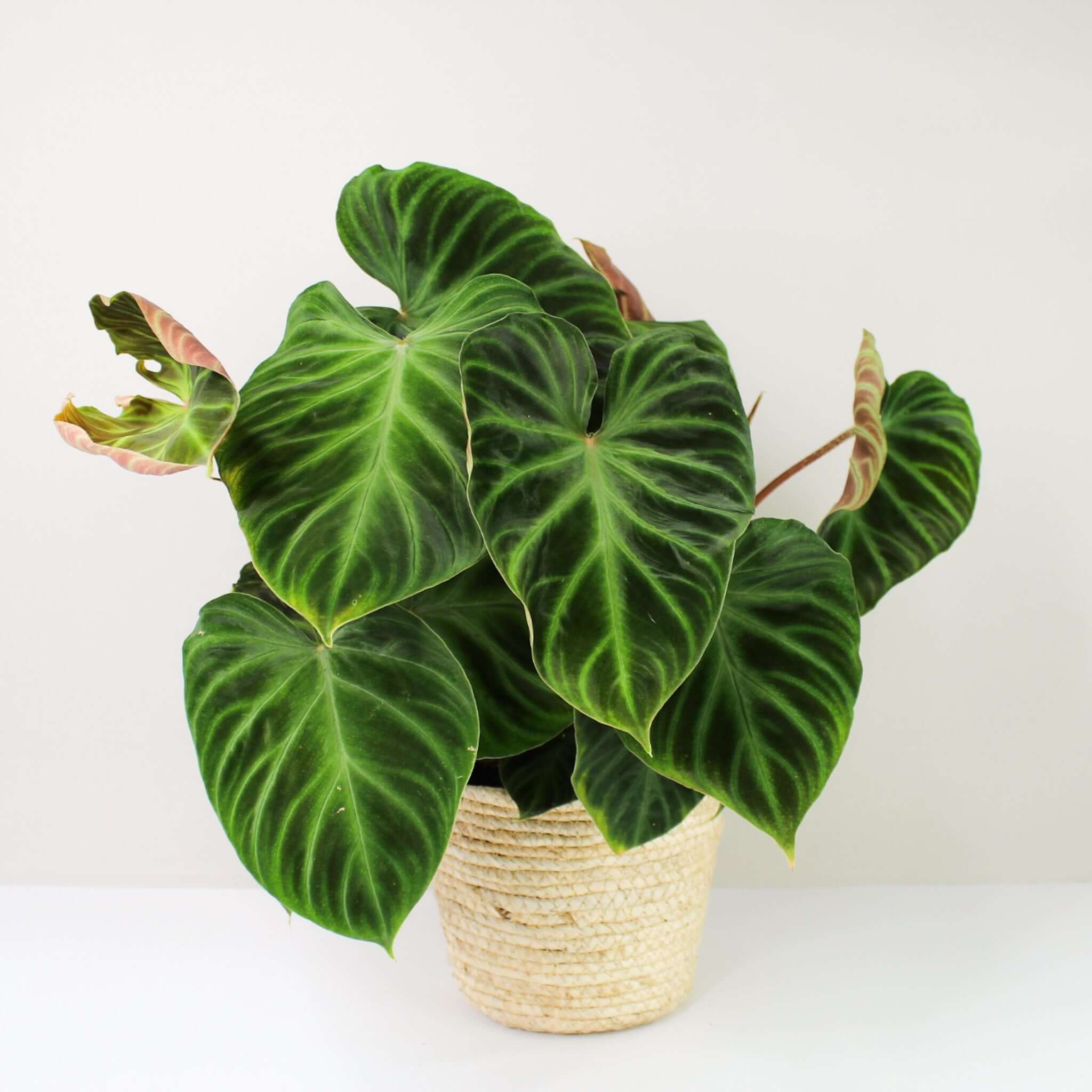
Greenboog velvet-aroid field guide
Use the climbing stem, fibrous cataphylls, velvet blade, pale veins and densely textured petiole together—then let the roots and newest leaf guide care.
Philodendron Verrucosum at a glance
| Question | Practical answer |
|---|---|
| What is it? | An accepted Philodendron species from Costa Rica to Peru, described in 1856 and adapted to wet tropical, often premontane or lower-montane forest. |
| Best identity clues? | Velvety broadly heart-shaped blade, paler major veins, scaly/setose petiole and stem, fibrous old cataphylls, climbing axis and often red-purple tones under new leaves. |
| Does it climb? | Yes. Give it a vertical support with space for nodes and aerial roots. It is not a trailing or naturally bushy hanging-basket plant. |
| How much light? | Bright diffused light after gradual acclimation. Watch the stem for stretch and the soft new leaf for heat or bleach. |
| When should I water? | When the upper root zone is drying and the pot is lighter, then saturate and drain. Do not use droop alone to decide. |
| How is it propagated? | With a stem section containing a viable node/growth point, or by air layering before cutting. A detached leaf and petiole are not enough. |
| What is Choco Red? | A horticultural trade label used for a reddish expression. It is not treated here as a formal taxonomic rank or a guaranteed mature color. |
| Is it pet-safe? | No. Philodendron contains insoluble calcium oxalates and should not be chewed. |
The accepted species and its natural range
Kew accepts Philodendron verrucosum L.Mathieu ex Schott, first published in 1856. Its native range extends from Costa Rica through Panama and northwestern South America to Peru. It is a climber of wet tropical forest, with many records from premontane and lower-montane conditions rather than one uniform lowland climate.
The botanical record describes a usually hemiepiphytic, appressed-climbing plant. Adult blades can be broadly ovate-heart-shaped with a velvety dark upper surface and paler major veins. The lower surface can carry red-purple color between the secondary veins. Stems, cataphylls, petioles and even inflorescences may bear a scaly or bristle-like covering.
A 2019 field synopsis from Cerro Pirre, Panama identifies the same combination: short internodes, subterete petioles nearly as long as the blade, broadly ovate-cordate velvet leaves and scaly-setose tissues. This multi-feature record is more useful than a seller photo edited to emphasize vein contrast.
How to identify Philodendron Verrucosum
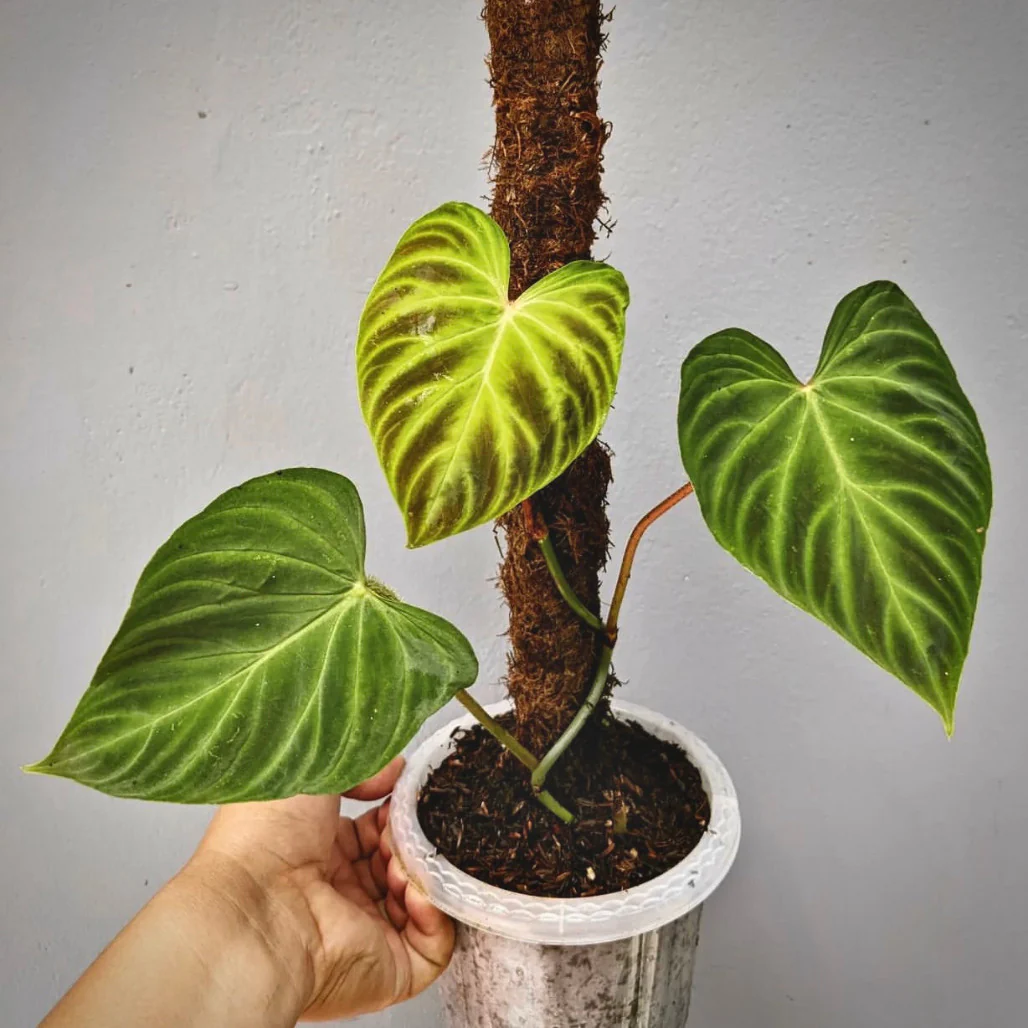
Use a set of features
- Growth axis: a climbing stem with nodes, internodes, cataphylls and aerial roots. It should be able to attach to a vertical surface.
- Blade: broadly ovate to heart-shaped, usually velvety or matte above rather than glossy and hard.
- Venation: major veins appear paler against the dark surface; the contrast changes with leaf age and light.
- Petiole and stem: scales or setose, bristle-like structures are important clues. Texture can be greenish, purple or brown.
- Cataphyll: older sheaths can persist as a tangled fibrous network around the climbing stem.
- Leaf back: new or particular forms may show purple-red color between veins, but red alone is not a species verdict.
Why a fuzzy petiole is not enough
Several Philodendron species and many horticultural hybrids have textured petioles or velvet leaves. A juvenile plant may not yet show the proportions of a supported adult. Ask for the stem, cataphyll, petiole surface, top and underside of a hardened leaf, plus the active new leaf. If only the leaf face is visible, the evidence is incomplete.
Keep Verrucosum separate from El Choco Red

El Choco Red is not a form of Philodendron verrucosum. Kew accepts it as the separate species Philodendron rubrijuvenile Croat & R.Kaufmann, first published in 2022, with Colombia as its recorded native range. IPNI explains that its name refers to the crimson lower surface usually seen on immature leaves.
| Check | P. verrucosum | El Choco Red / P. rubrijuvenile |
|---|---|---|
| Accepted status | Species published in 1856 | Separate species published in 2022 |
| Range in Kew | Costa Rica to Peru | Colombia |
| Red evidence | New lower surfaces may be red-purple | Crimson lower surface of immature leaves informs the published name |
| Petiole clue | Kew describes densely scaly petioles with two scale types | Do not infer identity from red color; inspect the actual petiole, stem and source |
Give an appressed climber a usable support
Place a plank, pole or moisture-compatible support close to the active stem. Secure the stem loosely between nodes and direct aerial roots toward the surface; never tie a soft petiole or emerging leaf. A support that is too far away forces the stem to bridge open air before it can attach.
The old advice to cut back the vine for bushiness conflicts with this architecture. One climbing axis does not become a naturally multi-vine basket because its tip is trimmed. If growth is stretched, first check light, root health and support contact. Prune to remove dead tissue, map a propagation node or restart an unmanageable stem – not on a calendar.
Light for velvet leaves
Use bright diffused light and change exposure gradually. The University of Minnesota Extension explains that low light reduces energy production and lengthens the space between nodes, while excessive light can bleach or scorch leaves. Window direction alone is not a prescription because distance, glass, curtains, season and outdoor shade all change intensity.
| Signal | Likely reading | First response |
|---|---|---|
| Long internodes and smaller new leaves | Light, support contact or root function may be limiting | Inspect roots/support, then increase diffused light in steps |
| Dry bleached patch facing the window | Heat or abrupt high-light exposure | Diffuse peak light and acclimate more slowly |
| Dark leaf but stalled stem | Color alone is not proof of adequate energy | Check root temperature, moisture, pests and total light duration |
| New leaf stuck or torn | Moisture swing, low airflow, pests or mechanical handling | Stabilize conditions and leave the emerging leaf alone |
Water the root zone, not once a week
`Moist but well-drained` describes a root-zone behavior, not constant wetness. NParks lists moist, well-drained soil and moderate water for the species. Iowa State Extension recommends checking the root ball instead of watering by weekday, saturating it fully and removing drainage water.
- Lift the pot and check the upper root zone. A dry decorative surface can hide a wet core.
- If the mix remains cool, heavy and wet, wait and preserve oxygen around the roots.
- If the upper zone is drying and the pot is lighter, soak the full root ball until runoff.
- Empty the saucer or cachepot and confirm water can leave every drainage hole.
- After droop, inspect moisture and root firmness before adding water; wet-root wilt and dry-root wilt require opposite actions. Use the Philodendron watering guide for the full wet-versus-dry diagnosis.
Verrucosum is not automatically more tolerant of drought than overwatering. Repeated severe drying can kill fine roots and damage an unfurling velvet leaf; persistent saturation removes air and encourages root decline. The useful goal is a repeatable wet-to-drying cycle matched to the actual pot.
Substrate, pot and roots
Use an open but moisture-buffered mix. Fine bark or coco chips create structure, pumice or perlite protects air space, and a smaller water-holding fraction keeps an active root system from drying instantly. Sand does not automatically make a mix airy, charcoal does not magically absorb excess irrigation, and terracotta is not universally ideal.
- Choose a pot only modestly wider than the active root mass, with unobstructed drainage.
- Use plastic or glazed containers when fast drying is the main risk; use a more porous pot only if you can keep the wet-dry cycle stable.
- Keep the lower stem above a permanently wet layer and leave room for the support.
- Repot when roots have occupied the mix, its structure has collapsed, salts have accumulated or watering becomes impossible to manage.
- After import, cutting or deflasking, avoid combining a large pot, dense mix, strong fertilizer and high light.
Temperature, humidity and airflow
Kew’s range data includes wet premontane and lower-montane forest, so `heat-loving` is too crude. Keep the plant warm and stable, but protect roots and leaves from heater blasts, cold glass, air-conditioner jets and abrupt night drops. A portable heater pointed at velvet foliage can cause more damage than a slightly cooler stable room.
Higher humidity can slow water loss while a large leaf unfurls, but there is no universal 40-50% pass mark. Read leaf edges, unfurling, pot drying and condensation together. Pair humidity with gentle air exchange; a sealed wet cabinet can still produce edema, fungal problems and pest outbreaks. Do not mist as a substitute for watering the roots.
Feeding, repotting and slowdown
Feed only while roots and leaves are actively growing. Begin with a dilute complete fertilizer and observe one or two growth cycles. Reduce concentration or frequency when tips burn, growth stops or salts crust the mix. Flush accumulated salts during normal thorough watering; spraying fertilizer residue from the leaf is not a root-zone fix.
Do not repot simply because the calendar says spring. Repot for a specific reason, keep the support stable and avoid burying healthy nodes. After root disturbance, reduce fertilizer and hold light steady until water uptake resumes. The broader Philodendron care guide covers shared genus-level routines.
Troubleshooting by symptom
| Symptom | Check first | Useful response |
|---|---|---|
| Yellow lower leaf | Root moisture, root firmness, age, recent repot | Correct the root-zone cause; one old leaf may be normal, a sequence is not |
| Droop in wet mix | Root color/odor, drainage, compacted substrate | Stop reflex watering, restore air space and remove only dead roots |
| Droop in dry light pot | Whether the root ball accepts water | Re-wet thoroughly, drain and review why it dried too fast |
| Brown crisp margin | Dry-root event, salts, heat, low humidity plus airflow | Stabilize the root cycle and environment; damaged tissue will not repair |
| Silver scars or distorted new leaf | Thrips, mites and cataphyll crevices | Isolate, inspect with magnification and treat the identified pest |
| Curling leaves | Wet/dry roots, light/heat, pests, new-leaf damage | Use the leaf-curl diagnostic guide before changing everything |
| Small leaves and long gaps | Support, total light, roots, recent cutting | Restore attachment and root function before pruning or feeding harder |
Propagation requires a viable node
A Verrucosum leaf and petiole can remain attractive for a time, but without viable stem tissue it cannot rebuild the climbing axis. Use a top or mid-stem section with a node and bud, or air-layer a node before separation. The detailed Philodendron propagation guide covers tools, rooting media and aftercare.
- Map the node, bud, aerial root and top/bottom orientation before cutting.
- Choose a healthy stem without active pest or root-collapse symptoms.
- For valuable material, air-layer while the node remains attached to the parent.
- Use a clean blade and an airy, evenly moist rooting medium.
- Provide warmth, diffused light, humidity with ventilation and patience.
- Wait for active roots and new growth before increasing pot size or fertilizer.
Penn State Extension defines a node as the stem area where a leaf or bud attaches and describes both stem cuttings and air layering. A rooted cutting remains juvenile; mature leaf size and vein contrast return through healthy supported growth, not instantly.
Tissue-culture acclimation: verify the species first
UF/IFAS describes Stage IV micropropagation as acclimatization, the transition from protected in-vitro conditions to potting mix and ordinary atmosphere. A plantlet’s first job is to establish functional roots and leaves, not prove a mature red-back expression.
- Confirm whether the purchase is sealed in vitro, freshly deflasked or already hardened.
- If deflasking, remove gel gently and discard tissue with obvious rot.
- Use a small clean container and pre-moistened airy medium.
- Begin with protected humidity, warmth, modest light and some ventilation.
- Increase ventilation and light in steps only when leaves remain firm and roots are active.
- Delay strong fertilizer, a large pot and repeated handling until growth is stable.
A listing that combines “Verrucosum” and “Choco Red” needs separate identity verification because the names now refer to two accepted species. The live Philodendron collection owns current format and availability details. Tissue culture alone does not guarantee a disease-free or true-to-type mature plant; evaluate the batch, acclimation stage and actual plant evidence.
Buyer checks for established plants
- Identity views: request the stem, petiole surface, top and underside of a hardened leaf, cataphyll and newest leaf.
- Actual plant: ask whether the photo shows the exact plant or representative stock.
- Support history: check whether it has been climbing or recently cut from a support.
- Roots: ask whether it is rooted, freshly imported, recently repotted or still acclimating.
- Growth point: verify a viable bud on a cutting; do not buy a leaf-only piece as a propagatable plant.
- Format: compare established sizes and tissue-culture stages on actual root, leaf and transition condition rather than assuming pot size alone predicts maturity.
Pet and handling safety
Philodendron is not pet-safe. The ASPCA lists Philodendron varieties among plants containing insoluble calcium-oxalate raphides. Chewing can cause mouth pain, drooling, retching, vomiting and, more rarely, swelling that interferes with swallowing or breathing. Keep the plant out of reach and contact a veterinarian or animal poison service after a concerning exposure.
Sources and evidence
- Kew POWO: Philodendron verrucosum – accepted name, publication, range, habitat and morphology.
- Ortiz et al., Check List 15 (2019) – field identification and montane occurrence.
- NParks Singapore: Philodendron verrucosum – habit, petiole/blade morphology, root-zone and propagation summary.
- Kew POWO: accepted Philodendron rubrijuvenile record – species boundary for El Choco Red.
- IPNI: Philodendron rubrijuvenile – publication and name etymology.
- RHS: Philodendron verrucosum – accepted horticultural profile.
- University of Minnesota Extension: indoor-plant lighting.
- Iowa State Extension: condition-based houseplant care.
- Penn State Extension: nodes, cuttings and air layering.
- UF/IFAS EP520: tropical-foliage micropropagation and acclimation.
- ASPCA: Philodendron calcium-oxalate exposure.
Evidence note: Verrucosum, its range and morphology are well documented. El Choco Red is now separated as the accepted species Philodendron rubrijuvenile; a seller label combining both names needs identity evidence rather than repetition as taxonomy.