
Greenboog taxonomy-first collector guide
A red leaf back is a useful clue, not a complete identification—and it is not a color target to force with sun, fertilizer or humidity.
The taxonomic and care facts that should frame every later decision.
| Question | Evidence-led answer |
|---|---|
| Accepted name | Philodendron rubrijuvenile Croat & R.Kaufmann |
| Horticultural name | Philodendron El Choco Red / El Chocó Red |
| Published | 2022 in Aroideana 45(1): 214 |
| Native range | Colombia according to Kew; exact provenance should not be narrowed to Chocó as fact |
| Red feature | Immature lower leaf surfaces are usually crimson; color can lessen with maturity |
| Care baseline | Bright filtered light, warm stability, airy mix and thorough watering after partial drying |

What is the accepted name of El Choco Red?
Kew’s Plants of the World Online accepts Philodendron rubrijuvenile Croat & R.Kaufmann and records its first publication in 2022. “El Choco Red” predates the botanical description in cultivation, so collectors will continue to encounter both names. A precise listing can show them together: Philodendron rubrijuvenile (El Choco Red).
The International Plant Names Index record explains the epithet rubrijuvenile from Latin elements for red and young, referring to immature leaves that are usually crimson on the lower surface. This corrects a common shortcut: the plant is not defined by permanently red upper leaf surfaces.
Does it really come from the Chocó region?
Kew supports a native range of Colombia. That does not establish the Chocó bioregion as the exact origin. A later Aroideana taxonomic discussion notes that the species was described from cultivated material long known as El Chocó Red and says it is tentatively thought to originate in Colombia’s Cundinamarca department—well east of the Chocoan bioregion.
“Tentatively” is the important word. The safe public statement is Colombia, with precise wild provenance unresolved in the sources cited here. The trade name is not a collection record.
How to identify Philodendron El Choco Red
Greenboog’s first-party plants show broad cordate blades with a dark green, velvet-looking upper surface and prominent lighter veins. A juvenile leaf can display a wine-red to crimson underside. As leaves mature, the red can fade or become less complete, so loss of vivid color is not automatically a health problem or a wrong plant.
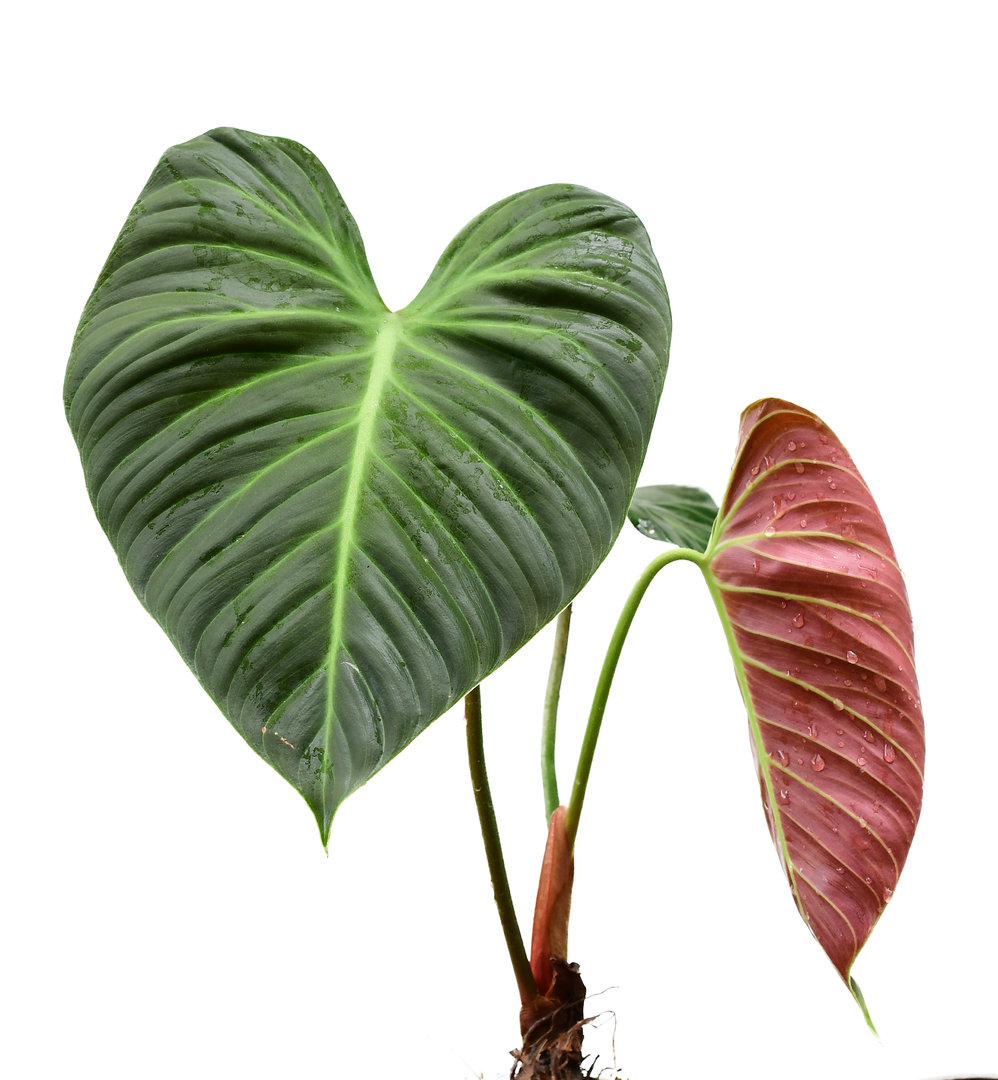
- Upper surface: green, broad and heart-shaped, with visible venation and a soft/velvety visual texture.
- Lower surface: strongest crimson coloring is expected on immature foliage; compare several ages.
- New growth: observe cataphyll, petiole, node and developing leaf together rather than matching color alone.
- Growth structure: inspect internodes and the active stem before deciding how to support or propagate it.
- Provenance: a documented source and consistent mature plant are stronger evidence than a seller title or one edited photo.
El Choco Red vs Philodendron verrucosum
Both can present green velvet-looking cordate leaves and reddish color below, so the red underside alone is not diagnostic. Kew’s description of Philodendron verrucosum emphasizes densely scaly petioles with two types of scales. Compare petioles, stems, leaf shape across ages and provenance.
This is a screening aid, not a remote botanical determination.
| Check | El Choco Red / P. rubrijuvenile | P. verrucosum |
|---|---|---|
| Accepted status | Accepted species published in 2022 | Accepted species published in 1856 |
| Red evidence | Immature lower leaf surface is central to the published name | New lower surfaces can also be purple-violet or red tinged |
| Petiole clue | Do not infer from color; inspect the actual petiole, stem and source | Kew describes densely scaly petioles |
| Can one photo prove it? | No | No |
Light: keep velvet foliage functional
Start with bright indirect or filtered light. The Royal Horticultural Society’s Philodendron guide recommends bright indirect light and gradual protection from direct summer sun. A plant arriving from a box, humid propagation cabinet or shaded nursery needs acclimation before stronger exposure.
Low light may keep a plant alive while reducing growth rate and leaf size. Harsh unacclimated light can bleach or scorch the upper surface. Do not chase a red underside by moving the plant abruptly into sun; juvenile color is an age-related identity feature, not a light-setting target.
Water from root-zone evidence
Check below the surface and learn the pot’s wet and dry weight. When the upper root zone has dried somewhat and the container is noticeably lighter, water the whole root ball until excess drains; empty the saucer. Do not keep the mix continuously saturated, and do not let a fine-rooted or newly acclimated plant dry hard.
Build a loose, moisture-balanced mix using a quality potting or coco/peat component plus coarse bark and mineral aeration such as perlite or pumice. Adjust it to the room: warm, bright airflow dries faster than a cool, dim shelf. A pot only modestly larger than the healthy root mass makes moisture easier to control.
Temperature, humidity and airflow
Keep the plant warm and stable. RHS advises keeping Philodendrons above 15°C/59°F and away from radiators and cold drafts. Higher humidity can reduce water loss from new leaves, but humidity is not a substitute for healthy roots and airflow. Routine misting changes the room briefly and can leave foliage wet; measure conditions and use a room humidifier if needed.
Feeding, support and repotting
Feed only during active growth and follow the product label conservatively. Do not fertilize a dry, rotting, recently shipped or freshly repotted root system to force a larger or redder leaf. Salt injury, root loss and excess light can produce overlapping symptoms.
Repot when roots are crowded, the medium has collapsed or water no longer moves evenly—not automatically every two or three years. Give a board or pole if the stem lengthens and the plant becomes unstable; do not force a small acclimating plant onto an oversized wet support system.
How to propagate El Choco Red
A complete new plant needs viable stem with a node and growth point. A detached leaf may remain decorative or form roots in some circumstances, but it is not a dependable complete-plant cutting without a bud. Likewise, “divide the roots” is unsafe advice for a single-stem specimen without independent growth points.
- Start with a hydrated, pest-free plant in active growth.
- Expose enough stem to locate the node and axillary bud before cutting.
- Use a clean sharp blade and clean work surface.
- Root in clean, airy, lightly moist medium under warmth and bright indirect light.
- Maintain humidity with airflow; do not bury or seal the stem in saturated media.
- Pot up after roots branch and new growth is stable.
Penn State Extension describes nodes as the points where leaves or buds attach and recommends healthy stock, clean tools and media. Its stem-cutting guidance places at least one node in the rooting medium, where roots can form.
Troubleshooting by pattern
Start with leaf age, roots and recent change before treating.
| Pattern | Check first | Do next |
|---|---|---|
| Red fades on older leaf | Leaf age and health of new growth | Treat age-related change as normal unless other symptoms appear |
| Yellow lower leaves; wet mix | Roots, drainage, pot size and temperature | Restore oxygen; remove only confirmed rot; do not fertilize |
| Pale window-side patches | Recent light increase or hot glass | Return to filtered light and acclimate gradually |
| Brown edges | Dry root ball, salts, root damage and hot/dry airflow | Correct measured cause rather than misting by default |
| Curled new leaf | Roots, humidity swing, thrips, mites and trapping | Use the leaf-curling diagnostic before spraying |
| Small leaves; long spacing | Usable light, roots and support | Improve one limiting factor and reassess new growth |
Inspect leaf backs, petiole bases and fresh growth for thrips, mites, scale and mealybugs. Quarantine new arrivals. Treat an identified pest only with a product legally labeled for that use and follow the label exactly.
Safety around pets and children
Treat El Choco Red as unsafe to chew. ASPCA Animal Poison Control explains that Philodendron tissue contains insoluble calcium oxalate crystals that can cause oral irritation, drooling, retching, vomiting and, in severe cases, swallowing or breathing difficulty. Keep leaves, sap, cuttings and pot debris out of reach; contact a veterinarian or local poison-control service after an exposure.
What to check before buying
- Does the invoice use the accepted identity P. rubrijuvenile, the horticultural name, or both?
- Is the image the exact plant, a current batch example or a mature reference plant?
- Can you see the upper and lower surfaces of more than one leaf, plus petioles, stem and active growth point?
- Is the offer a rooted potted plant, cutting or acclimated/unacclimated tissue-culture plantlet?
- Are root condition, pests, temperature protection, phytosanitary paperwork and arrival terms documented?
Use the rare Philodendron comparison hub for a broader buyer-evidence framework. Greenboog’s potted El Choco Red page owns current stock, format and transaction details. The El Choco Red × Billietiae variegated hybrid is a separate hybrid offer and should not be represented as the pure species.
FAQ
Is El Choco Red a real species?
Yes. Kew accepts Philodendron rubrijuvenile Croat & R.Kaufmann, first published in 2022. El Choco Red is the horticultural name long used for the plant.
Are El Choco Red leaves always red?
No. The published name refers to immature leaves that are usually crimson on the lower surface. Mature foliage can lose much of that red; the upper surface is green in Greenboog’s plants.
Is it native to Chocó, Colombia?
The confirmed range in Kew is Colombia. A taxonomic discussion tentatively points to Cundinamarca and notes that this is well east of the Chocoan bioregion, so “native to Chocó” should not be repeated as established fact.
How can I tell it from Philodendron verrucosum?
Do not use a red leaf back alone. Kew describes P. verrucosum petioles as densely scaly; compare petioles, stems, foliage across ages and provenance. A photograph may still be insufficient for a firm identification.
How often should I water El Choco Red?
There is no safe universal interval. Check moisture below the surface, pot weight, root mass, light and temperature; water thoroughly after the upper root zone has dried somewhat, then drain.
Can I propagate it from one leaf?
Not reliably. A complete new plant requires viable stem with a node and growth point.
Is Philodendron El Choco Red pet-safe?
No. Treat it as toxic if chewed because Philodendron tissue contains insoluble calcium oxalate crystals.
Sources and evidence boundaries
- Kew POWO: accepted P. rubrijuvenile name and Colombia range
- IPNI: publication and epithet evidence
- Aroideana: cultivated history and tentative provenance discussion
- RHS: genus-level light, temperature and watering
- Penn State Extension: humidity and misting limits
- Penn State Extension: healthy stock, nodes and clean propagation
- ASPCA Animal Poison Control: calcium-oxalate exposure

You never said anything about the blooms? I have regular Living Room conditions. I have three absolutely gorgeous blooms. Self watering pot, 3 parts Aroid Mix, 1 part soil, Foliage Pro. I do dump water from boiled eggs once a month