Greenboog variegated-cultivar field guide
Judge Strawberry Shake from a sequence of leaves, stem color and growth points—then protect the plant’s green tissue instead of chasing a guaranteed amount of pink.
Compare its role in the wider collection through Greenboog’s rare Philodendron varieties guide. This article owns Strawberry Shake identity, color-change literacy and care.
Strawberry Shake at a glance
| Question | Evidence-led answer |
|---|---|
| Name type | Horticultural cultivar/trade label; not an accepted wild-species binomial |
| Useful identity stack | Climbing stem, red petioles/stem, several hardened leaves and repeating multicolor variegation |
| Unresolved history | Breeder, exact parentage and the precise Red Emerald relationship were not confirmed |
| Light goal | Enough bright indirect light for compact growth and usable green tissue, without bleaching pale sectors |
| Watering goal | Even hydration followed by a reliable return of air to the rooted volume |
| Safety | Philodendron tissue contains irritating calcium-oxalate crystals |
Identify the plant, not the milkshake colors
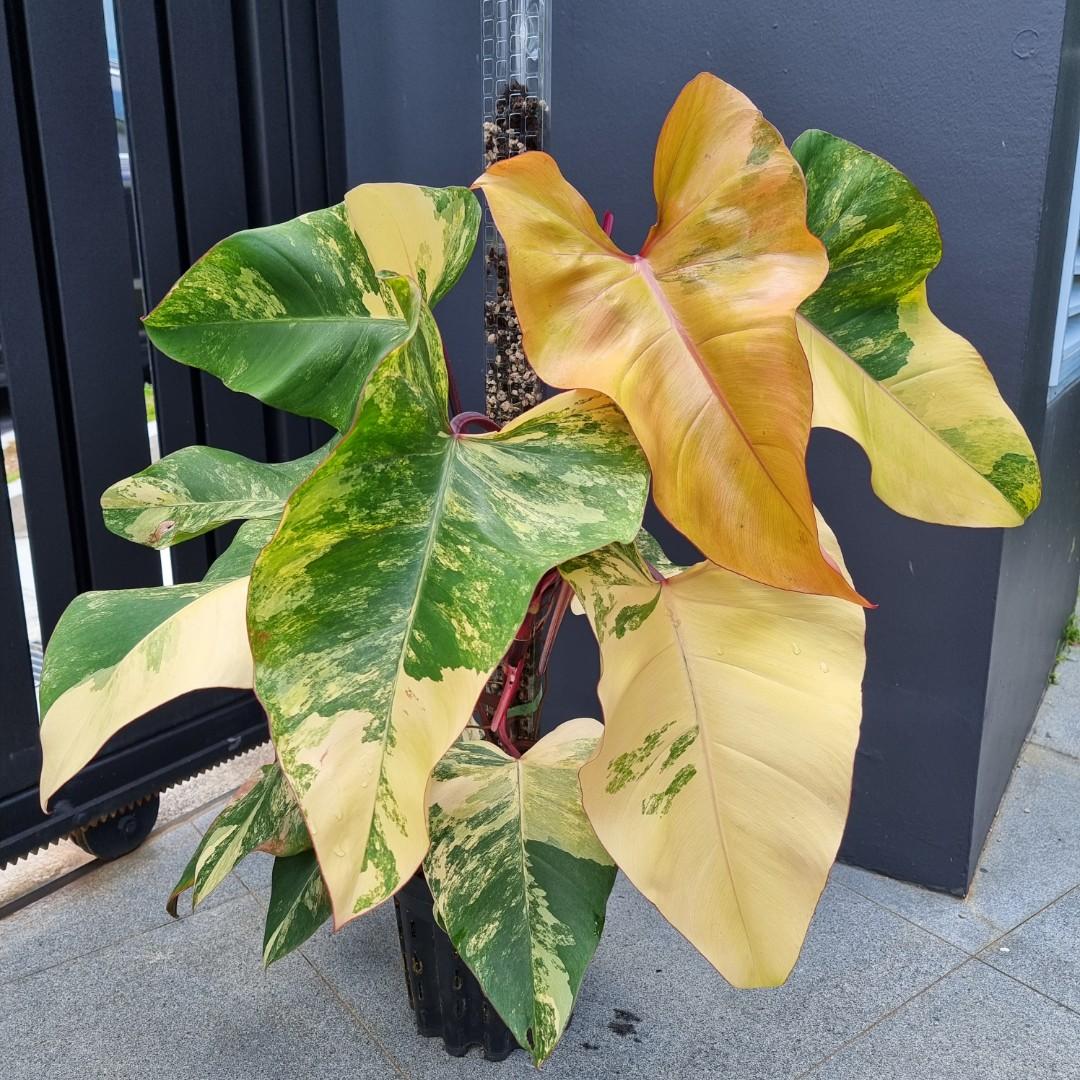
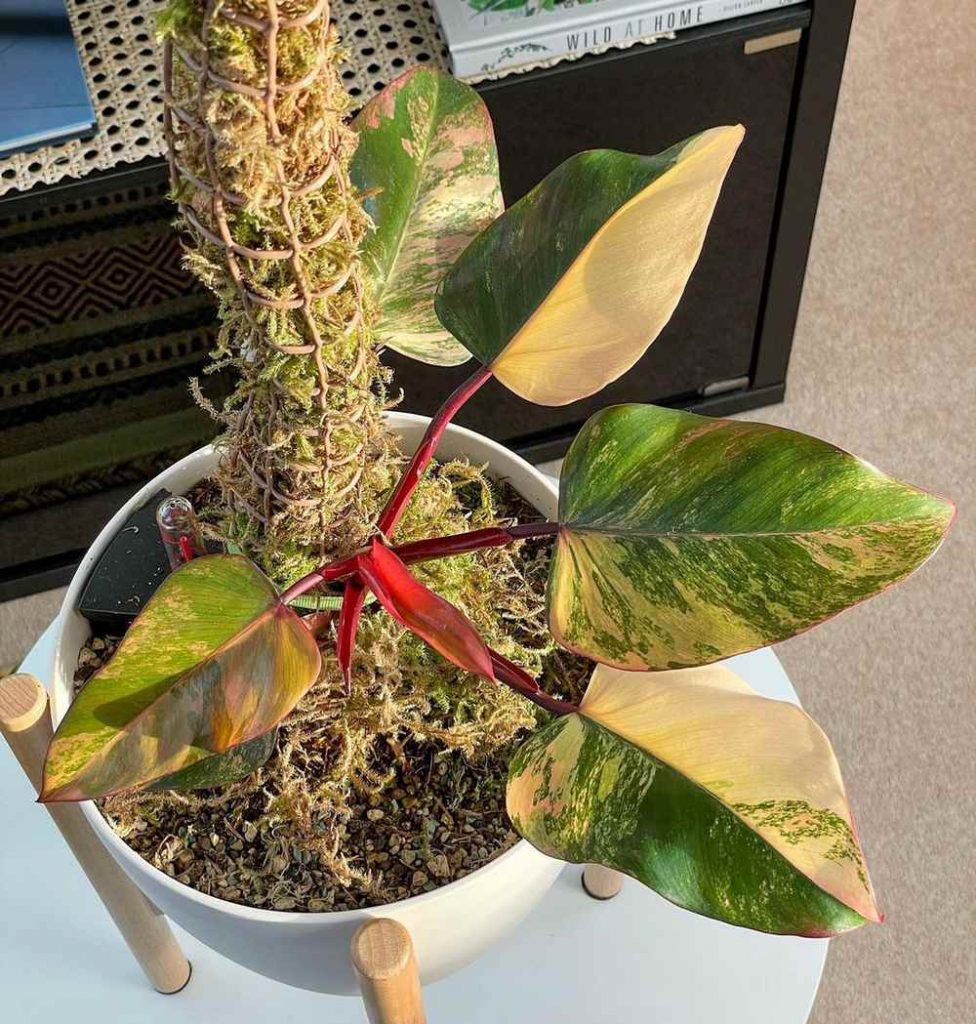
Color names are memorable but weak on their own. A newly opening leaf can look coppery or peach and then harden toward cream, yellow or green. Camera white balance and strong nursery light can also shift pink and red. Use several leaves in neutral light plus the climbing stem and red petioles.
Strong and weak evidence
| Check | Stronger evidence | Weak evidence |
|---|---|---|
| Leaf sequence | Several hardened leaves show changing green/cream/yellow/peach patterning | One pink new leaf photographed under warm light |
| Stem | Traceable climbing stem with red-toned petioles, nodes and growth points | A detached leaf or rooted petiole |
| Provenance | Current whole-plant photos and a documented mother plant | “Rare,” “high var” or “Red Emerald” text alone |
| Health | Firm roots and active mixed-green growth | A very pale plant assumed to be more valuable regardless of vigor |
Pink Princess may share red-toned stems and pink areas, but its pattern and trade history are separate. The Pink Princess guide owns that comparison target; do not rename either plant from color alone.
What variegation can—and cannot—tell you
Variegation has more than one biological cause. UF/IFAS explains that some ornamental variegation is chimeral, with genetically different cell layers in a growing tip, while other patterns have different causes. Chimeral growth can shift toward all-green or all-nonpigmented shoots. That general biology explains why a pattern can be unstable; it does not prove the exact mechanism in every Strawberry Shake clone.
Pale tissue contains less chlorophyll and contributes less photosynthesis than green tissue. Protect useful green area. An almost cream shoot is not automatically “better,” and an established green-bearing leaf may be supporting the plant while new growth hardens.
- Do not promise color: a photographed node cannot guarantee the next leaf’s sector balance.
- Do not blame every green leaf on low light: inspect the continuing stem and multiple growth points before deciding a shoot has reverted.
- Do not cut immediately: first confirm active roots and trace where colored and green tissues appear along the stem.
Light supports growth; it does not paint the next leaf
Give bright indirect light and adjust gradually. The goal is compact growth and enough energy for both green and pale tissue. Harsh direct exposure can bleach or scorch cream and pink sectors, while very low light can reduce growth and stretch the stem.
- Possible insufficient light: long internodes, slower growth and smaller leaves after root health is checked.
- Possible excess exposure: crisp or bleached damage concentrated on the window-facing pale tissue.
- Better test: change distance, filtering or lamp duration modestly, then assess the next two hardened leaves.
Use the Philodendron care guide for room-level light and acclimation methods.
Support the climbing stem early
Strawberry Shake is handled in cultivation as a climbing Philodendron. Give the stem a stable board, pole or trellis before it sprawls. Tie the stem loosely, leave petioles free to orient their leaves and guide aerial roots toward the support when practical.
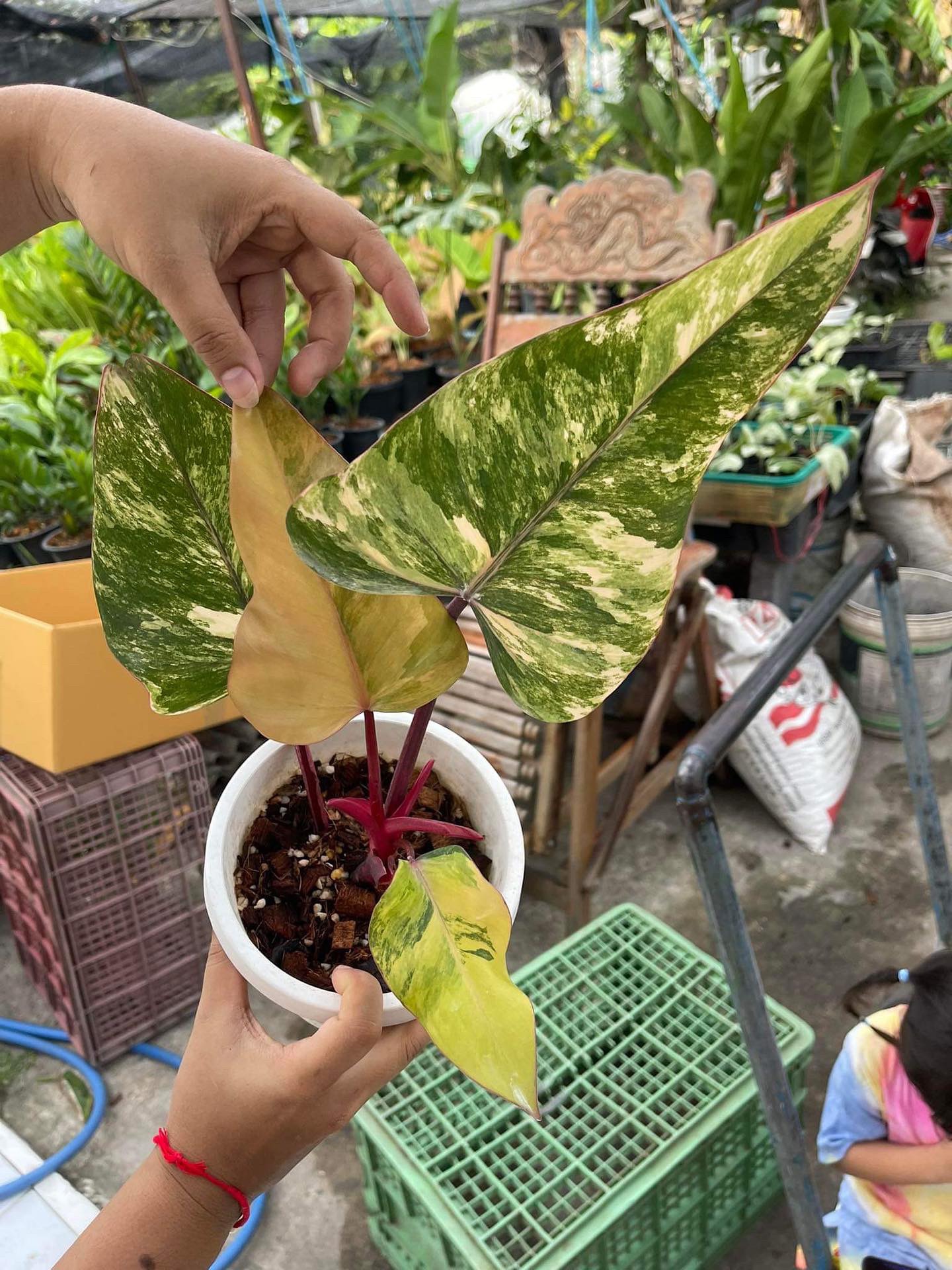
Support contact can make the plant easier to manage and observe; it cannot manufacture variegation. If a stem leans away from the support, rotate the pot gradually and retie only the stem.
Build an airy, evenly hydrated root zone
Use a pot with open drainage and a medium that holds some moisture while regaining air after watering. Bark, coarse mineral material and coco- or peat-based components can all work. What matters is the behavior of the complete pot in your light and temperature—not a universal ingredient list.
Water from the rooted volume
- Learn the pot’s weight after a thorough watering and full drainage.
- Check moisture below the decorative surface, where roots actually occupy the medium.
- Water when much of the rooted volume is approaching dry, then let excess escape.
- If the pot remains heavy unusually long, inspect compaction, oversized unrooted volume, lower light and root condition before adding more.
The Philodendron watering guide owns detailed wet-versus-dry checks. Yellowing does not prove overwatering, and drooping does not prove thirst; either can occur when roots are damaged.
Temperature, humidity, feeding and repotting
Keep conditions warm and stable, away from cold drafts and hot vents. Humidity can slow water loss in a dry room, but a fixed percentage does not replace healthy roots and airflow. Use a measured humidifier when genuinely needed; routine misting is brief surface wetting and can leave crowded growth damp.
Feed modestly while active growth is using water and producing leaves, following the label. Stop and inspect if growth has slowed from low light, cold or root damage. Repot when roots densely occupy the pot, drainage behavior changes or the medium has collapsed—not automatically each spring. Move up conservatively to avoid a wet buffer around a small root system.
Troubleshoot before pruning variegation
| Signal | Check first | Safer response |
|---|---|---|
| One greener leaf | Following nodes, stem pattern, light history and root health | Wait for a sequence; one leaf does not prove permanent reversion |
| Repeated all-green growth | Which growth point is active and whether colored stem tissue remains below | Plan any cut from node anatomy and preserve backup material; color is not guaranteed |
| Very pale new shoot | Remaining green leaf area, vigor and root function | Keep healthy green-bearing leaves and avoid compounding stress |
| Brown pale sectors | Direct exposure, salts, root hydration, heat and recent move | Stabilize the confirmed cause; damaged tissue will not recolor |
| Curling or drooping | Moisture at root depth, pests, heat load and root firmness | Treat the diagnosis, not the color or symptom name |
Propagate from a mapped node
A leaf and petiole without viable stem tissue cannot rebuild this climbing plant. Penn State Extension defines the node as the stem area where a leaf or bud attaches. For a variegated plant, also photograph the stem and growth point before cutting so the color history is not lost.
- Choose healthy, pest-free stem with a clearly visible node and active growth potential.
- Use a clean, sharp blade and leave enough stem to protect the node.
- Root in clean water or an airy medium kept moist rather than saturated under bright indirect light.
- Pot on after roots branch and new growth confirms that the cutting functions.
Vegetative propagation preserves more of a cultivar’s source history than an unsupported “variegated seed” claim, but it still cannot promise the exact next pattern. See the Philodendron propagation guide for method and aftercare details.
Buyer checklist
- Request current, unfiltered photos of the entire plant, stem and newest growth point.
- Compare several hardened leaves rather than the brightest new leaf.
- Inspect roots, nodes and the proportion of healthy green-bearing tissue.
- Ask whether the plant is a rooted cutting, established plant or recently acclimated tissue culture.
- Treat “Red Emerald,” “high var” and color promises as claims requiring provenance.
The Philodendron collection owns current availability. Product pages own the live offer; this guide owns identity, care and buyer evidence.
Safety
ASPCA explains that Philodendron tissue contains insoluble calcium-oxalate raphides that can cause oral pain, drooling, retching and vomiting when chewed. Keep plants, cuttings and sap away from children and pets. Contact a veterinarian or poison service after suspected ingestion, especially when swallowing or breathing is affected.
Strawberry Shake FAQ
Is Strawberry Shake the same as Red Emerald variegated?
That relationship is repeated inconsistently in horticultural trade, but a primary cultivar record was not confirmed here. Use Strawberry Shake as the practical label and preserve the seller’s provenance.
Can brighter light make the next leaf pink?
Better light can support compact, healthy growth, but it cannot guarantee the position or color of variegated tissue in the next growth point.
Has my plant reverted after one green leaf?
Not necessarily. Inspect several following nodes and the active stem. A repeated all-green shoot is stronger evidence than one leaf.
Should I cut off a mostly cream leaf?
Do not cut only because it is pale. Assess the whole plant’s green area, vigor and root condition. Preserve healthy green-bearing leaves while a pale shoot hardens.
Can a leaf without a node propagate Strawberry Shake?
No complete new climbing plant can develop without viable stem growth-point tissue. Use a mapped node and clean tools.
Evidence notes
General Philodendron care: NC State Extension. Variegation biology: UF/IFAS propagation education and University of Minnesota Extension; these sources describe general mechanisms, not confirmed Strawberry Shake parentage. Propagation: Penn State Extension. Safety: ASPCA. The exact breeder, parentage and Red Emerald relationship remain unresolved in the reviewed primary layer.