Cultivar identity, connected-leaf evidence and measured climbing care
Philodendron ‘Jose Buono’ is a horticultural name for a climbing variegated Philodendron. The cream-to-pale-green pattern is recognizable in cultivation, but the name does not provide a verified wild origin, parent formula or species assignment. Read several connected leaves, the stem and the plant’s provenance together.
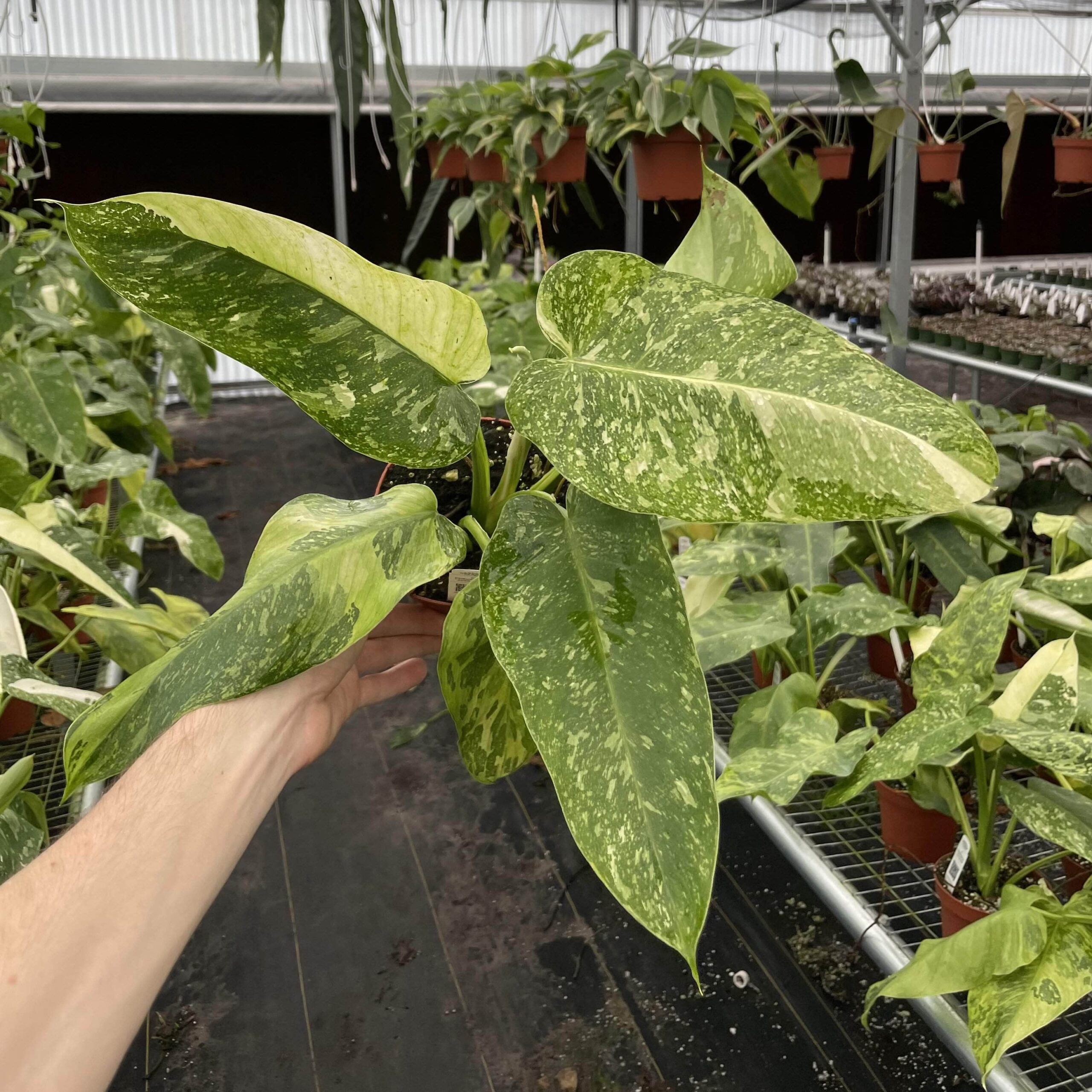
What the Jose Buono name proves
Jose Buono is established in horticultural trade as a variegated climbing Philodendron. Fairchild Tropical Botanic Garden describes the cultivated plant with large green, cream and white leaves and recommends support for its climbing habit. That is useful horticultural evidence, not a formal species diagnosis.
Some nursery lists place the name under Philodendron imbe ‘Variegata’; other trade records have associated it with Domesticum. Kew accepts P. imbe as a Brazilian wet-tropical climber, but Kew does not connect that species record to a verified Jose Buono clone. Without a traceable mother plant or primary breeder record, the careful label remains Philodendron ‘Jose Buono’.
Keep common and Texas Jose Buono separate
The International Aroid Society’s cultivar registry has a distinct accepted entry for ‘Texas Jose Buono’. It records unknown parents, a Texas cultivation history and rigid elongated arrowhead-like leaves with yellow variegation. The registry explicitly contrasts it with the more common Jose Buono, which has darker green foliage with lighter variegated splashes.
That entry should not be borrowed as the history of every Jose Buono. It gives collectors a comparison boundary: a seller using “Texas” should supply lineage and mature reference photos, not merely a particularly yellow common specimen.
| Evidence | Useful conclusion | Limit |
|---|---|---|
| Connected Greenboog leaves | Cultivated Jose Buono appearance and pattern variation. | Not breeder or species proof. |
| Texas Jose Buono registry | A separate named cultivar with its own recorded history. | Not the origin of common Jose Buono. |
| P. imbe record | An accepted Brazilian wet-tropical climbing species. | No verified clone-to-species link here. |
| Marketplace label | A seller’s claimed identity. | Needs whole-plant and lineage support. |
Identify the connected plant, not one leaf
Greenboog’s established specimens show elongated blades with basal shoulders, pointed tips and irregular cream-to-pale-green speckling, marbling or larger sectors over dark and medium green. Juvenile leaves may be simpler, and a new leaf can change colour as it hardens.
Follow the blade back through its petiole to a visible node and growth point. Then compare an older leaf, a hardened recent leaf and the newest growth. Repeated structure and pattern on one stem are stronger than a detached cutting or image-search match.
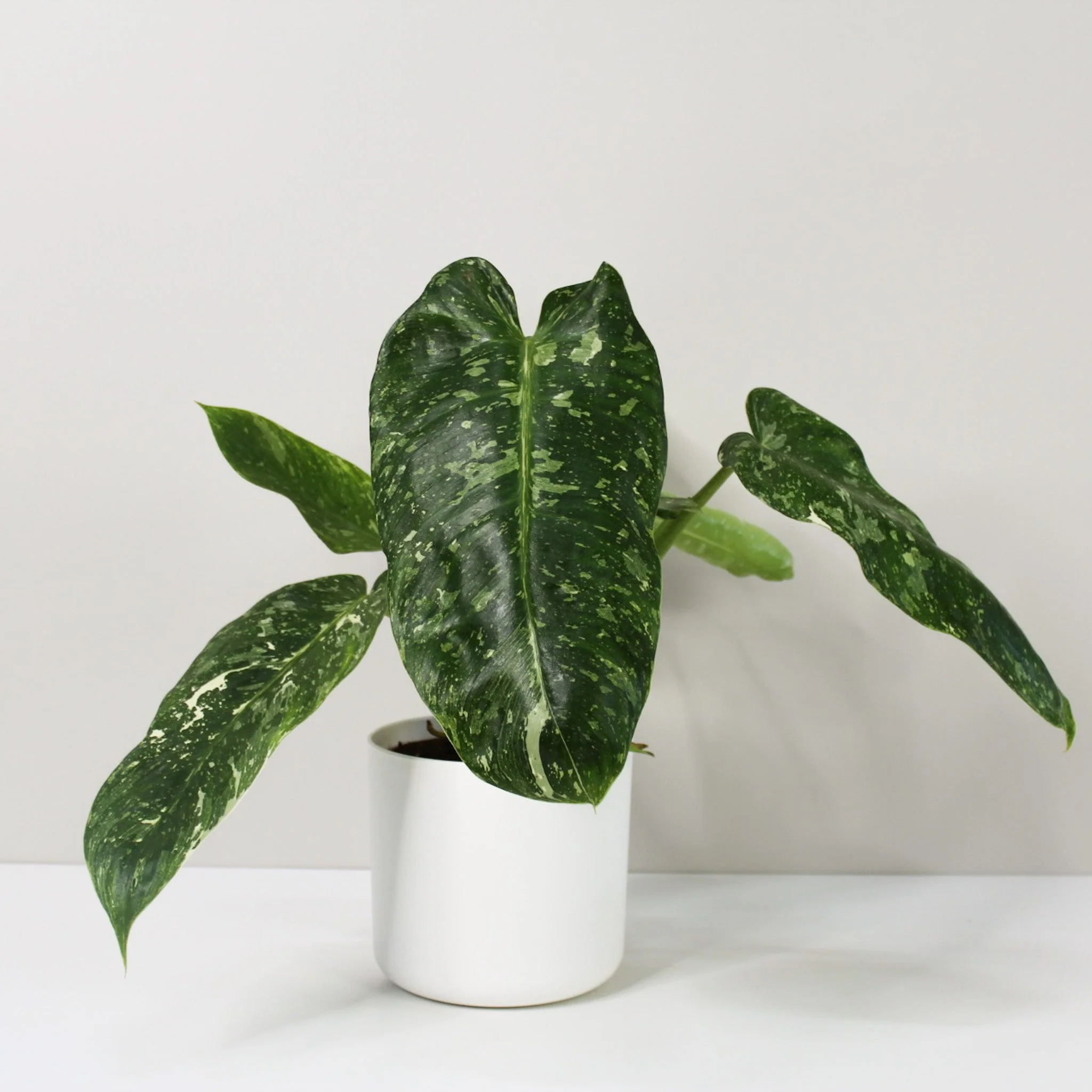
Variegated Domesticum can overlap in juvenile photos. Use the variegated Domesticum guide to compare its spade-leaf trade identity and separate taxonomy boundary rather than treating the names as interchangeable.
Light supports growth; it cannot promise a pattern
Start with bright filtered light and change exposure gradually. Green tissue supplies most of the leaf’s photosynthetic capacity, so a plant with broad pale sectors has less margin for abrupt sun, heat or weak roots. Low light may produce smaller leaves, longer gaps and slower drying; harsh exposure can create tan, crisp injury on the brightest side.
Do not move the plant into direct sun to “force” variegation. Light can support a healthy growth point, but it cannot guarantee the amount or placement of cream on the next leaf. Judge changes across several hardened leaves after the roots and support are stable.
Support the active stem and protect the root zone
Place a pole or plank beside the active stem. Tie stem tissue loosely and leave petioles free. Guide new flexible growth first; forcing an older hardened stem can damage nodes. Aerial roots need contact near the stem, not a decorative pole positioned across the pot.
Use an open, well-drained mix that still retains useful moisture and a container only modestly larger than the functional roots. Water the rooted volume thoroughly, allow excess to drain and check moisture below the decorative surface before watering again. Pot size, medium, root mass, light, warmth and airflow determine the interval; “once a week” and “dry the top inch” are not universal rules.
Keep the plant warm and away from cold drafts. Feed modestly during active rooted growth. More fertilizer cannot repair root loss or create variegation. The Philodendron care guide owns deeper room-level adjustments.
Diagnose the pattern before changing care
| Signal | Check first | Measured response |
|---|---|---|
| One greener leaf | Hardening stage and the previous growth-point sequence. | Observe later leaves before cutting. |
| Several all-green leaves | Same stem, viable node positions, roots and light trend. | Correct verified stress; cut only with a growth-point plan. |
| Pale tissue turns tan | Recent sun, heat and hydration change. | Filter exposure and stabilize root moisture. |
| Whole leaf yellows | Root texture, pot weight, age and nutrition history. | Separate chlorosis from variegation before treatment. |
| Distorted new growth | Growth point, leaf undersides, thrips, mites and roots. | Isolate and identify before stacking sprays. |
Propagate a viable node and preserve the evidence
A leaf and petiole cannot restart a Philodendron vine. A cutting needs viable stem tissue with a node and usable bud or growth point. Photograph the mother plant, stem pattern and leaf sequence before cutting; that evidence travels with the new plant.
- Choose a healthy node with enough stem and green tissue.
- Use clean tools and preserve aerial roots where practical.
- Keep the base warm, airy and moist rather than saturated.
- Pot only after functional roots can support the shoot.
- Judge variegation over later growth, not the cutting’s single leaf.
Use the Philodendron propagation guide for top-cut, mid-cut and transfer decisions. Tissue-culture plantlets require a separate acclimation stage; a selected batch still cannot promise that every plant will mature with identical pattern.
Buyer checklist
- Ask whether photos show the exact plant, representative stock or a mature reference.
- Request the whole plant, stem, growth point, roots and several hardened leaves.
- Confirm pot or lab format, item count, rootedness and shipment terms on the listing.
- Treat “Texas,” imbe, Domesticum and breeder claims as provenance questions.
- Value healthy roots and usable green tissue, not only the palest leaf.
Safety and sources
Philodendron tissue contains insoluble calcium-oxalate crystals that can irritate the mouth and digestive tract when chewed. Keep plants and cut material away from children and pets, and seek appropriate medical or veterinary guidance after a significant exposure.
- Aroid Cultivar Registry: distinct ‘Texas Jose Buono’ record
- Hawaiʻi Department of Agriculture: certified-nursery trade listing
- Kew POWO: accepted Philodendron imbe record
- Fairchild Tropical Botanic Garden: horticultural Jose Buono profile
- RHS: Philodendron light, water and support
- NC State Extension: Philodendron care and safety