Greenboog hybrid-label guide
For collectors, the useful question is not whether a hybrid looks impressive. It is what the label can prove, what the current plant shows and how much variation remains possible.
Species, hybrid, self and clone are different
Kew accepts Anthurium papillilaminum Croat, published in 1986 and native to Panama’s wet tropical biome. CATE describes matte, velvety, oblong-ovate to narrowly ovate blades with a lobed base, descending roots and a green-to-red-violet-tinged inflorescence. That botanical species record does not identify an unnamed hybrid’s other parent.
A written cross normally preserves two parent identities. A self indicates seed from one plant used as both seed and pollen parent; its seedlings can still vary. A vegetative division or cutting can preserve one individual’s genetics when viable growth tissue is retained. The word hybrid alone leaves less information, so provenance and exact imagery matter more.
| Label | What it records | What remains unknown |
|---|---|---|
| A. papillilaminum | Accepted species name | Line, clone and specimen provenance |
| A × B | Named seed and pollen parents | Which traits each seedling inherits |
| A × self | One plant supplied both gametes | Seedling phenotype and uniformity |
| Papillilaminum hybrid | Seller associates a parent/line with papillilaminum | Other parent and exact pedigree |
| Clone/division | Vegetative line from one individual | Identity unless source history is preserved |
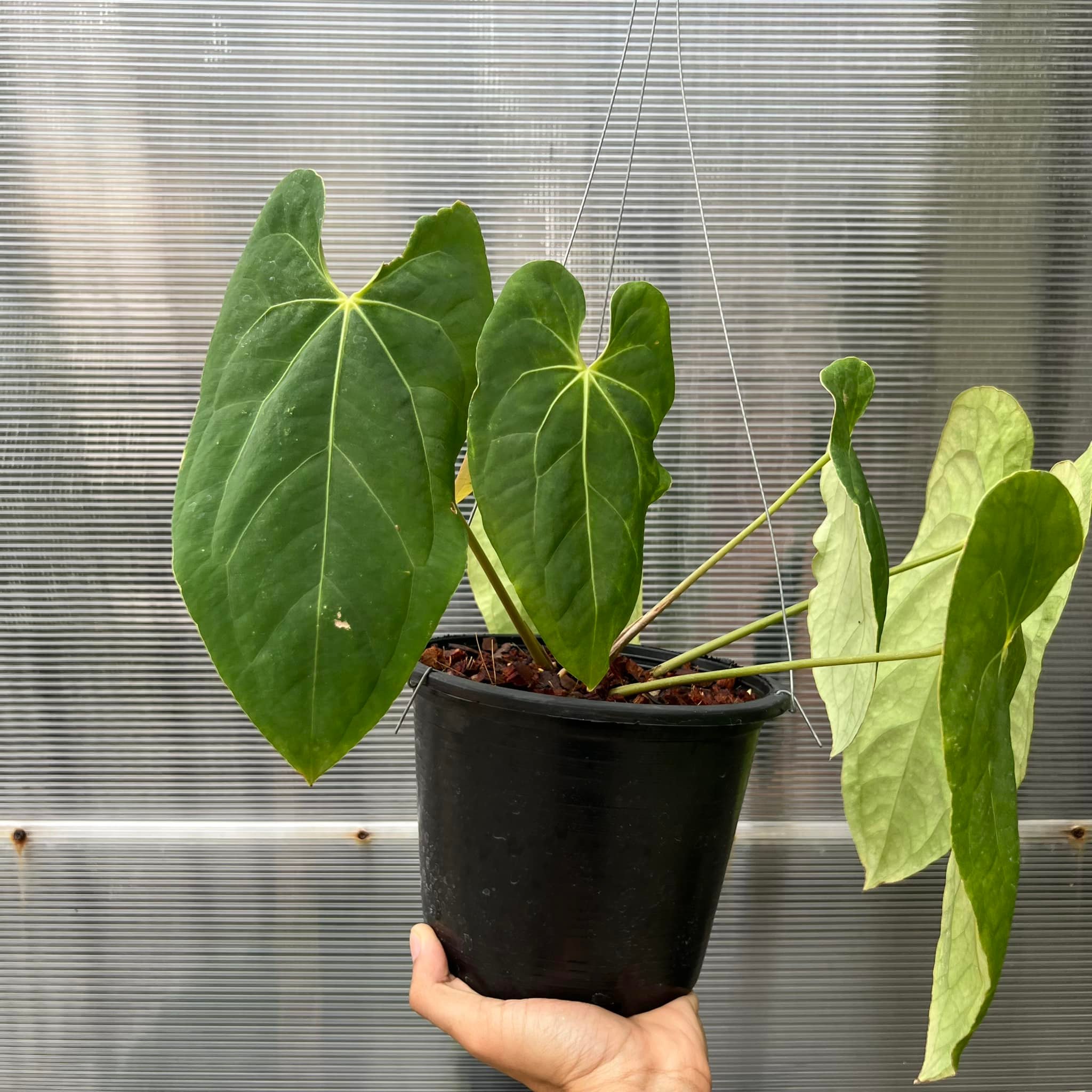
Read phenotype across successive leaves
Look at blade outline, sinus, basal lobes, surface finish, vein contrast, petiole color and the change from emerging to hardened leaves. Camera exposure can brighten veins and flatten velvet texture; a juvenile leaf may not predict mature proportions. Request more than one current leaf when a seller makes a specific phenotype claim.
Leaf appearance cannot reconstruct a pedigree with confidence. Different crosses can converge on similar shapes, while siblings from the same seed event can diverge. Preserve the written label and source history with the plant, especially before resale or breeding.
Use condition-led care, not a hybrid recipe
Start with bright filtered light and protect an expanding leaf from hard sun, walls and strong fans. Adjust from the next hardened leaf and active growth rather than targeting a universal foot-candle or grow-light distance. The old 12–14-hour, 5,000–6,500K formula was equipment advice presented as biology.
Use an aerated, structurally stable medium matched to the active root system. Water thoroughly when pot weight, depth moisture, drainage behavior and root activity agree, then drain. Top-inch and calendar rules miss changes in container depth, airflow and root mass. Feed only an established plant in active growth, following the product label and considering water/substrate mineral load; automatic calcium-magnesium supplementation at every cycle is not a diagnosis.
Troubleshoot with combined evidence
| Pattern | Check first | Response |
|---|---|---|
| Yellowing + heavy pot | Depth moisture, cold, odor and roots | Restore warmth/air; inspect roots if decline spreads |
| Crisp edge | Root function, salt load, heat and exposure | Correct the cause; do not assume humidity alone |
| New leaf distortion | Pests, contact, fan and expansion conditions | Protect the next leaf; old damage remains |
| Phenotype differs from photo | Exact vs representative image, age and cross label | Compare successive leaves and ask the seller |
Propagation preserves different things
Division or a stem section with a viable growth point can preserve the genetics of this individual. A leaf alone cannot produce a complete Anthurium. Seed propagation creates a new genetic combination and should not inherit a clonal phenotype promise. See the Anthurium propagation guide for method and recovery boundaries.
Buying checklist
- Cross: request both parents; if unavailable, retain `unspecified hybrid`.
- Photo scope: exact plant, representative batch or parent reference.
- Stage: compare several hardened leaves and one emerging sequence.
- Roots: ask for establishment, medium and current container.
- History: preserve source, label and whether the plant is seed-grown or clonal.
Use the Anthurium care guide for shared fundamentals, the types guide for species comparison and the rare Anthurium buying guide for provenance checks. Browse the Anthurium collection or inspect the current Papillilaminum Hybrid listing.
Papillilaminum Hybrid FAQ
Is this documented as papillilaminum × crystallinum?
No. That parentage appeared in the old blog copy but is not documented in the current post or product record, so it has been removed.
Is a papillilaminum hybrid the same as the species?
No. The species has an accepted botanical identity. A hybrid label indicates mixed ancestry, and this listing does not name the full cross.
Will every seedling look like the product photo?
No guarantee follows from the label alone. Seedlings can vary; confirm whether the photo is exact or representative.
Can a leaf cutting clone it?
No. Vegetative propagation requires viable stem growth tissue; a detached leaf does not regenerate a complete Anthurium.