Greenboog identification guide
This guide compares six accepted species that represent upright, velvet, climbing, peltate and pendant strap-leaf forms. It is a selection map, not a claim that these are the only or “best” Anthuriums.
Six species, six useful identification patterns
| Species | Look for | Growth form | Do not assume |
|---|---|---|---|
| A. watermaliense | Green ovate-triangular blade with deep basal lobes; often dark violet-purple spathe | Terrestrial subshrub | “Black Anthurium” means black leaves |
| A. crystallinum | Velvety cordate blade and contrasting primary veins | Epiphytic subshrub | Every silver-veined velvet leaf is crystallinum |
| A. scandens | Small elliptic leaves on an elongating climbing stem; roots at nodes | Climber | All Anthuriums are compact rosettes |
| A. clarinervium | Thick dark cordate blades with bold pale venation | Compact terrestrial/rock-associated habit | One bright vein pattern separates every hybrid |
| A. forgetii | Peltate blade: petiole attaches inside the blade and the basal sinus closes | Short erect subshrub | It is a six-inch miniature |
| A. pallidiflorum | Long narrow pendant strap blades | Western-Ecuador epiphyte | It has triangular dwarf foliage |
Watermaliense: the dark feature is the spathe
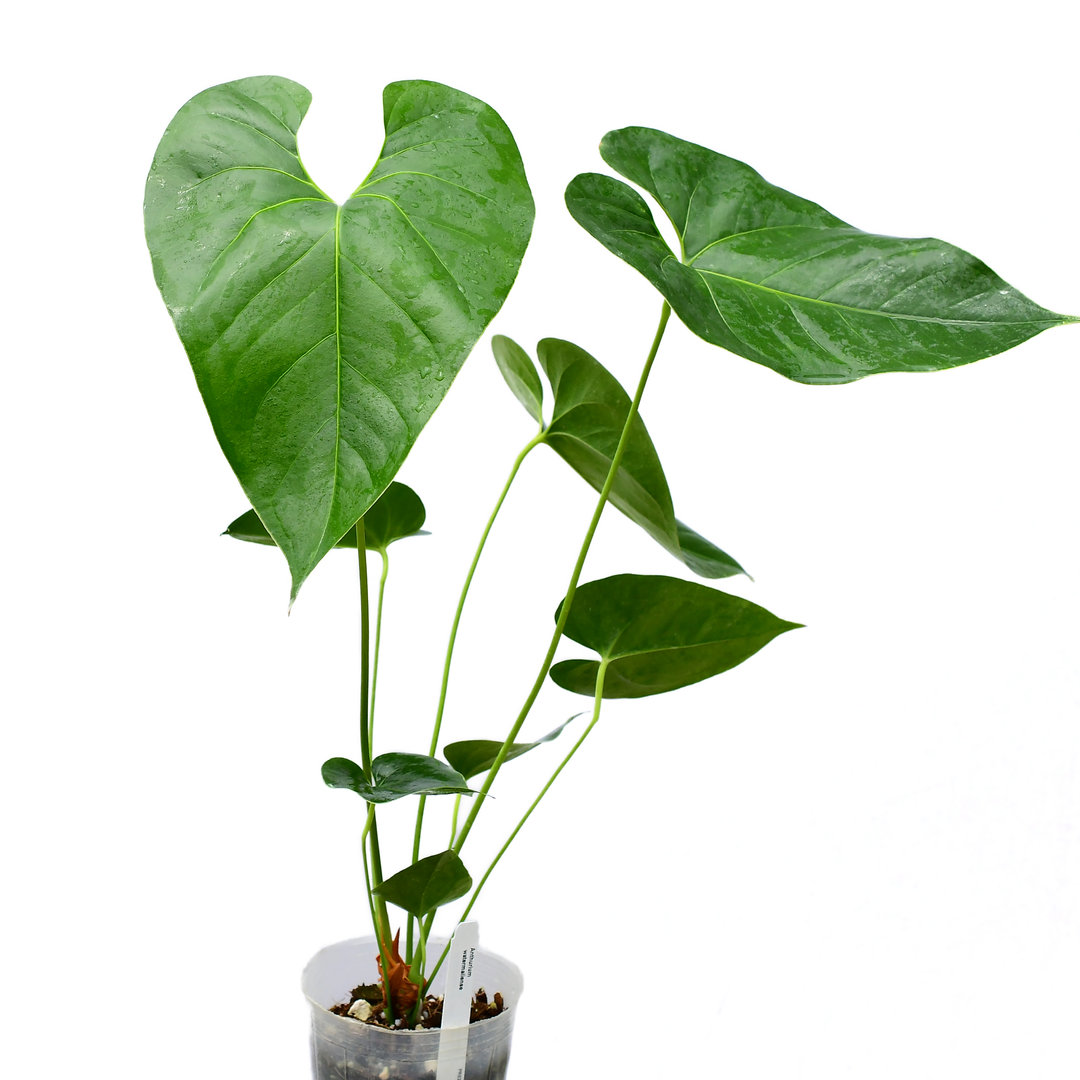
Anthurium watermaliense is accepted by Kew from Costa Rica to Colombia. Its leaves are green, moderately leathery and ovate-triangular with a deep basal sinus. Kew’s linked description records the spathe as usually dark violet-purple, sometimes green. The common “black Anthurium” idea therefore belongs to the inflorescence context, not to black leaf blades.
Crystallinum and clarinervium: velvet look-alikes need several traits
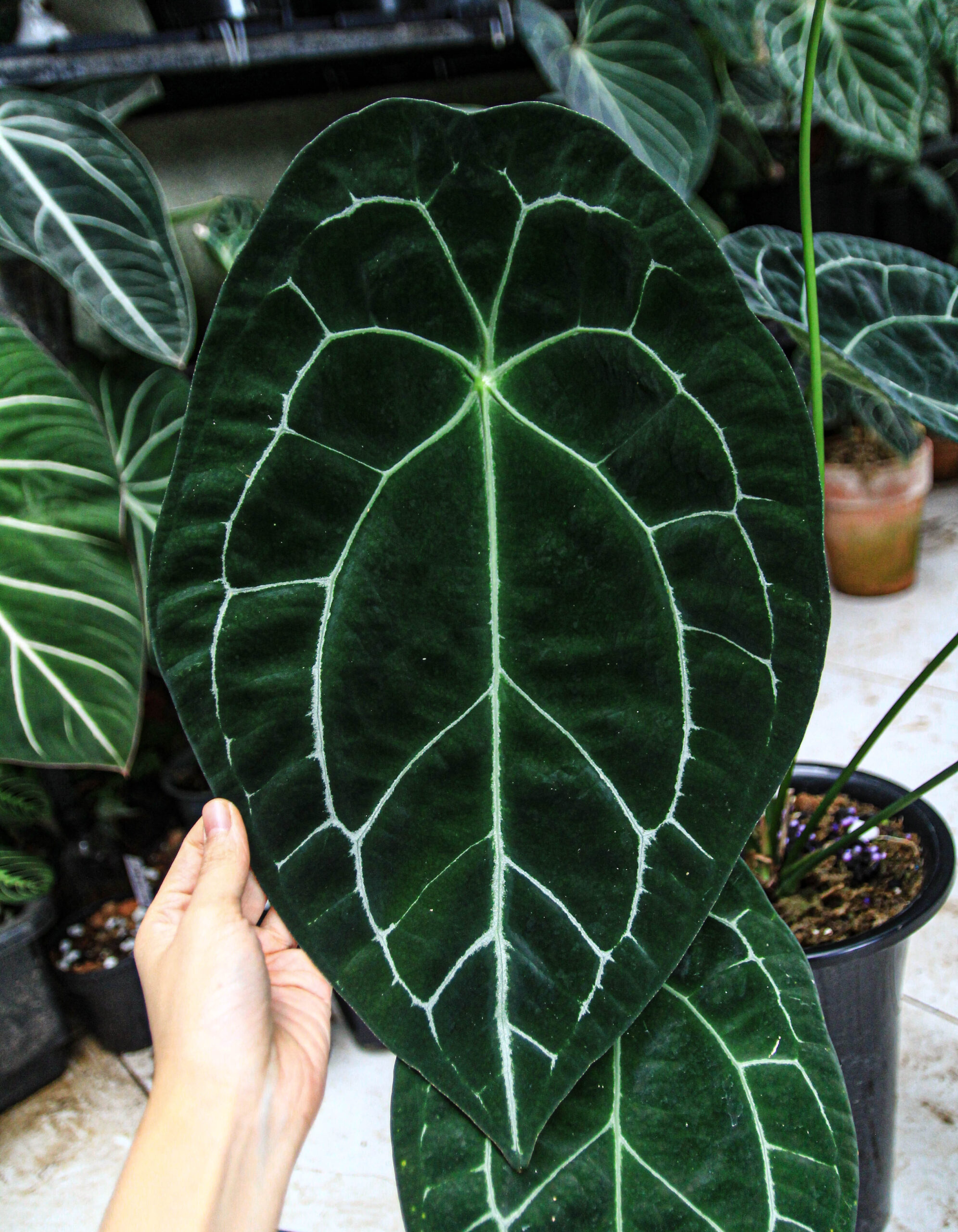
A. crystallinum is an accepted epiphytic subshrub native from Panama to Colombia. Mature blades are velvety and cordate with prominent pale venation—not “deeply lobed” as the old article claimed. A. clarinervium also presents dark heart-shaped blades and bold veins, but buyers should compare blade thickness, sinus, petiole, vein layout, emergent color and a sequence of mature leaves.
Photography complicates comparison: flash, backlighting, leaf age and editing can make veins or silver cast look stronger. Ask for current whole-plant, stem and underside images rather than matching a single hero photograph.
Scandens: a climbing architecture
A. scandens shows why growth habit is an identification character. It develops an elongating stem, roots at nodes and relatively small elliptic leaves; it is not a heart-leaf climber that needs to be described through showy spathes. A support can organize the stem, but container and watering decisions still follow active roots rather than vine length.
Forgetii: identify the closed sinus
A. forgetii is accepted from Colombia. Its decisive visual feature is a peltate blade: the petiole inserts within the blade and the usual open heart-shaped sinus is absent or nearly closed. Kew’s historical description records blades roughly 25–36 cm long and the vegetative plant around 38 cm high, so “six inches at maturity” is not a safe expectation.
Juvenile and hybrid plants may soften the pattern. Confirm several leaves and the petiole insertion rather than buying from the word “round” alone.
Pallidiflorum: pendant strap leaves need vertical room
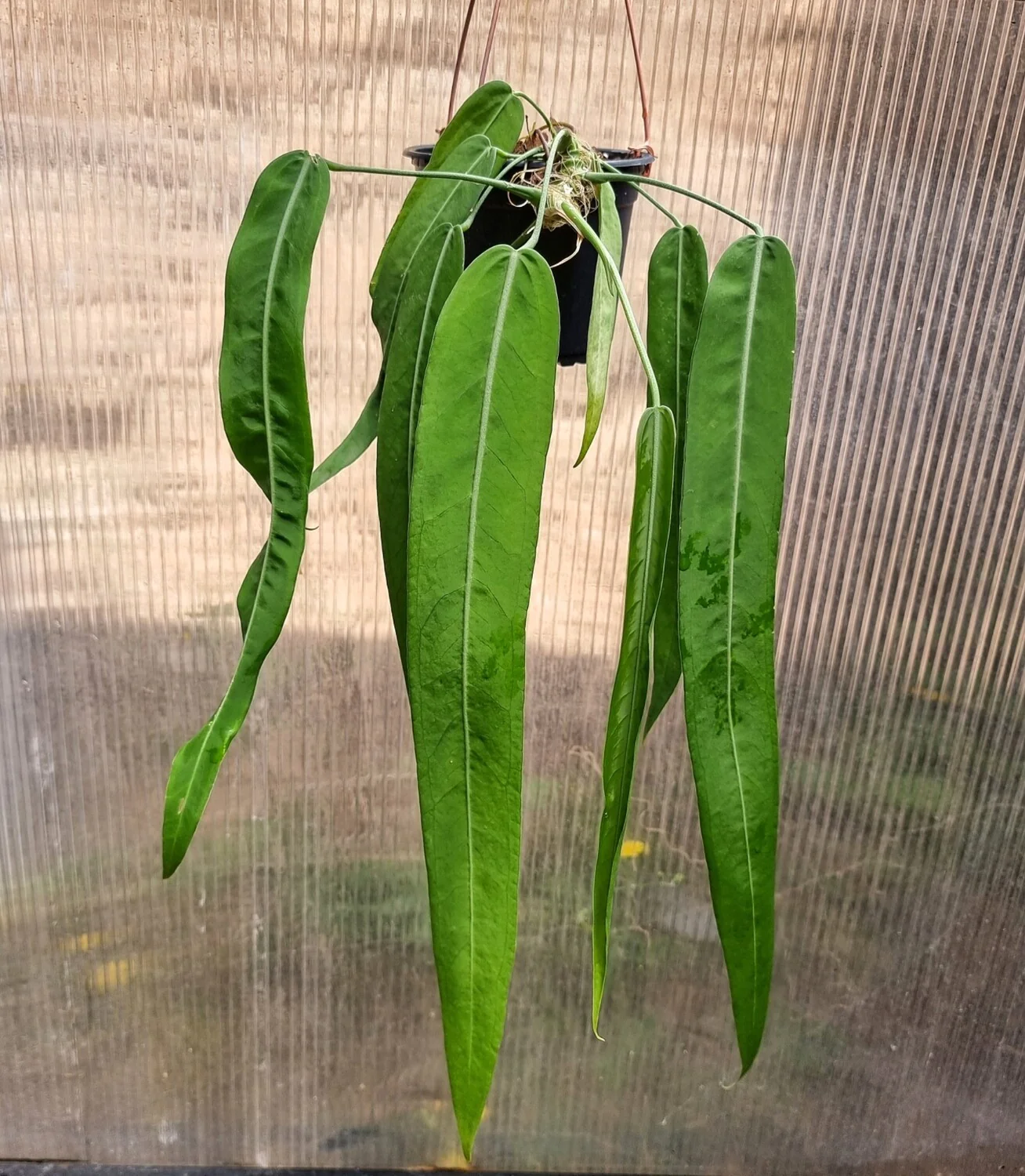
A. pallidiflorum is an accepted epiphyte native to western Ecuador. Its long, narrow hanging blades contradict the old description of triangular foliage in an eight-to-ten-inch clump. Evaluate shelf height, hanging clearance and leaf protection before choosing it; a small nursery pot can still carry a plant whose mature leaves need considerable vertical space.
Choose by evidence and space
- Identity: request the botanical or hybrid name, current whole plant, mature blade, petiole insertion, stem and underside.
- Growth form: decide whether your space supports upright, climbing or pendant growth.
- Format: distinguish established rooted plants, divisions, cuttings and in-vitro plantlets.
- Care delta: begin with the Anthurium care baseline, then adjust for the verified species and roots.
- Propagation: use the node-and-division guide; a detached leaf is not a complete plant.
Anthurium types FAQ
How many Anthurium types are there?
The genus is species-rich and the accepted list changes as taxonomy is revised; horticulture adds many hybrids and trade labels. Use a current authority such as Kew rather than a fixed marketing number.
Which Anthurium has black leaves?
Do not infer black foliage from the common “black Anthurium” name for A. watermaliense. Its blades are green; its spathe is often dark violet-purple.
How do I identify Anthurium forgetii?
Look for the peltate petiole attachment and closed or nearly absent basal sinus across several mature leaves.
Which type hangs down?
A. pallidiflorum is a clear pendant strap-leaf example and needs vertical clearance.
Continue to the right owner
Use the live Anthurium collection for current stock, price and format. The benefits guide covers household fit and claim boundaries; named guides such as Anthurium veitchii own species-level depth.