Variegated Monstera field guide
Monstera adansonii “Giant Aurea” combines an accepted species name with two commercial descriptors. Read “Giant” and “Aurea” as claims to verify through the whole vine and leaf sequence—not as guarantees of taxonomy, final size or the next yellow sector.
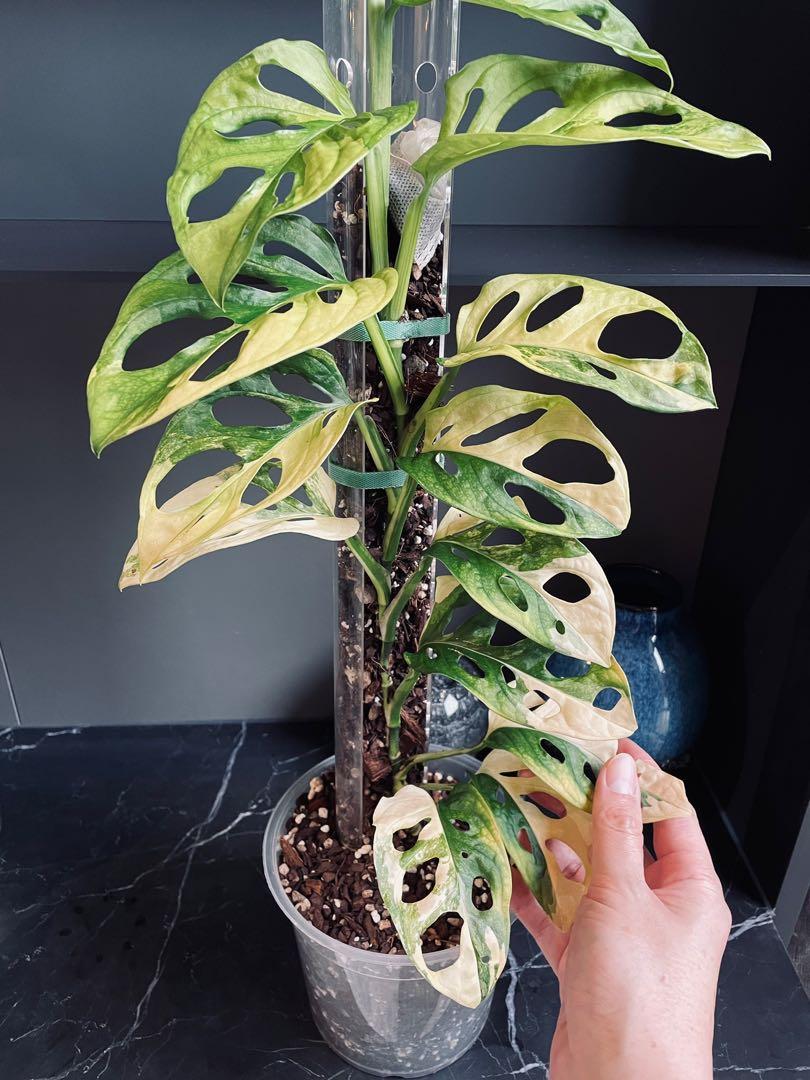
Separate the accepted species from the trade form
Kew’s Plants of the World Online accepts Monstera adansonii Schott, first published in 1830. Kew records a Tropical American native range, a wet-tropical climbing habit and four accepted infraspecific taxa. None is named “Giant Aurea.”
In commerce, “Aurea” usually signals yellow-to-cream variegation, while “Giant” suggests a selected line or larger presentation. Those words help buyers find a plant, but they do not establish an accepted subspecies, registered cultivar, fixed mature size or stable future pattern.
Screen the whole vine before buying
| Evidence | Useful signal | Limit |
|---|---|---|
| Several connected leaves | Repeated blade shape, perforation, green/yellow balance and change over time. | Cannot by itself prove provenance or accepted subspecies. |
| Stem and node views | Internode pattern, active growth, bud position and cutting viability. | A photo may hide roots, rot or an inactive bud. |
| Exact-plant and root photos | Which specimen and root system will ship. | Does not guarantee acclimation or the next leaf. |
| Mother-plant history | How the line has expressed under known conditions. | A propagated plant can still produce a different sequence. |
Adansonii has perforated blades, but fenestrations change with growth stage, support and conditions. Use Greenboog’s variegated Monstera comparison guide for the broader label map, then return to the exact plant evidence.
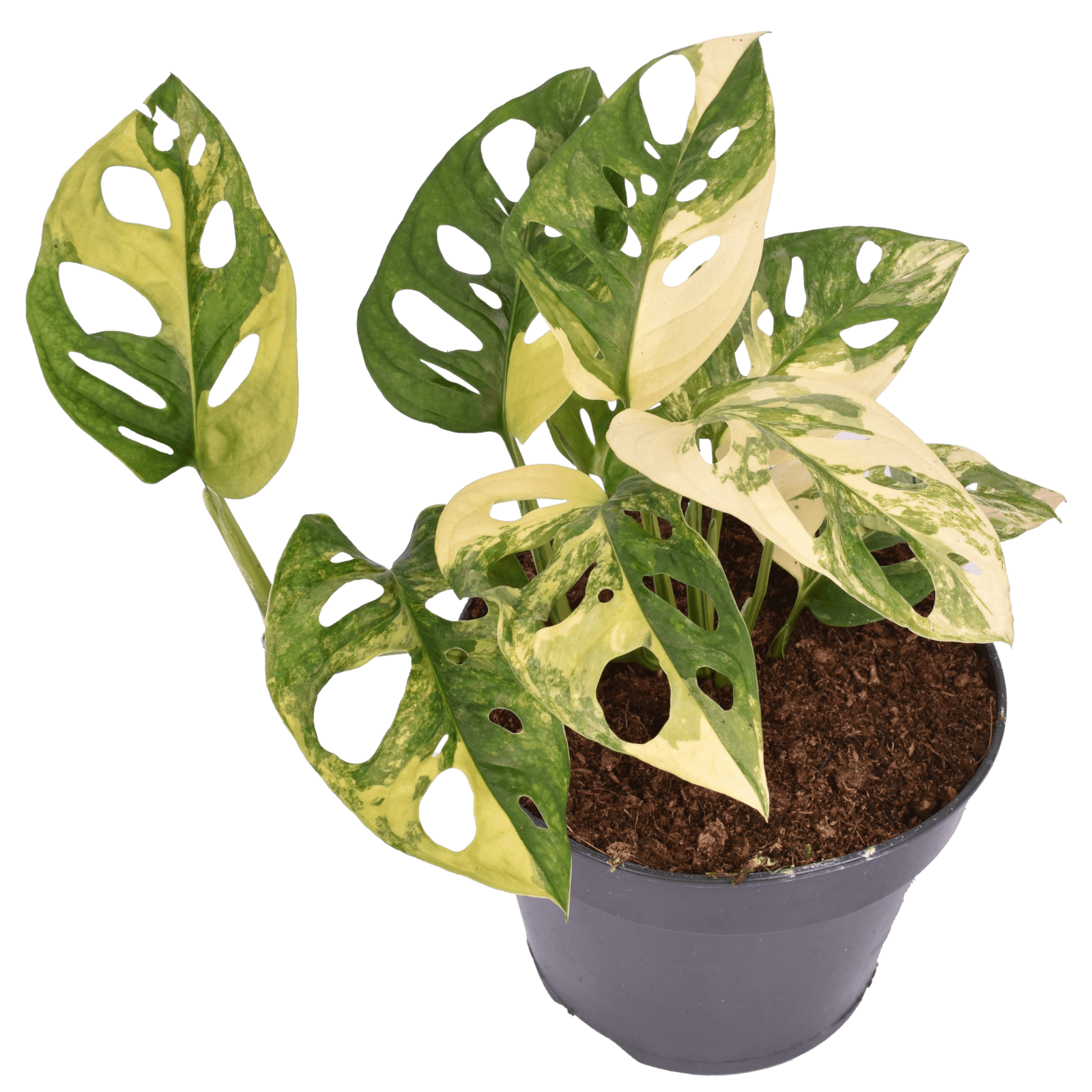
Care for productive green tissue and climbing growth
Yellow or cream sectors contain less chlorophyll than green tissue, but that fact does not justify blasting the plant with harsh sun or feeding it to force color. Give the green tissue workable conditions and let the new-leaf sequence show whether the setup is sustainable.
| Factor | Starting point | Read before changing |
|---|---|---|
| Light | Bright filtered light; acclimate gradually to stronger exposure. | Source-facing scorch, leaf temperature, internode change and the hardened leaf sequence. |
| Water | Water thoroughly, drain, then reassess after upper-layer dry-down. | Pot weight, root firmness, drainage and whether a dense core stays wet. |
| Root zone | Airy moisture-retentive mix in a pot with open drainage. | Root color/texture, collapse, odor and uneven wet pockets. |
| Support | Secure the stem to a pole or plank while leaving petioles free. | Aerial-root contact, upward orientation and stable new growth. |
| Feeding | Balanced fertilizer conservatively during active growth. | New roots/shoots, recent shipment stress and mineral crust. |
The Monstera light guide, condition-led watering guide and support guide own the detailed workflows.
Manage the leaf sequence without panic pruning
Track three to five hardened leaves and the active stem. A greener leaf can be normal variation; repeated all-green growth may show that the active sector has lost visible yellow expression. Repeated nearly all-pale leaves reduce the productive green area and leave less margin for root or shipping stress.
Do not cut after one disappointing leaf. First confirm root health, locate lower nodes and buds, and inspect how variegation runs through the stem. A cut can redirect growth to another bud, but it cannot promise an ideal pattern.
Propagate a viable node
- Locate stem tissue with a node and identifiable axillary bud; a leaf and petiole alone cannot continue as a vine.
- Choose firm material and avoid a black, hollow or soft node.
- Cut with a sterile sharp blade, leaving enough internode to handle the piece without crushing the bud.
- Root in clean water or an airy medium you can monitor, keeping the bud away from stagnant saturated material.
- Pot after functional branching roots and stable uptake—not the first tiny root tip.
Use the Monstera propagation guide for method trade-offs. Wear gloves if sap contacts your skin and keep cuttings away from children and pets; M. adansonii contains calcium oxalate, as covered in the Monstera toxicity guide.
Troubleshoot the pattern, not the marketing name
- Yellowing plus a heavy pot: inspect drainage and roots before changing light or adding fertilizer.
- Crisp pale-sector edges: check direct sun, heat, dry-down swings and mineral buildup; humidity alone is not a diagnosis.
- Long internodes and smaller leaves: check usable light, root health and support contact, then change the confirmed limit gradually.
- Stippling, webbing or black specks: inspect leaf backs and petiole bases, isolate the plant and identify the pest before treatment.