
Greenboog cultivar identity & care guide
Birkin is a compact crown plant with cream pinstripes—not a trailing vine. Track several hardened leaves before calling greener or reddish growth a reversion.
This page owns Birkin identity, changing pattern and compact-crown care. The rare Philodendron guide owns broad cultivar comparison.
Philodendron Birkin at a glance
| Question | Evidence-led answer |
|---|---|
| Name type | Horticultural cultivar; RHS name status unresolved |
| Habit | Compact, upright, self-heading crown; not a trailing basket vine |
| Pattern | Fine cream/yellow lines radiating through green leaves, variable leaf to leaf |
| Origin | Unclear; Rojo Congo sport and Congo × Imperial Green explanations both circulate |
| Root-zone goal | Even hydration followed by reliable return of air |
| Safety | Philodendron tissue contains irritating calcium-oxalate crystals |
Birkin origin: keep the uncertainty visible
RHS profiles ‘Birkin’ as a compact upright plant with creamy-yellow streaks and states that it is not a climber or trailer. RHS also marks the name unresolved. NC State Extension says the hybrid’s origin is unclear and records both a Rojo Congo mutation and a Congo × Imperial Green explanation.
Identify pinstripes and crown architecture
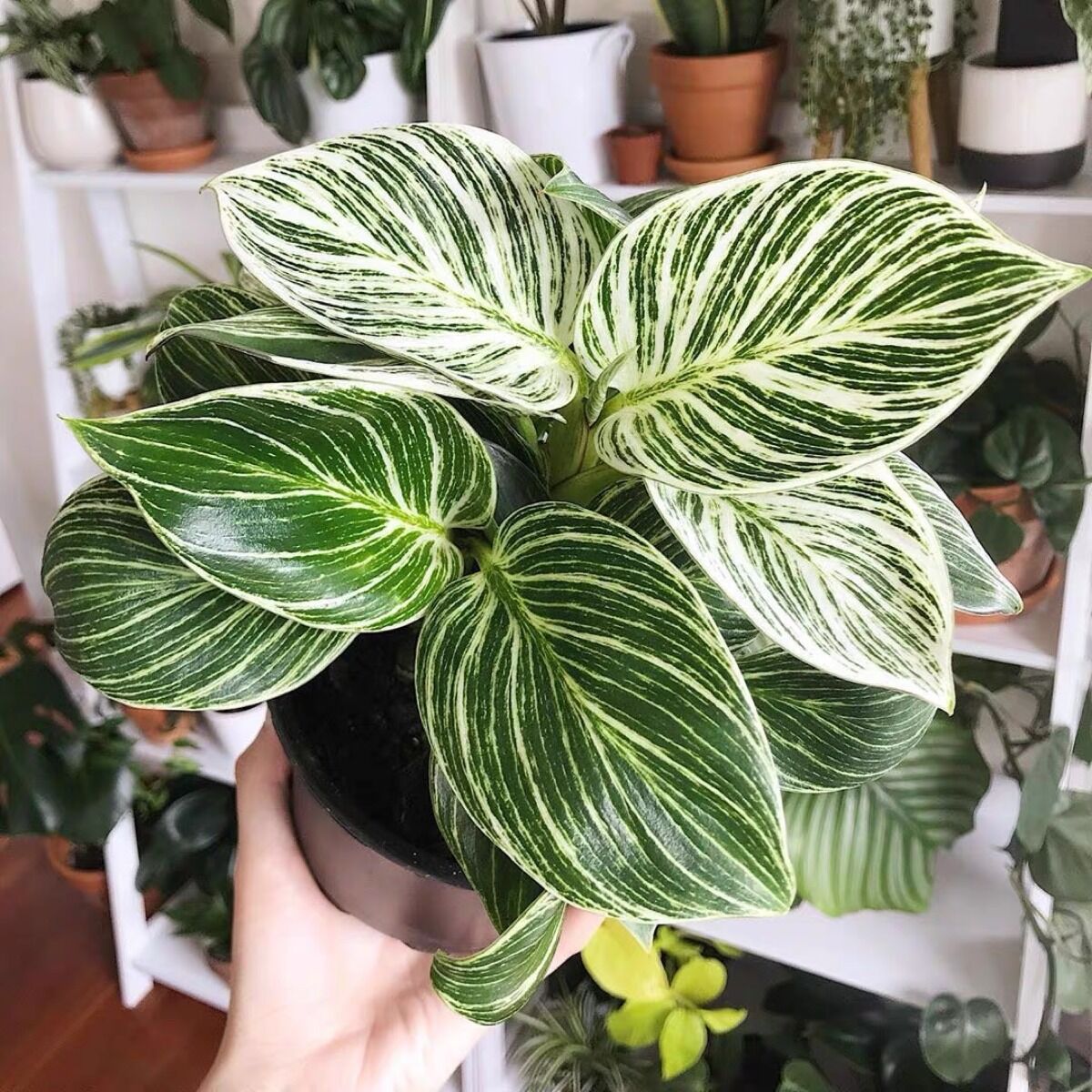
Birkin’s useful field stack is a compact central crown, sturdy petioles and glossy oval-to-heart-shaped leaves with fine pale lines radiating through the blade. Pinstripe density varies. New leaves can look lighter while expanding, so compare only after they harden.
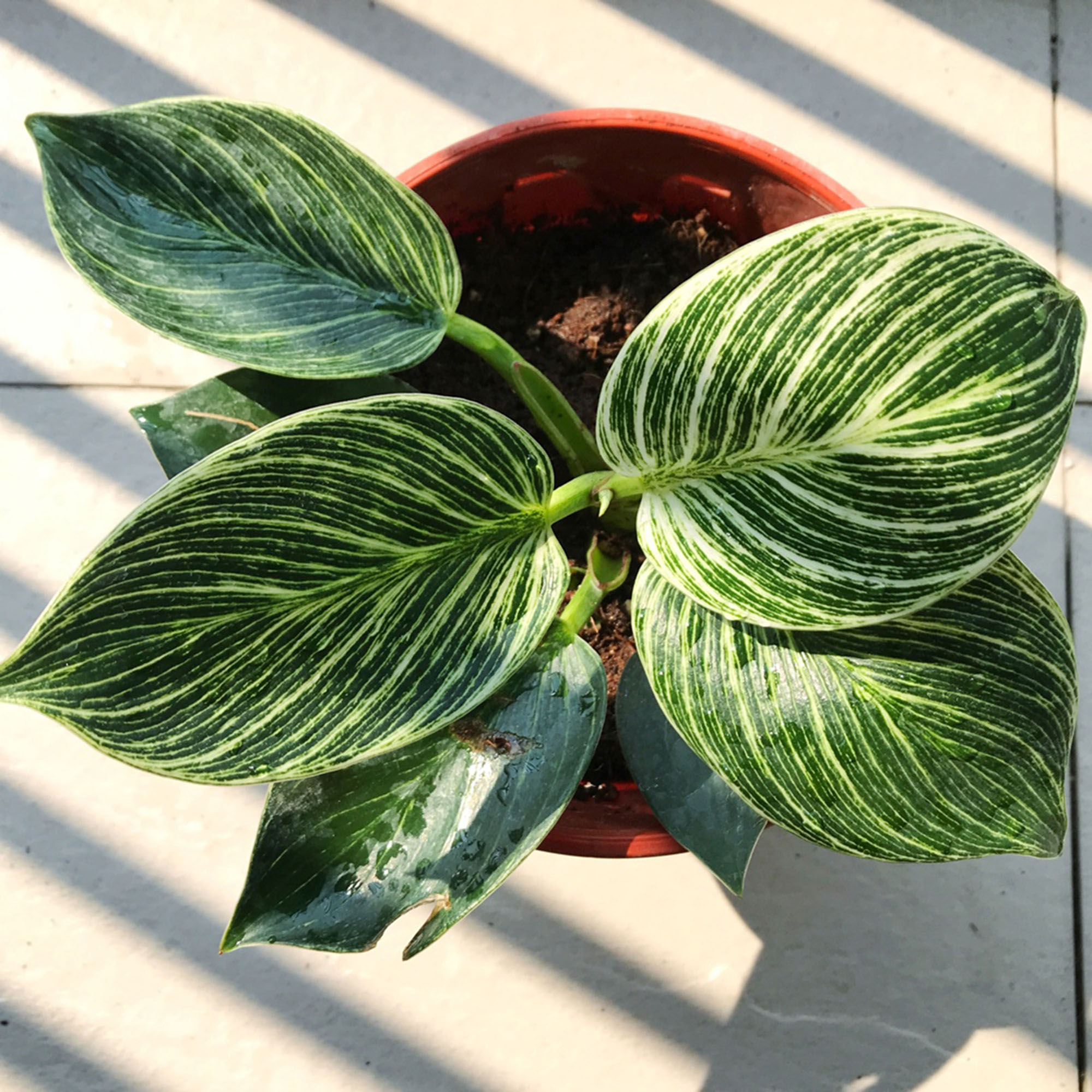
| Check | Stronger evidence | Weak evidence |
|---|---|---|
| Crown | Short central growth with upright petioles | A description calling it vining or cascading |
| Pattern | Fine pale lines repeated across several hardened leaves | One pale unfurling leaf |
| Green growth | Sequence tracked from the same growth center | Assuming low light caused a genetic switch |
| White spots | Integrated lines within healthy tissue | Raised residue, pests or lesions called variegation |
| Origin | Explicitly unresolved | Rojo Congo story repeated as proven genealogy |
Greener, reddish or nearly white leaves
Let each leaf harden before deciding what changed. One greener leaf may be ordinary variation. Several leaves from the same growth center that lose pinstripes deserve a check of identity, roots and usable light—but low light is not proof of a genetic reversion event. Reddish or sectoral growth can be documented without naming it Rojo Congo.
A nearly white leaf has less chlorophyll-bearing area and may not support itself well. Protect the green leaves that power the crown. Do not cut into a compact stem until a viable growth point and recovery plan are visible.
Light for a compact crown
Use bright filtered light to support growth while avoiding scorch. Possible shortage signals include progressively smaller leaves, leaning and slower drying after roots are checked. Excess exposure can leave bleached or crisp patches on the window-facing side.
Adjust curtain filtering, distance or lamp duration gradually, then judge the next two hardened leaves. The Philodendron care guide owns the broader acclimation workflow.
Pot the crown, not a hanging vine
Use a stable pot with open drainage and keep petiole bases above the medium. Birkin does not need a moss pole to express a trailing habit because it is not a trailer. A discreet stake can stabilize a tall or leaning crown, but it should not squeeze leaves together.
Choose a medium that holds useful moisture and returns air after watering. Bark, coarse mineral material and coco- or peat-based components can all contribute. Pot volume and particle behavior matter more than a branded mix.
Water from the rooted volume
- Water thoroughly and let excess drain.
- Learn the pot’s weight after watering and as the rooted volume dries.
- Check below the surface rather than relying on one inch.
- Water again from pot weight, roots, warmth and active growth—not a weekday.
The Philodendron watering guide owns wet-versus-dry and water-quality diagnosis. Wilt and yellowing can occur with both drought and damaged roots.
Warmth, humidity, feeding and repotting
Keep Birkin warm and away from cold drafts or hot vents. Average household humidity may work when roots are stable. A clean humidifier can help a genuinely dry room; pebble trays and misting do not replace root hydration or airflow.
Feed modestly during active growth according to the label. “Few leaves” is not proof of fertilizer shortage: check light, temperature and roots first. Repot when roots densely occupy the pot, the medium collapses or drainage changes; increase size conservatively.
Symptom table
| Signal | Check first | Safer response |
|---|---|---|
| One green leaf | Hardening and prior crown sequence | Observe; do not cut immediately |
| Raised white spots | Residue, scale, mealybugs and tissue damage | Identify before treating |
| Yellow lower leaf | Age, pot weight and roots | Treat the confirmed cause |
| Brown tips | Hydration swings, salts, heat and roots | Correct one verified variable |
| Crown leans | Light direction and root anchorage | Rotate gradually or add a discreet stake |
Propagation boundary
A detached Birkin leaf and petiole cannot rebuild the crown. Propagation requires viable stem tissue with a node and usable bud/growth point. Short internodes make blind cutting risky; wait until anatomy is clear or divide a genuinely separate offset with roots.
The Philodendron propagation guide owns node and rooting workflows. No cutting guarantees the same stripe density.
Buyer checklist
- Request a whole-crown photo and several hardened leaves.
- Confirm compact upright architecture, not a trailing vine.
- Separate integrated pinstripes from residue or pests.
- Ask for roots and growth center, not only the whitest leaf.
- Treat exact Rojo Congo pedigree as unverified.
The Philodendron benefits guide owns the air-purification evidence boundary; one Birkin is not a substitute for ventilation or source control. The Philodendron collection owns live inventory.
Safety
Philodendron tissue contains irritating calcium-oxalate crystals. Keep plants and cut material away from children and pets; contact a veterinarian or poison service after suspected ingestion.
Philodendron Birkin FAQ
Is Birkin a trailing plant?
No. RHS describes it as compact, upright, non-climbing and non-trailing.
Did Birkin come from Rojo Congo?
That story is widespread, but NC State records competing origin explanations and says the origin is unclear. No primary record was found here.
Does low light cause reversion?
Low light can weaken growth, but it does not prove a genetic switch. Track several hardened leaves and inspect roots and light together.
Should I mist Birkin?
Routine misting is not required and can leave the tight crown wet. Use measured room humidity and root-zone evidence.
Can one leaf propagate Birkin?
No. A new crown requires viable node and bud or growth-point tissue.

Thank you for all your wonderful tips on how to be a successful beginner in growing my birkin plant. I can’t wait till it gets bigger with luscious beautiful leaves. This the first time for me.
I Purchased 2 Philodendron Birkin Plants From Our FoodTown Supermarket On Tuesday, August 13th 2024. My Gorgeous Plants Are Already Sprouting New Leaves Beautifully While Sharing The Same Space Amongst My Beautiful Peace Lilie Plants. The Philodendron Is One Beautifully Gorgeous Plant! I’m Grateful To Have Such Beautiful Plants In My (Apartment) Home!
How do wholesale plant sellers ensure the quality and health of the plants during transportation, and what measures are taken to prevent damage or loss?